Where the Devil is Satan (in Contemporary Christianity)?

Where the Devil is Satan (in Contemporary Christianity)?

            When I write about “contemporary Christianity,” for the most part, I’m addressing what I see as my own religious-cultural context—moderate, centrist, evangelically-oriented Protestantism in the U.S. I’m not usually (unless I say otherwise) addressing fundamentalist or liberal Protestantism or Roman Catholicism.

            I hold in my hand a copy of the so-called Jefferson Bible (officially titled The Life and Morals of Jesus of Nazareth) created by Thomas Jefferson. In spite of some revisionist historians’ claims, it was not created as a tool of evangelism of native Americans. Jefferson explained very clearly, in letters to John Adams among others, why he created it. He admired Jesus but disagreed with much of what he said and most of what the writers of the gospels claimed about him. So, he cut everything out of the gospels he thought conflicted with reason and left only those teachings and acts of Jesus he considered admirable and believable.

            Evangelicals especially love to use Jefferson’s truncated New Testament as an example of what goes wrong when we come to the Bible with interpretive lenses determined by culture and philosophy rather than, in the inimitable words of theologian Hans Frei, allow the Bible to “absorb the world.” And yet, it seems to me, we (especially moderate to progressive) evangelicals (and other Christians) do it all the time.

            A glaring example, it seems to me, is the way we have exorcised Satan and demons from our New Testaments. Oh, sure, we haven’t literally cut all references to them out of our Bibles, but we have gotten used to ignoring them or “interpreting” them non-literally. We are, it seems to me, extremely uncomfortable with believing in Satan or demons—except perhaps as personifications of the evil that humans do.

            But it seems to me that’s very difficult to do while attempting to take the New Testament seriously. Satan is all over in it; he’s a major player, a significant character in the narrative.

            Some years ago my family and I were members of a church that advertised itself as “evangelically committed, ecumenically open.” The pastor announced he would teach a series on the Gospel of Mark on Wednesday evenings. The first evening he let us know that he did not believe in a literal Satan or demons. He explained that the believed them to be primitive personifications of human evil and mental illness or diseases. I wasn’t shocked as I knew that is fairly common among such moderate, centrist churches. (He did believe in the deity of Jesus Christ, the Trinity, salvation by grace alone, etc.) But I told him publicly that I would be interested to see how he handled Mark 5—Jesus’ exorcism of the demons from the “Gerasene demoniac”—the man possessed of many demons. According to the story, the demons leave the man but enter a herd of swine which then rushes off a cliff. The pastor never did get to Chapter 5 in his series on Mark.

            Most conservative Protestants will not openly or blatantly deny the non-symbolic existence of Satan or demons and, if pressed, will claim to believe in them as non-symbolic realities of some kind. But, in my experience, anyway, most such pastors and theologians do not really want to deal with them. They are left aside and rarely mentioned in sermons, Sunday School lessons, and Bible studies.

            My question is—why? Why do those Christian pastors and teachers who claim to take the Bible seriously, claim to love C. S. Lewis (author of The Screwtape Letters), claim to stand in basic continuity with historic, orthodox Christianity, so seldom even mention Satan or demons when the New Testament is full of them?

            It seems to me there are two interrelated reasons and a third. First, many such pastors and teachers grew up in fundamentalist or Pentecostal contexts where Satan and demons were over-emphasized. I recall, for example, seeing a book in our church’s library (and in some members’ homes) that claimed to contain illustrations of demons “seen” by a woman. The book gave me nightmares! Another popular book in my religious milieu was Pigs in the Parlor: A Practical Guide to Deliverance. You would have to see it to believe it. Another book guaranteed to give children (and maybe some adults!) nightmares.

            A second, related reason, I think, is our moderate Protestant craving for cultural respectability. Belief in a literal Satan and demons seems, however nuanced, guaranteed to bring scorn from sophisticated people living under the influence of the Enlightenment.

            A third reason may be the influence of philosophical reasoning, channeled through rational apologetics, among evangelicals (including many who consider themselves moderate, centrist). A big part of such apologetics is theodicy—the explanation of evil in light of the existence of God. Theodicy rarely finds place for Satan or demons in explaining the existence of evil in God’s universe.

            I’m tempted to add a fourth possible reason for the disappearance of Satan and demons and that is Calvinism. If God is the all-determining reality and Satan is just God’s instrument (however explained as a “secondary cause”) then why focus any attention on him it all? Go right to the ultimate cause of everything including evil—God. But, of course, Calvinist theologians generally do not deny Satan. But I suspect many pastors and lay people who teach in Calvinist churches do not see the point of Satan if God is the all-determining reality and so what’s the harm in leaving mention of him aside?

            I struggled with this issue for a long time—how to believe in what I’ll here call “Satanic realism”—Satan and demons are real beings and not merely symbolic representations of evil without falling into fanaticism or leaving behind reason.

            A bit of autobiography will help explain my dilemma and its solution (however partial) and, hopefully, resonate with some readers and help them.

            I earned my post-seminary Master of Arts and Ph.D. degrees in Religious Studies (with heavy emphasis on Christian theology) at a major, secular, national research university. As a graduate fellow I was assigned to help teach a course on C. S. Lewis to undergraduates. It was a team taught course with the chair of the Religious Studies department overseeing the two of us (graduate students) who actually taught the course. Of course, we read The Screwtape Letters and other books by Lewis that included Satanic realism. But some students and others argued that it was all allegory and not at all to be taken literally. I recall several heated conversations with fellow graduate students over Satanic realism; most of them considered it primitive, pre-modern belief not to be taken seriously by anyone in such a context.

            For a while, then, I seriously considered latching on to Karl Barth’s idea of Satan as “Das Nichtige”—“that Nothingness”—the power of evil that comes into being (or not-being but existing) as that which God does not will and opposes. After careful consideration, however, that did not seem plausible in light of the Satanic realism of the New Testament.

            During my fifteen years teaching theology at a moderate, centrist evangelical college and seminary, I taught an elective course on “America’s Cults and New Religions” (which I promoted as “Unsafe Sects” to get students to register for it). During that time I encountered many, many convincing evidences of Satanic realism in the dark underworld of American occultism. And I read many books about the occult in modernity that seemed to support Satanic realism in spite of the Enlightenment taboo against it.

            I will just mention one personal experience I had that seemed to me to provide experiential support for continuing belief in Satanic realism. As part of my research for my course I visited some occult shops in the metropolitan area where I lived. They were more numerous than most people knew. One in particular I had come to know as a favorite hangout for both Wiccans and Satanists. (A Wiccan high priestess told me this and claimed that the Wiccans would have nothing to do with the Satanists but that they came there anyway—to purchase books on occult power to use for their nefarious purposes.)

            I drove up to the bookstore, parked across the street and attempted to get out of my car. As usual, I had prayed for divine protection during my drive there. I found myself literally unable to get out of my car. I sat there for a very long time trying to exit the car but could not. It wasn’t fear; I’ve been in many occult and esoteric bookshops and was not afraid of any mere bookstore. As I sat there pinned inside my car by some mysterious force, I remembered praying for divine protection. Eventually I pulled away and never did go inside that bookstore.

            Two books appeared about that time that strongly influenced me to continue believing in Satanic realism—I Believe in Satan’s Downfall by Michael Green and People of the Lie by M. Scott Peck. The first one is, of course, a theological treatment of what used to be called “Demonology” in Christian theology, and the second one is a semi-autobiographical testimony of coming to belief in Satanic realism and demonic possession by a secular psychologist who became a Christian in part, at least, because he could not explain the pathology of some patients without belief in Satan.

            As for the first book—I Believe in Satan’s Downfall—I cannot recommend it highly enough, especially for Christians who struggle with belief in Satanic realism and want a reasonable, biblically faithful, account of demonology that avoids extremes and is rooted in revelation and Christian tradition.

            It seems to me that moderate, centrist Protestants need to overcome our own pathologies including 1) throwing the baby out with the bathwater (of fundamentalism or Pentecostal extremism), 2) seeking respectability from Enlightenment-based culture, and 3) being fascinated, if not obsessed, with rational apologetics including theodicies that have no room for Satanic realism.

R.I.P. Dallas Willard (and Was He an Open Theist?)

R.I.P. Dallas Willard (and Was He an Open Theist?)

            The evangelical Christian community has lost one of its best minds and most articulate writers—Professor Dallas Willard of the University of Southern California’s School of Philosophy (retired), associate of Richard Foster’s in the Renovaré movement, and author of numerous books in the philosophy of religion and spiritual theology. I only had the privilege of meeting him once—when we shared the platform at my final commencement ceremony at Bethel College (now Bethel University) in 1999. He was the guest speaker and I prayed for the graduates. Over the years, however, Dallas and I corresponded occasionally. Most of our exchanges had to do with so-called “open theism.”

            Willard was one of those rare intellectuals who could write both for other scholars and for non-scholars. And he was a philosopher who wrote theology (especially spiritual theology) very well. That is, he wore both hats, sometimes simultaneously.

            Probably Willard’s most influential Christian book was The Divine Conspiracy: Rediscovering Our Hidden Life in God (1998). (I wonder how many readers noticed that he dedicated it to, among others, fundamentalist preacher John R. Rice?) If I can summarize the thesis of the book (428 pages long!): True Christianity is something more than “sin management;” it is the experience of the “Kingdom of the heavens” here and now.

            Willard ranged far and wide over Christian theology in The Divine Conspiracy, touching on most doctrines even if only obliquely. What intrigued me most, however, were his reflections on God and especially divine providence (a subject I have written about here often).

            In The Divine Conspiracy Willard presented what I have called a “relational” view of God’s sovereignty. On pages 244-253 Willard argued that prayer can and sometimes does change God’s mind about what he intended to do. In a section subheaded “Can We Change God?” Willard wrote “God’s ‘response’ to our prayers is not a charade. He does not pretend that he is answering our prayer when he is only doing what he was going to do anyway. Our requests really do make a difference in what God does or does not do.” (p. 244)

            Also, “It was two Old Testament scenes that changed my own mind about these matters and permitted me to enter into the teachings of Jesus about prayer. For I too was raised in a theology that presents God as a great unblinking cosmic stare, who must know everything whether he wants to or not, and who never in the smallest respect changes his mind about what he is going to do.” (pp. 244-245) The two OT scenes are from Exodus 32 and 2 Kings 19. I’ll let you look them up if you’re so inclined.

            Further, “God is great enough that he can conduct his affairs in this way. His nature, identity, and overarching purposes are no doubt unchanging. But his intentions with regard to many particular matters that concern individual human beings are not. This does not diminish him. Far from it. He would be a lesser God if he could not change his intentions when he thinks it is appropriate. And if he chooses to deal with humanity in such a way that he will occasionally think it appropriate, that is just fine.” (p. 246)

            Willard went on to explain that none of this offends God’s dignity because this arrangement, in which our praying can affect God and even change his intentions and actions (from what they were) “is an arrangement he himself has chosen.” (p. 253) “It is not inherently ‘greater’ to be inflexible.”

            On the basis of those statements, many readers, including most open theists, believed Willard to be an open theist—one who believes that God knows everything actual as actual and everything possible as possible  but does not know the future exhaustively except as a realm of both settled and not-yet-settled events.

            Was Willard an open theist? No. So he said.

            But you will have to decide whether he agreed with open theism or not. That will require some fairly in depth knowledge of open theism (not acquired solely from its critics but especially from those who embrace it such as Greg Boyd, John Sanders, Clark Pinnock, et al.).

            I wrote two e-mails to Willard asking if he was an open theist. Here are his responses:

            March 27, 2000: “I do believe that God does limit himself…and that this is an essential part of what is required in order for him to have a personal relationship with free and historical beings such as ourselves. Many people do not understand that the attribute of omniscience, like that of omnipotence, as a matter of what God can do, not a matter of what he does [sic]. He doses not do everything he could do, and he does not know everything he can know.”

            I took that as a “yes.”

            However, later, a student challenged me about this and argued that Willard was not an open theist. So I wrote to him again, asking for clarification. I specifically asked him if he was an open theist. He responded and copied his response to several people, so I assume he did not intend it to be kept confidential. And it led to further e-mail exchanges between one of those people (John Ortberg) and Willard and me.

            Here is what Willard wrote in response to my question (whether he was an open theist):

            “I think I would not be called an open theist by any thoughtful person who knows what I write and say. The points which strike some people as ‘open’ might be these. I believe that God does modify his actions in response to human beings on some occasions: does what he was not going to do or does not do what he was going to do. And I do not think he has to know every detail of created reality to bring it out where he wants it. But there isn’t anything He needs or wants to know that he does not know. The picture of God as a great, unblinking, cosmic stare is a projection upon him of how some people try to deal with control from a human point of view. But he has resources for achieving his purposes that no human being has, and he doesn’t have to be mean or immediately on top of every detail of existence in order to run the universe. He does have considerable help and no need to micro-manage everything. If I leave some things to my helpers, as an administrator, that does not mean that I close off part of the future to my sight. But if I did not limit myself in terms of what I could know, and what I would do, it would soon ruin the operation. Limiting myself (‘holding back’) is not the same as ‘closing it off.’ Omniscience refers to God’s power to know absolutely everything. That I firmly accept. But I believe he does, by his choice, not know everything he could know—without it in any way defeating his purposes—and I also believe that human interaction with him modifies what he does or does not do in the details of individual and group life. Not to believe this seems to me to force one into false interpretations of the wordings of scripture and to make a farce of prayer. I think it is the main explanation of why very few people pray in any sensible and effectual manner.” (December 9, 2009)

            In my opinion, this could be fairly called “open theism”—or a version of it. But subsequent e-mail exchanges with Willard made clear that he did not want to wear that label.

            One question the above quote raises for me is the extent and depth of Willard’s knowledge of open theism. Did he understand what leading open theists say or was he under some false impression of open theism?

            Another question it raises (for me, anyway) is whether Willard’s aversion to being labeled an open theist had to do with the politics of evangelicalism. There is without any doubt a certain stigma attached to that label such that one will not likely be rejected (by moderate evangelical gate keepers) for holding the view but will be rejected for wearing the label. (It’s the same but reverse for “inerrantist”—as I have argued here before. One can deny inerrancy in any normal meaning of the term and be welcome among conservative evangelicals so long as one convincingly applies the label “inerrancy” to his or her theology of scripture.)

            I never figured out what to make of Willard’s denial of open theism in light of his statements about God’s self-limitation including of his knowledge and of God’s mind-changing responses to prayers.

            At the very least Willard was an ally, wittingly or unwittingly, of what I call “relational theism” and “relational sovereignty” and even of open theism.

            I suspect, in my more cynical moments, that many ardent, passionate, conservative evangelical critics of relational sovereignty and open theism loved Dallas Willard because of his profound piety and intellectual support of biblical Christianity (as a philosopher) and, so long as he did not embrace the label “open theism” were happy to overlook his section on prayer in The Divine Conspiracy.

Is the Bible Unclear? A Guide for the Perplexed

I received this question by e-mail:

“I’ve been wrestling lately with this question:  I’m wondering why the bible is so unclear on topics that are supposed to be so important (ie Divorce – I know the exception clause, but OK to remarry? Have a church position post-divorce;  Duration of Hell – is punishment eternal leading to annihilation or is it eternal punishment?; Baptism – essential to salvation? Pick a topic – the list goes on).  More broadly, if faith is the way and not the law, why was that not more clear to the Israelites of the Old Testament?  I’m sure the Church Fathers addressed this somewhere but not sure where to look.  My sense is that knowing too much has proven dangerous to us humans and this seeming obfuscation is to keep us on our knees.  As Greg Boyd says to his own father in Letters to a Skeptic, whatever we don’t know, we start with what we do, which is Christ (God’s full revelation) and work our way backwards and leave to a loving God that which we can’t understand.  I agree with that but when we’re looking for actual direction on how best to please God, why the lack of clarity doesn’t seem to make much sense.”

I offer no simplistic answers (I hope). But I am reminded of something Abraham Lincoln is supposed to have said (but it might have been any one of a number of famous people others attribute favorite sayings to): “It’s not the parts of the Bible I don’t understand that bother me; it’s the parts that I do understand.” Well, okay, that’s not going to go very far in answering the e-mailers honest question.

About a year ago I blogged here about Christian Smith’s book The Bible Made Impossible. Smith argues that there is a major obstacle to regarding the Bible as authoritative in the Protestant sense of “sola scriptura”–Scripture alone without any necessary interpretation magisterially given by tradition. That is “pervasive interpretive pluralism.” In other words, as Smith sees it, there are so many reasonable interpretations of the Bible (to say nothing of unreasonable ones!) that we must have something alongside scripture to tell us what it means–namely, magisterial tradition. Around the time he wrote that book Smith joined the Roman Catholic Church because, of course, the next question after his answer is–but who interprets tradition? So, he decided the pope does.

A problem with that, in my humble opinion, is that Christian Smith decided the pope decides what tradition means when it tells us what the Bible means. So, ultimately (and there’s no escaping this)–Smith himself was for himself the ultimate “decider” of what is authoritative and worthy of belief.

Back to the e-mailer’s good question above.

First, speaking only for myself, and realizing I will sound like a fundamentalist here, I don’t think the Bible is all that unclear if read and studied properly, that is, reasonably–recognizing the Bible for what it is (now I’ll stop sounding like a fundamentalist)–not a source book of propositional answers to curious questions but a complex narrative written and compiled by human authors led by but not over ridden by the Holy Spirit.

Second, still speaking only for myself, in my opinion, everything we need to know to have a sound relationship with God and to become whole and holy persons is clear in Scripture.

Third, just because people disagree about what a text means does not mean it isn’t clear. There are all kinds of reasons why people don’t “see” what is clear. They approach scripture with preconceived interpretive frameworks that don’t really fit all of scripture or they are morally challenged and don’t want the Bible to contradict their lifestyle or vested interests or they are looking for harmony beyond what the Bible offers or was intended to offer. There are many conceivable reasons why people disagree about what the Bible says.

An analogy–the U.S. Constitution. Right now a debate rages among Americans about the meaning of the “Second Amendment.” But is the Second Amendment really unclear? I don’t think so. I think some people whose minds are clouded by their love of guns over interpret it in a way that distorts its true, historical, simple meaning. The same thing happens with the Bible all the time.

Still, in spite of those explanations (for “pervasive interpretive pluralism” in spite of biblical perspicuity in essential matters) I will admit that there are many secondary matters of belief and practice where Scripture seems to lack the clarity I and most of us would like to see there. If scripture is truly unclear about a matter, it can’t be essential to a healthy relationship with God.

I often find myself saying to myself “Well, I can’t understand how that other person can be so wrong about what scripture means, but I have to remember I have been wrong and still might be wrong even though I don’t think so–about this. So I won’t condemn the person but gently strive with him to get him to see it my way. In the process it’s possible I’ll come to see it his way. That’s the nature of being finite and fallen. We are all fallible. But I can’t let that lack of absolute certainty paralyze me.”

Philosophers “doing” theology: pros and cons

I apologize that I have been unable to use my blog as usual. I’ve been traveling and had limited internet access. And I am still having difficult signing into and using Disqus. But I will persevere and I think you all for your patience.

I recently learned of a new scholarly journal dedicated to Christian philosophers “doing” theology. I welcome that except…it also makes me nervous.

Right now I’m reading Justice: Rights and Wrongs by Christian philosopher Nicholas Wolterstorff. I’ve always considered him as much a theologian as a philosopher. One person can be both although, in my opinion, it means wearing two hats because theology and philosopher are very distinct, if sometimes overlapping, disciplines.

To the best of my knowledge and way of thinking (as a theologian) theology uses special revelation while philosophy, AS philosophy, does not.

Now, of course, a philosopher like Wolterstorff can use revelation (as he does in many of his writings), but WHEN he uses revelation as a source and norm in an argument he is DOING theology, not philosophy.

My problem with philosophers doing theology, even if they are orthodox Christians, is that many of them are     nnot trained in theology’s main sources–biblical studies, Christian tradition (to say nothing of Wesley’s “experience”).

Not long ago I heard a philosopher lecture on the atonement. It was obvious that he did not know biblical studies or the history of Christian thought about the atonement. After critiquing many atonement theories (rather poorly, I thought), he expressed his own which I recognized as a version of Irenaeus’ recapitulation theory. I asked him about that after his lecture and he seemed completely unaware of it.

In my opinion, philosophers can be a great help to theologians and we theologians should rely on them for many things–primarily critical, logical analysis of concepts. Occasionally they come up with a concept that is extremely helpful to theology (e.g., evil as absence of the good). I just hope the Christian philosophers who plan to write for the new journal turn to orthodox theologians (broadly defined) for help when they write about doctrines such as the atonement.


A Concentration Camp by Any Other Name…

A Concentration Camp by Any Other Name….

For several years the United States has operated a “detention center” (or “detention camp”) in Guantanamo Bay, Cuba. It still holds fifty-some “detainees” captured during the U.S.’s invasion of Afghanistan after the terrorist attacks on New York and Washington, D.C.in 2001. They are not technically “Prisoners of War” because the center is not operated under the rules of war (Geneva Convention). It is called a detention center or camp and the men being held there indefinitely without trials are simply “detainees.”

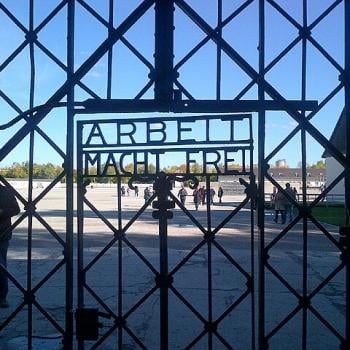
When I was a kid I thought a “concentration camp” was where people were sent to concentrate on their crimes. Later I thought only Germany set up concentration camps and they were all extermination centers for the holocaust. Later still I read more about the history of concentration camps and learned that their modern history dates back to the Boer War in South Africa when the English rounded up and detained Boers indefinitely in enclosed camps “for their own protection.” Dachau, the first German concentration camp (which I have visited), was established to detain political prisoners, enemies of the Nazi Party, again, “for their own protection.”

Surprisingly, Dachau was not established as an extermination camp and wasn’t used that way until it became a slaughterhouse of mainly Russian officers during World War 2. A gas chamber was added, but it was never used.

My point is that, contrary to popular belief, “concentration camp” does not necessarily mean “extermination camp” and “concentration camp” is not unique to the Nazis.

My question is whether the “detention center” at Guantanamo Bay would still be open if it were called what it is—a concentration camp. I doubt it.

So, I know some people will object and say “But it houses only terrorists!” How do we know that? Some will say “Our government says so.” But why trust our government? It also said Saddam Hussein was stockpiling weapons of mass destruction and used that as justification for our invasion of Iraq. Later it was revealed that American intelligence officers informed the Bush administration there were no weapons of mass destruction in Iraq—before the invasion.

What makes America America and great is that we don’t trust our government. That’s why we have three branches of government—checks and balances—because we know power corrupts and absolute power corrupts absolutely. America is not its government and the government is not America. “America” is a state of mind, a set of ideals, that includes not trusting power.

Again—how does anyone know for sure that the men being held indefinitely without trials in Cuba (by the American government) are guilty of anything? Whatever happened to “innocent until proven guilty?” Oh, some will say, that only applies to U.S. citizens. Really? Since when? Are you saying that only American citizens have human rights? Is it not a human right not to be held without bail or trial indefinitely by force? Isn’t that why we had a revolution in 1776—because we believed there are universal human rights not granted by government but by “nature’s God?” Have we now decided those rights apply only to us? Isn’t that the same as saying we, Americans, are the only true humans? The reasoning is patently absurd. (I am, of course, talking about “American exceptionalism” taken to the extreme to which some now take it.)

So what’s preventing the Obama administration from keeping its promise to close Guantanamo Bay’s detention center? I recently read an article saying it is due to roadblocks to closing it, and even to giving the detainees trials, set up by Congress. Who knows? Whatever the reason, it’s wrong. The men who have been held there now for over a decade are human beings, not aliens or animals. They have rights. A basic human right is not to be held indefinitely by force without justification and, so far as we know, there is no justification for it. If there is, why not prove it? Surely now, after more than a decade, it can’t be “for security reasons.” And the appeal to “national security” was never sufficient reason to do what is morally wrong (viz., violate human rights).

In my opinion, this is an example of where the U.S.’s mass media has bowed to the government inappropriately. They should be calling the “detention center” at Guantanamo Bay what it is—a concentration camp. Our national mass media tend to use whatever language the government uses for things. That’s bowing to and participating in propaganda.