L.B.: Muggletonians

Left Behind, pp. 301-302

As Chapter 17 begins, LaHaye and Jenkins seem suddenly to realize that they’ve scarcely made any headway through the End Times Checklist. Rapture? Check. Antichrist? Check. Woes, seals, trumpets, scrolls, angels, horsemen, witnesses, martyrs, dragons, talking eagles? Nothing yet and we’re already 300+ pages in.

So here’s where they start making up for lost time, plowing through the Book of Revelation with stretches of pure, unadulterated exposition.

It is still the Longest Day and Rayford still can’t sleep, so he turns on his new TV and puts on CNN. Instead of the usual Larry King reruns the not-really-24-hour network shows in the wee hours, he sees a report from the Temple Mount in Jerusalem:

“No one knows the two men,” said the CNN reporter on the scene, “who refer to each other as Eli and Moishe. They have stood here before the Wailing Wall since just before dawn, preaching in a style frankly reminiscent of the old American evangelists. Of course the Orthodox Jews here are in an uproar, charging the two with desecrating this holy place by proclaiming that Jesus Christ of the New Testament is the fulfillment of the Torah’s prophecy of a messiah.

“Thus far there has been no violence, though tempers are flaring, and authorities keep a watchful eye. Israeli police and military personnel have always been loath to enter this area, leaving religious zealots here to handle their own problems. This is the most explosive situation in the Holy Land since the destruction of the Russian air force, and this newly prosperous nation has been concerned almost primarily with outside threats.

“For CNN, this is Dan Bennett in Jerusalem.”

Bennett’s reference to “the old American evangelists” is puzzling. It’s possible he means old as in old-fashioned, or old-style — as though these two men were preaching like Billy Sunday. But it seems here more like he’s saying “old” in recognition of the fact that all of the American evangelists have disappeared. If that’s the case, Bennett is the first person — apart from those who have watched the ICR video — to have realized that the disappeared are all either children or born-again RTCs. It’s hard to know which is meant here because, of course, neither Bennett nor L&J allows CNN’s camera to show us the two men so we don’t get to hear them speak firsthand. The rushed exposition of Bennett’s report doesn’t really require him to be “on the scene” at all (which is, sadly, not an inaccurate portrayal of much of CNN’s reporting).

L&J have tried to make Dan Bennett talk like a reporter, and that’s how he comes across — as someone who’s trying to talk like a reporter. What we end up with is a mix of reporter-ish phrases (“authorities keep a watchful eye”), slightly altered prophecy-conference jargon (“fulfillment of the Torah’s prophecy of a messiah”) and gibberish (“almost primarily”). The details of Bennett’s report don’t ring true either, such as his use of the term “Wailing Wall” instead of Western Wall, and his apparent assumption that everyone knows what that refers to and why it is regarded as holy. His suggestion that military personnel are “loath to enter” the area of the Western Wall is only true if by that he means that most are too busy monitoring the checkpoints they have encircling the site, checkpoints through which every visitor to the wall must pass under the close scrutiny of heavily armed military personnel.

The authors also don’t seem to be aware of Jerusalem Syndrome, a form of psychotic religious delusion that afflicts about 100 visitors to that city each year. In this fascinating Journeyman Pictures video on Jerusalem Syndrome, the head of the city’s Kfar Shaul Mental Health Center describes some of the many sufferers he has encountered and treated over the years — dozens of people claiming to be Jesus or the Virgin Mary, and even one Canadian tourist who claimed to be Samson and who tore out the bars of a window to escape his hospital ward. (Note: When treating mental patients who think they’re Samson, cut their hair before putting them in the locked ward. And keep them away from stone pillars.*)

The situation Bennett reports on here — two guys claiming to be Moses and Elijah creating a public spectacle as street preachers — is actually a fairly routine occurrence in Jerusalem. This would be nothing the Israeli police hadn’t seen before, and nothing they wouldn’t know how to deal with. Once Eli and Moishe began to incite any kind of disturbance, they would be whisked off to Kfar Shaul. (“Where should I put Moses and Elijah?” “Moseses go in Ward 3 with the Abrahams. You’ll have to put Elijah in with the Jesuses, the Prophet Ward is getting crowded.”) Eventually they’d be sent back home to Texas or Indiana, where they could get the help and treatment they need.

The last thing that Israeli authorities would do in a situation like this, as tempers and tensions rise, would be to leave the situation to “religious zealots” to deal with. Most people suffering from Jerusalem Syndrome are harmless but some, like Australian tourist Michael Rohan, are not. In 1969, driven by the voices in his head which he believed were divine, Rohan set fire to the al-Aqsa Mosque on the Temple Mount, sparking international rioting and chaos. Since then, Israeli officials have been vigilant to ensure that JS-sufferers are not exploited by the many varieties of religious zealots who want to see a repeat of such chaos because they think it would hasten their longed-for End of the World scenarios.

In Left Behind, however, the Israeli police have also read the back of the book jacket, and therefore recognize that they’re not dealing with your run-of-the-mill Jerusalem Syndrome cases here, but with the actual Moses and Elijah, which is to say with L&J’s version of the “two witnesses” described in Revelation 11.

Even by the standards of Revelation, this is a perplexing passage. Here’s the key part:

I will give power to my two witnesses, and they will prophesy for 1,260 days, clothed in sackcloth. These are the two olive trees and the two lampstands that stand before the Lord of the earth. If anyone tries to harm them, fire comes from their mouths and devours their enemies. This is how anyone who wants to harm them must die. These men have power to shut up the sky so that it will not rain during the time they are prophesying; and they have power to turn the waters into blood and to strike the earth with every kind of plague as often as they want.

Now when they have finished their testimony, the beast that comes up from the Abyss will attack them, and overpower and kill them. Their bodies will lie in the street of the great city, which is figuratively called Sodom and Egypt, where also their Lord was crucified. For three and a half days men from every people, tribe, language and nation will gaze on their bodies and refuse them burial. The inhabitants of the earth will gloat over them and will celebrate by sending each other gifts, because these two prophets had tormented those who live on the earth.

But after the three and a half days a breath of life from God entered them, and they stood on their feet, and terror struck those who saw them. Then they heard a loud voice from heaven saying to them, “Come up here.” And they went up to heaven in a cloud, while their enemies looked on.

At that very hour there was a severe earthquake and a tenth of the city collapsed. Seven thousand people were killed in the earthquake, and the survivors were terrified and gave glory to the God of heaven.

L&J claim to read this passage “literally.” Good luck with that. Their “literal” interpretation causes them to regard things like CNN as fulfillments of biblical prophecy. Follow that? The passage says that people from every corner of the earth will see the dead bodies of the two witnesses. Clearly, John is describing satellite television. What else could it possibly mean?

I don’t have any idea what to make of Revelation 11. Set aside the opaque symbolism and numerology, I can’t even make sense of its verb tenses. I’m OK with that. I’m pretty sure that one can live a full life and be a faithful Christian without knowing what to make of passages like this.

The InterVarsity Press Commentary suggests that the two witnesses represent an aspect of John’s own testimony in his apocalypse. Could be, I guess, OK. The commentary also offers a bit of a cautionary tale regarding those, like L&J, who view such passages as transparent and obvious in their meaning:

Who are John’s “two witnesses”? Identifications have been varied and sometimes eccentric, ranging from the apostles Peter and Paul martyred in Rome (Munck 1950) to two 17th-century London tailors named John Reeve and Lodowick Muggleton! The latter interpretation created a sect known as the Muggletonians, which lasted for three hundred years.

The Wikipedia entry on the Muggletonians** underscores the commentary’s warning, ending with this weirdly poignant sentence:

The last Muggletonian, Mr. Phillip Noakes of Matfield, Kent, died in 1979.

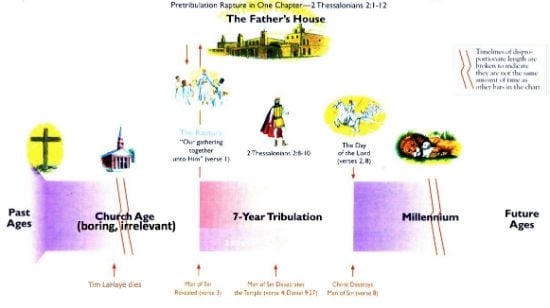
Lest we find ourselves doomed to repeat the sad, lonely fate of poor Mr. Noakes, let’s avoid delving much further into the esoteric symbolism of this passage. I should note, however, that L&J’s placement of the two witnesses here, in the earliest days of the Tribulation, is regarded by some of their fellow Darbytonians as controversial. We needn’t get into the details of this intramural dispute — that would be too much like walking into a room full of conspiracy theorists arguing over who Jack Ruby was really working for — but it’s worth keeping in mind that such disputes helped to shape the authors’ imagined audience for this book. It’s not only about reassuring their followers and condemning the pagans and False Christians. It’s also about condemning the mid-Trib Rapturists and all the other PMD factions whose tribulation timelines vary from L&J’s preferred version.

Want more details on these variations and the ins and outs of these disputes? OK, but be careful — remember Phillip Noakes. Some of the more splendid timelines I’ve found online can be viewed here, here, here, here, here and here. The first is the prettiest, but the last one is probably my favorite since it’s tied in to specific dates in 2009. L&J have their own version, but it’s not online because they want you to buy it. Some of LaHaye’s earlier versions can be found here. If you really want to spelunk further into these intramural disputes, try googling “secret rapture,” a contentious term used by L&J’s opponents (or, perhaps, by their allies, it can be hard to tell).

Finally, you may be wondering why the authors identify these two witnesses as Moses and Elijah when, as we have seen, Rev. 11 never mentions them. In part it’s because Moses and Elijah are said not to have died, per se, but to have been taken up to heaven by God. (That reasoning strikes me as unfair to Enoch.) It’s also because Moses and Elijah are mentioned by name in the Synoptic Gospels’ accounts of Jesus’ “transfiguration.” How does that story, which is not included in John’s Gospel, fit in with this seemingly unrelated story from John’s apocalypse? Well, when LaHaye shoved his Scofield Bible into his 86hp, hydraulic-feed Darby-matic wood chipper, a fragment of a page from Rev. 11 landed next to a fragment of a page from Matt. 17, so, clearly, these passages are related.

– – – – – – – – – – – –

* [woody]”We needed the eggs.”[/woody] Speaking of chickens and eggs, there’s some dispute over whether Jerusalem Syndrome is really something that happens to otherwise healthy people visiting the city, or whether it’s more a matter of the Holy City’s particular attraction to those who already are afflicted by religious delusions. See also, Graceland.

** The Muggletonians were obsessed with, among other things, denouncing Newtonian cosmology as antibiblical. The Fine Arts Museum of San Francisco has a collection of Isaac Frost’s Muggletonian astronomical charts which are, in their own way, oddly beautiful (see also here). Compare the craft and care of these lovely prints with the wanton ugliness of contemporary geocentrist Marshall Hall’s Web site — or with what passes for art among PMDs (as in this painting). The modern world is witnessing a lamentable decline in the craft and aesthetics of its religious quack fringe groups. The Shakers produced beautiful furniture. The PMDs produced the World’s Worst Books. But at least we still have Howard Finster.

Stay in touch with the Slacktivist on Facebook:

NRA: Get back Loretta
The Left Behind franchise is coming for your children
NRA: A piece of bread would buy a bag of gold
NRA: 'The Fugitive' meets 'Mad Max'
  • Ursula L

    (2) The idea that by waiving the punishment, God would be committing an injustice against Himself is incompatible with the divine attribute of mercy. Without the ability to alter or waive a penalty — especially an eternal one — God could not be merciful, but would Himself be a slave to the Law.
    I agree with this.
    This concept makes god curiously weak and impotent. I am capable of saying “I forgive” without making anyone pay for how they wronged me, if I so choose. Is god weaker, or less capable of mercy, than I am?
    I’ve noticed two strains of thought on this matter from Evangelical Christians.
    In the first strain of thought, god is so bound by justice so as to be incapable of mercy, as described above.
    In the second train of thought, if you say the magic words, you’re forgiven by god. God is so bound by mercy as to be incapable of justice – the magic words are a “get out of jail free” card, and any human who wants justice or recompense for how you have harmed them is not an aggrieved party, bur rather one whose interests are moot (or even a sinner for wanting to be made whole from the harm done), as long as you’ve said the magic words to gain god’s forgiveness.
    The latter particularly annoys me. It provides far to convenient a cover for harming others, and then turning on the one harmed as “harming” the one who initially harmed for not ignoring every possible harm committed by someone who has said the magic words. The concept of god’s forgiveness shouldn’t be a giant “kick me” sign on other people.

  • Skyknight

    Well, this WAS in the day of debtors’ prisons…
    To further detail what Anselm said, God actually WANTED to freely waive the debt (q.v. desiring , but was shackled by his own necessity of holiness. Only by creating the Christ–capable of paying an infinite number of infinite debts as deity, capable of accepting humanity’s debts as a human–could he satisfy both his wish and his needs.
    This, by the way, is a big portion of why Belial & Co. can never achieve redemption. Every angel is a unique entity, part of no greater tribe/species/etc. beyond the (no-longer-there in this case) fealty to God. And this is inherent–God can’t try to create a god-(fill in the angel) in the Christ. Thus, no hope was available the moment ANY angel went even a little counter to God’s will.

    No wonder Belial’s so bitter…

  • hapax

    I’m not an apologist for Anselm myself, because I think it is impossible to find his argument compelling unless you have thoroughly internalized his social/legal/philosophical presumptions.
    But I don’t think it’s fair to say it constrains God from freely choosing to exercise mercy. Anselm’s argument is a bit more subtle; he claims that God, being God, and ONLY God, could simultaneously be completely and fully “just” (within Anselm’s understanding of that term) AND completely and fully “merciful”, simultaneously, at the price of the Incarnation.
    If you go and read “Cur Deus Homo” (it’s pretty short, and well-written for that sort of thing) it is in fact a fairly elegant and tightly argued bit of reasoning, even if it leaves me aesthetically cold.

  • hapax

    or, in other words, What Skyknight Said.

  • aunursa

    Anselm’s argument is a bit more subtle; he claims that God … could simultaneously be completely and fully “just” (within Anselm’s understanding of that term) AND completely and fully “merciful”, simultaneously, at the price of the Incarnation.
    As noted, the problem with that argument is that (1) Divine punishment is akin to a prison sentence for a convicted criminal, not a civil debt/penalty. Unlike a fine, a prison term cannot be transferred to an innocent third party.
    For God to be perfectly just, no one can act as a substitute and pay the penalty to atone for the sins of another.

  • hapax

    aunursa: “Divine punishment is akin to a prison sentence for a convicted criminal, not a civil debt/penalty.”
    Well, maybe for you. I have a totally different perspective (“punishment”, if you can even call it that, is more self-imposed privation of essence). For Anselm, however, it was almost EXACTLY like a civil debt:
    “A person who does not render God this honor due Him, takes from God what is His and dishonors God, and this is to commit sin. Now, as long as he does not repay what he has plundered, he remains at fault. Neither is it enough merely to return what was taken away, but on account of the insult committed, he must give back more than he took away.” (CUR DEUS HOMO, Ch. 11)

  • Jeff

    I don’t believe in God, because *just look at what he did in the Bible!*
    While agreeing that the example given was pilpul, I don’t see why God’s behaviour in the Bible isn’t a valid reason not to believe in Him (for each version of Him corresponding to a particular reading of the Bible). I rejected the God of the Old Testament because I could not believe in a cruel God, and God, in the Old Testament, unspeakably cruel.
    I rejected the New Testament because the idea of a “Saviour” leaves me cold. If I reject the concept of “sin” (but not evil), I don’t need absolution for those sins.

  • Jeff

    Neither is it enough merely to return what was taken away, but on account of the insult committed, he must give back more than he took away.
    What’s the “nut”? (God is a loan shark!)

  • http://www.geocities.com/aunursa/jewish/counter aunursa

    hapax,
    So Anselm considered hell to be a payment, not a prison?
    Jeff,
    Interesting. I found the deity of the New Testament to be crueler than the God of the Hebrew Bible.

  • hapax

    @Jeff “God’s behaviour in the Bible isn’t a valid reason not to believe in Him (for each version of Him corresponding to a particular reading of the Bible”
    Oh, granted. I have always said that God (if there is a God) is such a radically different order of being from humanity, that there is no way to evenly meaningfully talk about God except in metaphors. Scripture (all Scriptures, Hebrew and Greek and Koran and Vedas and Sutras etc.) is the record of human attempts to grope their way towards a Better Metaphor.
    If a particular metaphor leaves you cold, why should you cling to it until your soul freezes over?
    I am just amused at a certain type of atheist, who treats the Bible in pretty much the way that the Pope evidently wants Protestants to treat his pronouncements: “Just because I reject the premises of everything you say doesn’t mean that I’m not going to let the details keep me up all night!”
    @aunursa: “So Anselm considered hell to be a payment, not a prison?”
    Mmm. More of a payBACK. His vision of God is very much of the ultimate feudal lord. Anselm really is worth reading, not just for the beauty and clarity of his prose (which is lovely in Latin, and not too bad in a good English translation), but also just to see how very very different the medieval mind is from the modern, despite claims that “everybody thinks basically the same way.”

  • Bugmaster

    I am just amused at a certain type of atheist…

    Well, this particular atheist rejects all gods, regardless of scripture — including YHVH and Thor and Inanna and Grandfather Thunder. I don’t believe that the very concept of divinity is reasonably likely to be true. However, there are additional reasons for rejecting the omni-everything Christian god (a.k.a OECG): he’s logically inconsistent, and therefore cannot exist at all. Thus, while it is possible (yet incredibly unlikely) for Grandfather Thunder to exist, it’s impossible for the OECG to exist at all. Note that this doesn’t eliminate other, less ridiculous Christian gods (who are not strictly omnipotent, or not strictly omniscient, or kinda evil, or whatever).

  • LMM

    (God is a loan shark!)
    Despite commands against usury at that.

  • Jeff

    this particular atheist rejects all gods
    Yet your moniker indicates you don’t reject Baalzebub.

  • Bugmaster

    Well, I can hardly reject my own existence, now can I ? *cackles demonically*

  • Jeff

    If a) you reject all gods and b) you do not reject yourself, then c) you are not a god.
    Conversely, if a) you reject all gods and c) you are a god, then b) you must reject yourself.
    Hmmmmm…..?????

  • Bugmaster

    It’s all part of the Great Mystery. A mortal human like you couldn’t possibly understand. I’m pretty damn epic.

  • Ursula L

    (Not that I’m immune from that tendency myself. But it always cracks me up when someone says, in effect: “I don’t believe in God, because *just look at what he did in the Bible!*”)
    Well, I’m not exactly saying “I don’t believe in god because…” what I’m saying is “If god exists as described in (this story from) the bible, I reject that god as a moral authority and as a being worthy of respect because…”
    As an agnostic, I see three separate questions to be asked before finding a god to worship.
    1. Does this god exist?
    2. What is this god like?
    3. Given what this god is like, is this something I want to be associated with, or worship?
    Answering the first question is the most difficult, in terms of proof. And a rather boring quesiton, in terms of online discussion/debate – if the proof of existance is there, then its there, but if it’s something you’re supposed to decide on faith, the proof won’t be there.
    But, by looking at various holy books, religious traditions, etc. you can answer the second and third more easily. And if the answer to the third is “no” then whether or not that god exists is moot, because even if it did, I wouldn’t worship it. That’s where I wind up on the god described for most of the OT. And that’s a different type of discussion – playing theology is much more fun than playing at blind faith.
    It rather amuses me to see people going to great lengths to excuse behavior in their god which they would reject as immoral coming from any human being. There are some versions of god which are not supposed to be morally perfect (looking at Greek mythology, it’s pretty easy to say “Zeus really messed up that time!), but the Christian/Jewish/Islamic god(s) are theoretically supposed to be perfect.

  • Ursula L

    Actually, according to St. Anselm of Canterbury, the punishment has to be eternal because the debt to God humans incurred by even the slightest disobedience/wavering/etc. is infinite. If God forgave the debt without a proper being (i.e. the God-man known as the Christ) to pay the debt himself, he’d be perpetrating an injustice against himself–and God is supposed to be incapable of doing ANYTHING that’s unjust.
    I’d say that measuring a harm caused by a finite act as infinite is inherently unjust. Someone who is just only expects payment back according to the harm done (reasonable damages) not holding a grudge forever because someone accidentally slighted them. This argument starts out with an inherently unjust measure of harm, and then tries to claim “mercy” for not going through with the injustice.
    Mercy can be a blessing or gift after justice, it can’t exist as a mitigation for injustice.

  • http://www.geocities.com/aunursa/jewish/counter aunursa

    the punishment has to be eternal because the debt to God humans incurred by even the slightest disobedience/wavering/etc. is infinite.
    That would be like calculating damages against a dry cleaner that loses a $150 pair of dress pants at $67 million. N’est-ce pas?

  • http://accidental-historian.blogspot.com/ Geds

    If St. Anselm of Canterbury is the same as the Anselm I’m thinking about, then he was forcibly castrated after getting a woman (Heloise?) pregnant, then marrying her. He saw this as God’s divine judgment and went off to live as a monk.
    So, um, I have a hard time taking his word as a final authority on much of anything involving the nature of justice or equal punishment for any action (since the sex and whatnot was consensual and all…). I have a theory that if God is infinitely just and merciful and loving and all that, then God should be more loving and merciful and whatnot than even the best example of humanity. Anselm really wasn’t, even if you stick a Saint on the front of his name.
    Also, I find that I’m agreeing with almost everything aunursa has had to say. I’m ever so slightly weirded out by that.

  • http://accidental-historian.blogspot.com/ Geds

    Wait, dammit, I was thinking of a different person.
    My bad. Go on about your days, nothing to see here.

  • http://www.geocities.com/aunursa/jewish/counter aunursa

    Right back at ya. ;)
    People can still get along even if they don’t wee eye to eye on every issue — even major issues. Even the Reagan Republicans and Clinton Democrats in my family get along during the holidays.

  • Bugmaster

    People can still get along even if they don’t wee eye to eye on every issue

    They must have some interesting culture in wherever you’re from :-)

  • Spike

    “In part it’s because Moses and Elijah are said not to have died, per se, but to have been taken up to heaven by God.”
    Not to be too pedantic, but the Bible is quite clear on the fact that Moses, as opposed to Elijah, actually died. Unless Moses’ ascent to heaven is some sort of PMD invention with which I’m not familiar?

  • Skyknight

    Anselm was thinking in terms of not merely reversing the direct damage wrought, but also the offense against/denigration of God’s dignity. The punishment needs to be infinite on account of God’s dignity being infinite, and the infinite loyalty humanity owes to God for bringing them into existence (i.e. they literally owe everything to God, so they have no right whatsoever to go counter to him). Think of it as being like unto stealing three or four sheep of a freeman, against poaching a deer from the king’s hunting grounds.

  • http://www.geocities.com/aunursa/jewish/counter aunursa

    They must have some interesting culture in wherever you’re from :-)
    Doh! I need to preview more carefully. ;)

  • Ember Keelty

    I know this thread was a long time ago, but I just read it, and I have to say…
    The punishment needs to be infinite on account of God’s dignity being infinite
    But the human offense to to God’s infinite dignity was still finite (because the capabilities of humans, including, presumably, the ability to offend, are finite), and therefor, if we’re talking proportions, the offense is actually infinitely small. The way I see it, the suggestion that we puny mortals could do any real damage to God’s dignity is completely blasphemous.
    and the infinite loyalty humanity owes to God for bringing them into existence (i.e. they literally owe everything to God, so they have no right whatsoever to go counter to him).
    Children owe their existence to their parents, but there’s still a limit to what parents have a right to demand from their children.
    Think of it as being like unto stealing three or four sheep of a freeman, against poaching a deer from the king’s hunting grounds.
    See, from my perspective (the perspective of liberal morality), the former is actually morally worse. The freeman may not have that many sheep, and is therefor likely to feel the loss of three or for of them. The king, on the other hand, isn’t likely to even notice that one of his deer has gone missing unless he catches you in the act of taking it.

  • Anonymous

    This is the stuipest dam thing i ever seen. i tried for the TIMELINE n this isnt shit.

  • Kunal Chattopadhyay

    I was actually doing some serious research on 17th century English dissenters, and stumbled on this by accident. But given what I know and more what I feel about CNN, I found this absolutely great. Will make sure to forward this to friends.


CLOSE | X

HIDE | X