‘The Avengers,’ ‘Blink,’ Superman and the problem of evil

OK, let’s step aside from politics and religion (mostly) for a moment and talk about comic book superheroes and Doctor Who. Because we can.

Like most people who are fans of comics and/or Joss Whedon, I’m geekily excited about the Avengers movie coming out this summer.

I was never more than an occasional reader of the Avengers comics, but those characters made an impressive appearance in one of my all-time favorite comic book stories — the  1986 Daredevil “Born Again” series by Frank Miller and David Mazzucchelli.

That series was a brilliant bit of noir-ish storytelling, with Matt Murdock falling to pieces as the Kingpin — a crime lord with no super powers — slowly took away or destroyed every part of his life. The big final showdown involved the Kingpin losing all restraint and sending a psychotic killer after Murdock with automatic weapons and a helicopter gunship, wreaking havoc and mass-destruction in the middle of Manhattan.

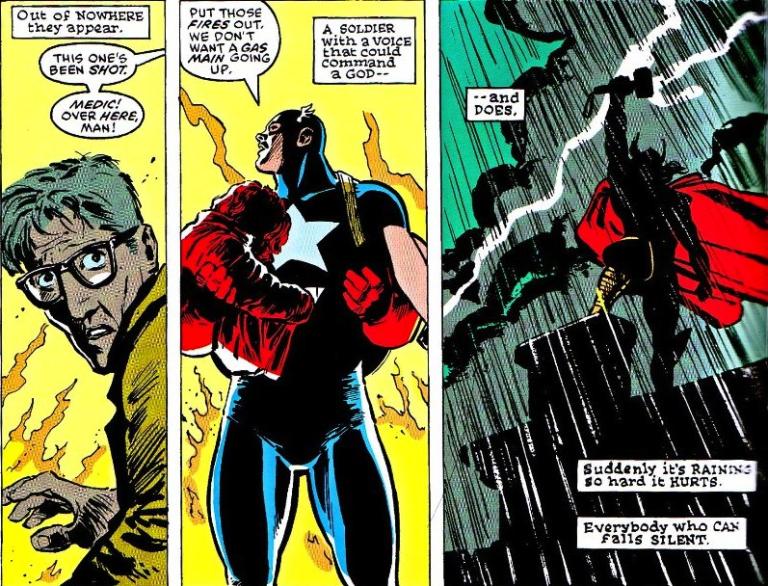
And that’s when, “Out of nowhere they appear.” The Avengers show up and take charge and you suddenly remembered that in the Manhattan of the Marvel comics universe there aren’t just heroes, but super-heroes.
As I said, I’m looking forward to the Avengers movie. I’m sure it will be great fun to see such a talented cast exploring the characters and camaraderie of this super-powered team as they battle against super-powered villains like the Marvel-universe version of Loki (and, possibly, the Red Skull). Plus I think Whedon’s dialogue as spoken by Robert Downey Jr. promises to be enormously entertaining.

But the kind of comic-book superhero movie I’d like to see would be one that captures the awe that poor Ben Urich shares with the reader as he narrates those panels shown above. I haven’t seen the recent Captain America or Thor movies, but I doubt they convey the essence of those two heroes any better than that single page by Mazzucchelli. By showing us how they appear through another character’s eyes, Miller and Mazzucchelli allow us to see what familiarity had worn away.

One perennial trouble with superhero stories is that they turn into an arms race. The more powerful the hero, the more powerful the villains need to be to provide a credible challenge. This is part of why I’ve always found characters like Daredevil and Batman more interesting than Thor or Superman.

One way around this arms-race problem is to move the superhero to the periphery of the story — to allow your superheroes to be superheroes, but not to make them your superprotagonists. Make the story about someone else, someone more human and not quite so unstoppably powerful and invulnerable. The trick is to find a way of doing that without reducing the superheroes themselves to a tacked-on deus-ex-machina role.

Two of my favorite episodes of TV shows managed to do this, and I think they point to two different approaches — either one of which might work to give us a superhero movie quite unlike the summer blockbusters we’ve been seeing.

The first example I’m thinking of is the Doctor Who episode “Blink.” If you’re a Doctor Who fan, then I’m sure you’ve seen it. If you’re not a fan, then I can’t think of a better introduction to the show than this episode, even though the Doctor himself appears only as a peripheral character. Moffat turns the usual story around. Instead of a story about the hero racing to the rescue to save some random damsel in distress, the random damsel, Sally Sparrow, turns out to be the one who rescues the hero. The story is told through her eyes, allowing viewers to see the familiar hero with a fresh perspective.

Darin Morgan did something similar in a classic episode of the X Files spin-off Millennium called “Somehow, Satan Got Behind Me.” The show’s main character, Frank Black, barely appears in that episode, which focuses on four grumpy old demons telling stories in a coffee shop. When Frank Black does appear, briefly, in each of their stories, he is seen as they see him and, again, viewers are given a fresh perspective and new insight into a familiar hero. Morgan turns the usual story around by showing us the hero through the eyes of the villains.

Both of those approaches might serve as a model for a superhero movie that wanted to be something other than an explosion-y summer blockbuster that ratchets up the arms race between superheroes and super villains.

Again, I’ve never been a big fan of Superman. His almost limitless power creates an obstacle that proves too great for many writers to overcome. Ultimately, there’s only so much kryptonite to go around. But what would it mean to tell a story set in Metropolis, but not centered around Superman, or Lois Lane, or the Daily Planet? What would it mean to turn the story around, to move Superman to the periphery and put a fresh perspective at the center of the story?

That would raise another problem, I think, but it’s a good problem — or, rather, it’s a problem that ought to provide grist for a good story. This problem, which is always lurking somewhere in the background of every Superman story, is more or less the same as one of the central puzzles of theology: the problem of evil.

Think of it in terms of Ben Parker’s famous advice for his nephew: “With great power comes great responsibility.” If that was true for Spiderman, who has “great power,” what does it mean for Superman, who has nearly limitless power? It seems to follow that with nearly limitless power comes nearly limitless responsibility.

One night in Metropolis there’s an accident. A drunk driver strikes and kills a pedestrian, a newlywed as it turns out. These things happen all the time in big cities. But they don’t happen all the time in this city. In Metropolis, most of the time — but not all of the time — Superman flies in to carry off the car, or carry off the pedestrian, or both, and save the day.

But not all the time. And not this time. This time he was off with the Justice League, or he was spooning with Lois or he was battling Lex Luthor or he was asleep or … he wasn’t there, is the point. And because he wasn’t there when he was needed, someone died, leaving behind a spouse who carries an aching resentment for the drunk driver and an even greater, more painful resentment for the city’s red-caped hero. Where was he? Why did he allow that to happen?

If this were a Golden Age comic book story, this grieving spouse would go mad and turn to a life of crime, vowing to destroy Superman. But I don’t want to turn this grieving spouse into a super-villain. I want to see what she will do if she finds herself in the same situation as Sally Sparrow, having to risk her life to save this alien hero.

That’s the Superman movie I want to see.

In the meantime, I’m looking forward to Whedon’s explosion-y summer blockbuster, and I’m hoping that Darren Franich gets his wish to see Ryan Gosling play Matt Murdock in the rumored Daredevil: Born Again movie.

  • http://twitter.com/AbelUndercity Abel Undercity

    That’s known as “fodder for future episodes.” ;)

  • Chunky Style

    “I think Star Wars: The Old Republic (the new MMO) is doing an all right job of showing the Jedi as flawed but of good intent.”

    You know, I still get kick around the prequels in my mind and what George Lucas could have done to fix them.  A thought occurred to me the other day.  In “Attack of the Clones”, the Jedis took over an army of clones and used them as cannon fodder — in effect, they took men as slaves for the sake of expediency.  That was the moment at which the Jedi order broke with its own ideals, and that moment pretty much went unnoticed.  But suppose a certain young Jedi (and former slave) became so disillusioned with the Jedis at that point that he were to help to put the Jedis down, not realizing Palpatine would be even worse … eh, it’s an idea.

  • GeniusLemur

    I think that’s just an example of phenomenally bad writing. I mean, they hear that a Jedi Master ordered this army for the republic, and say “great, we have an army!” and leave it at that. No one ever tries to find out who it was that ordered the army or who PAID for it. No one ever checks the instructions these guys are getting to see if there’s a nasty surprise somewhere in them.
    So rather than the Jedi breaking with their ideals, it’s more George Lucas writing for convenience (and doing a lousy job of it).

    I mean, when Obi-Wan is trying to find the planet they were made on, he finds that gravitationally, it’s there, but there’s no data. And it takes a personal consultation with Yoda to come up with, “Hey, maybe someone erased the file.” And they never try to figure out who erased the file or why, either.

    I think that a major problem trying to get the measure of the Jedi or Republic via the prequels is that the writing is so bad.

  • Anonymous

    Oh, I like that.

    And, now that I think about it, the fact that the Republic is utterly messed up in game fits right in with the Republic of the prequels and Clone Wars series (from what I know of it).  They don’t, so far as I know, have slaves (unlike the Sith Empire), but is abandoning tons of refugees to their fates really an improvement?  I’m not sure that if my smuggler and my agent could sit down and talk about all that’s wrong with their respective governments, they wouldn’t come to the conclusion that both were equally bad.

  • http://www.facebook.com/lepperdaw Andrew W Lepperd

    You would really enjoy the story of Samaritan from Astro City, I think.  He’s the setting’s Superman analogue, and it tackles the “responsibility” thing head on.  It begins with him dreaming of flight.  He’s capable of flying (like Superman), but during the day he is constantly flying from one emergency to the next.  Only in his dreams can he just soar without direction and truly enjoy flight for its own sake.

  • GeniusLemur

    Well, what would the Sith do with the refugees in the same situation? Does the Republic have the resources to deal with them?

  • Cathy W

    Apparently Salt was originally written with a male protagonist (intended to be Tom Cruise), and then they cast Angelina Jolie and changed only as much of the film as necessary to make that work.

  • http://stealingcommas.blogspot.com/ chris the cynic

    I hate Midnight with the fires of a thousand suns.  It seemed to be an episode with a point to make and the only point it made was that human beings are evil.  Completely rotten to the core.

    [Spoilers]

    It should be pointed out that the single most heroic character in Midnight was the one who originally suggested that they solve their problems by resorting to murder.  This was not because she somehow improved by that point, she hadn’t.  (She solved their problems via murder-suicide.)  Everyone else was worse with the only possible exceptions being two people who died before they got a chance to prove themselves evil and one person who was possessed the whole time and thus couldn’t have demonstrated evil if she wanted to.

    I think that the reason the Doctor needs saving by the end is that he was the only person who wasn’t an explicit villain by that point.  If anyone else were in need of saving you’d have to wonder if things would really be better if they were saved.  Attempted murderers all of them, and disturbingly enthusiastic about the whole thing.  Fear might have been their original motivator, but by the end they were reveling in it.

    There have been aliens who attempted to hold the whole world hostage who didn’t come across as half as evil as those humans.

    [Added:]

    My personal feeling is that the reason the Doctor didn’t have a companion in that episode is that it would have either messed up the message or the companion. If Donna didn’t turn evil on an extremely rapid time table then the episode couldn’t have had its whole, “People are universally evil,” message. If Donna did then you’d never be able to look at her the same way again.

  • Anonymous

    I’m pretty sure the Sith Empire would enslave them.  I can’t be a hundred percent sure, since the equivalent hasn’t come up, but the Empire does seem to use slaves for a lot.  It should be noted that the Empire is not good.  I’d probably sum it up as The British Empire at the height of colonialism, only run by an evil religion.  (What’s a godless version of a theocracy?  Rule by priests also isn’t quite right. Fie.)  It also keeps prompting Warhammer 40K jokes in chat, since it’s headed by an absurdly long lived Emperor.

    Your second question is harder to answer.  There’s a severe divide between the bright shiny rich parts of the Republic and the slums.  Also, there are odd things like something that is either a crime syndicate or the galactic equivalent of Palestinians giving a senator money for her campaign with the promise that housing would be built for the refugees…but the game goes morally odd and thinks the objection is her taking money (a reasonable objection) and not her not then following through on building housing for the refugees (an equally reasonable objection, I’d say).  I really can’t tell whether Republic could re-allocate resources and deal with the refugees, or whether the problem is that they don’t have the resources.  Somehow the Republic seems to be having more trouble recovering from the recent (though I’m not sure how recent) war with the Sith Empire.  Of course some of the people in the Republic talk about the refugees as less than people, which is seriously not helping matters.  (In the Empire, there are people who do the same thing with slaves and non-humans, by which I mean, members of any race that isn’t human.)

  • http://jamoche.dreamwidth.org/ Jamoche

    Four boys talking about how they had seen some crime foiled by The Batman

    Unless they’ve done that twice, that was a scene from “Batman: The Animated Series” – one of the incarnations is the infamous Schumacher “nipple suit”, which gets deservedly mocked by the other kids.

  • http://www.facebook.com/profile.php?id=659001961 Brad Ellison

    They did do it twice.  The second time was the opening sequence of the Gotham Knight animated feature.

  • Patches

    “I hate Midnight with the fires of a thousand suns.  It seemed to be an
    episode with a point to make and the only point it made was that human
    beings are evil.  Completely rotten to the core.”

    I didn’t get that vibe from the episode at all.  These people were on a bus that broke down, the drive section was chopped off, and there’s suddenly an alien entity possessing one of the passengers.  The normal human reaction is “Kill it!”  Is it paranoia?  Yes.  Is it groupthink?  Yes?  Is it evil?  No.  The entire setup of the episode was that there’s this unknown entity on the bus, they have no way of communicating with it or finding out what it’s intentions are, so end up coming up with paranoid conspiracies on their own until they work themselves into a frenzy.  It’s not an admirable trait, but it’s what people do.  I didn’t see the episode as a jab at humanity at all, I saw it as a test of the Doctor’s character in a situation where nobody is on his side and his usual diplomatic tactics aren’t getting him anywhere.

  • CaryB

    “I hate Midnight with the fires of a thousand suns.  It seemed to be an 
    episode with a point to make and the only point it made was that human 
    beings are evil.  Completely rotten to the core.”Like Patches, I disagree with this assessment. Personally, I think its supposed to be a time when the Doctors usual “No, we can work this out!” approach is just plain wrong.  Whatever the thing is that possesses them, it can’t be talked to, or helped, or dissuaded. It can only be killed.  What the writers have essentially set up is a situation familiar to anyone who studies things like disaster relief- its a triage situation.  Sometimes, you can’t save everybody, and, in real life, people have to make these decisions all the time.  There is no “right” decision. There’s only a choice of either one person dies, or, as actually happened, two people die. Or even more. 

  • http://stealingcommas.blogspot.com/ chris the cynic

    Except you just described, pretty much exactly, the plot of Torchwood: Miracle Day with one exception.  In Midnight they knew everything was going to be all right.  All they had to do was wait.  Help was on the way.  And not in some vague sense.  They had time table.  They could have just taken a nap (appointing a pair of people to stand watch, of course, I don’t advocate stupidity) and everything would have been better.

    So in that positively rosy sure to be solved situation 100% of all humans become murderers.  Which probably wouldn’t bother me quite so much if they weren’t so damned enthusiastic about it.  When they were trying to murder the Doctor, or earlier when they had argued to murder the woman, they weren’t doing it as an option of last resort they saw themselves forced into.  They were practically cheering as the dragged the helpless Doctor to his death.  Actually, I think might have been cheering, but I’d have to rewatch to check and I’m not going to subject myself to that any time soon.

    Now Torchwood Miracle Day put everyone in a situation where there was no help on the way, no possibility of escape, and and they were facing not just their own end but the total collapse of everything they had ever cared about.  Some people, like those from Midnight, turned to murder, but none did it with enthusiasm and to get them to that point required global manipulation by a group that had spent the last ninety years, at least, studying how to manipulate people and gaining positions of authority.

    Even with that conspiracy trying as hard as it could to get people to pull a Midnight we saw nothing like a 100% rate of “Let’s commit murder” and even those who were on board with the “Let’s commit murder” plan weren’t happy about it.  Even the doctor who was onboard with the whole murder plan to the point of being unapologetically responsible for trying incinerate Gwen’s father alive wasn’t anywhere near as far gone as every single human character who knew help was on the way in Midnight.  Instead she was showing a hell of a lot of guilt and having to resort to the Nuremberg defense.

    That was with people actively trying to get the reaction we saw in Midnight via multiple levels of manipulation.

    The normal human reaction is “Kill it!”  Is it paranoia?  Yes.  Is it groupthink?  Yes?  Is it evil?  No.

    You’re going to have to explain this one because as near as I can tell you’ve just described the rationale behind most genocides and then labeled it not-evil.  I’d like to go into more detail, but I’m really at a loss.  How is, “I’m scared.  Let’s kill someone so I can feel better,” not evil?

    And let’s not forget, unlike cases of bigotry, there was no debate in Midnight that they were killing an innocent person.  They weren’t scared of her, they had nothing to fear from her, she had done nothing wrong.  They were all well aware that she was a victim.  If it had just been her they would have had nothing to fear.  She wasn’t the target, she was collateral.

    Mind you once they shifted their attention to the Doctor that didn’t apply because they never liked him in the first place.

  • Anonymous

    Touching on the issue of responsibility, but from the flip side, is Irredeemable, an ongoing series by Mark Waid and Peter Krause.  This story is about a Superman analogue (“The Plutonian”) who sadly lacks the moral fortitude needed to deal with his godlike power, and who finally snaps from the pressure and goes on a rampage.  His surviving teammates have to figure out what made the Plutonian lose it (from flashbacks, we know it’s the cumulative weight of a lot of buried issues), as well as how the hell to stop him.

    In his introduction, Waid gave his mission statement as: “In superhero comics, pretty much everyone who’s called upon to put on a cape is, at heart, emotionally equipped for the job.  I reject that premise.”  In many ways Irredeemable is a deconstruction of Superman and his associated tropes.  But it’s also kind of a celebration of the Man of Steel, showing the pressures and disappointments a guy like him must face constantly; it’s a credit to Supes’ strength of character that he does manage to stay grounded, instead of collapsing emotionally the way the Plutonian does.

  • FangsFirst

    Irredeemable is fantastic, and the companion piece Incorruptible is also pretty good.

    And on that whole subject, as a Rayner fan, it was interesting to have Superman explain why he doesn’t fix every damn thing that goes wrong, once Kyle got the power–as the Ion–to fix, well, every damn thing that goes wrong.

  • Jenny Islander

    That little scene where Salt matter-of-factly strips off some of her clothes in a bathroom in front of a mirror so she can use a menstrual pad to bandage a bullet graze got me.  It was a half-naked model-gorgeous woman under bright lighting, shot completely without pandering to the so-called core demographic.  I’m sure that some people in the audience found it sexy.  The point is that none of the standard “Okay, guys, sexytiems, this is what you paid for” treatment was applied to the scene.

  • Patches

    “You’re going to have to explain this one because as near as I can tell
    you’ve just described the rationale behind most genocides and
    then labeled it not-evil.  I’d like to go into more detail, but I’m
    really at a loss.  How is, “I’m scared.  Let’s kill someone so I can
    feel better,” not evil?”

    Because the point I was trying to contest wasn’t whether or not the actions of the passengers were wrong, but whether or not the theme of the episode was “humans are evil”.  I was trying to point out that the less-than-heroic actions of a group of half a dozen people in a single stressful situation can not reasonably be seen as reflecting the general actions of the rest of the human population.

    And, no, in this situation, it is not evil.  Fearing for your life and being willing to resort to murder because of it is not evil, it’s a survival instinct.  “Evil” would be someone who knows there is no threat but nevertheless manipulates that instinct in their followers to coerce them into murder.  From an outsider’s perspective, yes, the people on that bus were behaving in a reactionary and inappropriate manner, but the point of the episode is that’s what people are liable to do when put in that situation, and the Doctor has to be able to deal with that.  It’s not saying “humans are evil”, it’s saying “there are exceptional circumstances that can drive ordinary people to do terrible things”.  It’s an acknowledgement, not a condoning.

  • Anonymous
    The TARDIS barely appears and its ‘bigger on the inside’ aspect is never explained.

    I’ve never had the pleasure of watching Doctor Who (no cable), but I was under the impression that the whole shebang ran on wibbly-wobbly, timey-wimey stuff?

    Well, there aren’t exactly schematics of the mechaism, but the TARDIS (Time And Relative Dimensions In Space) is actually a planet-sized bubble universe.  The police box is just a portal into it, or its manifestation within the normal universe.  Normally this manifestation can be configured into any shape, but the Doctor’s Tardis basically got stuck…

    he finds that gravitationally, it’s there, but there’s no data. And it takes a personal consultation with Yoda to come up with, “Hey, maybe someone erased the file.”

    Don’t forget ‘if it isn’t in our archives, it doesn’t exist’.

    “In superhero comics, pretty much everyone who’s called upon to put on a cape is, at heart, emotionally equipped for the job.  I reject that premise.”

    Except, you know, all the supervillains.  And a fair number of individuals of still tolerable but less sterling moral character.

    As for Midnight, what time did that episode take place in?  Perhaps the bus passengers were simply from the Chibi-perium?  I mean, yes, it’s chibi, but perhaps it shares the insane paranoia and ‘kill first, ask questions never’ attitude of the real Imperium of Man?

  • http://www.facebook.com/shaenon Shaenon K. Garrity

    Darin Morgan loves writing scripts like that.  He also wrote the wonderful X-Files episode “Jose Chung’s From Outer Space,” which shows a particularly mind-bending X-File through the eyes of various peripheral characters, including a conspiracy theorist who assumes the eerily expressionless Mulder is a “mandroid.”

    Superman is my favorite superhero; I tend to be deeply touched by stories about people who do good for no other reason than that it’s the right thing to do.  He’s usually best in stories that pit him against moral or intellectual problems that he can’t solve by punching.  In his very first adventures, he fought enemies like corrupt politicians and strikebreakers.  I also agree that, as much as I love mad scientists, Lex Luthor is at his best as an evil CEO whose wealth and corporate power are at least a match for Superman’s physical strength.

    I once saw a Comic-Con panel where a bunch of creators were asked which supervillain they found scariest.  John Romita Jr. named the Kingpin, because the idea that some crooked guy in power could suddenly just decide to make his life hell terrified him.  The “Born Again” arc really illustrates how an ordinary human being who’s bound and determined to cause harm can be more frightening than any super-powered villain.

  • Anonymous

    The Superman problem happened to the X-Men, where the telepaths can solve pretty much any problem they want, but the solution is different: it kicked off an arms race. Everybody brings along anti-telepathy gear, the telepaths all learned to punch and kick, and now it’s pretty much just a tool for soap opera plot lines.

  • vsm

    I loved the hell out of the KOTOR series, but always ended up going DS not just for the Force Lightning but because Jedi Council were always a bunch of dicks.

    Even if you play the game as a goody two-shoes light sider and let the Jedi live, Kreia makes sure the bastards fry but only after she tells them exactly what’s wrong with them. Kotor 2 went pretty far in its criticism of Star Wars in general, especially for a licensed product. Kreia’s desire to kill the Force was essentially her raging at George Lucas for making her live in a badly-written world.

    As for what a hero is supposed to be, I always liked the Fallout games for having a system that favors, shall we say, resourceful characters. Sure, strength and good looks have their uses, but there’s not much intelligence and skills won’t solve in the post-apocalyptic wasteland.

  • CaryB

    “As for Midnight, what time did that episode take place in?  Perhaps the bus passengers were simply from the Chibi-perium?  I mean, yes, it’s chibi, but perhaps it shares the insane paranoia and ‘kill first, ask questions never’ attitude of the real Imperium of Man?”No, for better or worse, that episode was pretty much how actual humans would (and have) responded in high stress situations.  We aren’t very nice when we think we’re in danger.   Now, personally, I think “throw her out the airlock” was the right response. I mean, this thing effortless took over the mind of an ancient, unbelievably powerful alien being without even trying.  The person who is literally the smartest being in the universe has no clue what to do or how to stop it.* And, being human, you KNOW we’d try to study it if we brought it back.Of course, this relies on knowledge the people on the shuttle didn’t have, so it doesn’t exculpate them, but I do agree that it was the right choice.*Main reason I love Doctor Who? It’s an entire show about why it’s good to be smart. The Doctor is basically a god. But its not because of any supernatural powers but because as the last of the Time Lords, he is quite literally the most intelligent being left in the universe. The reason he was so much more human beforehand, I think, is that there was an entire race of people just as smart as he was (if not smarter- it’s never really implied that the Doctor is an unusually INTELLIGENT Time Lord- just lucky) keeping him in check. ”Breaking Bad” is another show about why being Smart is Good.  Which is not to say that Walter White is a good man (quite the opposite, actually.) But the show is about how being smart and knowing a lot can actually be incredibly useful- like being able to manufacture a battery out of bits of wire and a few simple chemicals can get your ass out of the desert. 

  • CaryB

    F**k. This. Comment. System. 

  • http://twitter.com/FearlessSon FearlessSon

    But the kind of comic-book superhero movie I’d like to see would be one that captures the awe that poor Ben Urich shares with the reader as he narrates those panels shown above. I haven’t seen the recent Captain America or Thor movies, but I doubt they convey the essence of those two heroes any better than that single page by Mazzucchelli. By showing us how they appear through another character’s eyes, Miller and Mazzucchelli allow us to see what familiarity had worn away.

    You know, some years ago there was serious preproduction work for a film based off the Halo video game franchise. Yes, video game movies tend to suck, but in this case Microsoft was demanding complete creative control over the project, along with a bigger than usual cut of the profits. They knew that they could get away with such demands because they had a guarenteed hit on their hands. Unfortunately, they did not get away with it, and the distributers putting up the money demanded some serious eleventh-hour renegotiation, among which was the letting go of the then-unknown director Neill Blomkamp (who would later go on to make the excellent District 9.) Microsoft refused, and the film died on the branch.

    However, there was some talk in interviews about how the film would be structured. Among other things, the Master Chief (the player character in the game and known by his iconic green armor with opaque golden visor) would not have been the viewpoint character in the film. The Master Chief (and other SPARTAN-IIs) are inflated by in-universe propoganda into a battalion of one-man-armies, and the writers (Joe Staten of Bungie chief among them) felt that by taking them out of focus, only seen from a distance by other characters, and only coming in at the most desperate times, they could tell a better story in movie format, and avoid the pitfalls of a lot of films adapted from games.

    Incidentally, after the movie was canned, Peter Jackson and Blomkamp decided to take some of the props and CGI they already had made for the film and throw them together into a little “proof-of-concept” promotional short-film. Check it out.

    (And is it too geeky of me that I own a home-made replica of those ODST armor suits?)

  • Anonymous

    Superman could at any time smash through that giant bay window Lex
    Luthor has in his top-floor office at LexCorp and snap his neck.  But
    Superman doesn’t.  He won’t.  He can’t.  Such an amoral – no, wait, check that – such an utterly evil action on Superman’s part would be a betrayal of everything he believes and he will not do it.

    And the one time Superman does do it, in the Justice League cartoon, it’s in an alternate universe, and leads to the creation of the Justice Lords, and there’s a sequence in the alternate Arkham Asylum in which several of Batman’s villains are sitting around very calmly watching television, not doing much of anything, each sporting a pair of pinprick scars on their foreheads where Superman gave them heat-vision lobotomies ….

    It’s a compelling story when it first appears, but it comes back and drives a lot of the arc of the second season of JLU.

    The third season focuses, as has been said, on a lot of minor heroes … but it also spends a lot of time on minor villains who are busy plotting and backstabbing away in their fortress which is a blatant shout-out to Super Friends.

  • hf

    You know, I still get kick around the prequels in my mind and what George Lucas could have done to fix them…suppose a certain young Jedi (and former slave) became so disillusioned
    with the Jedis at that point that he were to help to put the Jedis down,
    not realizing Palpatine would be even worse

    I thought about this recently when I saw Plinkett’s long and merciless review of EIII. I think I’ve found the chief problem. Fix that one, and it would only take a frak-pack of hard work to make a brilliant movie from Sith.

    Because in the abstract, Anakin’s turn to the Dark Side seems like it should have worked. He’d broken every part of the Jedi code. Yet he still saw himself as a Jedi because he worked for the Jedi Council and the Chancellor. Anakin saw the Dark Side as a matter of organizational loyalty rather than actions. After he’d gone against the Jedi Council (by following the code for once) he thought he’d already made his decision. So he went ahead and killed children, without recognizing that as his actual moment of choice.

    But we’re not watching him in the abstract. A good movie director would have shown us all this. Anakin had been fighting a war, so it shouldn’t have taken much to show him desperately needing to distinguish himself from the people he’d killed, and finding no way to do so except by pointing to the people he served. Except that up to this point we only see him kill droids, Saruman, and the tribe that killed his mother. Even the most human of this lot has ordered the deaths of non-droids, making him more like Palpatine than Anakin on the surface.

    This could still work if Lucas emphasized the fact that the Jedi sent brainwashed children to kill and die. Yoda could have pointed this out explicitly at the end of the previous film, instead of making a vague comment about war. We could have seen Ani stressing about the child-soldiers who died on his watch. Then he’d be dealing with the same problem as the audience, who probably saw the clones as disposable before Yoda pointed it out. And like the audience, Anakin would still want his ‘side’ to win. This seems like a vast improvement. It might not explain all the stupidity we see from him, but it would account for a lot.

  • http://www.oliviareviews.com/ PepperjackCandy

    the TARDIS (Time And Relative Dimensions In Space) is actually a
    planet-sized bubble universe.  The police box is just a portal into it,
    or its manifestation within the normal universe.  Normally this
    manifestation can be configured into any shape, but the Doctor’s Tardis
    basically got stuck…

    Although at 5,000 tons (5×10^6 kilograms), that’s one heck of a portal.

    And also means the Marshmen were crazy strong.

  • http://blog.trenchcoatsoft.com Ross

    Well, there aren’t exactly schematics of the mechaism, but the TARDIS (Time And Relative Dimensions In Space) is actually a planet-sized bubble universe.  The police box is just a portal into it, or its manifestation within the normal universe.  Normally this manifestation can be configured into any shape, but the Doctor’s Tardis basically got stuck…

    No, not really. I know lots of fans think that, just like how they think there was an anteroom between the inner doors and the outer doors until the new series. BUt it’s not the case. The outside of the TARDIS is not a magic door or a sufficiently advanced elevator or a wardrobe to narnia. 

    The inside of the TARDIS really, truly, *literally* is inside that police box. This was demonstrated numerous times in both the original series and the current one. (Most visually in ‘Voyage of the Damned’, but there’s several Tom Baker and Peter Davidson era stories which have similar bits)

    (Got a copy of the ‘TARDIS handbook’ for christmas, which points out that most lower beings can’t get their mind around that bit and think the whole thing sounds silly)

  • Feinne

    This actually reminds me about one of the things I’ve always loved about my favorite comic series, Lucifer. The overall plot of the series always spirals around him but he’s only tangentially in a lot of issues. It also does a really good job dealing with a protagonist who is not at all a good guy but also not a bad guy in ways that make you dislike him for the most part.  

  • Anonymous

    Yes, there are some weird bits with TOR, and some of its morality is skewed.  Why is making public documents that a senator is attempting to ally the Replublic with the Sith Order, a *dark side* action?  The light side argument is that he has a right to express his political beliefs… but they aren’t HIS political beliefs anymore, they’re supposed to be his constituents beliefs… and the Sith Empire has been pretty firmly established as, if not objectively evil, than certainly made up almost completely of darksiders!

    Though the Big Reveal of the Revanchist mission chain may add a little grey area there, too….

  • Anonymous

    Yeah, both my smuggler and I were Bwuh? Over that one.  I did it with a couple of friends and ended up not making a dialogue choice because my brain was busy spluttering.  Which isn’t entirely a bad thing, because I can totally see my character doing exactly what I did – and since my friends were playing a trooper and a jedi, in a story, they’d have overruled her, anyway.  And their characters believe in the Republic.  My smuggler thinks it’s deeply messed up and completely not living up to its shiny ideals.  (She also thinks that it’s a very bad sign when an independent business person who just wants to make a living cares more about people than a supposedly sparkly good government.)

    (It is such an RP friendly game.  I can’t not think of my characters as, well, characters.)

    And, even though I’m also merrily playing an utterly light side Imperial Agent, I can’t argue with your assertion that the Empire is pretty damn evil.  I haven’t gotten that far (he’s level 16) and he’s already made several choices that I’m pretty sure would get him executed for treason if his superiors knew.  You do meet some (other) good Imperials, of course, but you also meet plenty of NPCs who’re pretty clearly darksiders.  And the Sith (excepting some player characters…and maybe a few NPCs? (I haven’t played a Sith yet)) pretty much have “Hi, I’m evil” tattooed on their foreheads.  My agent thinks the Sith are the problem and that if it weren’t for them, the good people of the Empire would take over.  (And it occurs to me that he’s a bit over optimistic there.)

    However, when it comes to the Jedi, their morality is sometimes a bit blue and orange, at least to me.  But that’s accurate to the movies.  The Jedi have always left me periodically going Whaaat!?  Why is…?  Whu…?  What is wrong with you people!?

  • Kish

    What did I post on another forum about the morality system in The Old Republic recently? Here it is:

    Bioware chose, in The Old Republic MMORPG, to make “Light Side/Dark Side” not equal good/evil. It’s…a rather bizarre decision. It certainly has no precedent in any of their previous games; where they often describe a system more complicated than good/evil and implement it as simply good/evil (quick, think of a time in Jade Empire where the Closed Fist option is the more morally good option, or a time in Mass Effect where the Renegade option is the more morally good option), here they’ve taken a system designed to be as straightforwardly good/evil as you can get and implemented it as more complicated than good/evil.

  • Anonymous

    Actually, that’s the stance my normally utterly professional Agent takes as well.  =) The greatest… *remembering Keeper’s advice* challenge to the Sith Empire is the Sith themselves.  ImpInt is pretty much tasked with cleaning up after a bunch of self-absorbed, self-centered, selfish might-makes-right jerkasses.  For the Empire to survive, those messes must be cleaned up, but at some point there comes the mess that the Sith have to clean up themselves.  *cough* bunch of acolytes being hunted *cough*

    I’ve seen the Jedi being portrayed somewhat sympathetically.  They learn; they grow; they make mistakes and learn from them.  They’re an organization in transition and realizing they’ve done some remarkably stupid things, but now they have to step up.  They alone seem to realize that the conflict between Empire and Republic is not merely political, but with the darkside ‘ideocracy’ (not rule by idiots, but rule by an ideology or idealogues) (since I can’t find the term for ‘rule by self-centered prats’) running the Empire, the stakes are much larger than that.

    This being said, the Jedi storyline isn’t without its problems.  The documents one is just one example.  The romantic entanglements mission on Tython is pretty much to be expected, but there are other missions where it’s not so clear-cut.  But maybe because the writers were trying so hard to make things ambiguous or complicated that in some places they seem to have gotten it right.  I found it noteworthy that the very best outcome of a particular *sith warrior* mission garnered your character *lightside* points.

    Unfortunately, like most Bioware games, the reaction selections are pretty much ‘I’m a Saint!’, ‘Neutral’ and ‘I’m a total jerk and you should not like or trust me.’  There’s very few ‘[Lie] I’m a Saint!’ selections.  The default assumption is that you are telling the truth all the time and your words match your thoughts.  Something we’ve touched upon here now and then with the old question of ‘Would you like to save Anne Frank?’ question.

  • Anonymous

    Indeed; and they’ve even more or less indirectly stated — with the way some of the missions are set up — that what’s best for the Empire is NOT always an uninterrupted string of selfish Dark Side choices.  In fact in Black Talon, things work out MUCH better if you don’t take the obvious Dark Side route. Likewise for the Republic in at least one mission (thought the LS/DS dichotomy in the Senatorial documents mission is much more questionable to me.)

  • Dragoness Eclectic

    You really ought to read the current run of “Journey Into Mystery”, then. But note that even a ‘redeemed’ Loki is still a Trickster and not really trusted…

  • Dragoness Eclectic

    I’m surprised no one has mentioned “Gotham Central” yet, which was a comic (now graphic novel) telling the story of the Gotham City Major Crimes Unit through the eyes of the cops in the unit. It’s a police procedural by Brubaker and Rucka, set in Batman’s home city, and most of Batman’s traditional opponents are absolutely terrifying seen through the eyes of normal people. So is Batman. It’s an awesome series.

  • Dragoness Eclectic

    I always figured that Palpatine set up the whole clone army deal partially as a way to corrupt the Jedi. Slavery is a condition that corrupts the master as much as it degrades the slave.

  • Dragoness Eclectic

    since I can’t find the term for ‘rule by self-centered prats’

    Aristocracy

  • FangsFirst

    It also does a really good job dealing with a protagonist who is not at
    all a good guy but also not a bad guy in ways that make you dislike him
    for the most part.

    I LOVE Lucifer. (watch some nutbar Christianist take that sentence out of context as proof that atheists are satan worshippers…crap!)

    I’m just curious:
    “but also not-a-bad-guy-in-ways-that-make-you-dislike-him
    for the most part.”
    or
    “but also not a bad guy–in ways that make you dislike him”?

    IOW: I ended up liking him a lot, but I also liked Light in DeathNote, so I think I may have some issues. Just wondering if it’s odd/morally questionable that I loved Lucifer as a character, too and didn’t really dislike him.

  • Anonymous

    There are several lightside agent options that involve lying to people, including (indirectly) your superiors. It is also lightside to sleep with people for information, at least if you’re an agent. (Male agent only, for the quest I’m thinking of, unless that changes when they add same-sex romance options, which they can do any day now, please.)

    Come to think of it, one of those lying good guy options is on a quest bounty hunters can get, too. And lying to an enemy is a light side option for at least one smuggler (possibly also trooper) quest as well. Lying and sex, only bad if you’re a Jedi.

    I must say, though, that at least for Smuggler and Agent, the non-light/dark choice options don’t map out saint, neutral, jerk that much of the time. Hell, I’m pretty sure my agent’s unwise choice to refuse to kneel to a Sith lord was the bottom choice on the wheel (jerk if you’re a Jedi, more often just snarky if you’re not). Being politely disrespectful to a Sith who wants you to work for him hardly seems like being an unlikable jerk (except from said Sith’s viewpoint, which might explain the force lighting…); it’s more the slightly-unwise-hero option that gives the villain a chance to do a villainy speech.

  • http://twitter.com/Three_Star_Dave Dave Hill

    Sorry, skipping over four pages of comments to note a couple of items that fit in with your themes:

    1. The excellent Batman: The Animated Series episode “Legends of the Dark Knight” in which some kids tell stories they’ve heard about the Batman, each of which portrays a very different character (including a 40s-style, a 60s-style, and a Miller-esque Dark Knight).

    2. The comic series Gotham Central (avaliable in three trade paperbacks) told the story of the Gotham PD, and how they go about their job with peripheral (but often deadly) contact with Batman and his crazy foes.

    3. And dittos to the folks who have mentioned the excellent Astro City series as an example of “life for normal humans in a world where super-powered beings exist.”  

  • Diona the Lurker

    In Classic Who, the Time Lords aren’t really the most intelligent and powerful race in the universe. There are other superraces and superbeings that match or exceed them – the Osirans, the Chronovores, the Eternals, the Black and White Guardians, Fenric, and the Celestial Toymaker are a few I can think of. I’ve read extended canon that suggests that the Time War destroyed or drove off most of the beings with this sort of power, but I’m sceptical; the Guardians, for a start, are powerful enough to make the Time Lords look like cavemen, and are almost certainly still around post-Time War. I seriously doubt that the Doctor, even after the Time Lords’ destruction, is really the most intelligent being around; there are just too many powerful superbeings around, capable of surviving the Time War, for that.
     
    It’s also possible that other races have or will evolve to fill the gap the Time Lords left. The Fourth Doctor story the Deadly Assassin has the Doctor point out that a lot of Time Lord technology is actually outdated, with other races coming up with much more efficient technology – and this is before the Time War.
     
    People keep saying that in Classic Who, the Time Lords kept the Doctor in check, which tends to make me giggle a bit. If anything, the Doctor kept the Time Lords in check. Quite apart from the Doctor having to stop various Gallifreyan renegades causing havoc on Earth and other planets, he also had to deal with a Gallifrey that was corrupt, scheming and in decline. People seem to forget how many stories set on his home planet saw him deal with corrupt Time Lords trying to gain power, or engage in distinctly evil actions. In The Trial of a Time Lord, we discover that the Time Lords destroyed Earth in the future in order to suppress secrets stolen from the Matrix, then shifted the planet in space and gave it a new name in order to conceal their actions. Really, in the old series, Time Lord society may pretend to be responsible and mature, but their actions rather bely that; and the Doctor is more responsible that they (and a lot of viewers) give him credit for.

  • http://twitter.com/AbelUndercity Abel Undercity

    Perhaps I lack the analytical urge.  I just say: “It’s bigger on the inside.  Roll with it.”

  • Ima Pseudonym

    Damn….beat me to it.  Fred, if you read down that far, I second that recommendation.  Lex Luthor:  Man of Steel is exactly what you’re going to like.  It’s also an interesting look into the life of someone who is arguably one of the most evil people who ever walked the Earth–who somehow, stubbornly, thinks of himself as one of the good guys. 

  • fraser

    Disagree. The Nomad arc and the Secret Empire that preceded it were awesome at the time, and they still hold up today. 

  • fraser

    There’s an excellent story from some years back in which a group of hard-core vigilantes move into Metropolis and the public finds their approach much more appealing than his good-guy shtick. So he finds a way to show why he plays by the rules …
    There’s also Irredeemable, a series about a Superman type, the Plutonian, who goes insane from the demands on him and starts killing people. Though the spinoff Incorruptible (a career supervillain sets out to take down the Plutonian) was more fun.

  • fraser

    And both I imagine based on “The Batman Nobody Knows,” a delightful backup story from the 1970s.

  • fraser

    Ah, I see I should lhave finished reading the thread first.

  • http://profile.yahoo.com/M4WUMPLOBQUQ5ZUUNVIKPZTIVI Jimmie G.

    Hello! Wow! I’ve somehow read all 4 pages of comments and not once did I have the urge to want to hit somebody because of his or her rudeness. (Too often when I read the comments posted for “The Amazing Race”, for example, I want to hit some bully within a few comments of Page 1.) So congratulations for not being one of those types of forums! I not only enjoyed the main article, but I liked reading every comment, even from those that don’t get/understand Superman, or other characters, as I do. I want to e-mail this article to an English friend to show him that not all articles written on Christian/Faith sites are stupid ones. But I don’t see a method to do that here. Oh well. Happy Star Wars Day! Happy Free Comic Book Day! Now let us go out and enjoy “Avengers”!