

5. Be aware of a recent Stanford study.
The Stanford study—published in one of the most prestigious scientific journals in the world—is long, dense, and difficult for us non-neuroscientists to understand. But if you want to try to wade through it, it is also fascinating. The researchers pointed out that traditional brain imaging methods often blurred things together and was thus better at identifying what men and women had in common (which is also valuable!). But in this study they used a new method, called a spatiotemporal deep neural network, or stDNN, which analyzes brain activity dynamically across time.
They mapped resting brain organization activity (something researchers call a “fingerprint”) in a group of 1,500 20- to 35-year-olds. Then they used a big-data AI model to analyze it. The AI model was able to tell whether a particular scan was of a man or a woman with 90% accuracy.
And that doesn’t mean that 10% of people have gender-fluid brains. Other specialized brain maps they created were even more stark.
For example, look at this chart—and show it to someone who thinks men and women are essentially the same, or that gender is a fluid social construct. The distinct “fingerprints” grouped in this chart represent one map of the activity of those 1,500 brains at rest. Not only do male and female brains group into opposite corners; there is literally no overlap in activity.
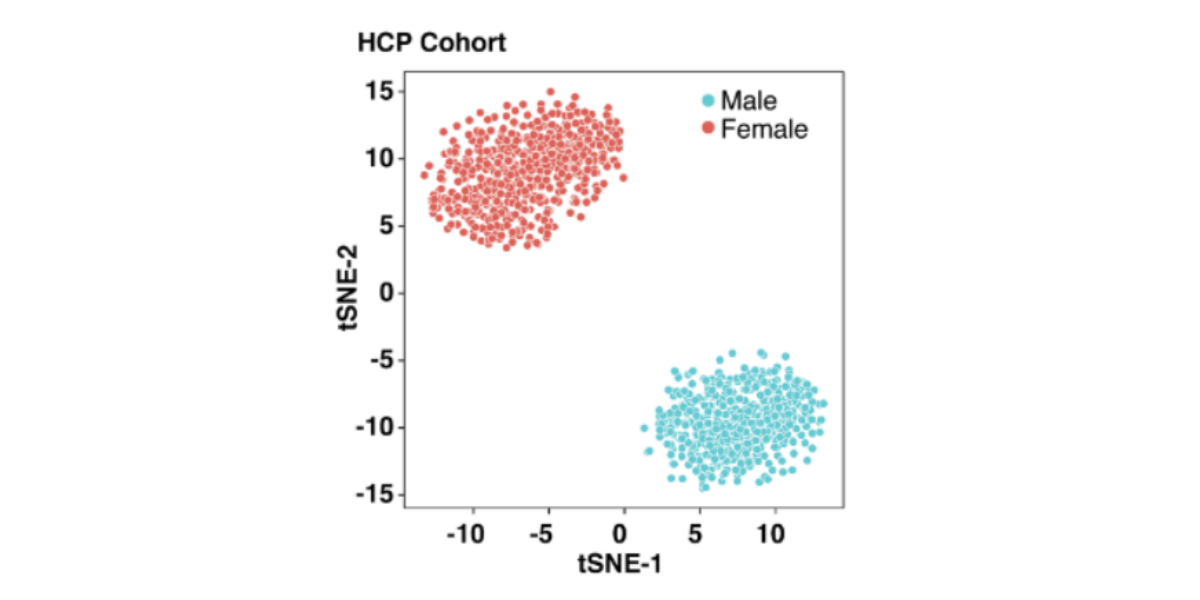
Source: Ryali, S., Zhang, Y., de los Angeles, C., Supekar, K., & Menon, V. (2024). Deep learning models reveal replicable, generalizable, and behaviorally relevant sex differences in human functional brain organization. Proceedings of the National Academy of Sciences of the United States of America, 121(9), e2310012121. https://doi.org/10.1073/pnas.2310012121
It doesn’t take an AI model to look at each data point here and tell which gender is which. Male and female brains are simply designed differently in some ways.
And not surprisingly, these distinct brain characteristics show up in multiple practical ways. The Stanford researchers found “sex-specific cognitive profiles”—patterns of mental strengths and tendencies—that often lead to different ways of thinking and acting. In fact, the patterns were so precise and distinct that when an AI model was trained on the male brain scans and tried to apply that learning to female brain scans (and vice versa) it didn’t even work. Essentially, scientists needed a map of the male brain and a map of the female brain, and weren’t going to get anywhere if they tried to use the map for the opposite sex.
Writing about these important findings for the Institute for Family Studies, Leonard Sax concluded, “There are hardwired female/male differences, and those differences matter. Ignoring reality is never best practice.”
I would add: Ignoring reality is never best practice if we want great relationships with the opposite sex. I’m grateful to see the continued, robust neuroscientific basis for what our surveys have found about how these “hardwired” differences tend to play out in practical ways in everything from how we process conflict to secret male and female insecurities.















 Ad-Free & Subscriber Log-In