2015-03-13T22:54:38-04:00

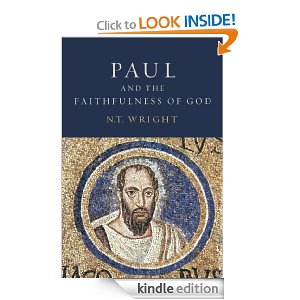
The discussion between p. 500 and the end of the chapter at p. 537 present us with some of the most critical and also controversial elements in Wright’s analysis. We need to bear in mind that Wright is hear talking about worldview, and stories that are part of the worldview, that which lies beneath and undergirds the theologizing. For example, Deut. 27-30, which is so fundamental to Wright’s argument is treated as something of a long range prophecy, not merely... Read more

2015-03-13T22:54:38-04:00

More on track is the discussion of the praxis of the Lord’s Supper, and to a lesser degree Baptism. I agree that these symbolic rites encode a good deal of the Gospel message deliberately, and they reinforce the message. They do indeed help form world view and ethos. The trick is to neither say too much or too little about the ‘sacraments’ and Paul. On the one hand, Paul is prepared to say ‘I thank God I did not baptize... Read more

2015-03-13T22:54:38-04:00

Under the heading of the large plot about God and creation does come the theme which crops up some seven times in Paul’s letter— the Dominion of God, or God retaking back his creation from the powers of darkness. In other words, God is not just interested in saving humans, he’s interested in the renewal of his whole creation (see Rom. 8). Thus Wright stresses that the larger outer story about God and creation is a story about judgment (p.... Read more

2015-03-13T22:54:38-04:00

In Chapter Seven, Tom takes on the pushback against narratival analysis of Paul’s letters. He does so not just because he knows that human beings make sense of what happens to them by telling stories, but because Bultmann was wrong. “The main problem with Bultmann’s [demythologizing] proposal, in addition to the muddling of the different senses of ‘myth’ [which does not necessarily refer to a fictional story], is that when he insisted that we should strip the early Christian world... Read more

2015-03-13T22:54:39-04:00

Wright explores what Schweitzer was perhaps the first to call the mysticism of Paul. He does so in the larger context of early Jewish mysticism which focused on “penetration of the secrets of creation and cosmology on the one hand and gazing on the vision of the God enthroned on his chariot (as in Ezek. 1) on the other” (p. 415). Only now when Paul ‘sees’ God he has the face of Jesus, indeed he sees the glory of God... Read more

2015-03-13T22:54:39-04:00

RSVP To move from fast to feast, From ashes to riding an ass, From wilderness wandering God’s willingness wondering To follow the way of the cross To find what was utterly lost All this was Lent to us. The cup not passed over By our Passover The vinegar he willingly drank— But through gift divine New covenant wine Came forth from his side as he sank All this was given to us Through breaking of bread They knew their head... Read more

2015-03-13T22:54:39-04:00

Lest one think, in light of Wright’s strong conviction that Paul is critiquing the Imperial Cult, that Wright is actually an advocate of Paul being seen as something of a subversive or a political revolutionary in general, the following should lay such concerns to rest. He says “Yet I believe in the last analysis Paul did affirm the goodness, the God-givenness, of human structures of authority, even while at the same time undermining, through central aspects of his theology, the... Read more

2015-03-13T22:54:39-04:00

(Below is the continuation of Dr. Kuruvilla’s case for non-resistance). What about men like David who served in war? The Old Testament is filled with men of faith who engaged in physical combat. David is but one example. Like practices of polygamy or animal sacrifice, physical war pertains to the Old Covenant but not to the New. Jesus often supersedes Old Testament practices in the Sermon on the Mount. A Christocentric, New Covenant perspective demands that Jesus’ followers obey His... Read more

2015-03-13T22:54:40-04:00

The following is an excellent presentation of the case for non-resistance (not to be confused with certain forms of pacifism) from the pen of Dr. Finny Kuruvilla, a Harvard graduate. We will post the rest of this excerpt from his recent book King Jesus Claims his Church(-available on Amazon– reprinted by his kind permission) in a further post tomorrow. Chapter 17 Peacemaking and nonresistance Blessed are the peacemakers, for they shall be called sons of God. (Matthew 5:9) The nations... Read more

2015-03-13T22:54:40-04:00

As it turns out, the real radical Reformation did not take place shortly after Luther (and in reaction to him). No, it happened in the first century when Paul revamped the whole symbol system of early Judaism. When someone reorients and reinterprets things like Temple, Territory, Torah, Prayer, Family, Battle etc. then they are messing with the vital parts of an ancient religion, not merely its thought world, but its praxis. So Wright correctly points out how different prayer looks... Read more

Follow Us!


TAKE THE
Religious Wisdom Quiz

According to Ecclesiastes 12, what happens to the human spirit when a person dies?

Select your answer to see how you score.


Browse Our Archives