

Renaming God as the Unmoved Mover and the Center displays the Divine as stillness in motion—where Greek, Christian, and Taoist wisdom meet.
Renaming God
In the same way, certain divine designations resonate with one group of people, while others make sense to a different set. If we limit the names of God to the traditional terms, we risk losing generations who abandon a sense of ineffable wonder altogether. Stale names for God shrink the horizon of our imagination, making faith seem out of touch. By exploring new names for the Divine, we keep God relevant and honorable, rather than skibidi-rizz. (Did I say that right?)
In the series “Renaming God,” I have discussed many divine titles. Some appear in the Bible, and others arise from culture or imagination. Some you won’t. Here are just a few that we’ve explored:
- Light and Life
- God of My Understanding, Higher Power
- Father, Son, Holy Spirit
- Redeemer, Shepherd, King, Judge, Potter
- Mother, Nurturing Woman
- Way, Tao
- Source, Wellspring, Living Water
- Dove, Hen, Eagle, Bear
- Tree of Life, Root, Vine, Nature
- The Host, The Husband
- El Elyon (God in the Highest), Yahweh Yireh (God who Provides)
- Yahweh Nissi (Lord is My Banner), Yahweh Shalom (Lord is My Peace)
Today, I’ll explore two names for God: The Unmoved (Prime) Mover and The Center. The first comes from Western philosophy and theology. The second derives from Chinese Taoism, with its emphasis on balance and belonging. Together, these two names reveal a God who is not a micromanager in the sky, but the still source of all motion—the cosmic gravity around which life turns.
Aristotle’s “Unmoved Mover”
Aristotle gave us the term The Unmoved Mover, reasoning that every motion have a cause. The stone moving through the air was caused by someone’s hand. The hand was caused by desire. The desire was caused by imagination. You can stretch this chain of causation indefinitely—like a child playing the game of “Why?” until an exasperated parent blurts, “Just because!”
The Greek philosopher’s “Because” was the Unmoved Mover. In Metaphysics, Aristotle said that there must be a first cause that moves all things without itself being moved—a being of pure actuality that needs nothing, never changes, and is complete in itself.
Aristotle said the Prime Mover is pure actuality (energeia), without potentiality, change, or lack. It is perfect, eternal, and immaterial. Imagine it as a kind of spiritual Gravity, drawing all things to their proper place. Think of this as roughly equivalent to Paul Tillich’s term for God, the Ground of All Being.
Aquinas’s “Prime Mover”
In his Summa Theologica, medieval theologian Thomas Aquinas adopted Aristotle’s concept as the first of his “Five Ways” of proving God’s existence. For Aquinas, the Prime Mover is no cosmic clockmaker who creates the universe, sets it, and forgets it. Instead, as the Prime Mover, God is both the Creator and Sustainer that holds all things together by sheer divine presence.
Theological Implications of the “Unmoved (Prime) Mover”
Theologically, this means the Unmoved Mover is transcendent. This divine primal essence dwells beyond the world’s constant change, untouched by its storms, yet the very reason time flows at all.
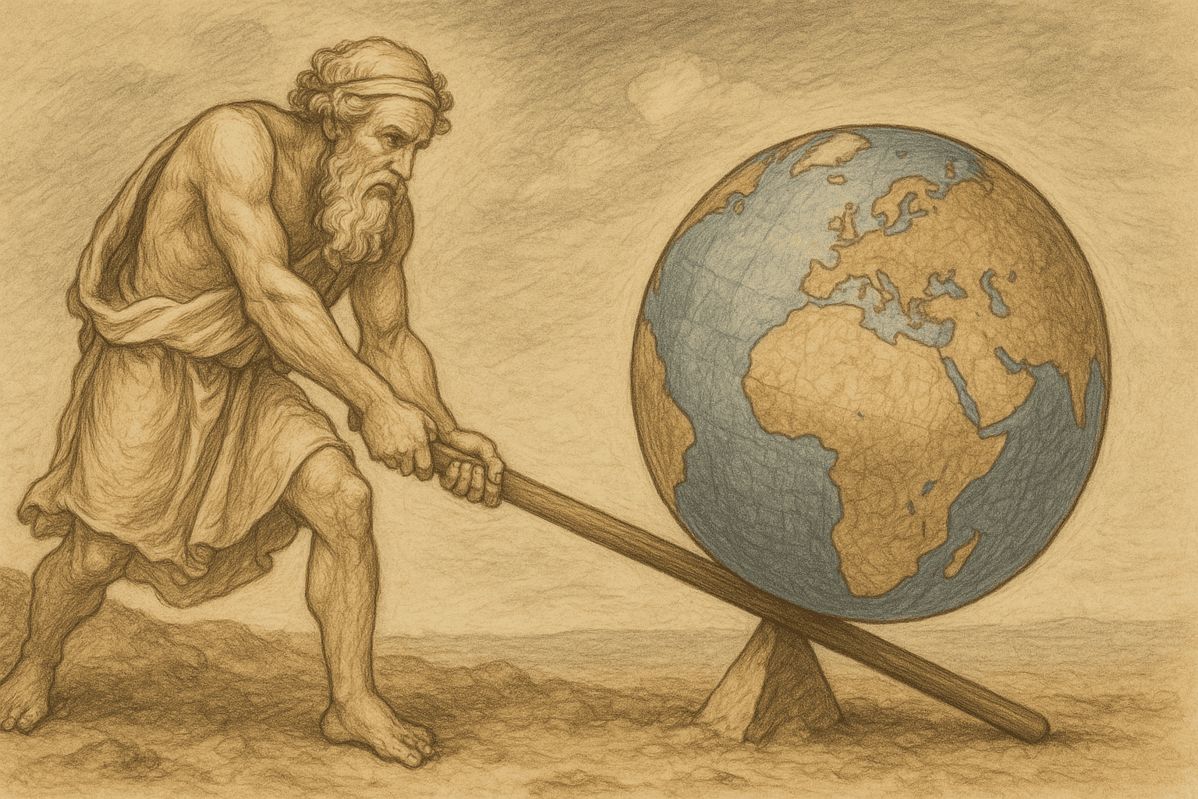
The universe, therefore, is eternally dependent upon this Prime Mover for its eternal motion. Archimedes reportedly said, “If you give me a lever and a place to stand, I can move the world.” You might say that the Prime Mover is the lever that motivates all things.
Finally, the Unmoved Mover remains a divine mystery. It cannot be bribed or persuaded. It is not a personality to placate but a mystery to contemplate—a truth that invites wonder rather than transaction.
The Center: God as the Still Point
If the Unmoved Mover reveals God’s transcendence, the Center reveals God’s immanence—the sacred stillness within all motion. Chinese philosopher Lao Tzu described it beautifully in chapter 11 of the Tao Te Ching:
Thirty spokes are joined together in a wheel,
but it is the center hole
that allows the wheel to function.
The Center is the hollow through which the wheel turns, the musical pauses that make song possible, the pause between breaths that gives rhythm to life. It does not force movement; it allows it. Lao Tzu describes the Tao—the unseen unifying force of the universe—as the center that holds all things together. While the cosmos spins in constant motion, the Center is always empty, always still, and never disturbed.
Multiple Meanings of “Center”
It helps to recognize the multiple meanings of the Center (or Centre, if you’re from outside the United States). Each sheds light on why I suggest this as an alternative name for God.
The center is where life gathers. Think of the city center, the marketplace, the meeting place. The center is the crowded intersection of human stories. God as the Center is the pulse of community—the point where diverse lives converge and find belonging. Calling God the Center reminds us that we can find the Sacred best when we are among community.
Of course, Center is also a verb (as is God, but that’s another article). In mindfulness, to “center” means to return to what is true. God as the Center is the inviting pull that welcomes us home when we are scattered. Centering ourselves means attuning to the voice of alignment and peace that brings us balance. By naming God the Center, we turn to this holy presence to find rest for our souls.
The Axis and Void
God as the Axis of the Universe. My hometown, Ashland, Virginia, takes pride in being “the center of the universe.” Except, nope—we’ll give that one to God. Cosmically, the Center is the fulcrum of order. God as the Center is the harmony beneath chaos, the balance that allows life to exist. If the Unmoved Mover is the divine lever that moves all things, the Center is the place for Archimedes to stand. When we call God the Center, we recognize the pivotal role God plays as the axis of the universe.
Tao as the Sacred Void. In Taoist thought, the empty center is not meaningless vacuity but pregnant presence. It is an openness in which the divine can dwell, unlimited and unconfined. The sacred void is not something dark and fearful. Rather, it is the openness inside that gives the cup its meaning, the hole in the hub around which the wheel spins, and the sacred space within the womb where life grows. When we call God the Center, we recognize the value of emptiness, the holiness of the hurricane’s eye.
Theological Implications
Theologically, renaming God as the Center highlights the divine non-coercive presence. The Center does not manipulate or command. It allows, supports, and invites. This is a God of influence, not domination.
This name for God also emphasizes Inclusivity. The Center is not “out there” but “right here,” available in the breathing space we create within ourselves and our world. As the Center, God exists within all people and all things.
Calling God the Center also spotlights the paradox of God’s dynamic stillness. The Center is not frozen—it is the still point in motion itself, the mystery of a God who is both unchanging and endlessly creative.
In this age of division and noise, it’s easy to lose our center. We get so caught up in the hurricane’s spin that we neglect to center ourselves in the Divine. The Center calls us home. This name reminds us that peace is not found in the wind, fire, and earthquake, but in the still small voice that speaks from within. This is the stillness that does not deny movement but gives it coherence. It is holiness as equilibrium, rest as revelation.
Bringing the Names Together
These two names, The Unmoved Mover and the Center speak with one voice. Both offer nonanthropomorphic titles for God that recognize the holy and transcendent source from which all movement springs. They depict God as the immanent stillness through which all movement flows. Together, they describe a paradox both philosophers and mystics have tried to express for millennia: the motion of the world rooted in a changeless peace.
When the wheel of life spins too fast, these two names remind us that the power that moves the world is never in distress. The still point holds. The Center remains.
Perhaps renaming God is not about correcting the names we have given God in the past but widening our perception of the present. The Unmoved Mover and the Center are not final titles but doorways—ways of stepping through language into mystery. At the heart of all things, beneath every name, the same truth awaits: motion rooted in stillness, change held by love, the universe circling quietly around the One who never turns.












 Ad-Free & Subscriber Log-In