

One of the joys of conducting these interviews is seeing how much each writer embraces his or her skills as a calling to write. It is something that has seeped into their bones and the fiber of their being. Our latest writer incorporates her Catholic identity into her fantasy stories. She has incorporated her very life with Catholic identity by becoming a lay Cath0lic Dominican just like my wife has become a Lay Carmelite. It’s easy to see where she gets her talent and love of writing as her father Deacon Steven D. Greydanus is a very wonderful and profound Catholic writer over at SDG’s Dailies & Sundays | Substack. He even allowed be to share one of his articles on our blog. And now I’m pleased to have his daughter tell us about her thoughts on her work and Catholic writing in general. I think you’ll be delighted as well as you…
Meet Lay Dominican Catholic Writer Sarah Greydanus
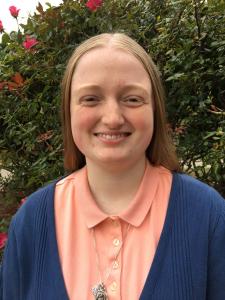
1. Tell something interesting about yourself.
I’m a lay Dominican, for which I’m profoundly grateful. That doesn’t mean I’m a nun or quasi-nun; I and my fellow lay Dominicans are true laity, but we belong to the Order of St. Dominic and live a form of the Dominican Rule that’s suited to our lives in the world. We pray Morning and Evening Prayer; all the members of our fraternity (local group) meet once a month; we commit ourselves to ongoing study of our Catholic Faith; and we each have some form of apostolate (mine, unsurprisingly, is in writing and editing for Catholic media). I’m less than a year from perpetual profession, God willing.

2. What makes a good Catholic writer?
First of all, to be a good Catholic anything means living our call to love God and our neighbor with all our hearts. Being united with Him is the center from which all the fruitfulness in our lives will come. Second, because He made us writers, we cultivate our writing as an extension of that first point. By being the best writers we can be, we give glory to Him and service to our readers.
3. What do you like about being a Catholic/Christian writer?
In writing I find the joy of doing what I was made to do; something very deep at the core of me comes to life and is fulfilled. And in my Catholic faith God assures me that the beauty and goodness my heart longs for constantly, and senses in the artistic world, is true in the world we live in. I’m trying to express something much greater than I know how to say in words. You might say we’re living in the greatest, most beautiful story there is, and all the stories and poetry we produce are each a unique way of paying homage to that great and wonderful reality.
4. What is the main focus of your particular writing or what do you like to write about?
I write poetry occasionally.
We’re told this life is like a storied mountain.
We’ve seen mountains steeped in mist.
In mist things emerge and fade,
shift and metamorphose.
Each scene of our climb is yielded
only for a minute.
And even we ourselves are not what we were,
nor what we will be.
It’s easy to grieve what’s left behind,
easy to fear what comes ahead,
lonely in this pocket in the mist.
Still one thing stays fixed —
a light-speck burning at the peak,
burning beyond the mist,
burning at the trail’s end.
It tells us the trail has an end.
There, from the summit,
we look for a different view.
There, in the light,
the climber can see the trail below
as he never saw it then.
There all the scattered things are brought together.
The mists obscure the burning speck,
yet can’t quench it,
can’t bar us from desiring it.
Hope is the end of the trail,
the summit where air is clear.
Hope is the light burning above the mist.
See you there.
I’ve contributed articles to various Catholic websites including articles at Homiletic & Pastoral Review.
This inner attitude of charity will show itself in exterior interactions. If we can see each other as God sees, made in His image, manifestations of His goodness, our interactions will be marked with courtesy and charity. We will be more disposed to listen to one another, to truly communicate and seek to understand. Again, this way of living can’t be learned in a day nor achieved by unaided human nature; the Holy Spirit brings it about in us, if we seek His help.
Imagine: What would happen if Catholics everywhere started living this way? If each of us put first our Faith, and our bond therein, and united as brothers and sisters? If, when disagreements arose, we handled them accordingly, looking to our one Church for guidance and truly seeking resolution? Might not the children of the Church become a powerful force for change in the culture, instead of being more voices in the clamor of the world?
You and I may not be in a position to change the world. But each of us can change our own hearts.
Can We Be Recognized As Christians? – Homiletic & Pastoral Review
But my first love is fantasy.
I’ve published three books via KDP, and am working toward traditional publishing for my fourth completed manuscript. In order of publication:
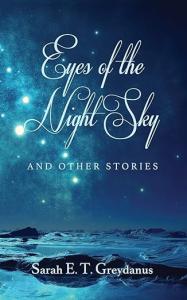
Eyes of the Night Sky and Other Stories: A family seeking help for an ailing son makes its way to the lost world where a mysterious healer dwells … a young girl descends from her home high in an arbor to the perilous twilit world beneath the forest roof … a ruined castle attracts monsters, but still holds the splendors and powerful secrets of its builders … No adventure or world is like another in this collection of ten stories, a celebration of glory and wonder, in all their forms, whether taking shape in an alternative world or breaking into our own.
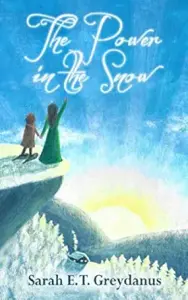
The Power in the Snow: On a remote mountain, a young girl discovers a hidden world where legends live on. Befriended by a Snow Elf, she becomes part of the mountain’s unique life—but her adventures bring her face to face with long-hidden fears and an important decision about her future.
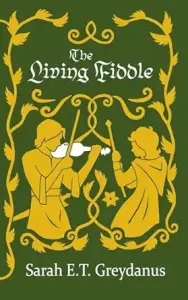
The Living Fiddle: Christina’s happy childhood world is swept away when a pair of witches attack her family and take her captive. When unexpected help comes from a young man named Roland with a magic fiddle, Christina bends her own mysterious gifts toward a bid for freedom—but the witches won’t let her go easily! Inspired by the Grimms’ fairy tale “Sweetheart Roland,” The Living Fiddle blends magic, memory, and love in a tale of a young heroine discovering her power, facing her fears, and finding her place in the world.
The coming book is The Cursebreaking of Lord Montaryn’s Daughters, centering on three aristocratic sisters who have grown up in the shadow of their eldest sister’s scandalous disappearance. At the betrothal of the next eldest, signs of trouble quickly spiral, forcing the sisters to confront a secret society of dark sorcerers, an even greater threat that lurks behind it—and their own wounds and differences.
5. How does your Catholic Faith influence your writing?
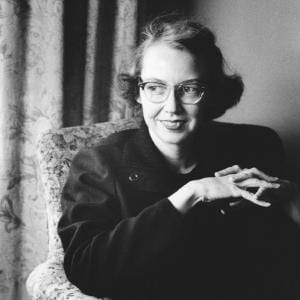
When I was very young, my dad gave me a piece of life-changing advice: “If you’re Catholic, your imagination will be Catholic.” Much later I found a similar remark in the letters of Flannery O’Connor: “Wouldn’t it be better for you to discover a meaning in what you write than to impose one? Nothing you write will lack meaning because the meaning is in you.” I don’t have to try to make my stories Catholic; they have the stamp of Catholic thought in them because that’s the kind of thought that produced them. That’s not to say that I don’t always have to learn to be a better Catholic and a better writer! Of course, I can and should always improve in both areas. It is to say that the influence you’re asking about happens naturally, because our Faith molds our hearts, our spirits (at least it’s meant to do that), and art comes out of the human spirit.
6. What’s your favorite article/post/book/story you have written?
I like to think I get better with each new project. It’s hard to be objective because I’m so much in love with each one as I do it.
7. What is your favorite topic/subject to write about?
In fiction, anything that shows the world in its beauty and wonder and magic.
In nonfiction, probably the lives of the saints.
8. Favorite scripture verse.
I have many, but my go-to is John 15:9-11: “As the Father has loved me, so have I loved you; abide in my love … These things I have spoken to you, that my joy may be in you, and that your joy may be full.”
9. What are you currently working on?
I just started a middle-grade fantasy novel about a boy who grows up underground and discovers the outside world at about twelve years old. The working title is The Boy Who Found the Dangerous Place.
10. Name a favorite saint or Catholic or some other figure who inspires you in your life.
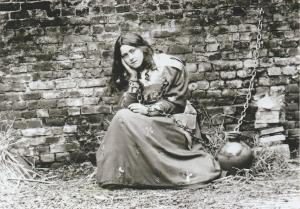
It may be common to say St. Thérèse of Lisieux, but some things are popular for a reason! She’s so well known, and sometimes sentimentalized, to the point that I think the power of her story may be forgotten. In a time and place when the truth of our Faith was being obscured on the one hand by modern skepticism and on the other by rigorist, Jansenist theology, she rediscovered the authentic teaching of the Gospel practically on her own. Her “Little Way” is simply a revival of the fundamental Christian reality that Our Lord loves us infinitely and unconditionally; that all He wants from us is our confident, childlike love; that everything we do can become part of our journey home if it’s done in that free spirit of love. Also, not only is her autobiography a spiritual masterpiece, but her letters are treasures, as are her poetry and plays, making her a most fitting patron for a writer.
11. Who is your favorite living writer?
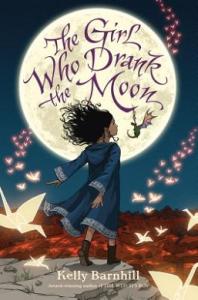
Probably Kelly Barnhill. Admittedly I’ve only read her children’s books, but those novels are the kind I aspire to write: gorgeously crafted fantasy worlds framing plots and characters of depth and substance, presented in a way that’s accessible to kids as well as engaging for the open-minded adult.
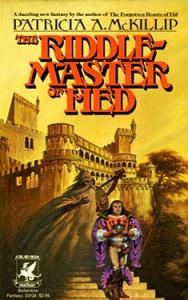
If we can expand the category to “modern writer,” I would also like to mention Patricia McKillip, who died just a few years ago. Her many books show an extraordinary grasp of how to translate the spirit of fairytale and myth into contemporary storytelling.
12. If you could have lunch with any deceased writer who would it be, what would you eat and what would you talk about?
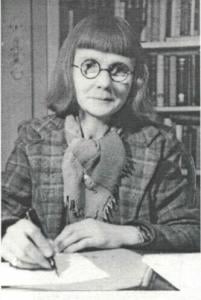
Tough choice, but right now Caryll Houselander. I imagine it would be a very profound conversation in which food would be forgotten and the topic would range all over. If you’ve read any of her works, you probably know what I mean. If not, I highly recommend you go find one.
“Most people know the sheer wonder that goes with falling in love, how not only does everything in heaven and earth become new, but the lover himself becomes new. It is literally like the sap rising in the tree, putting forth new green shoots of life.”
― The Reed of God
13. Name a favorite movie/TV show or music you find worth sharing with others.
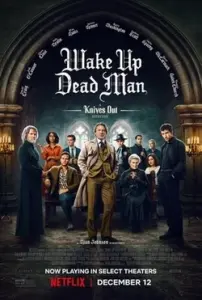
At least some readers will certainly be familiar with my dad’s writings on film. I’ve grown up watching, discussing, and learning to appreciate a variety of movies, and could talk much more on this subject; but I’ll confine myself to highlighting the third Knives Out movie, Wake Up Dead Man, which came out last year. Besides being a thrilling murder mystery, it’s a penetrating exploration of how our faith can go wrong when it’s distorted and what it can be when it’s lived authentically. The whole Knives Out trilogy is very much worth seeing—and having seen the first two is helpful for going into the third with a better knowledge of the detective, Benoit Blanc—but the third film can be watched on its own.
14. Can you see one of your books being made into a movie or TV series? Who would you want to star or direct?
For reasons indicated in the above question, I think often about how my books would play out as movies. Perhaps because they’re fantasy, I sometimes imagine them in animation, and like to picture how magic would be manifested in animated effects. I’d especially love to see them in the animation of either Studio Ghibli or Cartoon Saloon, whose styles are very different but both gorgeous.
15. Favorite historical event.
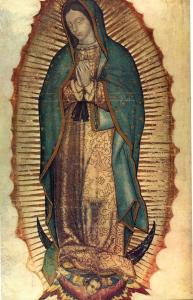
Assuming Biblical events are off the table? I think Tuesday, December 12, 1531, the manifestation of Our Lady of Guadalupe. The whole trajectory of Mexico was transformed that day: fear, ignorance, hatred, bigotry, cruelty, and despair gave way to hope, healing, faith, joy, charity, and a new unified nation. To know that such a thing happened gives me hope.
The Woman Behind the Words – Shrine of Our Lady of Guadalupe
This interview was published on June 8, 2026
The day these events took place.
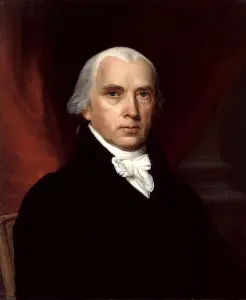
1789 – James Madison introduces twelve proposed amendments to the United States Constitution in Congress.
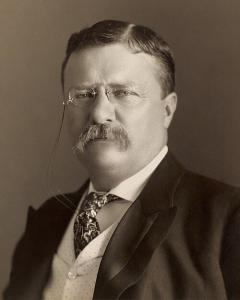
1906 – Theodore Roosevelt signs the Antiquities Act into law, authorizing the President to restrict the use of certain parcels of public land with historical or conservation value.
1953 – The United States Supreme Court rules in District of Columbia v. John R. Thompson Co. that restaurants in Washington, D.C., cannot refuse to serve black patrons.
1962 – Skeeter Davis recorded ‘The End of the World’ at RCA Victor Studios in Nashville. The song was released in December the same year and it became a chart-topper in 1963.
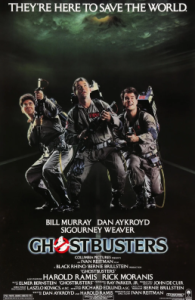
1984 – Ghostbusters opens in theaters.
16. What else do you want people to know about anything?
I do freelance editing for my main job and have worked on books in all different genres for Seton Educational Media, Pauline Media, and New City Press as well as a variety of private clients. It’s a natural fit, since even when I’m not working I read quickly and notice details at the same time! If you’re interested in having a project edited, or want to know more, you can reach me at [email protected].
Learn More @ Gilded Weavings
I quote Sarah’s dad a lot in this particular article that I think worth sharing.
Want to Be Interviewed Also?
The Catholic Bard Wants To Interview You! |
Interview Questions For My Catholic Blog
Meet The Catholic Writers |
A Link List To The Catholic Bard’s Meet The Writer Series








 Ad-Free & Subscriber Log-In