

Recently, news broke that popular YouTuber Jesse Ridgeway and his wife chose to terminate a pregnancy at thirty-one weeks after genetic testing revealed that their unborn child had Down syndrome. For context, at thirty-one weeks, an unborn child looks remarkably like a newborn, with defined facial features, plump skin, and coordinated movements. At this stage of development, the child typically weighs around three pounds and measures about sixteen inches long. Until the diagnosis, the Ridgeways celebrated each milestone of the pregnancy and shared their joy with followers, which makes the story all the more heartbreaking.
Adding to the tragedy is a profound cultural paradox. Society generally celebrates people with Down syndrome. They compete in the Special Olympics, inspire millions through public achievements, and enrich their communities. Comedian Shane Gillis often speaks affectionately about family members with Down syndrome, while Madeline Stuart became the world’s first professional model with Down syndrome. Schools welcome students with Down syndrome, employers increasingly recognize their contributions, and communities honor their unique gifts.
Yet beneath this story of inclusion lies another story—one rarely discussed. Across much of the developed world, people with Down syndrome are quietly disappearing.
Sadly, the Ridgeways’ decision does not represent an exception. It reflects an increasingly common response to a prenatal Down syndrome diagnosis. While society celebrates people with Down syndrome after birth, many parents receive strong cultural signals that discourage bringing them into the world in the first place.
The Numbers…
According to Healthline, citing statistics from the National Down Syndrome Society, approximately 6,000 babies with Down syndrome are born each year in the United States. The numbers in some European countries, however, tell a much different story.
In Iceland, nearly 100 percent of women who receive a prenatal Down syndrome diagnosis choose to abort their unborn children. Denmark follows closely behind at 98 percent. France reports a rate of 77 percent, while the United States comes in at 67 percent.
The cumulative effect has proven staggering. Researchers estimate that prenatal screening and selective abortion have reduced the number of children born with Down syndrome in Europe by more than half. In other words, Europe has effectively eliminated a majority of the Down syndrome population that otherwise would have been born.
This reality has alarmed advocates such as Sara Hart Weir, former president of the National Down Syndrome Society, who has warned about the cultural implications of these trends.
The contradiction remains difficult to ignore: we celebrate inclusion after birth while increasingly preventing birth altogether.
The Return of Eugenics—With a Smile
Discussions about prenatal testing and genetic abnormalities naturally invite comparisons to eugenics. In the past, “old eugenics” relied on coercion, government intervention, and openly stated goals of improving the gene pool. Today’s “new eugenics” operates differently. It emphasizes individual choice, presents itself as compassionate, and often arises from concern rather than malice.
Yet an important question remains. Regardless of motives, if the result is the systematic elimination of a population with a specific genetic trait, how different is the outcome?
The methods have changed. The rhetoric has changed. The results, however, appear remarkably similar.
If Their Lives Are Worth Celebrating, Why Prevent Them?
Society presents a contradiction when it comes to people with Down syndrome. We hear that they belong, that they matter, and that they enrich our communities. At the same time, society increasingly signals that it is better not to bring them into existence in the first place.
Consider Jesse Ridgeway’s own words following the termination of his child:
Down Syndrome isn’t a ‘blessing,’ it is objectively s–tty from a health perspective. I didn’t realize just how rough it is for the child, let alone the family … more often than not, they would be fully dependent on others for the rest of their life.
What message does that send to people living with Down syndrome today?
Imagine a young adult with Down syndrome hearing this message: “We are glad you are here, but given the choice, most people would have chosen otherwise.”
That is the contradiction at the heart of this issue. We celebrate people with Down syndrome after birth while increasingly choosing to prevent their birth altogether.
Down Syndrome Is Only the Beginning
If you think genetic screening begins and ends with Down syndrome, think again. As science advances, prenatal testing grows increasingly sophisticated. Today, parents screen for Down syndrome. Tomorrow, they may screen for other chromosomal conditions. What follows after that? Markers associated with autism? Deafness? Dwarfism? Other disabilities?
If human dignity depends on possessing certain abilities or traits, where does the screening stop?
Down syndrome is not merely a disability issue. It serves as a test case for how society defines human worth. So far, society has not answered that test well.
A Catholic Response: Healing Versus Eliminating
Within the Catholic framework, medicine seeks to heal the patient, not eliminate the patient. Prenatal screening can serve legitimate medical purposes, helping parents and physicians prepare for complications and provide appropriate care. Yet when screening becomes a tool for identifying children who may later be aborted, it transforms from an instrument of healing into an instrument of selection.
In such cases, society faces a temptation to treat human lives as disposable when they appear burdensome, inconvenient, dependent, or lacking certain qualities. This temptation reflects what St. Pope John Paul II called the “culture of death.” In Evangelium Vitae, he observed:
This culture is actively fostered by powerful cultural, economic and political currents which encourage an idea of society excessively concerned with efficiency. Looking at the situation from this point of view, it is possible to speak in a certain sense of a war of the powerful against the weak: a life which would require greater acceptance, love and care is considered useless, or held to be an intolerable burden, and is therefore rejected in one way or another.
The disappearance of people with Down syndrome through prenatal screening and selective abortion raises precisely that concern. If society increasingly chooses which lives deserve to exist based on genetic characteristics, then the question is no longer merely medical. It becomes a question of whether human dignity belongs to every human being or only to those who meet certain standards.
A civilization reveals its character by how it treats those who contribute the least to its productivity and demand the most of its love.
Final Thought… The Quiet Extinction
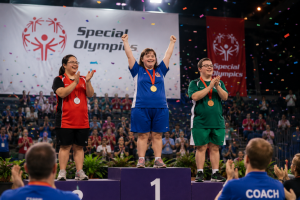
Imagine a Special Olympics medal ceremony. Picture the children and adults with Down syndrome smiling as they receive their medals, cheered on by their families, friends, and communities.
Now ask a simple question: If these lives are worth celebrating, why are so many prevented from existing in the first place?
The quiet disappearance of people with Down syndrome means more than fewer athletes competing for medals. It means fewer classmates in our schools, fewer coworkers in our workplaces, fewer parishioners in our churches, and fewer neighbors in our communities. A society that once struggled to include people with Down syndrome now increasingly chooses not to welcome them at all.
This issue concerns far more than participation in sports or representation in public life. It concerns human lives. It concerns whether a person’s value depends upon meeting the expectations of others or whether human dignity belongs equally to every member of the human family.
Remember the Ridgeways’ child. Whatever challenges he or she may have faced, that child possessed an inherent dignity that no diagnosis could diminish. The same holds true for every child diagnosed with Down syndrome.
We often hear that science is helping us defeat Down syndrome. Yet Down syndrome itself remains. What is disappearing are the people who have it. The question future generations will have to answer is whether that represents progress—or a tragedy hidden behind the language of compassion.
Thank you!
Read The Latin Right’s other writing here.
Please visit my Facebook page and IM your questions (and follow my page) or topics for articles you would like covered.














 Ad-Free & Subscriber Log-In