

On October 18, 1851, Herman Melville‘s masterpiece of the Great American Novel Moby-Dick is first published as The Whale by Richard Bentley of London. Not too long ago Kristin and I were in Pittsfield Massachusetts and had we more time and money we could have visited the place where the bulk of the book had been written.
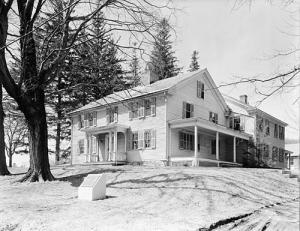
In a letter Melville wrote to American lawyer and politician Richard Henry Dana Jr. on May 1, 1850, he described his journey in writing The Whale (the original name of the book).
About the “whaling voyage”—I am half way in the work, & am very glad that your suggestion so jumps with mine. It will be a strange sort of book, tho’, I fear; blubber is blubber you know; tho’ you may get oil out of it, the poetry runs as hard as sap from a frozen maple tree; — & to cook the thing up, one must needs throw in a little fancy, which from the nature of the thing, must be ungainly as the gambols of the whales themselves. Yet I mean to give the truth of the thing, spite of this.
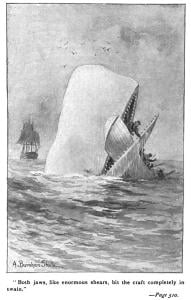
It is considered one of the greatest American novels ever written.
“What makes Moby-Dick the Greatest American Novel, in other words, is that Melville can invoke the preposterous image of a sobbing, heart-stricken moose and we think, yes, I have come to know exactly what that sounds like, and I know what world of meaning is contained within that terrific sound”.- Hester Blum of Penn State University,
So, in honor of its 174th anniversary here is a section from the book in which Father Mapple gives a rousing sermon to the whalers about to set sail.
So you can set in your mind what he may have looked like picture one of these men.
- John Ince plays the part in the 1930 film, in which Father Mapple also has a daughter (played by Joan Bennett) with whom Ahab (John Barrymore) falls in love.
- Father Mapple was played by Orson Welles in the 1956 film.
- Gregory Peck, who played Ahab in the 1956 film, won a Golden Globe as Father Mapple in the 1998 television series.[17][18]
- In the 2011 television series Donald Sutherland plays Father Mapple.
Introducing the main character of Moby Dick
Call me Ishmael. Some years ago—never mind how long precisely—having little or no money in my purse, and nothing particular to interest me on shore, I thought I would sail about a little and see the watery part of the world. It is a way I have of driving off the spleen, and regulating the circulation. Whenever I find myself growing grim about the mouth; whenever it is a damp, drizzly November in my soul; whenever I find myself involuntarily pausing before coffin warehouses, and bringing up the rear of every funeral I meet; and especially whenever my hypos get such an upper hand of me, that it requires a strong moral principle to prevent me from deliberately stepping into the street, and methodically knocking people’s hats off—then, I account it high time to get to sea as soon as I can. This is my substitute for pistol and ball. With a philosophical flourish Cato throws himself upon his sword; I quietly take to the ship. There is nothing surprising in this. If they but knew it, almost all men in their degree, some time or other, cherish very nearly the same feelings towards the ocean with me.
Ishmael in New Bedford
I stuffed a shirt or two into my old carpet-bag, tucked it under my arm, and started for Cape Horn and the Pacific. Quitting the good city of old Manhatto, I duly arrived in New Bedford. It was on a Saturday night in December. Much was I disappointed upon learning that the little packet for Nantucket had already sailed, and that no way of reaching that place would offer, till the following Monday.
Now having a night, a day, and still another night following before me in New Bedford, ere I could embark for my destined port, it became a matter of concernment where I was to eat and sleep meanwhile. It was a very dubious-looking, nay, a very dark and dismal night, bitingly cold and cheerless. I knew no one in the place. With anxious grapnels I had sounded my pocket, and only brought up a few pieces of silver,—So, wherever you go, Ishmael, said I to myself, as I stood in the middle of a dreary street shouldering my bag, and comparing the gloom towards the north with the darkness towards the south—wherever in your wisdom you may conclude to lodge for the night, my dear Ishmael, be sure to inquire the price, and don’t be too particular.
New Bedford is a queer place.
In New Bedford, fathers, they say, give whales for dowers to their daughters, and portion off their nieces with a few porpoises a-piece. You must go to New Bedford to see a brilliant wedding; for, they say, they have reservoirs of oil in every house, and every night recklessly burn their lengths in spermaceti candles.
In summer time, the town is sweet to see; full of fine maples—long avenues of green and gold. And in August, high in air, the beautiful and bountiful horse-chestnuts, candelabra-wise, proffer the passer-by their tapering upright cones of congregated blossoms. So omnipotent is art; which in many a district of New Bedford has superinduced bright terraces of flowers upon the barren refuse rocks thrown aside at creation’s final day.
And the women of New Bedford, they bloom like their own red roses. But roses only bloom in summer; whereas the fine carnation of their cheeks is perennial as sunlight in the seventh heavens. Elsewhere match that bloom of theirs, ye cannot, save in Salem, where they tell me the young girls breathe such musk, their sailor sweethearts smell them miles off shore, as though they were drawing nigh the odorous Moluccas instead of the Puritanic sands.
The Whaleman’s Chapel
In this same New Bedford there stands a Whaleman’s Chapel, and few are the moody fishermen, shortly bound for the Indian Ocean or Pacific, who fail to make a Sunday visit to the spot. I am sure that I did not.
I had not been seated very long ere a man of a certain venerable robustness entered; immediately as the storm-pelted door flew back upon admitting him, a quick regardful eyeing of him by all the congregation, sufficiently attested that this fine old man was the chaplain. Yes, it was the famous Father Mapple, so called by the whalemen, among whom he was a very great favorite.
Father Mapple
He had been a sailor and a harpooneer in his youth, but for many years past had dedicated his life to the ministry. At the time I now write of, Father Mapple was in the hardy winter of a healthy old age; that sort of old age which seems merging into a second flowering youth, for among all the fissures of his wrinkles, there shone certain mild gleams of a newly developing bloom—the spring verdure peeping forth even beneath February’s snow. No one having previously heard his history, could for the first time behold Father Mapple without the utmost interest, because there were certain engrafted clerical peculiarities about him, imputable to that adventurous maritime life he had led. When he entered I observed that he carried no umbrella, and certainly had not come in his carriage, for his tarpaulin hat ran down with melting sleet, and his great pilot cloth jacket seemed almost to drag him to the floor with the weight of the water it had absorbed. However, hat and coat and overshoes were one by one removed, and hung up in a little space in an adjacent corner; when, arrayed in a decent suit, he quietly approached the pulpit.
The Pulpit
Like most old fashioned pulpits, it was a very lofty one, and since a regular stairs to such a height would, by its long angle with the floor, seriously contract the already small area of the chapel, the architect, it seemed, had acted upon the hint of Father Mapple, and finished the pulpit without a stairs, substituting a perpendicular side ladder, like those used in mounting a ship from a boat at sea. The wife of a whaling captain had provided the chapel with a handsome pair of red worsted man-ropes for this ladder, which, being itself nicely headed, and stained with a mahogany color, the whole contrivance, considering what manner of chapel it was, seemed by no means in bad taste. Halting for an instant at the foot of the ladder, and with both hands grasping the ornamental knobs of the man-ropes, Father Mapple cast a look upwards, and then with a truly sailor-like but still reverential dexterity, hand over hand, mounted the steps as if ascending the main-top of his vessel.
The Sermon
Father Mapple rose, and in a mild voice of unassuming authority ordered the scattered people to condense. “Starboard gangway, there! side away to larboard—larboard gangway to starboard! Midships! midships!”
There was a low rumbling of heavy sea-boots among the benches, and a still slighter shuffling of women’s shoes, and all was quiet again, and every eye on the preacher.
A brief pause ensued; the preacher slowly turned over the leaves of the Bible, and at last, folding his hand down upon the proper page, said:
“Shipmates, God has laid but one hand upon you; both his hands press upon me. I have read ye by what murky light may be mine the lesson that Jonah teaches to all sinners; and therefore to ye, and still more to me, for I am a greater sinner than ye. And now how gladly would I come down from this mast-head and sit on the hatches there where you sit, and listen as you listen, while some one of you reads me that other and more awful lesson which Jonah teaches to me as a pilot of the living God. How being an anointed pilot-prophet, or speaker of true things, and bidden by the Lord to sound those unwelcome truths in the ears of a wicked Nineveh, Jonah, appalled at the hostility he should raise, fled from his mission, and sought to escape his duty and his God by taking ship at Joppa. But God is everywhere; Tarshish he never reached.
As we have seen, God came upon him in the whale, and swallowed him down to living gulfs of doom, and with swift slantings tore him along ‘into the midst of the seas,’ where the eddying depths sucked him ten thousand fathoms down, and ‘the weeds were wrapped about his head,’ and all the watery world of woe bowled over him. Yet even then beyond the reach of any plummet—‘out of the belly of hell’—when the whale grounded upon the ocean’s utmost bones, even then, God heard the engulphed, repenting prophet when he cried. Then God spake unto the fish; and from the shuddering cold and blackness of the sea, the whale came breeching up towards the warm and pleasant sun, and all the delights of air and earth; and ‘vomited out Jonah upon the dry land;’ when the word of the Lord came a second time; and Jonah, bruised and beaten—his ears, like two sea-shells, still multitudinously murmuring of the ocean—Jonah did the Almighty’s bidding. And what was that, shipmates? To preach the Truth to the face of Falsehood!
That was it!
“This, shipmates, this is that other lesson; and woe to that pilot of the living God who slights it. Woe to him whom this world charms from Gospel duty! Woe to him who seeks to pour oil upon the waters when God has brewed them into a gale! Woe to him who seeks to please rather than to appal! Woe to him whose good name is more to him than goodness! Woe to him who, in this world, courts not dishonor! Woe to him who would not be true, even though to be false were salvation! Yea, woe to him who, as the great Pilot Paul has it, while preaching to others is himself a castaway!”
He drooped and fell away from himself for a moment; then lifting his face to them again, showed a deep joy in his eyes, as he cried out with a heavenly enthusiasm,
—“But oh! shipmates! on the starboard hand of every woe, there is a sure delight; and higher the top of that delight, than the bottom of the woe is deep. Is not the main-truck higher than the kelson is low? Delight is to him—a far, far upward, and inward delight—who against the proud gods and commodores of this earth, ever stands forth his own inexorable self. Delight is to him whose strong arms yet support him, when the ship of this base treacherous world has gone down beneath him. Delight is to him, who gives no quarter in the truth, and kills, burns, and destroys all sin though he pluck it out from under the robes of Senators and Judges.
Delight,—top-gallant delight is to him, who acknowledges no law or lord, but the Lord his God, and is only a patriot to heaven. Delight is to him, whom all the waves of the billows of the seas of the boisterous mob can never shake from this sure Keel of the Ages. And eternal delight and deliciousness will be his, who coming to lay him down, can say with his final breath—O Father!—chiefly known to me by Thy rod—mortal or immortal, here I die. I have striven to be Thine, more than to be this world’s, or mine own. Yet this is nothing; I leave eternity to Thee; for what is man that he should live out the lifetime of his God?”
Father Mapple’s Departure
He said no more, but slowly waving a benediction, covered his face with his hands, and so remained kneeling, till all the people had departed, and he was left alone in the place.















 Ad-Free & Subscriber Log-In