

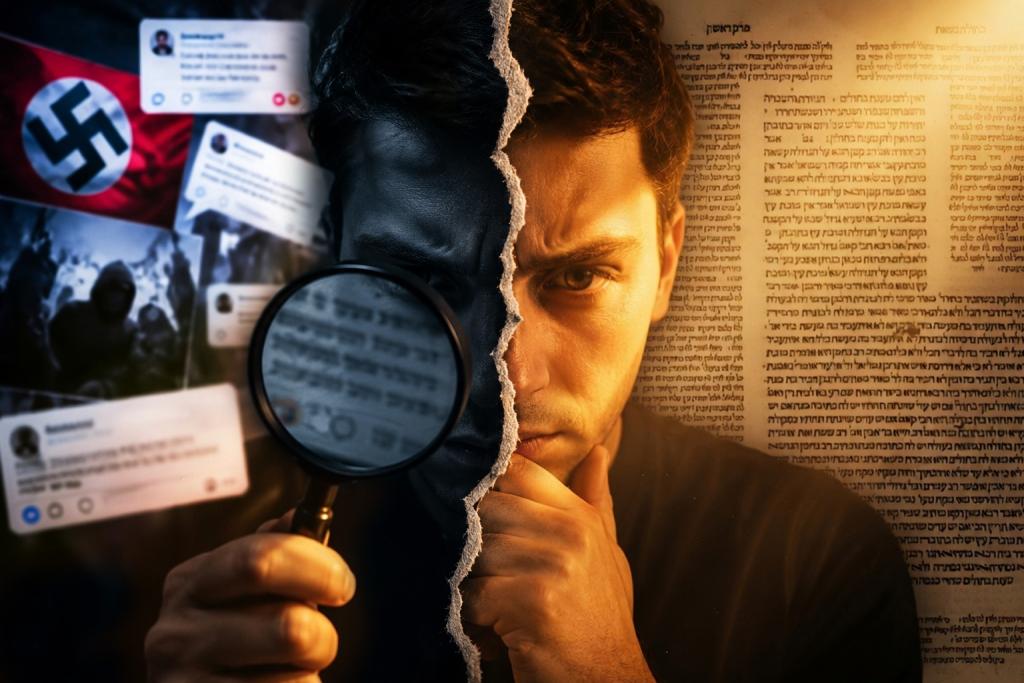
For centuries, antisemites have relied upon a remarkably consistent strategy: isolate an unfamiliar Jewish text, rip a sentence from its legal and linguistic context, mistranslate it into emotionally inflammatory modern language, and then circulate the distortion among audiences unlikely ever to verify the original source.
In the digital age, this process has accelerated exponentially. Misconstrued and mistranslated fragments of the Talmud now circulate endlessly across extremist forums, TikTok clips, neo-Nazi message boards, and conspiratorial social media ecosystems where ancient rabbinic legal terminology is presented as though it were a transparent modern English statement requiring no expertise, no context, and no historical literacy to understand.
One of the most abused and ridiculous examples is the infamously misconstrued passage in the Talmud concerning a girl under the age of three and her status as a virgin for purposes of ketūbah law. Online propagandists routinely present the text as proof that Judaism supposedly “permits” or “endorses” child abuse. The claim is not merely false; it requires completely ignoring the tractate’s subject matter, the technical meaning of the legal terminology being used, and the entire surrounding discussion. More importantly, it requires reversing the actual function of the ruling itself.
Because the passage is not about excusing abuse. It is about preventing a woman from being punished later in life because she had been abused as a very small child.
The tractate itself makes this clear. The Bavlī Talmūd here is fundamentally concerned with marriage contracts, dowries, widow protections, financial obligations, and the preservation of women’s legal standing within the framework of ancient Jewish family law.
In this tractate Ketūbōt, the rabbis are debating whether a grown woman who suffered violation before physical maturity should later be treated as “damaged,” worth less financially, or deprived of the full protections and status accorded to a virgin bride. Their answer is that the abuse inflicted upon her as a child does not diminish her legal dignity, does not reduce her marriage ketūbah document and contract of rights, and does not permit a future husband to regard her as tarnished.
This is why the key phrase in the sūgyā has been so catastrophically mistranslated online. When the Talmūd says that intercourse below a certain age is “nothing,” it is not saying that “nothing happened.” It is saying that the abuse does not alter her legal status as a virgin for purposes of marriage law. The “nothing” refers to legal effect upon her future standing, not to the absence of violence, trauma, or wrongdoing. The distinction is obvious to anyone familiar with legal discourse, where technical terminology routinely carries meanings radically different from ordinary conversational speech.
But antisemitic propaganda depends precisely upon readers not understanding that distinction.
And so an ancient legal mechanism intended—however imperfectly by modern standards—to protect the future dignity of a victimized girl becomes inverted into its exact opposite by those determined to weaponize Jewish texts against Jews themselves.
“Billions of Antisemites Can’t Be Wrong…” Can They?
A major reason antisemitism persists so infectiously across societies is that Judaism occupies a uniquely uncomfortable position within the theological architecture of both Christianity and Islam. Both religions emerge historically, textually, linguistically, and conceptually out of Jewish sectarian worlds. Neither appears in a vacuum. Christianity begins as a Jewish messianic movement within Second Temple Judaism. Islam emerges in a Late Antique environment saturated with Jewish and Jewish-adjacent traditions, narratives, law, prophetology, apocalypticism, and monotheistic discourse.
In both cases, the newer universalizing religious movement must simultaneously affirm Jewish revelation while also transcending, superseding, or repositioning the Jewish people themselves. That creates a permanent theological tension.
The problem is structural. Both religions require the authority of the Jewish Hebrew Bible and Israelite revelation while also needing to explain why the majority of Jews did not accept the later universal claims made by Christianity or Islam. This creates what scholars often call a “supersessionist” or “replacement theology” dynamic.
The original covenant cannot simply be discarded, because the newer religions depend upon it for legitimacy. Yet if the covenant remains eternally valid exactly as Jews understand it, then the necessity of the newer revelation becomes destabilized.
This is why Jewish persistence itself becomes psychologically and theologically disruptive to later religious institutions. While the Qur’an and early Hadith literature often affirm the textual reliability and authority of the contemporary Jewish scriptures (Qur’an 5:43–47; 10:94), later Caliphal-era tafsīr traditions increasingly developed the doctrine that the Torah had been corrupted sometime between the Gospel era and the advent of Muhammad. Yet the discovery of the Dead Sea Scrolls discovery fundamentally undermined that claim. The Biblical manuscripts from Qumran differ from the later Masoretic textual tradition in comparatively minor ways—far less dramatically than the variations found among the earliest Qur’anic codices when compared to the modern Cairo Standard Edition, itself only formally standardized in the twentieth century.
Muhammad even appears in one particularly uncomfortable and often-overlooked Ḥadīth physically honoring a Torah scroll itself. In the report preserved in Sunan Abī Dāwūd, when a case involving Jewish law was brought before him, a Torah scroll was produced. Muhammad reportedly placed the Torah upon a cushion and declared “Āmantu biki wa bi-man anzalaki” (فَوُضِعَتِ التَّوْرَاةُ عَلَى وِسَادَةٍ، فَقَالَ رَسُولُ اللَّهِ آمَنْتُ بِكِ وَبِمَنْ أَنْزَلَكِ), meaning “I believe in you and in he who revealed you” (Abū Dāwūd Sulaymān ibn al-Ashʿath, Sunan Abī Dāwūd, Kitāb al-Ḥudūd, “Bāb fī rajm al-Yahūd”, no. 4449 numbering varies by edition).
The tradition is especially significant because it depicts reverence not merely for a hypothetical “original Torah” lost in antiquity, but for an actual Torah scroll possessed by the Jewish community in Muhammad’s own lifetime. The solution of the Muslim Ummah has been to simply sweep Ḥadīth narrations like this under the rug and hope normative Muslims who do fairly little studying of material like this don’t notice. So far, they have gotten their wish.
In Christian history, this tension appears in the doctrine often called supersessionism: the belief that the Church becomes the “New Israel” inheriting or fulfilling the covenantal role of biblical Israel. Yet the continued existence of Jews practicing Torah observance complicates that claim. If the covenant with Israel was eternal, why do Jews continue observing it? Why did the covenantal nation itself not universally recognize the messianic claims about Jesus?
The New Testament itself reflects this tension repeatedly. Even the Gospel attributed to Matthew preserves Jesus declaring: “For truly I tell you, until heaven and earth pass away, not one iota, not one serif, will pass from the Torah (νόμος) until all is accomplished” (5:18). The permanence of the Torah, the Law, the Nomos (νόμος), is not erased there; rather, the interpretive struggle becomes centered upon fulfillment, expansion, and covenantal inclusion.
For Jews, however, the Torah itself repeatedly frames the covenant as eternal. The Hebrew Bible describes the covenant with Israel as “an everlasting covenant throughout your generations” (Berashīt/Genesis 17:7), while the commandments themselves are repeatedly called “a statute forever throughout your generations” (Shmōt/Exodus 12:14; Vayiqra/Leviticus 23:14, 21, 31, 41). Deuteronomy presents the covenant not as temporary legislation awaiting replacement, but as binding continuity between Israel and God (Devarīm/Deuteronomy 29:29). Thus, from within traditional Jewish hermeneutics, abandoning Torah observance would itself appear as covenantal rupture rather than fulfillment.
Likewise, much of what scholars of Christian origins and Historical-Jesus research identify as Paul’s authentic writing does not actually instruct Jews to abandon Torah wholesale. Rather, Paul’s central move concerns the status of non-Jews within the covenantal framework of the God of Israel. His argument consistently targets the question of whether gentile adherents must undergo full proselyte conversion into Jewish ethnic-legal identity in order to participate in the promises associated with Israel’s God.
Within this framework, Paul’s mission appears directed largely toward gentile Theosebeis (“God-fearers”; θεοσεβεῖς), that is, non-Jewish sympathizers attached to synagogue communities who revered the God of Israel without becoming full Jews (Acts 13:16, 26, 43; 16:14; 17:4, 17). Paul therefore emphasizes covenantal participation for gentiles apart from compulsory conversion, circumcision, and total incorporation into Jewish ethnos.
This is precisely the context in which passages such as Galatians 3:28 and Romans 11:17–24 operate. The former does not erase Jewish identity, but relativizes ethnic distinction with regard to access to covenantal promise “in Christ.” The latter explicitly preserves Israel’s priority and continuity by portraying gentile believers as wild branches grafted onto an already-existing cultivated olive tree rooted in Israel itself. Paul warns gentiles not to boast against the “natural branches,” insisting that “you do not support the root, but the root supports you” (Romans 11:18).
Such language is difficult to reconcile with later supersessionist readings that imagine Paul abolishing Jewish covenantal identity altogether. Instead, the authentic Pauline corpus more plausibly reflects an intra-Jewish debate over gentile inclusion rather than a wholesale rejection of Torah observance for Jews themselves.
The “newness” in Paul’s “New Testament” letters is often directed more toward inclusion of the nations than toward abolition of Jewish covenantal life itself for the Jewish people. Whatever disagreements we may have with Paul theologically related to the concept of a primordial “Christ” figure as a divine incarnation, his argument related to gentile participation was not at all “new” nor foreign to Judaism as theology or praxis.
Instead, as I documented in my undergraduate senior thesis the Theosebes Movement of non-Jewish “half-converts” to Judaism as entrenched synagogue participants in the Second Temple Era is widely understood as forming the primary targets of his ministry and proto-Christian proselytism.
That theological necessity generates cognitive dissonance. Jews cannot disappear entirely, because they are living proof of the scriptural origins of Christianity. Yet their continued refusal to dissolve into Christianity simultaneously threatens triumphalist theological narratives. The result historically becomes what many scholars identify as the “witness theory” of Jewish existence: Jews are tolerated as proof of biblical antiquity while also degraded as examples of supposed covenantal failure.
Islam inherits a parallel but distinct tension. The Qur’an repeatedly validates prior revelation, Israelite prophets, Mosaic law, and biblical sacred history (2:40–47; 5:44–48). Jewish figures dominate the Qur’anic prophetic universe. Yet Islam also positions itself as the final and perfected revelation correcting prior distortions or incomplete understandings. Here again, Jewish persistence creates friction. If revelation culminates definitively in Islam, why do Jews continue existing as covenantal communities outside the ummah? Why do they preserve legal, textual, and ritual systems predating Islam while refusing Muhammad’s prophetic authority?
The result in many Islamic traditions became the idea that Jews possessed authentic revelation originally but altered, concealed, misunderstood, or failed to properly uphold it. This allows Islam simultaneously to appropriate biblical legitimacy while explaining Jewish non-acceptance. Yet psychologically, the continued existence of Jews preserving Hebrew scripture, ancient ritual systems, and pre-Islamic covenantal identity remains an uncomfortable reminder that Islam arose downstream from already-existing Jewish religious worlds.
Thus, in both Christianity and Islam, Jews become simultaneously foundational and problematic: necessary for legitimacy yet threatening by their persistence.
The Hebrew Bible repeatedly describes the covenant and Torah in enduring or perpetual terms. The covenant with Abraham is called berīt ʿolam (ברית עולם) “everlasting covenant” (Berashīt/Genesis 17:7, 13, 19). The Sabbath is likewise described as berītʿolam, “a perpetual covenant” between Israel and God (Shmot/Exodus 31:16–17). The Torah itself is repeatedly framed as huqqatʿolam le-doroteikhem (חקת עולם לדרתיכם) “an everlasting statute throughout your generations” (Vayiqra/Leviticus 16:29, 34; 23:14, 21, 31, 41). Deuteronomy presents the covenant not merely as a temporary national arrangement but as binding upon both those present and those asher einennu poh immanu ha-yom (אשר איננו פה עמנו היום) “who are not here with us today” (Devarīm/Deuteronomy 29:14–15).
The Biblical Tehillīm (תהלים), Psalms and the Nevi’īm (נביאים), Prophets similarly emphasize the enduring nature of divine instruction and covenantal speech. Devar Eloheinu yaqum le-ʿolam (דבר־אלהינו יקום לעולם) “the word of our God stands forever” (Isaiah 40:8). Psalm 119 repeatedly describes Torah as eternal and everlasting: tzidqatekha tzedeq le-ʿolam ve-toratekha emet (צדקתך צדק לעולם ותורתך אמת) “Your righteousness is an everlasting righteousness, and Your Torah is truth” (Tehillah/Psalm 119:142), and yada’ti me-edotekha ki le-ʿolam yesadtam (ידעתי מעדתיך כי לעולם יסדתם) “I know from Your testimonies that You established them forever” (119:152).
Even prophetic restoration texts later interpreted by Christians as anticipating a “new covenant” do not describe Torah’s abolition. Jeremiah’s berīt hadashah (ברית חדשה) explicitly states: natattī et toratī be-qirbam ve-ʿal libbam ekhtavennah (נתתי את־תורתי בקרבם ועל לבם אכתבנה) “I will place My Torah within them, and upon their hearts I will write it” (Yermiyahu/Jeremiah 31:31–33). The covenant is internalized and renewed, not discarded. Likewise Ezekiel envisions restored covenant fidelity and obedience to divine statutes rather than their cancellation (Yeḥezqel/Ezekiel 36:26–27).
The Quran likewise preserves striking remnants of this same conceptual world regarding the enduring obligation of the Sabbath upon the Jews. In recounting Sabbath violations among Israelites, the text declares: wa-laqad ʿalimtumu allazhina iʿtadaw minkum fi al-sabti fa-qulna lahum kunu qiradatan khasiin (ولقد علمتم الذين اعتدوا منكم في السبت فقلنا لهم كونوا قردة خاسئين) “And you certainly knew those among you who transgressed concerning the Sabbath, so We said to them: ‘Be apes, despised’” (Qur’an 2:65; cf. 5:60; 7:163–166).
The severity of the condemnation only makes sense within a framework in which the Shabbat obligation itself remained binding upon the Jewish community.
At the same time, the Quran distinguishes this specifically Jewish obligation from disputes among other communities regarding sacred days: innama juʿila al-Sabtu ʿala allazhina ikhtalafu fihi (إنما جعل السبت على الذين اختلفوا فيه) “The Sabbath was only appointed for those who differed concerning it” (Quran 16:124).
In this context, the verse functions not as abolition of the Sabbath for Jews, but as limitation of the command specifically to the community upon whom it had been imposed. Thus, while non-Jews need not quarrel over Shabbat observance or which day constitutes it, the Qur’an still presents Shabbat as something juʿilaʿala (جعل على) “placed upon” or “ordained for” the Jews themselves (Qur’an 16:124). Far from erasing Jewish covenantal distinctiveness, the text implicitly preserves it.
The Persistent Jew and the Eternal Torah
The existence of the Persistent Jew thus creates what might be called “civilizational sibling rivalry” on a massive scale. The newer traditions universalize what originated within Jewish covenantal frameworks while simultaneously struggling with the fact that the originating community itself continues to exist independently. The Jewish people therefore become not merely another minority, but a permanent theological mirror. Their existence raises implicit questions that can feel destabilizing:
If the covenant was eternal, then what exactly changed? According to the Matthean Gospel tradition, the Gospel protagonist himself asserts that nothing has changed in regard to the Torah’s validity. The undeniably Jewish Jesus figure explicitly declares: “Do not think that I came to abolish the Torah or the Prophets; I came not to abolish but to fulfill” (Matthew 5:17), followed immediately by the warning that not even the smallest aspect of the Torah would pass away “until heaven and earth pass away” (Matthew 5:18). Within this framework, the distinction is not between “Law” and “no Law,” but between differing covenantal obligations for Jews and non-Jews.
For the nations, the Goyyīm (גוים), the older Jewish framework concerning the Shevaʿ Mitzvōt Bnei Noaḥ (שבע מצות בני נח), the Seven Noaḥide Laws, remained applicable as the minimal universal covenantal structure for humanity (b. Sanhedrin 56a–60a). For the Jewish people, however, there remained the full ʿol Tōrah (על תורה) “yoke of the Tōrah,” including the covenantal obligations associated with the 613 mitzvōt (מצות). Even Paul, despite later Christian interpretations, can still speak positively of this covenantal framework, referring to the Tōrah as “holy,” the commandment as “holy and righteous and good” (Romans 7:12), while explicitly insisting: “Do we then nullify the Torah through faith? By no means! On the contrary, we uphold the Tōrah” (Romans 3:31). Rabbinic tradition likewise speaks repeatedly of accepting the “yoke of the commandments” (ʿol mitzvōt [על מצות]; m. Berakhōt 2:2; b. Berakhōt 13a).
The covenant at Sinai itself is framed in Exodus according to the formula naʿaseh ve-nishmaʿ (נעשה ונשמע) “we will do, and we will hear/listen” (Shmōt/Exodus 24:7). Significantly, the order is reversed from what modern rationalism might expect. Israel first pledges obedience and covenantal participation, and only afterward proceeds into the lifelong process of hearing, studying, interpreting, debating, and legally unpacking the Tōrah’s meaning.
Rabbinic Judaism understood this inversion not as irrationality, but as the very foundation of covenantal fidelity. The commandments are lived before they are fully comprehended. In this sense, the immense legal, interpretive, and dialectical tradition of Judaism emerges precisely because the covenant is eternal, multifaceted, and practically inexhaustible. Many commandments apply only within the Land of Israel, others only during Temple conditions, others only to specific classes within the covenantal community. The necessity of study therefore becomes intrinsic to covenantal life itself.
Indeed, the Qur’an appears aware of this specifically Jewish covenantal formula and polemicizes against those who invert it hypocritically. In describing disobedient elements among the Children of Israel, the text condemns those who say: samiʿna wa-ʿasayna (سمعنا وعصينا) “we hear and we disobey” (Qur’an 2:93; 4:46), in direct contrast to the Biblical covenantal formula naʿaseh ve-nishmaʿ (נעשה ונשמע) “we will do and we will hear.” The rhetorical inversion functions as a pointed critique of covenantal hypocrisy. Rather than obedient participation leading into understanding, the Qur’anic critique portrays certain figures as verbally acknowledging revelation while simultaneously rejecting its demands.
The very presence of this polemic demonstrates how deeply the Qur’an remains embedded within the broader Jewish sectarian and exegetical milieu of Late Antiquity. Such wordplay and covenantal inversion presuppose familiarity with specifically Jewish theological discourse surrounding Sinai, obedience, and Tōrah praxis. The Qur’an therefore emerges not from a vacuum, but from within the wider sitz im Jamaʿah of Levantine, Arabian, and Persian forms of Yahadūt (יהדות), engaging directly with living Jewish debates, formulas, and covenantal concepts circulating throughout the late antique Near East.
Thus, for the supersessionist frameworks developed within later Jewishly-derived institutional religions, the persistent existence of the Jew becomes an enduring theological problem. The continued survival of the Jewish people forces constant confrontation with — or deliberate avoidance of — a profoundly uncomfortable question: if revelation was truly fulfilled, superseded, or replaced, why did the originating covenantal community not universally recognize this fulfillment and move beyond the so-called “Old Covenant”?
The Persistent Jew answers: because the Tōrah itself teaches that the covenant is eternal. For Israel, the covenant at Sinai is neither temporary nor revocable. No external theological claim, no imperial religion, no philosophical reinterpretation, and no historical pressure can nullify what the Torah itself repeatedly calls berīt ʿolam (ברית עולם) “an everlasting covenant.”
Thus, accusations that Tōrah observance constitutes a “yoke of slavery” fail entirely to persuade the covenantal Jew, for the relationship is entered willingly and consciously. If service to the Tōrah is called “slavery,” then the Jew replies willingly: let us forever remain servants of Ha-Shem, not as coerced captives, but as a people who openly consent to divine service and sanctification through the mitzvōt (מצות).
The theological dilemma therefore remains unresolved: if the newer revelation truly supersedes the older one, why does the older covenant continue surviving against all historical expectation, exile, dispersion, persecution, forced conversion campaigns, expulsions, massacres, inquisitions, pogroms, and genocidal attempts at eradication?
Again, the Persistent Jew answers: because the Tōrah itself promises this continuity. Indeed, even the Jewish Gospel figure later worshipped as divine within Christianity appears, in the Matthian tradition, to affirm precisely this principle when he declares that heaven and earth would sooner pass away than the smallest aspect of the Tōrah itself (Matthew 5:17–18). The passage employs the Greek phrase iota hen ē mia keraia (ιώτα ἓν ἢ μία κεραία), “not one iota or one serif/stroke.” The “iota” reflects the Hebrew yud (י), the smallest letter of the Hebrew alphabet, while the “serif” or “stroke” corresponds conceptually to the tiny ornamental projections and crown-like markings attached to Hebrew letters in scribal tradition.
In Hebrew these are called tagīn (תאגין; singular: tag [תג]), also sometimes associated with the notion of keterīm (כתרים) “crowns.” These minute scribal embellishments appear atop specific letters within Tōrah scrolls, tefillīn (תפילין), and mezuzōt (מזוזות). The imagery is striking precisely because it communicates not merely the endurance of general ethical principles, but the enduring sanctity of the Tōrah down to its smallest textual and scribal detail. Within this framework, the survival of the Jew and the survival of the Torah become inseparable realities.
These tensions do not necessarily produce hatred. Modern Christianity has found some quite reconciliatory answers to these tensions. The Mutaslim Ummah—not so much, as of yet. Historically, under social stress, political instability, or identity crisis, unresolved theological tension can mutate into resentment and projection. The Jew becomes symbolically associated with refusal, contradiction, persistence, and uncomfortable continuity with the past.
This helps explain why antisemitism often appears irrational compared to ordinary prejudice. Jews are simultaneously stereotyped as rootless cosmopolitans and tribal separatists, weak and hyper-powerful, capitalist and communist, archaic and modernist. Such contradictions persist because antisemitism is not fundamentally about empirical Jews. It is about the symbolic role Jews occupy within civilizations whose own identities emerged through complex relationships with Jewish origins.
That is why Sartre’s observation remains so powerful: “If the Jew did not exist, the anti-Semite would invent him.” The “Jew” in antisemitic consciousness frequently functions less as a real human being and more as a psychological and theological placeholder onto which unresolved anxieties about history, authority, legitimacy, continuity, and identity are projected.
Okay, But Surely 109 Countries Can’t Be Wrong… Can They?
Inextricably tied to this broader global bias—itself deeply shaped by nearly half the world’s population adhering, in one form or another, to supersessionist theological frameworks—is the bizarre modern internet-age claim that the Jewish people were “kicked out of 109 countries.” This slogan, however, is not serious historiography. It is propaganda masquerading as arithmetic, designed for audiences more interested in rhetorical confirmation bias than historical method.
The claim deliberately collapses vastly different historical circumstances into a single misleading narrative category called “expulsion.” Medieval city bans, temporary wartime removals, localized decrees, dynastic territorial reorganizations, repeated expulsions from the same kingdom under different rulers, departures amid mob violence, and migrations under economic or political pressure are all indiscriminately lumped together and inflated numerically in order to create the illusion of a uniquely pathological Jewish pattern. In many cases, the “countries” cited did not even exist as unified nation-states at the time in question. Elsewhere, the same geographic region is counted multiple times under different regimes, principalities, duchies, or crowns in order to artificially magnify the total.
The underlying implication is rarely subtle: “if Jews were expelled so often, the problem must have been the Jews themselves.” Yet this reasoning collapses immediately when applied consistently to other historically persecuted minorities. One could just as absurdly count expulsions, massacres, or forced migrations involving Armenians, Romani populations, Christians under certain Islamic empires, Muslims under certain Christian empires, or countless indigenous peoples, and then falsely conclude that persecution itself proves collective guilt. Such logic merely launders prejudice through selective numerology.
What the slogan actually reveals is not some mysterious defect within Jewish civilization, but the remarkable persistence of Jewish identity despite centuries of imperial instability, religious conflict, scapegoating, economic resentment, theological hostility, forced conversion campaigns, and ethnoreligious nationalism. The historical anomaly is not that Jews were expelled repeatedly in different contexts across two millennia of diaspora existence. The anomaly is that the Jewish people survived at all.
The Jewish people were not expelled from 109 countries—nor from fifty—not even from fifteen, if the claim is being made in the crude conspiratorial sense that antisemites intend. The number is manufactured by stacking unrelated categories, double-counting cities as countries, counting the same decree multiple times, counting ancient imperial conquests of Israel and Judea as if Jews were “expelled from foreign nations,” counting Holocaust deportations to death camps as “expulsions,” counting forced conversions, mob violence, blood libels, debt seizures, economic persecutions, and even events that simply did not happen.
The purpose of the meme is not to teach history. It is to launder antisemitism through fake pattern recognition. The insinuation is simple: if Jews were supposedly expelled so many times, then “the Jews” must have been the problem. But this collapses the moment the actual cases are examined. Jewish expulsions overwhelmingly arose from religious intolerance, theological conflict, economic resentment, debt cancellation, seizure of Jewish assets, political consolidation, nationalist anxiety, mob violence, and scapegoating. In other words, the expulsions prove the persistence of antisemitism, not the guilt of Jews.
The Anti-Defamation League has rightly noted that the “109 expulsions” claim has also produced the white supremacist slogan of “110,” meaning that the United States, or some other present society, should become the next place to expel Jews. That alone exposes the function of the number. It is not a neutral historical statistic. It is a coded incitement device.
This matters because the meme works only when history is flattened into a slogan. The list counts Assyrian, Babylonian, Roman, and Byzantine conquests of Jewish land as though Israel itself were several different foreign countries. It counts Holocaust deportations from Austria, Poland, Hungary, the Netherlands, Belgium, Greece, Italy, and elsewhere as if Nazi transfers to ghettos and extermination camps were ordinary expulsions. It counts cities as countries. It counts single royal decrees multiple times according to where they were implemented. It counts Arab and Muslim expulsions of Jews after 1948 without admitting the retaliatory nationalist context created by the Arab-Israeli war. It counts episodes of mob violence, blood libel, coerced conversion, and economic confiscation as though these were rational legal judgments against Jewish wrongdoing.
They were not.
The historical reality is far uglier and far more revealing. Jews were expelled not because Jewish communities were uniquely criminal, parasitic, or destabilizing, but because Jews occupied a uniquely vulnerable position inside Christian and later Islamic civilizations. We were useful as taxpayers, lenders, physicians, merchants, translators, scholars, and administrators, yet always theologically suspect, socially exposed, and politically expendable. When kings needed money, Jewish assets could be seized. When debts became inconvenient, Jewish creditors could be expelled. When plague, famine, war, or religious panic shook society, Jews could be blamed. When rulers needed unity, the Jew could be turned into the common enemy.
The “109 countries” lie therefore belongs inside the larger history of antisemitism after Christianity and Islam: two massive civilizations that inherited, appropriated, and reinterpreted Jewish revelation while struggling with the continued existence of Jews as Jews. Christianity and Islam both required Jewish scripture, Jewish prophets, Jewish sacred history, and Jewish covenantal memory. Yet both also had to explain why the Jewish people themselves did not collectively accept the later claims made about Jesus or Muhammad. That unresolved theological tension made Jewish persistence intolerable. Jews became the living reminder that the older covenantal people had not disappeared, had not conceded, and had not dissolved into the newer universal religions.
This is why antisemitism so often looks irrational. It is not simply ordinary prejudice. It is theological resentment, political convenience, economic opportunism, and civilizational insecurity fused into one durable mythology. The Jew becomes whatever the surrounding society needs him to be: too rich and too poor, too separate and too assimilated, too weak and too powerful, too ancient and too modern, too foreign and too deeply rooted. The contradiction is the point. Antisemitism does not begin with evidence and reason toward hatred. It begins with hatred and manufactures evidence afterward.
The “109 expulsions” meme is one more example of that process. It pretends to ask, “Why were Jews expelled so often?” But its real purpose is to imply, “Maybe they deserved it.” The answer must therefore be direct: We were not expelled from 109 countries, and the expulsions that did occur were not evidence of Jewish guilt. Instead, they were evidence of the societies that persecuted us.
Cognitive Antisemitic Global Bias
The outrage surrounding Talmūd often says far more about the reader than about the text itself. Few passages in rabbinic literature are circulated online with more bad faith, less context, and more deliberate mistranslation than the discussion concerning a girl under the age of three and her legal status regarding virginity and Ketūbah rights. Neo-Nazi propagandists, antisemites, and internet polemicists routinely rip a single line from a highly technical legal discussion, strip it from its tractate, remove it from the broader legal logic of rabbinic jurisprudence, and then project onto Jews the very institutional horrors that have plagued sectors of their own societies and religious institutions for generations.
The tractate itself makes the actual meaning unmistakably clear to anyone with even minimal familiarity with rabbinic legal discourse. The discussion is not about whether abuse “happened.” The discussion is about whether a girl who suffered abuse as a very small child should later, as a grown woman entering marriage, be considered legally “damaged goods” for purposes of Ketūbah valuation and marital status. In other words, the rabbis are debating whether a future husband may reduce her financial and social standing because she was victimized before she was physically mature.
That distinction is everything.
When the Talmūd states that intercourse with a girl below a certain age is considered “nothing” in this narrow legal framework, it does not mean “nothing happened.” It means the act does not alter her halakhic classification as a virgin woman for purposes of her marriage contract. The “nothing” refers to legal effect upon her status, not absence of criminality, absence of violence, or absence of action. The tractate is discussing the preservation of the girl’s future dignity and rights, not erasure of abuse.
This becomes obvious from the very context of Talmūd itself. The tractate concerns marriage law, financial protections, dowry structures, obligations between spouses, widow rights, and the economic safeguarding of women within the realities of the ancient Near East. The rabbis are not conducting a philosophical meditation on sexuality in abstraction. They are asking whether a woman abused in infancy or early childhood may later be deprived of full marital protections because of violence committed against her before physical maturity.
Their answer is effectively: no.
The ruling functions to prevent later stigmatization of the victim.
The legal analogy comparing such injury to “a finger in the eye” is admittedly jarring and uncomfortable to modern ears. Ancient legal literature is often clinically anatomical in ways contemporary readers find emotionally cold. But the analogy’s purpose is not to trivialize abuse; it is to establish that the physical signs associated with virginity status are considered legally restored and therefore cannot be used to reduce the woman’s standing. The point is restorative rather than exploitative.
This is precisely why internet antisemites must deliberately mistranslate and decontextualize the passage. The actual sūgyā undermines their narrative entirely. They require readers ignorant of rabbinic legal terminology, ignorant of the structure of the Talmūd, ignorant of halakhic categories, and ignorant of the tractate’s subject matter altogether. They rely upon the modern reader confusing legal classification with moral approval.
But anyone familiar with legal systems knows that technical language often has meanings radically different from ordinary speech. No sane person assumes that reading isolated phrases from tax law, constitutional litigation, military codes, or medical statutes without training grants immediate understanding. Yet antisemites routinely approach the Talmūd with exactly that arrogance. They seize upon translated fragments of a two-thousand-year-old legal corpus composed in highly specialized juridical dialects and then proclaim themselves experts after five minutes on extremist message boards.
The result resembles a Rorschach test more than scholarship. Those approaching the Talmūd with obsessive hostility toward Jews predictably discover exactly what they arrived seeking. Their readings often reveal more about the psychology of antisemitic projection than about rabbinic Judaism itself.
That projection becomes especially grotesque when one considers the historical record. Some of the loudest voices accusing Jews over distorted Talmūd passages emerge from ideological environments whose own institutions carry catastrophic documented histories of child abuse, concealment, and systemic protection of predators. The mountain of lawsuits associated with clerical abuse scandals across sectors of Christendom is not a fantasy invented by antisemites; it is historical fact documented in courts worldwide. Yet rather than confront those realities honestly, propagandists frequently attempt psychological inversion: projecting their own civilizational trauma and institutional crimes onto Jewish texts through malicious mistranslation.
The irony is profound. The passage in question is actually attempting—within the limitations of ancient legal culture—to protect a victimized girl from future degradation and financial diminishment. The rabbis insist that abuse suffered in early childhood does not strip her of status, dignity, or entitlement. She is not to be viewed as “lesser.” She remains fully eligible for the protections accorded to a virgin bride.
One need not romanticize the ancient world to recognize this. Rabbinic literature contains difficult material, harsh language, and legal assumptions shaped by antiquity. But intellectual honesty requires reading texts in their actual context rather than weaponizing fragments as propaganda. What the Talmūd demonstrates is not endorsement of abuse, but an effort—expressed through the technical vocabulary of ancient jurisprudence—to ensure that a woman abused as a child would not later bear social and economic punishment for crimes committed against her.
Sartre, Bad Faith, and the Antisemitic Rorschach Test
The furious online reaction to passages like this reveals something deeper than mere misunderstanding. It reveals precisely the phenomenon that Jean-Paul Sartre identified in Anti-Semite and Jew nearly eighty years ago. As Sartre wrote in 1946, “Never believe that anti-Semites are completely unaware of the absurdity of their replies.”¹ They know their arguments are “frivolous” and “open to challenge,” yet “they are amusing themselves,” because their opponents still believe language carries responsibility and precision. The antisemite, Sartre observed, “delight[s] in acting in bad faith,” seeking “not to persuade by sound argument but to intimidate and disconcert.”²
Nothing demonstrates this dynamic more clearly than the deliberate mistranslation and decontextualization of the aforementioned Talmūdic legal discourse online. The tractate itself makes unmistakably clear that the discussion concerns the preservation of a future woman’s legal dignity, dowry rights, and status after suffering abuse as a very small child. The rabbis are arguing that such abuse does not render her “damaged goods,” does not diminish her Ketūbah entitlement, and does not strip her of recognition as a virgin bride within the legal framework of the tractate. The “nothing” under discussion is not the absence of violence or abuse, but the absence of legal diminishment to her future standing.
Yet antisemites intentionally erase that context because the actual meaning destroys the narrative they wish to construct. Sartre understood this pathology perfectly. “If the Jew did not exist,” he wrote, “the anti-Semite would invent him.”³ The target is less important than the emotional function the hatred serves. Ancient legal terminology becomes raw material onto which fears, obsessions, resentments, and projections are mapped.
This is why the Talmūd so often functions as a Rorschach test for hostile readers. Those approaching the text honestly—even critically—recognize they are dealing with an ancient and highly technical legal corpus operating within specific juridical categories. Those approaching it with hatred instead seize isolated phrases while refusing the surrounding legal structure, historical context, linguistic nuance, or tractate-wide subject matter. No serious person would assume that glancing at fragments of constitutional law, military law, or medical statutes grants immediate expertise. Yet antisemites routinely approach rabbinic literature with exactly that arrogance, mistaking ignorance for insight.
Sartre also recognized that such hatred is fundamentally emotional rather than intellectual. “Since the anti-Semite has chosen hate,” he wrote, “we are forced to conclude that it is the state of passion that he loves.”⁴ The outrage generated around passages like Ketūbōt 11b is therefore rarely about genuine concern for victims. More often, it reflects the thrill of moral panic, the intoxication of outrage, and the communal bonding produced by shared hostility toward Jews. In the digital age, where anonymity and algorithmic echo chambers reward provocation over understanding, this pathology has only intensified.
Most hauntingly, Sartre argued that the anti-Semite fears self-confrontation itself. “[The anti-Semite is afraid] of himself, of his own consciousness, of his own liberty, of his responsibilities, of solitariness, of change, of society, and the world — of everything except the Jews.”⁵ Hatred becomes a refuge from complexity. Projection becomes easier than introspection. This is why some of the loudest voices obsessively distorting Jewish texts emerge from ideological and institutional environments burdened with their own catastrophic histories of abuse and concealment. Rather than confront those realities honestly, they invert them outward through antisemitic mythology.
The tragic irony is that the Talmūdic passage under discussion is attempting—within the limitations and vocabulary of ancient jurisprudence—to preserve the dignity of a victimized girl and protect her future standing from reduction or stigma. The rabbis insist that violence committed against her as a child does not lessen her value, rights, or status. What internet propagandists present as evidence of barbarism is, in context, an effort to prevent a victim from carrying lifelong legal and social punishment for abuse inflicted upon her.
Sartre’s conclusion remains devastatingly relevant: “Anti-Semitism, in short, is fear of the human condition.”⁶ The anti-Semite “wishes to be a pitiless stone, a furious torrent, a devastating thunderbolt — anything except a man.”⁷ In the end, the distortions surrounding passages like Ketūbōt 11b reveal less about Judaism than about the enduring psychology of those determined to hate it.
Selective Moral Outrage, Politicization of Religious Texts and Ironic Support for the Pedophilic Iranian Regime
One of the clearest indicators that much contemporary outrage surrounding rabbinic literature is driven more by ideology than by genuine concern for victims is the striking asymmetry with which religious texts are scrutinized online. Distorted and decontextualized passages from the Talmūd are circulated endlessly as supposed evidence of uniquely Jewish depravity, while far more explicit materials emerging from other religious or political systems are frequently minimized, ignored, or rationalized when acknowledging them would disrupt preferred geopolitical narratives.
This asymmetry becomes particularly revealing when comparing the treatment of Talmūdic discussions such as Ketūbōt 11b with documented legal controversies associated with elements of the modern Iranian clerical establishment. As discussed in my article “Ayatollahs’ Secret Pedophilia Fatwah Exposed!”, certain publicly documented juridical discussions within Shīʿī legal traditions address questions involving underage marriage and sexual access in ways that modern readers find deeply disturbing. Yet many of the same online activists and propagandists who obsessively weaponize mistranslated fragments of rabbinic literature often remain comparatively silent regarding such materials when they emerge from regimes or movements perceived as politically aligned against Israel or the West.
The point here is not to engage in civilizational scorekeeping or blanket condemnation of entire religious traditions. Rather, it is to observe how interpretive standards shift depending upon ideological commitments. Jewish texts are frequently approached with a presumption of guilt, stripped of linguistic, legal, and historical context, and interpreted in the harshest manner possible. By contrast, troubling materials from favored political or religious systems are often contextualized, softened, historicized, or ignored altogether.
This reveals that the issue is frequently not consistent moral concern, but selective moral outrage.
The irony is especially stark because the Talmūdic passage under discussion in Ketūbōt is fundamentally attempting—within the framework of ancient jurisprudence—to preserve the future dignity, status, and economic protections of a girl abused in early childhood. The legal argument insists that she is not to be viewed as “damaged,” that her Ketūbah rights remain intact, and that she retains the status of a virgin bride despite violence committed against her. What antisemites present as evidence of barbarism is, in context, an effort to prevent lifelong stigmatization of the victim.
At the same time, contemporary political discourse often produces a strange romanticization or “angelification” of authoritarian regimes so long as those regimes occupy the correct symbolic position within modern ideological conflicts. The result is a deeply inconsistent moral landscape in which evidence matters less than tribal affiliation. Texts are not interpreted neutrally; they are filtered through preexisting narratives about who must be presumed guilty and who must be presumed righteous.
This is precisely the dynamic that Jean-Paul Sartre identified when discussing antisemitism as a form of bad faith. The antisemite does not approach Jewish material seeking understanding, but confirmation. The conclusion is predetermined, and interpretation merely follows. As Sartre famously observed, “If the Jew did not exist, the anti-Semite would invent him.” In this sense, the endless weaponization of misunderstood Talmūdic passages says far less about Judaism than about the enduring psychological and ideological need to construct Jews as symbolic repositories for broader cultural anxieties and political resentments.
For those who have absorbed antisemitic and anti-Jewish narratives built upon such distortions and propagandistic manipulations, especially those sincere individuals whose outrage has been redirected through selective historical framing, a more fundamental question deserves reflection: what is the ultimate purpose behind these narratives? Is the hostility purely theological, or does it point toward something deeper — an attempt to sever peoples from memory, ancestry, covenant, and historical continuity itself?
Within Yahadūt, a term signifying both “Judaism” and “Jewry,” there persists the ancient belief that the dispersed tribes of Israel, scattered in the earliest Galūt (גלות), the Exile or Diaspora, will ultimately be regathered and restored to the eternal covenant of the Tōrah and its mitzvōt (מצות). Throughout history, numerous ideological movements hostile to Judaism — including racial mysticist currents influencing proto-Nazi and later Nazi thought — sought not merely to oppose Jews politically or religiously, but to erase the very covenantal continuity and historical memory represented by Jewish survival itself.
Against this backdrop, some have speculated upon the deeper implications of ancient traditions concerning the “Lost Tribes” of Israel, including enigmatic Biblical passages such as the statement regarding Dan remaining with the ships (Shōfṭīm/Judges 5:17). Such ideas have fueled centuries of theories, myths, migrations narratives, and identity claims across Europe, Asia, Africa, and the wider diaspora world. Whether historically provable or not, these traditions continue to resonate because they speak to a persistent human question regarding origins, belonging, exile, and return.
At minimum, one may ask whether modern ideological systems benefit from keeping populations disconnected from older covenantal identities, ancestral memories, and shared historical roots. The possibility itself invites reflection. If nothing else, it reminds us that historical narratives are never merely about the past. They shape present identity, collective memory, and the boundaries of who is permitted to belong within sacred history.
Food for thought — perhaps even food for the spirit — for those willing to “eat the scroll” of prophecy itself (Yeḥezqel/Ezekiel 2:8–3:3), contemplating the enduring visions surrounding the Yamōt Ha-Mashiaḥ (ימות המשיח), the Messianic Age, and humanity’s reconciliation with memory, justice, covenant, and the Divine.
Endnotes
¹ Jean-Paul Sartre, Anti-Semite and Jew, trans. George J. Becker (New York: Schocken Books, 1948), 13.
² Sartre, Anti-Semite and Jew, 13–14.
³ Sartre, Anti-Semite and Jew, 13.
⁴ Sartre, Anti-Semite and Jew, 24.
⁵ Sartre, Anti-Semite and Jew, 54.
⁶ Sartre, Anti-Semite and Jew, 55.
⁷ Sartre, Anti-Semite and Jew, 55.











 Ad-Free & Subscriber Log-In