

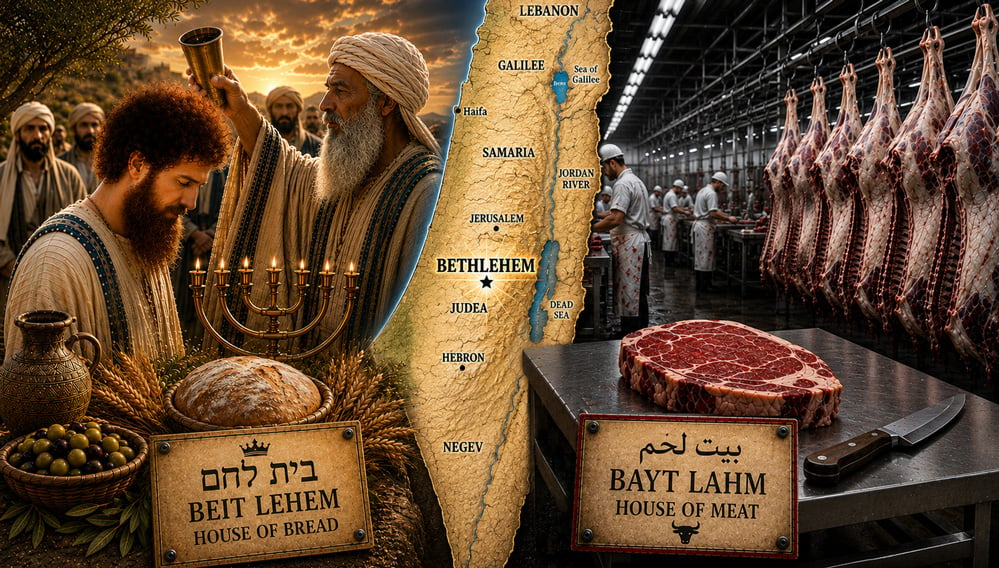
One of the most revealing and defining characteristics of the Semitic language family is the way a single triliteral root can preserve a shared semantic core while simultaneously diverging into radically different cultural expressions. Few roots expose this phenomenon across languages more clearly than the root from which the very city name of Bethlehem derives (L-Ḥ-M).
Across most Semitic languages, the root overwhelmingly denotes bread, nourishment, staple food, or sustenance in general. In Biblical Hebrew, leḥem (לחם) means bread and often functions metonymically for food itself. Yet importantly, it never intrinsically means meat or flesh. Whenever the Hebrew Bible wishes to specify flesh foods, it turns instead to entirely different vocabulary, particularly basar (בשר). The distinction is consistent and foundational.
Aramaic preserves the same semantic structure. Jewish Aramaic, Syriac, and related dialects use laḥmāʾ (לחמא / ܠܚܡܐ) for bread or staple nourishment. Ugaritic follows the same pattern. So too does Classical Ethiopic Geʿez, whose cognate form leḥem (ልሕም) continues to signify bread specifically or food or sustenance broadly. Arabic stands almost entirely alone in defining laḥm as “meat.”
In Classical Arabic and Modern Standard Arabic, laḥm (لَحْم) refers specifically to meat or flesh. Bread is no longer represented by the inherited Semitic root at all, but instead by khubz (خُبْز), a term associated with later lexical developments shaped in part by Persian and broader Indo-Iranian linguistic influence. This means Arabic is effectively the sole major Semitic language in which the ancient L-Ḥ-M root underwent semantic narrowing from general nourishment to flesh specifically.
Why Does Arabic Call Meat Laḥm While Every Other Semitic Language Calls Bread Leḥem?
What makes this particularly striking is how little sustained scholarly attention the anomaly has received. Given the overwhelming consistency of the root across the Semitic linguistic world, one would expect the Arabic divergence to have become a central case study in Semitic philology and historical semantics. Yet comparatively little serious discussion exists outside technical linguistic literature, and even there the issue is often treated only briefly.
That absence of attention is itself revealing precisely because the question is not merely lexical. It opens a window into the relationship between language, ecology, subsistence patterns, prestige structures, and civilizational identity.
As someone raised amid both Ashkenazi and Sephardic inheritances and fascinated from an early age by the Judeo-Arabic linguistic world associated with my paternal Andalusian lineage, the issue stood out immediately. Reading the Qurʾān as a teenager alongside Hebrew Bible texts, Syriac materials, and eventually the literature of Qumran, the cognate structure of the languages became impossible to ignore. The Qurʾān’s oracular cadence, apocalyptic imagery, compressed rhetorical architecture, and semantic atmosphere frequently resembled the world of the Dead Sea Scrolls far more than later readers often realize.
The L-Ḥ-M root became especially illuminating because it reveals that languages do not simply transmit meaning neutrally over time. Languages preserve cultural priorities. They fossilize value systems. They encode entire environmental and social realities inside ordinary words, and speakers eventually stop questioning. And in this case, the divergence is too dramatic to ignore.
The broader comparative evidence surrounding the Semitic root L-Ḥ-M is remarkably consistent and reveals a semantic pattern that stretches across nearly the entire Semitic linguistic family. Reconstructed Proto-Semitic appears to have preserved laḥm in the broad sense of nourishment, staple food, sustenance generally or bread specifically rather than flesh. This older semantic horizon survives clearly within Northwest Semitic languages.
In Biblical Hebrew, leḥem (לחם) signifies bread, food, and sustenance, functioning not merely as a dietary term but as a symbol of covenantal life itself. Aramaic and Syriac preserve the same structure through laḥmāʾ (לחמא / ܠܚܡܐ), meaning bread or staple nourishment.
Ugaritic likewise employs lḥm in the primary sense of bread or laḥmu ( ), and generally non-meat provisions and sustenance. Ugaritic was an ancient Northwest Semitic language spoken in the Late Bronze Age city of Ugarit (modern Ras Shamra, Syria) between the 14ᵗʰ and 12ᵗʰ centuries BCE. Closely related to early Canaanite or rather Phoenician and Biblical Hebrew, it provides important evidence for understanding the development of the Hebrew language and ancient Levantine religion. The language is known from approximately 1,500 clay tablets and fragments discovered by archaeologists in 1928.
Against this overwhelming comparative consistency, Classical Arabic emerges as the major exception within the Semitic family, narrowing laḥm (لَحْم) into the highly specific meaning of meat or flesh. The divergence is therefore not random but historically revealing, preserving within Arabic the traces of a distinct cultural and civilizational reinterpretation of nourishment itself.
Arabic, therefore, emerges not as the norm within the Semitic linguistic family, but as the exception whose divergence becomes visible only when viewed comparatively against the broader historical continuum of Semitic philology. The overwhelming majority of Semitic languages preserve the root L-Ḥ-M in association with nourishment generally, bread specifically, or staple sustenance as the foundation of life itself.
Hebrew preserves this structure לחם.
Aramaic preserves it: לחמא.
Syriac preserves it: ܠܚܡܐ.
Ugaritic preserves it: .
Geʿez preserves it: ልሕም.
Arabic alone narrows the semantic field completely into flesh.
Once viewed from this wider historical perspective, the Arabic usage ceases to appear primordial or universal and instead reveals itself as a culturally specific development emerging from Arabian environmental realities, prestige hierarchies, and later literary standardization.
Moreover, far from Arabic existing as the ancient mother tongue from which the rest of the Semitic world somehow fragmented or degenerated—a claim still commonly repeated within portions of the Islamicate Ummah as a theological assumption rather than a linguistic conclusion—standardized Classical Arabic is historically among the youngest major literary expressions of the Semitic language family. Akkadian appears in written form already in the third millennium BCE.
Ugaritic texts emerge during the Late Bronze Age. Hebrew preserves textual strata extending deep into the Iron Age. Imperial Aramaic spread across the Near East centuries before Islam, while Syriac developed into a vast theological, philosophical, and literary civilization long before the Qurʾānic period. Even Geʿez preserves ancient written traditions predating the formal codification of Arabic under the great philological movements of the Umayyad and Abbasid eras.
This point is often obscured because many modern readers unconsciously collapse together several entirely different historical categories: ancient spoken dialects of Arabia, Qurʾānic recitation, sacred prestige language, and the later grammatically standardized institution known as Classical Arabic. Yet these are not identical phenomena. Arabia unquestionably possessed ancient Semitic speech communities long before Islam, just as the Italian peninsula possessed spoken Latin centuries before Medieval literary Italian emerged. But the mere existence of spoken dialect continua does not mean a fully systematized literary civilization already existed in standardized form. What later generations inherited as “Classical Arabic” was the result of a prolonged process of codification, selection, canonization, and grammatical regulation carried out especially under Abbasid scholarly authority.
The Arabic familiar from tafsīr, jurisprudence, grammar manuals, theology, poetry anthologies, and formal Islamic scholarship therefore reflects not merely untouched primordial speech preserved in pristine isolation, but a carefully stabilized literary system shaped through imperial centralization and philological intervention. Grammarians such as Sībawayh (c. 760–796/798 CE) were not passive stenographers recording an eternally frozen language; they were active participants in selecting among competing dialects, regulating usage, establishing norms, and defining authoritative linguistic boundaries for an expanding imperial civilization. The result was one of the greatest literary languages in human history—but also one that was historically developed, standardized, and institutionally reinforced rather than timelessly fixed from the beginning.
This distinction becomes especially important when apologetic narratives attempt to portray Arabic as intrinsically older, purer, or more original than Hebrew and Aramaic simply because Arabic preserves certain conservative Semitic grammatical features. Comparative linguistics does indeed recognize Arabic as preserving remarkable archaisms in phonology, morphology, and root structure. Yet preservation of some ancient features does not make a language historically prior to its relatives in totality. Icelandic preserves ancient Germanic traits absent from English, yet this does not make Icelandic older than all other Germanic languages. Likewise, Arabic preserves certain deeply archaic Semitic structures while simultaneously exhibiting dramatic later innovations of its own.
The semantic narrowing of L-Ḥ-M into “meat” rather than “bread” or “nourishment” is precisely one such innovation. Comparative Semitic evidence overwhelmingly demonstrates that the broader inherited semantic horizon centered upon sustenance generally, with bread occupying the symbolic core of nourishment across most Semitic-speaking civilizations. Arabic diverged from this pattern, not simply because it corrupted the root, but because Arabian society increasingly reinterpreted nourishment through the prestige framework of flesh, hospitality, pastoral wealth, and sacrificial culture. What survives in Arabic therefore preserves not primordial Semitic purity, but a distinct civilizational trajectory encoded into language itself.
This ultimately reveals something far more fascinating than simplistic debates over which language is “older” or “more authentic.” It is not uncommon, in fact, for Muslims to regard Arabic as the first human language–though there is no serious scholarly position that maintains such a view among linguists.
Languages are not static monuments descending unchanged from Heaven. They are living historical organisms shaped by ecology, empire, ritual, migration, economics, conquest, memory, and cultural value systems. Arabic’s greatness lies not in imagined timeless immutability, but precisely in its dynamic synthesis of ancient Semitic inheritance and uniquely Arabian historical development. And the root L-Ḥ-M stands as one small but extraordinarily revealing witness to that process.
Semantic Narrowing and the Logic of Cultural Value
From a historical-linguistic standpoint, the direction of semantic change visible in Arabic is not mysterious. In fact, it is typologically ordinary.
Languages frequently narrow broad terms into more specialized meanings over time. A word meaning “food” may gradually come to signify “preferred food,” “prestige food,” or the culturally dominant form of nourishment within a society. The movement from general nourishment toward meat specifically is therefore neither linguistically bizarre nor historically implausible.
What requires explanation is not how Arabic arrived at laḥm meaning meat, but why Arabic alone completed this narrowing while the surrounding Semitic linguistic world did not.
The answer likely lies not in accidental linguistic drift, but in ecology, economy, and civilizational emphasis.
The Levantine and Mesopotamian environments that shaped Biblical Hebrew and Aramaic were fundamentally grain-centered civilizations. Bread stood at the center of daily life, economy, covenantal symbolism, taxation, ritual offering, and survival itself. Grain storage determined political stability. Famine narratives revolved around grain failure. Agricultural cycles shaped liturgical calendars. The Hebrew Bible encodes this worldview everywhere.
Bread is civilization.
Bread is social continuity.
Bread is survival itself.
This is why leḥem naturally becomes synonymous with nourishment in Hebrew consciousness.
One need only examine the symbolic role of bread throughout the Biblical Tanakh to recognize its foundational status. The Israelites pray for bread in the wilderness. Bread offerings appear in Temple ritual. The Leḥem ha-Panim—“Bread of the Presence”—occupies sacred liturgical space.
Throughout cultures associated with Semitic languages historically, hospitality has always been framed through bread-sharing prior to the Islamicate Colonization of the regions which are today purported as “Islamic lands.” Covenant itself is frequently mediated through meal symbolism centered on grain. Even the destruction of social order is portrayed through the removal of bread.
Flesh foods, by contrast, remain secondary and marked linguistically through entirely different roots.
Arabia developed under very different conditions.
Pre-Islamic Arabia certainly cultivated grain in numerous regions, particularly oasis settlements and trading centers. Yet socially, economically, and symbolically, animal wealth carried extraordinary prestige. Bedouin cultures naturally elevated meat, milk, and animal possession into markers of power, abundance, and honor.
Hospitality itself became inseparable from slaughtering animals for guests–particularly within the context of the wealthy Meccan elite of the competing Abbasid Caliphate. Meat carried ritual weight, tribal significance, and social prestige in ways fundamentally distinct from grain-centered agricultural societies.
Under such conditions, it becomes unsurprising that the inherited Semitic term for nourishment gradually narrowed until “real food” increasingly meant flesh specifically. This, however, does not make such a definition the norm, nor does it argue for its primacy historically.
“House of Bread” or “House of Meat”?
In the Hebrew and Aramaic worlds, staple nourishment remained identified primarily with grain and bread. Within Arabic-speaking Arabia, however—especially during the formative centuries preceding and surrounding early Islamic expansion—flesh increasingly occupied the culturally privileged category of nourishment worthy of inheriting the ancestral Semitic root itself.
Thus, the lexicon preserves a fossilized hierarchy of value. What kind of food was considered central enough to inherit the ancient Semitic root L-Ḥ-M? Hebrew answered: bread. Arabic answered: meat.
The divergence is therefore not merely semantic. It is civilizational. Languages preserve cultural memory long after civilizations themselves cease consciously recognizing the assumptions embedded within their vocabulary.
This has profound implications when considering names such as Bethlehem—Beit Leḥem (בית לחם). Within Hebrew, the meaning is unmistakable: “House of Bread.” The symbolism is covenantal, agricultural, messianic, and deeply tied to abundance, sustenance, and divine provision. Bread, within the Biblical world, signifies life itself. This is precisely why the Davidic city associated with messianic expectation bears such a name.
Yet within modern Arabic, where laḥm has undergone semantic narrowing toward flesh or meat, Bayt Laḥm (بيت لحم) is naturally heard very differently by native speakers. Ask the average Arabic-speaking Palestinian what the name means and the immediate answer will often be “House of Meat” or “House of Flesh.” The semantic instinct is automatic because Arabic preserved the root through an entirely different cultural lens.
The same ancient Semitic place-name now evokes radically different symbolic worlds depending upon the linguistic civilization hearing it. To Hebrew ears, Bethlehem evokes bread, covenant, nourishment, hospitality, stability, and messianic abundance. To modern Arabic ears, the same root increasingly evokes flesh, meat, slaughter, and bodily substance.
This is not merely a linguistic curiosity. It demonstrates how language subtly shapes symbolic imagination itself.
A Christian from Europe, Ethiopia, Armenia, or the Syriac world hearing “Bethlehem” through Biblical tradition imagines the “House of Bread,” naturally associating the city with Eucharistic symbolism, divine sustenance, and the messianic feeding of the world. Yet an Arabic-speaking hearer whose semantic instinct associates laḥm primarily with flesh may unconsciously process the symbolism through an entirely different emotional and conceptual framework.
This raises difficult but unavoidable questions. If one hears “Bethlehem” and instinctively processes it less as “House of Bread” and more as “House of Flesh” or even something approaching “slaughterhouse,” how might that subtly influence perceptions of sacrifice, suffering, violence, flesh, martyrdom, and even religiously sanctioned violence itself?
Languages do not determine behavior mechanically, of course. Yet they absolutely shape symbolic atmosphere, emotional association, and civilizational imagination. Words carry worlds within them. Because of this, sometimes entire theologies shift simply because civilizations begin hearing ancient roots differently.
Arabia, Caliphal Meat Prestige, and the Reinterpretation of Nourishment
The deeper one examines the semantic divergence surrounding the L-Ḥ-M root, the more apparent it becomes that language cannot be separated from environment and social structure. Words do not evolve in abstraction. They evolve inside economies, landscapes, anxieties, ritual systems, and prestige hierarchies.
The Arabian Peninsula was not the Fertile Crescent. This point seems obvious, yet its implications for language are often insufficiently appreciated.
The civilizations that shaped Biblical Hebrew emerged from environments where grain agriculture formed the backbone of survival. Even when pastoralism existed, stable grain production remained the marker of continuity, settlement, taxation, kingship, and statecraft. The Torah itself reflects this repeatedly through its covenantal fixation upon grain, oil, and wine as the core symbols of blessing and stability.
Arabia functioned differently. Much of Arabian social prestige emerged from pastoral and caravan structures rather than heavily centralized grain economies. Livestock represented wealth, mobility, tribal viability, sacrificial power, and social honor. Hospitality culture revolved around animal slaughter. The ability to provide meat to guests signaled status in ways difficult to overstate within Arab Bedouin society.
Under such circumstances, semantic narrowing from “food” to “meat” becomes not only understandable, but almost predictable. The process likely unfolded gradually across dialects long before the rise of Islam. Yet it was the later standardization of Arabic under the Caliphal system—particularly under the Abbasids—that cemented one semantic possibility into normative literary permanence.
This distinction matters enormously. Languages contain many semantic possibilities simultaneously during periods of transition. Dialects overlap. Meanings fluctuate. Regional usages compete. But once a language becomes institutionalized through imperial bureaucracy, grammar schools, literary canonization, and religious authority, one version becomes fixed while others disappear from collective memory.
Classical Arabic did not emerge in a vacuum. It emerged through codification. Under the Abbasids, Arabic became increasingly regulated through grammar, lexicography, tafsīr, poetry preservation, and administrative standardization. What had once existed as fluid spoken diversity hardened into literary orthodoxy. Once this occurred, laḥm as “meat” ceased being merely one possible semantic layer and became authoritative Arabic itself.
What survived in the lexicon, therefore, was not simply a random linguistic outcome. It was a cultural decision frozen into literary permanence. That permanence obscures the older Semitic pattern still visible everywhere else.
This becomes particularly fascinating when viewed against the broader religious and ideological transformations of Late Antiquity. The Qurʾānic world emerged within an environment saturated with Jewish, Christian, Syriac, and broader Semitic linguistic influence. Qurʾānic Arabic repeatedly preserves cognate structures whose deeper meanings become clearer only when compared against Hebrew and Aramaic parallels. This is especially true regarding terms associated with humanity, embodiment, warning, revelation, proclamation, and flesh itself.
The distinction between bashar (بشر) and laḥm becomes especially important in this context. In Biblical Hebrew, basar (בשר) consistently means flesh. Arabic preserves the cognate bashar with overlapping anthropological implications concerning embodied humanity. Meanwhile laḥm, which elsewhere in Semitic languages remained tied to bread and sustenance, shifts in Arabic toward flesh itself. The semantic map effectively reorganizes categories of nourishment and embodiment.
This matters exegetically because roots carry memory. Semitic languages are structured around root systems precisely because those roots preserve deep conceptual continuity even when surface meanings shift dramatically over time. Once one recognizes that Arabic alone transformed the inherited nourishment-root into flesh terminology, numerous interpretive questions surrounding Qurʾānic anthropology, embodiment, sustenance, and social value begin to look very different.
The issue is therefore not merely philological trivia. It reveals how civilizations reinterpret inherited semantic architecture according to their own environmental and ideological priorities.
Hebrew preserved bread as the symbolic center of life. Arabic elevated flesh of slaughtered animals. Both choices reveal the worlds that produced them.
The Ethiopian Factor and the Equation of Arabic Semantic Instability
Any serious discussion of the Arabic semantic shift surrounding L-Ḥ-M must also grapple with the Abyssinian connection in early Islamic history. This is where the matter becomes considerably more complex—and considerably more interesting.
According to early Islamic tradition, members of the movement surrounding Muhammad sought refuge in Abyssinia during the Meccan period. Whether every detail of the later narrative is historically recoverable is secondary to the larger point: contact between Arabic-speaking populations and the Semitic linguistic world of the Horn of Africa during Late Antiquity is historically undeniable.
Ethiopian Geʿez changes the picture. Unlike Arabic, Classical Ethiopic preserves the older Semitic semantic structure. Cognates of L-Ḥ-M in Geʿez continues to signify nourishment or food broadly rather than meat specifically. In this regard, Geʿez aligns not with Arabic, but with Hebrew, Aramaic, Syriac, and the broader Semitic pattern.
This creates an intriguing tension. If Arabic speakers interacting with Abyssinian society encountered a living Semitic language still preserving the older meaning of the root, then the semantic environment surrounding L-Ḥ-M during the formative Islamic period may have been far more fluid than later literary Arabic allows modern readers to perceive. That possibility deserves far more scholarly attention than it has received.
Arabic usage of laḥm for meat appears early enough that the narrowing was likely already underway prior to or independent from direct Geʿez influence. Moreover, semantic narrowing from “food” to “meat” is cross-linguistically common and requires no external trigger whatsoever. But that does not make the Abyssinian period irrelevant.
What contact with Geʿez may have produced was not the semantic content of the shift, but heightened awareness of competing semantic possibilities already present within the broader Semitic linguistic continuum. In other words, Arabic speakers may have become more consciously aware that cognate languages preserved meanings their own dialectal developments were beginning to abandon.
This matters because semantic shifts are rarely instantaneous. Languages often pass through periods of instability in which older and newer meanings coexist simultaneously across dialects, classes, and regions. Competing interpretations overlap before one eventually triumphs through political or literary authority. It is entirely conceivable that pre-standardized Arabic contained broader semantic flexibility surrounding laḥm than later Abbasid-era codification would preserve.
Once Arabic became institutionalized through grammar schools, imperial bureaucracy, Qurʾānic exegesis, and literary canonization, however, those ambiguities hardened into orthodoxy. What modern readers encounter as “Classical Arabic” is therefore not pristine primordial speech frozen untouched from eternity. It is standardized Arabic; Codified Arabic; Imperial Arabic—that distinction cannot be overstated.
The Abbasid period did not merely preserve Arabic; it selected from Arabic. It formalized certain dialectal trajectories while marginalizing others. It transformed fluid spoken diversity into literary authority. And once this occurred, semantic alternatives increasingly vanished from ordinary awareness.
This broader historical process helps explain why the Arabic divergence surrounding L-Ḥ-M now appears so natural to native speakers despite being profoundly anomalous within the wider Semitic family. The anomaly disappeared into normalization. Yet comparative philology preserves the older memory.
Hebrew still remembers bread; Aramaic still remembers bread; Syriac still remembers bread; Geʿez remembered nourishment broadly. Arabic alone completed the narrowing fully into flesh.
That narrowing tells us something extraordinarily important: linguistic history is not merely about words changing mechanically over time. It is about civilizations deciding what matters enough to become synonymous with life itself.
Abbasid Standardization and the Cementing of Meaning
One of the greatest misconceptions modern readers bring to Classical Arabic is the assumption that it emerged fully formed, fixed, and semantically stable from the beginning. In reality, what later generations inherited as “Classical Arabic” was the product of a long process of selection, codification, normalization, and ideological consolidation.
Languages do not standardize neutrally. Empires standardize languages the way states standardize law, ritual, currency, and memory itself: by elevating one stream of usage into authority while suppressing or marginalizing competing forms. Arabic was no exception.
The Abbasid Caliphate inherited a vast multilingual world stretching across former Byzantine, Persian, Aramaic, Coptic, and broader Semitic cultural zones. In order to administer such an empire, Arabic increasingly became regulated through grammar schools, philological projects, lexicographical compilation, Qurʾānic exegesis, poetry preservation movements, and state-sponsored literary culture.
This process fundamentally altered the relationship between speech and authority. Before standardization, spoken Arabic almost certainly existed as a spectrum of regional dialects containing overlapping semantic possibilities, local usages, tribal distinctions, and unstable meanings. After standardization, however, one version became canonical. This is why later readers often mistake standardized Arabic for Qur’anic Arabic. But the two are not identical in any demonstrable way.
The Arabic preserved in formal grammatical tradition reflects literary selection and political centralization as much as purely organic linguistic continuity. Once Abbasid philologists fixed meanings into dictionaries, tafsīr traditions, and educational institutions, semantic flexibility narrowed dramatically. Words that may once have possessed broader or contested ranges became rigidly defined through literary authority itself.
The case of laḥm illustrates this process perfectly. At some earlier stage of Semitic linguistic history, the root clearly denoted nourishment generally. That memory survives across Hebrew, Aramaic, Syriac, Ugaritic, and Geʿez. Arabic inherited the same root structure, yet under the cultural conditions of Arabia and later Abbasid literary consolidation, one semantic trajectory triumphed completely: flesh became the definitive meaning.
What disappeared was not merely an alternative translation possibility. What disappeared was awareness that another semantic world had ever existed. This is precisely why comparative Semitic philology matters. Without Hebrew, Aramaic, Syriac, and Ethiopic parallels, modern readers might easily assume Arabic usage represented the original meaning of the root. Comparative linguistics reveals the opposite. Arabic preserves the innovation. The broader Semitic world preserves the older inheritance.
The lexicon records what a civilization considers central enough to become linguistically normative. In grain-centered civilizations, bread naturally occupies the symbolic core of nourishment. In societies where pastoral prestige dominates, flesh acquires elevated semantic weight. Language then freezes these priorities into ordinary speech until later generations cease noticing them altogether. This is why philology can become anthropological archaeology. Words preserve forgotten social realities.
The Arabic narrowing of laḥm from nourishment broadly into flesh specifically therefore functions almost like a linguistic fossil from Late Antique Arabia. It reveals a world in which meat possessed such symbolic and social prominence that the inherited Semitic term for sustenance itself became identified primarily with flesh. Meanwhile bread required replacement terminology entirely. That replacement is equally revealing.
Arabic uses khubz for bread rather than preserving the ancestral Semitic root in its older meaning. Thus, what was central elsewhere became secondary in Arabic semantic organization. Bread remained important materially, of course, but linguistically it no longer occupied the privileged inherited category of nourishment itself.
This is not random drift. It is civilizational prioritization encoded into vocabulary. Once codified under Abbasid authority, the hierarchy became permanent and memory of origins, etymologies or alternative meanings—symbolic or literal—were lost, or perhaps even intentionally buried.
Language as Civilizational Memory
At its deepest level, however, the L-Ḥ-M divergence is not fundamentally about etymology at all. It is about memory. Languages preserve civilizational assumptions long after the societies that produced them cease consciously recognizing those assumptions. Every root carries sediment from older worlds: forgotten ecologies, vanished economies, ritual structures, prestige hierarchies, anxieties, and social realities. Most speakers inherit these semantic structures unconsciously. Philology allows us to excavate them.
This is especially true within Semitic languages because the triliteral, tri-consonantal root system preserves conceptual continuity with extraordinary durability across millennia. Even when meanings shift dramatically, the roots themselves retain traces of older semantic worlds beneath later reinterpretations. The L-Ḥ-M root is therefore more than a lexical curiosity. It is a window into how entire civilizations conceptualized sustenance itself.
Hebrew preserves a vegetation- and grain-centered symbolic universe. As we have already seen now, the very first dietary command in the Torah appears not in the Sinaitic covenant but in the Celestial Gan Eden itself:
“Behold, I have given you every herb yielding seed which is upon the Face of all the Land, and every Tree in which is the fruit of a tree yielding seed—it will be yours to eat.” (Berashit/Genesis 1:29)
Hineh natati lakhem et kol-esev zorea zera asher al penei kol ha-Aretz, ve’et kol ha-etz asher bo peri etz zorea zara; lakhem yihyeh le-okhlah
הִנֵּה נָתַתִּי לָכֶם אֶת־כָּל־עֵשֶׂב זֹרֵעַ זֶרַע אֲשֶׁר עַל־פְּנֵי כָל־הָאָרֶץ וְאֶת־כָּל־הָעֵץ אֲשֶׁר־בּוֹ פְרִי־עֵץ זֹרֵעַ זָרַע לָכֶם יִהְיֶה לְאָכְלָה
This primordial dietary structure was understood by many later Jewish traditions as the Minhag ʿEden—the Edenic pattern of herbivorous nourishment existing prior to the violence introduced after the expulsion from Eden and later after the Flood narrative. While not counted among the later 613 mitzvot revealed through Sinai, the Edenic model remained deeply influential in Jewish ethical and mystical reflection.
Later, in the figure of Qayin (Cain), grain itself becomes symbolically ambivalent. Qayin, the cultivator of the earth, embodies both wisdom and the danger of wisdom divorced from compassion. Midrashic and mystical traditions repeatedly play upon this tension. The gematria of Mashiaḥ (משיח) and Naḥash (נחש) are both 358, a fact heavily explored within Kabbalistic traditions. The problem with the Naḥash is not simply that it is a serpent. Even within Eden, all creatures are portrayed as herbivorous prior to the curse. The story is therefore not fundamentally zoological. It is anthropological and civilizational.
Indeed, the Torah itself hints that the Naḥash was not originally a mere crawling snake. Genesis describes the creature as uniquely subtle among the animals before later condemnation “upon your belly shall you go” (Berashit/Genesis 3:14), implying a prior state. Exegetical Midrash elaborates repeatedly upon this theme, portraying the Naḥash as upright, intelligent, and quasi-human in symbolic function. The Eden narrative therefore concerns wisdom, temptation, appetite, and the misuse of knowledge rather than primitive snake mythology in the simplistic modern sense.
This symbolism deepens dramatically in Enochic Judaism. In traditions preserved among the Qumranic writings of the Dead Sea Scrolls, in Ethiopic Enochic transmission, and later in certain Manichaean and Judeo-Arabic streams whose materials eventually surfaced within the Cairo Genizah, the Watchers (ʿIrin) and the Nefilim are associated with the transmission of forbidden technologies to humanity. These include metallurgy, weaponry, cosmetics, astrology, intoxicants, and significantly, advanced agricultural and grain technologies. The teaching of bread-making and fermented drink production occupies a symbolic place within this broader narrative of civilizational acceleration through illicit wisdom.
Even the Hebrew wordplay surrounding grain and sin reflects this tension. Wheat, ḥiṭṭah (חטה), echoes ḥeṭʾ (חטא), “sin,” while God warns Qayin: la-petaḥ ḥaṭṭāʾt roveṣ (לַפֶּתַח חַטָּאת רֹבֵץ) “Sin crouches at the door” (Berashit/Genesis 4:7).
The etymological and symbolic resonance is difficult to ignore within Jewish interpretive traditions. Grain itself is not evil. Rather, wisdom misused “misses the mark,” which is precisely the underlying sense of ḥeṭʾ or “sin.” This is why Torah includes grain offerings alongside animal offerings, and why Nazirites who abstained from flesh and wine were not condemned for doing so. Indeed, the Nazirite legislation only requires a ḥaṭṭaʾt (“sin offering”) upon completion of the vow and reintegration into ordinary social life involving flesh consumption and corpse impurity contact (Bamidbar/Numbers 6:13–20). The issue is not abstention itself, but transition and ritual reintegration.
The term shōmer means guardian, keeper, watcher, or protector. This becomes deeply suggestive when compared with Sumer itself—Shumer—whose name resonates strikingly with the same conceptual world of guarding and storing. Sumerian civilization depended upon grain accumulation in granaries. Stored food required protection. Surplus required walls. Wealth required armed guardians. Thus civilization increasingly shifted from horticultural reciprocity toward accumulation, militarization, and defended ownership.
Yet with this development came ecological collapse. Ancient Mesopotamian over-farming, irrigation salinization, and soil exhaustion contributed to regional instability remembered across numerous flood traditions. The Atrahasis Epic, the Sumerian flood traditions, and the Biblical account of Noaḥ all preserve echoes of civilizational memory surrounding environmental catastrophe tied to human excess and imbalance. The so-called “Fertile Crescent” repeatedly appears in ancient literature not merely as a cradle of civilization, but as a warning concerning civilization itself.
The Torah responds to this crisis not by rejecting agriculture, but by regulating it ethically and cosmologically. The land itself must rest. Crop rotation becomes sacred. The Sabbatical year (Shemittah) interrupts endless extraction. The Torah teaches: u-va-shanah ha-sheviʿit shabbat shabbaton yihyeh la-aretz (וּבַשָּׁנָה הַשְּׁבִיעִת שַׁבַּת שַׁבָּתוֹן יִהְיֶה לָאָרֶץ) “But in the seventh year shall be a Shabbat of rest unto the Land” (Vayiqra/Leviticus 25:4).
Thus Torah represents not primitive legalism but ecological wisdom encoded covenantally. Eden itself is situated not in Sumer proper but before it—between the river systems linking Africa and Mesopotamia. Like many Indigenous narrative structures, the Torah ultimately ends where it begins: in the Land of Israel, centered upon Jerusalem.
Bread and grain are therefore not condemned within Torah. They are symbols of wisdom rightly used. This is why Yosef (Joseph), often identified symbolically with Imhotep traditions in Egypt, stores grain not for hoarding and domination but for preservation of life during famine (Berashit/Genesis 41). Grain storage itself is not sinful. Hoarding without compassion is sinful. Yosef stores grain so that nations may survive. Qayin stores and guards for self-protection and domination.
This distinction culminates beautifully in the symbolism surrounding Mashiaḥ. Bethlehem—Beit Leḥem, the “House of Bread”—becomes associated with Davidic kingship and messianic expectation through Sefer Mikhah (Micah 5:2). Bread symbolizes abundance, covenant, stability, and the Yemot ha-Mashiaḥ themselves. Even the Mann in the wilderness functions as miraculous bread sustaining existence. In the teachings of my Alter Zeidy, Rabbi Naḥman of Breslov (April 4, 1772 – October 16, 1810), bread imagery frequently becomes mystical anthropology itself, with corrupted bread symbolizing dissociative consciousness and delerium within fallen civilization.
Biblical literature therefore repeatedly centers grain within covenantal blessing. Famine means grain failure. Prosperity means overflowing storehouses. Temple ritual revolves around bread and grain products. Social morality itself becomes linked to whether one feeds the hungry bread. There exists a universal b’rakhah for bread—Ha-Motzi Leḥem min ha-Aretz—yet no uniquely elevated blessing exists for flesh foods themselves. The symbolism permeates Jewish scripture and liturgy so completely that later readers often cease noticing it at all.
The Term Laham in the Qur’an
The Qurʾān uses laḥm (لَحْم) repeatedly in the sense of flesh or meat, never in the older Northwest Semitic sense of bread or staple nourishment. This is precisely what makes the Arabic semantic shift so philologically significant when compared against Hebrew, Aramaic, Syriac, and Geʿez parallels.
One of the clearest examples appears in Sūrat al-Naḥl, which is rendered: wa-huwa alladhī sakhkhara al-baḥra li-taʾkulū minhu laḥman ṭariyyan (وَهُوَ ٱلَّذِى سَخَّرَ ٱلْبَحْرَ لِتَأْكُلُوا۟ مِنْهُ لَحْمًا طَرِيًّا). This is typically rendered as “And from them you eat fresh meat…” (16:14).
Yet there is no reason to presume meat here. At some point, Caliphal cementing of Arabic as a fixed, separate language, determined that this must be read as implying fish or whatever the given Islamicate orientation determined to be ḥalāl.
With that said, it is worth commenting that Jaʿfarī fiqh—the Shīʿah or rather mutashayyiʿīn (those who profess to be the Shīʿah of the family, the Ahl al-Bayt of Muḥammad), maintain Jewish kashrut relative to sea life, prohibiting the likes of ḥirmah of shrimp and the like as ḥarām, which the bulk of the Sunnī Ummah regard as ḥalāl.
Particularly within vegetarian communities and faiths, sea vegetation is not only viable for food but is a particularly rich source of iodine. Of course, if Muḥammad was an isolated desert-dweller then this would seem a moot point to discuss—but then again, if that were the case and he was not in fact a quite mobile, traveling merchant familiar with the Levant like his second home and well acquainted with the Silk Road and everything from East Asia, from sea vegetation as food to the apparently Asian-originated double-edged zhul-fiqar—which the Mutaslim Ummah seems almost painfully ignorant of, not deducing that a broadsword or Arabian scimitar (as it is often oddly portrayed as), would be incapable of being “a possessor of” or “endowed with piercing qualities” in any intelligible or meaningful way. Indeed, one possible clue may survive even in the name itself.
While the standard etymology of the Southeast Asian kris derives from Austronesian languages, it is noteworthy that the Arabic root K-R-S (ك ر س) carries meanings of consecration, dedication, and something set apart for a special purpose. Given that many kris blades—particularly those forged from meteoritic iron—were regarded as sacred ritual objects, ancestral heirlooms, and vessels of spiritual power rather than mere weapons, an association with takrīs (تكريس), “consecration” or “dedication,” would be both natural and historically plausible. Whether or not such a connection ultimately proves correct, it serves as a reminder that the commercial and cultural horizons of Late Antiquity were far broader than later popular assumptions often allow.
Here laḥm explicitly refers to edible animal flesh drawn from the sea—fish and marine life. The phrase laḥman ṭariyyan literally means “fresh/tender meat.” The semantic field is unmistakably flesh-oriented rather than nourishment generally.
A similar example is orated in Sūrat Fāṭir (35:12):
Again the term is commonly interpreted as referring directly to animal flesh obtained from the waters. The usage is concrete, dietary, and entirely consistent with Classical Arabic semantics.
“None shall hurt nor kill in all My Holy Mountain…”
Another striking occurrence appears in Sūrat al-Ṭūr:
The same pattern, however, appears in Sūrat al-Wāqiʿah (56:21), where it is said: Wa-laḥmi ṭayrin mimmā yashtahūn (وَلَحْمِ طَيْرٍۢ مِّمَّا يَشْتَهُونَ) meaning “and the laḥm of birds from whatever they desire.”
But if this means birds, why didn’t the previously examined ayah say fruit and lahm of birds—from whatever they desire”?
Does this mean that birds will be killed in Jannat ʿEden?
What if one desired the flesh of birds—were that in fact the meaning? The ayah in Sūrat al-Ṭūr is saying fruit and laḥm—why not the laḥm of birds if means flesh here? What if someone wished to eat the flesh of a cow, goat or lamb in Jannah?
Where it says the laḥm of birds—if flesh—this would indicate only bird meat. If it meant the laḥm of the Ṭūr, however—the very name of the previous Surah a similar ayah is found within—then this would mean the food of the Mountain, as in the Celestial Mount Zion mentioned so often by the Prophets of the Children of Israel.
The Prophet Yeshayahu writes in the Name of the same God of the Bible and of the Qur’an:
“None shall hurt nor kill in all My Holy Mountain.” (Isaiah 11:9)
loʾ-yarēʿū ve-loʾ-yashḥītū be-khol-har qodshī
לֹא־יָרֵעוּ וְלֹא־יַשְׁחִיתוּ בְּכָל־הַר קָדְשִׁי
Could one imagine a bloody Heaven?
This is a strange imagining indeed. Yet that is precisely what the Mutaslim Ummah believes they are being promised: an afterlife of slaughtering animals and having fleshly copulation with young virgins whom they seem to imagine will have their hymens restored after every strangely three-dimensional act of coitus with the ascended Mutaslim.
It would be tangential, yet apropos, to mention here the well-known—even notorious—revisionist scholarship on the Syriac-Aramaic origins of the Qurʾān and, accordingly, the relevant re-reading of this āyah as referencing luscious, juicy grapes—dark ones and those white and transparent, almost like the popular “cotton candy” grapes enjoyed from produce sections today.
Again, flesh functions as a luxurious consumable within Paradise imagery. The semantic orientation remains entirely centered upon meat rather than bread, grain, or nourishment generally.
Collectively, these passages demonstrate that Qurʾānic Arabic consistently employs laḥm in the narrowed sense characteristic of Arabic usage: flesh, meat, bodily tissue, or animal consumption. The older Semitic semantic horizon associated with bread or staple nourishment is absent from Qurʾānic usage entirely.
This is precisely what makes the comparative evidence so revealing. Hebrew leḥem preserves bread at the center of nourishment symbolism, while Qurʾānic Arabic employs laḥm overwhelmingly in contexts of flesh, bodily formation, animal consumption, prestige food, and eschatological abundance. The divergence therefore reflects not merely lexical difference, but distinct civilizational conceptions of what nourishment itself symbolically meant.
Take the recurring phrase above: laḥman ṭariyyan (لَحْمًا طَرِيًّا), normatively translated as “fresh meat” in Qurʾān (16:14 and 35:12). Classical Arabic mufassirūn commentators read this through the later stabilized meaning of laḥm as flesh. Yet from a comparative Semitic perspective, the phrase can just as plausibly preserve echoes of “fresh nourishment,” “fresh food,” or “fresh sustenance” drawn from the sea, or food of birds—meaning seeds and other bloodless fruit of the trees—in connection with fruit.
Crazy, right?
Except for the fact we must remember that the Celestial Gan Eden—the Torah’s earlier cognate with the later Arabic Jannat ʿEden—says specifically that in this Heavenly Garden…
“‘Behold, I have given you every herb yielding seed which is upon the Face of all the Land, and every Tree in which is the fruit of a Tree yielding seed; it will be yours to eat.’” (Berashit/Genesis 1:29)
Hinnēh natattī lakhem et kol-esev zōrea zera asher al-penei kol-haaretz, ve’et kol-haetz asher bō peri-etz zōrea zara; lakhem yihyeh le’okhlah.
הִנֵּה נָתַתִּי לָכֶם אֶת־כָּל־עֵשֶׂב זֹרֵעַ זֶרַע אֲשֶׁר עַל־פְּנֵי כָל־הָאָרֶץ וְאֶת־כָּל־הָעֵץ אֲשֶׁר־בּוֹ פְרִי־עֵץ זֹרֵעַ זָרַע לָכֶם יִהְיֶה לְאָכְלָה׃
The following verse extends the same plant-based provision to animals as well (1:30). The Torah is thus clear that the Heavenly Garden will be one where there is zero bloodshed, whether from human spirits or non-human spirits. Lest the reader disbelieve that the Biblical position maintains non-human animal spirits as present in the Celestial realms, Sefer Qohelet makes the following point clear from its outset:
“For that which happens to the B’nei Ha-Adam Human Beings happens also the same to [non-human] animals. As the one dies, so dies the [perceived] other. Indeed, they all have a Rūaḥ ʾEḥad One and the Same Spirit, and Ha-Adam—the Human Being—has no advantage over the [non-human] animals, for all is vanity (havel).” (Ecclesiastes 3:19)
Kī miqreh bnēi-hāʾādām ūmiqreh habbehēmāh ūmiqreh ʾeḥad lāhem; kemōth zeh kēn mōth zeh, ve-rūaḥ ʾeḥad lakkōl, ūmōthar hāʾādām min-habbehēmāh ʾayin, kī hakkōl hāvel
כִּי מִקְרֶה בְנֵי הָאָדָם וּמִקְרֶה הַבְּהֵמָה וּמִקְרֶה אֶחָד לָהֶם כְּמוֹת זֶה כֵּן מוֹת זֶה וְרוּחַ אֶחָד לַכֹּל וּמוֹתַר הָאָדָם מִן־הַבְּהֵמָה אָיִן כִּי הַכֹּל הָבֶל
This is precisely the danger of reading Qurʾānic Arabic exclusively through later Abbasid lexical stabilization rather than through broader comparative Semitic philology. A root does not instantly forget its older semantic layers simply because one meaning becomes dominant. Semantic transitions often preserve older resonances beneath newer primary meanings for centuries. This is especially true in sacred and poetic literature, where archaic conceptual strata frequently survive long after ordinary speech narrows. In other words, the issue may not be binary.
It may not be that laḥm means “bread” in the Qurʾān in the Hebrew exclusive sense of only “bread”, nor merely that it means “meat” in the later rigid Classical Arabic sense. Rather, Qurʾānic usage seems to sit precisely at an intermediate historical stage where the root still carried a broader semantic aura of nourishment, valued sustenance, embodied food, and life-giving substance even while increasingly gravitating toward flesh in Arabian usage. That possibility would actually fit the broader historical situation remarkably well.
The Qurʾān emerges from a Late Antique Semitic environment saturated with Hebrew, Aramaic, Syriac, Nabatean, Ethiopic, and Arabian conceptual overlap. In such an environment, roots likely retained wider semantic resonance than later standardized lexicons allowed. Once Abbasid philologists codified Arabic formally, however, the narrower flesh-oriented interpretation became dominant and retroactively appeared “obvious” to later readers.
But comparative Semitic evidence suggests the older semantic horizon may never have disappeared entirely from the Qurʾānic linguistic subconscious.
Arabic Laham and Ethiopic-Abbasinian “Food”
According to early Islamic tradition, portions of the Qurʾānic proclamation were directly recited in the context of the Abyssinian refuge and specifically before the Christian Negus (ንጉሥ) al-Najāshī, usually identified with the Aksumite ruler Aṣḥama ibn Abjar.
The migration to Al-Ḥabashah (Abyssinia), the Christian Kingdom of Aksum in present-day Ethiopia and Eritrea, occupies a unique place in the earliest history of Muḥammad’s community. According to the Islamic tradition, as persecution intensified in Mecca, Muḥammad instructed a group of his followers to seek refuge under the protection of Al-Najāshī, describing him as a king under whom no injustice was tolerated. This emigration came to be known as the First Hijrah. It preceded the later migration to Medīnat Yathrib and established one of the earliest recorded encounters between the emerging Qurʾānic movement and a Christian polity—a Tawaḥedo (ተዋሕዶ) Judaic one at that.
The broad memory of strong early contact between the Qurʾānic movement and the Christian Semitic world of Abyssinia is deeply embedded within Islamic tradition itself. Central to the narrative is the recitation of portions of the Qurʾān before the royal court of the Najāshī, particularly passages concerning the figures of Maryam and ʿĪsā, which served both as a theological explanation of the new faith and as a plea for asylum.
The most famous example of these involves the recitation of passages associated with Sūrat Maryam (19). According to the traditional narrative, Jaʿfar ibn Abī Ṭālib recited portions concerning Maryam and the birth of the Qur’anic—Primordial Spirit of God or Ruḥ Allah—ʿĪsā before the Negus when the Muslim refugees were summoned to explain their beliefs at the Abyssinian court.
Although the details of the account are preserved in sources compiled generations after the events themselves, the migration to al-Ḥabashah and the audience before the Najāshī are attested across multiple independent streams of the early Islamic literary tradition, including works of sīrah, tārīkh, and tafsīr. The episode appears in Ibn Hishām’s al-Sīrah al-Nabawiyyah (drawing upon Ibn Isḥāq), Al-Ṭabarī’s Tārīkh al-Rusul wa-l-Mulūk, Ibn Kathīr’s al-Bidāyah wa-l-Nihāyah, and Ibn Kathīr’s Tafsīr al-Qurʾān al-ʿAẓīm.
While modern historians debate the precise wording of speeches and the literary shaping of the narratives, the broad event itself is generally regarded as possessing at least a historical core due to the criterion of multiple attestation. The convergence of numerous early Muslim sources upon the existence of the Abyssinian refuge, the protection granted by the Najāshī, and the presentation of Qurʾānic teachings before his court suggests that these traditions are unlikely to be purely legendary inventions, even if particular details remain difficult to verify.
The primary source for the story of Jaʿfar ibn Abī Ṭālib reciting Sūrat Maryam before the Najāshī is Ibn Hishām’s al-Sīrah al-Nabawiyyah, preserving material from Ibn Isḥāq’s Sīrat Rasūl Allāh. According to the narrative, when the Quraysh sent ʿAmr ibn al-ʿĀṣ and ʿAbdullāh ibn Abī Rabīʿah to persuade the Christian king of Aksum to surrender the Muslim refugees, Jaʿfar served as spokesman for the emigrants. After explaining the beliefs of the nascent Muslim community, he was asked to recite something from the revelation. He then recited the opening portion of Sūrat Maryam concerning Maryam and ʿĪsā. Ibn Isḥāq reports that the Najāshī and his bishops wept upon hearing the recitation and that the king subsequently refused to hand the Muslims over to the Quraysh.
The same episode is preserved in Al-Ṭabarī’s Tārīkh al-Rusul wa-l-Mulūk, Ibn Kathīr’s al-Bidāyah wa-l-Nihāyah, and Ibn Kathīr’s Tafsīr al-Qurʾān al-ʿAẓīm in his commentary on Sūrat Maryam. According to the traditional narrative, when the Quraysh delegation sought the extradition of the Muslim refugees from al-Ḥabashah, Jaʿfar spoke on behalf of the emigrants and recited passages from Sūrat Maryam concerning Maryam and ʿĪsā, after which the Najāshī and members of his court were deeply moved and refused to surrender them.
Although the Qurʾān itself does not explicitly mention this audience before the Najāshī, the episode became one of the most celebrated events associated with the Abyssinian migration and is the principal reason Sūrat Maryam is often regarded as the quintessential “Ḥabashah-period” sūrah. More broadly, the tradition provides the earliest recorded example of Qurʾānic recitation functioning as a bridge between the emerging Muslim community and the Christian world, highlighting the importance of Maryam and ʿĪsā within the Qurʾānic message presented to an audience already deeply rooted in Biblical and Christian traditions.
This matters enormously for the linguistic issue at hand. Because the Qurʾān did not emerge inside an isolated “pure Arabic” vacuum. It emerged within a multilingual Late Antique Semitic environment involving:
- Arabic dialects
- Syriac and broader Aramaic influence
- Hebrew conceptual structures
- Ethiopic/Geʿez contact
- Jewish sectarian and Syriac Thomasine Christian liturgical language worlds
- Caravan and mercantile multilingualism
- Imperial border-zone vocabulary exchange
The Abyssinian episode therefore becomes philologically important not necessarily because it “caused” semantic shifts mechanically, but because it demonstrates that the earliest Qurʾānic community actively interacted with another living Semitic civilization whose linguistic structures often preserved older semantic horizons than later standardized Arabic.
And Geʿez is crucial here because, unlike Arabic, it appears to preserve the broader inherited Semitic sense of L-Ḥ-M as nourishment generally rather than flesh specifically. Thus if portions of Qurʾānic proclamation were indeed recited within the Aksumite courtly environment, then audiences hearing cognate roots may not necessarily have processed them through the same narrowed lexical assumptions later Abbasid Arabic readers would impose centuries afterward.
That possibility is extraordinarily important because it means the semantic world surrounding the early Qurʾān may have been considerably more fluid, layered, and cross-pollinated than later Islamic grammatical tradition tended to present. The Qurʾān repeatedly assumes audiences capable of recognizing cognates, allusions, compressed scriptural references, and overlapping Semitic conceptual fields. Once Arabic became rigidly codified under later philological orthodoxy, many of those broader semantic resonances may have narrowed retroactively.
In other words, if the early Qurʾānic movement was actively engaging Ethiopic Christian courts, Syriac-speaking Christians, Jews familiar with Hebrew and Aramaic, and mixed Semitic populations generally, then it becomes much harder to imagine Qurʾānic roots functioning with the kind of rigid monosemic precision later dictionaries often assume. The language environment of the Qurʾān was without question far more semantically porous than later tradition admitted.
Bread As Flesh in Aramaic and Thomasine Docetism
The correlation becomes especially striking once the Qurʾānic passages are read not through later frozen Abbasid lexical assumptions alone, but against the broader multilingual Semitic environment in which the proclamations originally circulated.
Take first the repeated Qurʾānic phrase laḥman ṭariyyan (لَحْمًا طَرِيًّا) in Qurʾān (16:14 and 35:12), conventionally translated “fresh meat.” Modern readers usually imagine this as an obvious reference to fish flesh because later Classical Arabic had already stabilized laḥm toward meat specifically. Yet if audiences within the Abyssinian or broader Semitic world still retained awareness of the older semantic horizon associated with nourishment generally, then the phrase may have functioned with considerably greater semantic openness.
In other words, laḥman ṭariyyan may have communicated something closer to “fresh nourishment,” “fresh sustenance,” or “living food drawn from the sea” rather than merely “animal flesh” in the narrow modern sense. Thus, the Qurʾānic maritime passages may preserve semantic layering precisely because the root itself still carried older associations with nourishment broadly conceived.
The Abyssinian connection sharpens this possibility further. If portions of Qurʾānic proclamation were indeed recited before the Negus and within an Aksumite Semitic environment, then Geʿez-speaking hearers encountering cognates of L-Ḥ-M would likely have processed the term through a semantic field far broader than later Arabic lexicographers eventually allowed. Since Geʿez preserves the older Semitic sense of non-meat nourishment broadly, and bread specifically, audiences familiar with Ethiopic conceptual structures may have heard resonances modern Arabic readers no longer perceive.
This suggests the root may still have occupied an intermediate semantic stage where nourishment, flesh, sustenance, vitality, and valued food overlapped more fluidly than later standardized Arabic permitted.
Clothed in Flesh—“Coats of Skin”
The embryological passage in Qurʾān 23:14 illustrates this transition particularly well. After describing the formation of the skeletal structure, the text states: laḥman (لَحْمًا) “flesh”—or perhaps more broadly “living tissue” or “substance of bodily embodiment”—in the phrase: fa-kasawnā al-ʿiẓāma laḥman (فَكَسَوْنَا ٱلْعِظَـٰمَ لَحْمًا) “Then We clothed the bones with laḥm” (Qurʾān 23:14).
Here, laḥm clearly does not signify meat in the culinary sense but rather the living material that covers, fills out, and animates the skeletal frame. The term therefore occupies a semantic range extending beyond the narrow category of edible flesh, denoting embodied substance itself. This broader usage becomes especially significant when considered alongside cognate Semitic traditions in which related terms can likewise signify nourishment, bodily substance, or that which sustains life.
A further layer of meaning emerges when this Qurʾānic imagery is read against the backdrop of ancient Torah symbolism. The expression fa-kasawnā al-ʿiẓāma laḥman (فَكَسَوْنَا ٱلْعِظَـٰمَ لَحْمًا) “Then We clothed the bones with laḥm” (23:14) employs imagery to intentionally evoke Biblical motifs in which human incarnation in the physical world of the Dunyā itself is portrayed as a form of Divine vesture.
Within the Torah after the expulsion from Gan ʿEden, humanity is described as being clothed by the Unified Ha-Shem Elohim: Va-yaʿas Y-H-V-H Elohim le-ʾAdam u-le-ʾishto kotnot ʿor va-yalbishem (וַיַּעַשׂ יְהוָה אֱלֹהִים לְאָדָם וּלְאִשְׁתּוֹ כָּתְנוֹת עוֹר וַיַּלְבִּשֵׁם) “And Ha’Shem Elohim made for Adam and his female” incarnation into the world of dualism and duality, Yin and Yang, “Coats of Skin and clothed them” (Berashit/Genesis 3:21).
Within esoteric Judaism’s Kabbalah, the “Coats of Skin” (kotnot ʿor) are not merely garments but symbols of incarnation itself. Adam and Ḥavvah are clothed in material existence as they descend from the celestial realities of Gan ʿEden into the physical world. Flesh becomes a garment of the soul. The language of clothing therefore functions simultaneously as the language of embodiment. To be clothed is to enter material existence. This symbolism becomes especially relevant when compared with Qurʾān (23:14), where the bones are “clothed” with laḥm, suggesting a similar conception of bodily substance as a form of vesture through which life becomes manifest in the created world.
This interpretation becomes particularly intriguing when considered alongside Berashit (Genesis 1:27), which describes primordial humanity before the later differentiation of Adam and Ḥavvah: zākhār ūneqēvāh bārāʾ ʾōthām (זָכָר וּנְקֵבָה בָּרָא אֹתָם) “Male and female He created them.”
Rabbinic and mystical traditions frequently understood this verse as referring to an original androgynous or unified human being who contained both masculine and feminine principles within a single primordial reality. Humanity, in this reading, descends from a higher celestial state into differentiated material existence.
Against this backdrop, the Qurʾānic statement that the bones are “clothed” with laḥm may be understood as participating in a much older symbolic vocabulary in which embodiment is depicted as vesture. Flesh becomes a garment. Materiality becomes clothing. Incarnation becomes a process of being vested in bodily substance. Just as Adam and Ḥavvah receive “coats of skin” as they enter the physical realm, the developing human being in the womb is progressively clothed in the substances necessary for embodied life.
This phrase Kaṯnōṯ ʿŌr (כָּתְנוֹת עוֹר), the “coats of skin” with which Adam and Ḥavvah are clothed in participate in a wordplay remarkably similar in structure to the Qurʾānic use of laḥm when read through the lens of Docetic Syriac Thomasine and broader Near Eastern mystical traditions. Just as the bones in Qurʾān (23:14) are said to be clothed with laḥm—imagery that Syriac-speaking Christians and Nazarenes associated with the Eucharistic mystery of bread becoming flesh—the Torah likewise depicts primordial humanity being clothed in a new form of embodiment.
The Hebrew expression kaṯnōṯ ʿōr (כָּתְנוֹת עוֹר), “garments of skin,” stands in deliberate tension with the famous rabbinic tradition that reads the word as ʾōr (אוֹר), “light.” Thus humanity is no longer clothed in light but in skin; no longer arrayed in luminous celestial substance but invested with material embodiment. The distinction hinges on the substitution of ע (ʿayin) for א (ʾaleph), creating one of the most celebrated wordplays in Jewish tradition.
Within Judaism—and especially within Midrash, Kabbalah, and later Ḥasidic exegesis—such sacred wordplay is entirely normal. Scripture is understood to operate simultaneously on multiple levels, with letters, sounds, spellings, and even omissions carrying symbolic significance. Accordingly, one may observe a further resonance within the word עוֹר (ʿōr). If the central ו (vav) is removed, עוֹר becomes עֵר (ʿēr), meaning “awake” or “awakened.” The term for skin thus becomes awakenedness. Embodiment itself becomes the condition of awakened existence.
How does Ha-Shem Elohim clothe us in skin?
By awakening us within it.
The narrative context reinforces precisely this reading. Immediately before the separation of Adam and Ḥavvah, the Torah states:
‘Tardēmāh hifpīl Y-H-V-H ʾElohīm ʿal-haʾadam wayyīšan.’ (תַּרְדֵּמָה הִפִּיל יְהוָה אֱלֹהִים עַל־הָאָדָם וַיִּישָׁן) “The Ha-Shem Elohim caused a deep sleep to fall upon Ha-Adam, and he slept.” (Genesis 2:21)
Classical rabbinic tradition understood the primordial Adam not as a solitary male but as a unified male-and-female being. The Midrash Genesis Rabbah (8:1) describes the first human as du-partzufin (דו־פרצופין), “double-faced,” while Talmud (b. Eruvin 18a), preserves a similar tradition that Adam was originally created with two sides before being divided into male and female. Adam therefore enters the tardēmāh as primordial humanity and awakens as Adam and Ḥavvah.
In this light, the transition from אוֹר (ʾōr), “light,” to עוֹר (ʿōr), “skin,” and mystically to עֵר (ʿēr), “awake,” becomes profoundly suggestive. Adam falls asleep in a state of primordial unity and awakens in a state of differentiated embodiment. Instead of existing as a celestial “Being of ʾŌr” (אוֹר), a Being of Light analogous to the androgynous or hermaphroditic Adam Qadmon of Kabbalistic tradition, Adam now awakens divided into Adam and Ḥavvah. No longer clothed in ʾōr (“light”), humanity is clothed in ʿōr (“skin”); no longer a unified celestial reality, humanity becomes differentiated and embodied within the material world. The movement is simultaneously from celestial light to fleshly existence, from unity to multiplicity, and from latent being to awakened manifestation. The “coats of skin” are therefore not merely garments but the very condition of incarnation itself.
Within Kabbalistic tradition, Adam Qadmon represents the primordial heavenly Human, encompassing within himself the totality of creation before differentiation. The rabbinic traditions concerning the original male-and-female Adam can thus be read as earthly reflections of this more primordial unity. The sleep of Adam becomes a symbolic passage from undivided celestial being into dualized earthly existence. He enters the sleep as one and awakens as two. He enters clothed in light and awakens clothed in skin. He enters as primordial humanity and awakens as embodied humanity.
This symbolism closely parallels the Qurʾānic statement that bones are clothed with laḥm. In both traditions, embodiment is described through the language of clothing. Just as the bones are vested with laḥm, humanity is vested with skin. The imagery points beyond mere anatomy toward a metaphysics of incarnation. Spirit is clothed in matter. Light is clothed in skin. Primordial unity is clothed in flesh.
The symbolism becomes even more striking when one recalls that, according to both Genesis Rabbah 8:1 and Eruvin 18a, the primordial Adam already contained within himself both male and female dimensions. The division into Adam and Ḥavvah therefore mirrors the movement from unity into multiplicity that characterizes embodiment itself. The transition from ʾōr (אוֹר), “light,” to ʿōr (עוֹר), “skin,” and finally to ʿēr (עֵר), “awake,” encapsulates the entire process: the luminous primordial human descends into materiality and awakens within the world of flesh.
The Torah’s kaṯnōṯ ʿōr and the Qurʾān’s clothing of bones with laḥm thus function as parallel symbols of the same mystery: the assumption of flesh, the donning of material existence, and the awakening of humanity into the world of embodied life. Through skin and flesh alike, the celestial becomes terrestrial, the luminous becomes corporeal, and the primordial human awakens within the garments of matter. In both symbolic systems, incarnation is portrayed not merely as the acquisition of a body but as a clothing of spirit in substance. The primordial Adam, once a celestial “Being of ʾŌr” (אוֹר), awakens as embodied humanity clothed in ʿōr (עוֹר), while the Qurʾānic bones are clothed in laḥm. Both images describe the same fundamental transition: the descent of luminous being into the realm of flesh, multiplicity, and material existence.
The shared imagery of clothing, flesh, embodiment, and transition from a higher state into material existence reveals a striking continuity of symbolism across the broader Semitic religious world. Within that symbolic universe, to be “clothed” was not merely to receive a covering; it was to assume a mode of existence. The language of vesture therefore functioned simultaneously as the language of creation, incarnation, and entry into the material domain.
Here corporeal flesh is clearly central to the imagery. Yet even in this case, the broader Semitic conceptual environment matters. Ancient Semitic thought often treated flesh not merely as inert tissue, but as living substance animated through nourishment and vitality. Thus the root may still preserve echoes of embodied sustenance even while functioning anatomically. The semantic field remains broader than modern biomedical categories tend to assume.
The Paradise ayāt become even more revealing (Qurʾān 52:22 and 56:21) describing the righteous receiving laḥm according to their desire. Later translators routinely render this as “meat,” yet the actual rhetorical emphasis lies less upon dietary taxonomy than upon abundance, fulfillment, prestige nourishment, and perfected provision. Within a Caliphal prestige economy, flesh naturally symbolized elevated nourishment. Yet against the wider Semitic background, the root conveyed idea of richly satisfying sustenance itself.
This is where the Abyssinian context becomes philologically explosive. Because once one recognizes that the earliest Qurʾānic community operated within active contact zones involving Ethiopic Christians, Syriac-speaking populations, Jews familiar with Hebrew and Aramaic, and multilingual mercantile communities, the assumption that Qurʾānic vocabulary functioned with later monolithic dictionary precision becomes increasingly difficult to sustain.
The Qurʾān repeatedly behaves like a text emerging from a semantically intertwined world. Roots overlap. Conceptual echoes reverberate. Cognates carry layered associations. Older meanings survive beneath newer dominant usages. Audiences likely heard multiple semantic registers simultaneously depending upon their linguistic and cultural background.
Thus, the L-Ḥ-M passages preserve the kind of semantic transitionality one would expect within a Late Antique Semitic proclamation circulating before rigid Abbasid lexical codification hardened meanings into later orthodoxy. In this context, the Qurʾān becomes not merely an Arabic text in isolation, but a document emerging from a living Semitic ecumene in which roots still carried deep interlinguistic memory across Hebrew, Aramaic, Syriac, Ethiopic, and Arabian conceptual worlds simultaneously.
The implications become even more profound once this semantic history is placed alongside Syriac Thomasine Christianity, Eucharistic theology, and the broader Late Antique religious environment surrounding the rise of Islam as a fixed noun and institutional religion. This is precisely because within Syriac Christian thought especially, bread and flesh were never cleanly separated symbolic categories. They interpenetrated. This matters enormously for understanding how Semitic-speaking religious communities heard roots associated with nourishment, embodiment, flesh, sacrifice, and Divine sustenance.
In the Hebrew and Aramaic worlds, leḥem or laḥmāʾ fundamentally signified bread and staple nourishment. Yet within Christian sacramental theology—especially Syriac Thomasine Christianity and vegetarian Elchasite, Diaspora-Essene Manichean Syriac docetism—the bread of the Eucharist simultaneously became cosmically allegorical if not transubstantiated flesh. Not metaphorically in the weak modern sense, but mystically, cosmologically, and liturgically. The bread was the body. Nourishment became incarnation. Eaten with intent of transubstantiating the docetist “Spirit of God” which Manichean belief held as the incorporeal Primordial Messiah—simultaneously the “Buddha” and “Angel Mani”—Sustenance itself nourishment and becoming the body of the Believer, became Divine embodiment and transubstantiation within their own physical flesh.
The connection with Mani is far from incidental. Whether one considers the title “Seal of the Prophets,” the identification of the “Comforter,” the distinctly docetic conception of the incorporeal ʿĪsā as “Spirit of God,” the primordial and multi-incarnational Mary of Manichaean Gnostic thought—arguably reflected in the Qurʾān’s unusual presentation of Maryam across multiple historical horizons—or the so-called “Secret Script” of Mani, whose forms bear a closer resemblance to early Kufic Qurʾānic script than to the predominantly Nabataean-derived Arabian scripts attested in the approximately 196 pre-Qurʾānic Arabic inscriptions found throughout the region, the cumulative parallels are difficult to dismiss lightly.
The same observation extends to the structure of the Manichaean community itself. Mani’s movement was divided into two principal tiers: the ordinary adherents, commonly known as the “Hearers” (Shemmāʿē; ܫܡܥܐ), a designation whose possible resonance with the pre-Islamicate third-party designation of Muḥammad’s followers as “Ishmaelites” invites further consideration, and the ascetic spiritual elite, the Gnostics or “Knowers” (Gnōstiqāyē; ܓܢܘܣܛܝܩܝܐ). The latter may be compared to the category of Believers—Maʾaminim (מאמינים) or Muʾminīn (مؤمنين)—a distinction reflected in the two-tiered structure examined in the author’s master’s thesis, People of the Book: What the Religions Named in the Qur’an Can Tell Us About the Earliest Understanding of “Islam” (2012).
As detailed therein, one is reminded of the two-tiered Qurʾānic distinction between outward submission and inward faith: qālati l-aʿrābu āmannā qul lam tuʾminū wa-lākin qūlū aslamnā (قالت الأعراب آمنا قل لم تؤمنوا ولكن قولوا أسلمنا) (49:14). It is even tempting to wonder whether the recurrence of roots related to īmānu here creates a deliberate field of wordplay around Mani and his followers. For the Qurʾān, no less than the Torah, is replete with puns, layered etymologies, and polyvalent linguistic constructions.
Modern scholarship routinely renders Mani’s spiritual elite as the “Elect” or “Chosen,” yet this translation may obscure as much as it reveals. Mani’s own terminology more closely reflected the notion of Gnostics or Knowers, emphasizing possession of salvific knowledge rather than mere election. The common rendering as “Chosen Ones” risks severing these figures from the broader Jewish and Near Eastern ascetic milieu from which they emerged. Indeed, in many respects the Manichaean elite resemble the vegetarian, wine-abstaining N’zirim (נזירים) of Jewish tradition—individuals separated through vows of consecration, ritual discipline, and ascetic practice.
Likewise noteworthy is the possible interplay of terminology surrounding religious specialists. Later sīrah and ḥadīth traditions famously report that Muḥammad encountered a Christian holy man known as Baḥīrā. Yet in Aramaic, bahira (ܒܚܝܪܐ) means “the chosen one,” or “the elect one,” or “the distinguished one,” or even “the enlightened one.” The final aleph functions as the definite ending characteristic of Eastern Aramaic, much as Arabic preserves vestiges of a case-ending system in Qurʾānic recitation—for instance, through forms such as salāmun ʿalaykum (سَلَامٌ عَلَيْكُمْ) and ummatan wāḥidatan (أُمَّةً وَاحِدَةً).
One must therefore ask whether later Arabic-speaking transmitters inherited what was originally a title and subsequently understood it as a personal name. The question becomes even more intriguing when one considers that Arabic sources frequently describe Baḥīrā as a rabbān (رهبان or رهبانـي), commonly rendered as a “monk” or “religious scholar,” while Hebrew possesses the parallel concept of the Nazir (נזיר), one set apart through ascetic devotion. If the Manichaean Gnostics were indeed vegetarian, wine-abstaining ascetics, then the overlap with the broader Nazirite ideal becomes difficult to ignore. Whether these convergences reflect direct historical relationships or the persistence of a shared Semitic religious vocabulary remains a question worthy of considerably deeper investigation.
Further questions arise in the possible relationship between Zhū al-Kifl (ذو الكفل) and Mani’s Kephalaia (ⲕⲉⲫⲁⲗⲁⲓⲁ, Κεφαλαία; Syriac chapter “heads”—Reshe, ܪ̈ܝܫܐ— attested throughout the Manichaean corpus), especially in light of Mani’s own claims regarding Kapilavastu (कपिलवस्तु) and Buddhist connections. One might also note the broader Thomasine orientation of certain themes.
The Qurʾān contains 114 suwar, while the chronologically earliest surviving gospel tradition, the Gnostic Gospel of Thomas, contains 114 sayings. The latter survives today not only in its well-known Coptic and Greek witnesses but, according to the tradition of the Ṭarīqat ʿĪsāwiyyah, also in a Hebrew recension preserved within that lineage and accessible only to fully initiated members of the ṭarīqah.
All of these matters, however, lie well beyond the scope of the present discussion. Indeed, the foregoing summary alone demonstrates that the subject deserves a dedicated treatment of its own—perhaps even a magnum opus. Such a work is presently in preparation. The intention is to place this material into print before a number of related ʿĪsāwiyyah theories and hypotheses, some of which were first published more than a decade ago, are independently rediscovered and subsequently presented as novel insights. Intellectual history is replete with examples of ideas being detached from their original formulators and repackaged as fresh discoveries.
Proper scholarship demands a more careful accounting of sources and influences, particularly when the relevant materials were already publicly available through earlier publications with New Dawn Publications and in the author’s master’s thesis, People of the Book: What the Religions Named in the Qur’an Can Tell Us About the Earliest Understanding of “Islam” (2012). Several themes explored there later emerged as recurring subjects within the field now commonly designated “Revisionist Islamic Origins” scholarship, often without acknowledgment of their earlier treatment.
Such omissions are ultimately of little consequence. Serious scholars tend to trace ideas to their origins, provided they are diligent and intellectually honest in their research. The pursuit of truth has never depended upon immediate recognition. As the Tao Te Ching observes, the person of the Tao works from the shadows and does not concern themselves with personal lauding nor recognition so long as the ideas are spread and the Work is accomplished, and thus: gōng chéng shì suì, bǎixìng jiē wèi wǒ zìrán (功成事遂 百姓皆謂我自然), “When the Work is accomplished and the task completed, the people all say: ‘We did it all by ourselves!”
This is critical because Syriac Christianity constituted one of the dominant religious and linguistic environments surrounding the early Qurʾānic movement. Any attempt to understand the semantic and symbolic world of Late Antiquity must therefore account for the theological vocabulary, liturgical imagery, and sacramental concepts that permeated the Syriac-speaking religious landscape. The communities inhabiting this world did not merely share geographic proximity with emerging Islamic traditions; they participated in a broader Near Eastern cultural milieu in which symbols, metaphors, and religious language circulated across communal boundaries.
Within Syriac Christianity, themes of bread, flesh, embodiment, heavenly nourishment, sacrificial consumption, incarnation, and divine life entering matter were not isolated concepts but deeply interconnected elements of a unified theological imagination. Bread was never merely bread. Through liturgical and sacramental interpretation, it became inseparably associated with the body of the Messiah, the mystery of incarnation, and the means by which divine life was communicated to humanity. Physical nourishment functioned simultaneously as spiritual nourishment, while earthly substances became vehicles through which heavenly realities were manifested.
The Syriac liturgical tradition repeatedly fused together the imagery of bread and flesh in ways that dissolved rigid distinctions between sustenance and embodiment. The Eucharistic loaf represented both nourishment and incarnate presence. Consumption became participation. Eating became communion. The believer did not simply receive food but entered into a transformative encounter with Divine Life itself. As a result, language associated with nourishment frequently carried layers of meaning extending far beyond ordinary dietary categories.
This symbolic framework was further reinforced by Syriac reflections upon incarnation. In the Syriac Christian imagination, God entered material reality not by rejecting matter but by inhabiting it. Flesh became a vessel of revelation. Material substances became conduits of grace. The movement from heaven to earth, from spirit to embodiment, and from divine transcendence to human participation formed one of the central themes of Syriac theology and worship. Consequently, imagery involving food, bread, flesh, and consumption often operated simultaneously on physical, liturgical, and cosmological levels.
The broader significance of this symbolic universe should not be underestimated. When texts emerging from the same cultural and linguistic environment employ terms associated with nourishment, bread, or flesh, it cannot simply be assumed that later, narrower interpretations exhaust their possible meanings. The Syriac religious world demonstrates that such language frequently functioned within a much richer network of associations involving heavenly sustenance, divine embodiment, sacramental participation, and the infusion of transcendent life into the material realm. Understanding this context is therefore essential for reconstructing how such imagery may have been heard and understood in the religious landscape of Late Antiquity.
The Eucharistic loaf functioned simultaneously as laḥmāʾ “bread” and as the body of the Messiah. Thus in Syriac conceptual worlds, the distinction modern readers attempt to impose between “bread-root” and “flesh-root” may not have felt rigid at all. Bread already symbolized flesh sacramentally.
This becomes philologically explosive once compared against Arabic’s semantic narrowing of L-Ḥ-M toward flesh. Because what Arabic effectively does linguistically, Syriac Christianity was already doing symbolically. The Eucharist transforms nourishment into flesh. The loaf becomes body. Food becomes incarnate life—and the Believer consumes divine embodiment through sacred nourishment.
Once viewed in this context, the Arabic semantic transition surrounding laḥm begins looking less isolated and more deeply embedded within broader Late Antique Semitic religious currents where nourishment and flesh increasingly merged conceptually.
The Qurʾān itself emerges from precisely this world—not in a socio-religious vacuum, nor in an isolated “ pagan” desert disconnected from surrounding civilizations. An ironic aside, the Greek Pagan refers to rural agricultural or farmer culture. In context, that referred to polytheistic fertility rites, as one might imagine of the term pagan or in fictional narratives like Midsommar (2019). It would thus be oxymoronic to speak of “Pagan Beduins” or desert-dwellers. With that pedantic issue set aside, we return the the underlying point that the Qurʾān emerged instead within a dense religious ecosystem saturated with Syriac Christian liturgy, Jewish apocalypticism, monastic vocabulary, Aramaic conceptual structures, Ethiopic Christianity, and broader Near Eastern ascetic traditions.
This is also where Jewish Diaspora Essene Manichaean parallels become incredibly relevant. What we describe with the misnomer of Manichaeism, spread extensively across Mesopotamia, Persia and Arabia. It did so beyond before and during the rise of Islam, possessed extraordinarily developed symbolic systems surrounding light, food, flesh, purification, and cosmic consumption. In Manichaean cosmology, eating itself became metaphysical. Matter trapped divine light. Food carried spiritual implications. The consumption and refinement of nourishment participated in cosmic restoration.
Manichaean communities also operated heavily in Syriac and Eastern Aramaic linguistic environments. Their symbolic world frequently blurred distinctions between bodily substance, nourishment, spiritual purification, and cosmic embodiment. This broader atmosphere forms part of the same Late Antique conceptual matrix within which the Qurʾān emerged.
Even the Qurʾānic rhetoric surrounding heavenly food, bodily resurrection, flesh formation, and paradisal consumption often operates within symbolic structures recognizable across Syriac Christian and broader Late Antique religious discourse. Thus ,the semantic history of L-Ḥ-M may preserve more than simple dietary vocabulary.
What may be preserved within the semantic history of the L-Ḥ-M root, therefore, are traces of an enormous religious and civilizational transformation unfolding across the Semitic Near East during Late Antiquity. Throughout this period, one witnesses an increasingly complex symbolic fusion between nourishment, flesh, embodiment, sacred consumption, sacrifice, and spiritual life itself. These themes do not emerge independently within isolated traditions. Rather, they move fluidly across interconnected Jewish, Christian, Manichaean, and Arabian religious environments sharing overlapping linguistic and conceptual worlds.
Within the Hebrew tradition, bread remained fundamentally covenantal nourishment. Grain symbolized stability, divine blessing, abundance, and life sustained through covenant with God. Bread was not merely food; it was civilization itself. Temple offerings revolved around grain and bread products, famine signified grain failure, and the ethical obligation to feed the hungry centered overwhelmingly upon bread rather than flesh. Even the wilderness Mann (מן) functioned as miraculous nourishment preserving Israel’s existence. The symbolic universe of Biblical Hebrew therefore consistently treated bread as the sacred center of sustenance.
Meanwhile, within Manichaean systems, nourishment itself acquired cosmic and metaphysical significance. Food was not merely consumed biologically but participated in the liberation of divine light trapped within matter. Eating became purification. Digestion became cosmology. The consumption of properly ordered nourishment contributed to spiritual restoration and the reordering of creation itself. Matter, flesh, nourishment, spirit, and salvation became deeply intertwined categories within the broader symbolic world of Late Antique Manichaeism (Menachemi, מנחמי).
Against this backdrop, Arabic’s semantic narrowing of the ancient nourishment-root L-Ḥ-M into flesh becomes especially revealing. What Hebrew preserved through bread symbolism, and what Syriac Christianity fused sacramentally through Eucharistic theology, Arabic ultimately internalized linguistically. The nourishment-root itself increasingly came to signify flesh directly. In this sense, Arabic appears not as an isolated anomaly but as part of a broader Late Antique transformation in which nourishment, embodiment, sacred consumption, and flesh were becoming progressively intertwined across multiple Semitic religious worlds simultaneously.
These are therefore not isolated phenomena appearing independently by coincidence. They are overlapping civilizational currents moving through the same multilingual religious environment stretching across the Semitic Near East in Late Antiquity. Jewish apocalypticism, Syriac Christianity, Manichaean cosmology, Ethiopic traditions, Arabian religious culture, and eventually the Qurʾānic proclamation all emerged within a world where roots, symbols, metaphors, and sacred vocabulary circulated across porous linguistic and theological boundaries. Once this broader matrix is restored, the semantic instability and transformation surrounding L-Ḥ-M no longer appears accidental. It appears historical, civilizational, and profoundly revealing.
This may also explain why the Qurʾān often feels semantically denser than later lexicons permit. The text repeatedly behaves like proclamation emerging from an environment where roots still carried layered associations inherited across multiple Semitic religious traditions simultaneously. Words had not yet fully hardened into the rigid lexical categories later philologists imposed upon them.
The early Qurʾānic audience likely inhabited a world where bread could signify flesh, flesh could signify life, nourishment could signify spirit, and eating itself could function cosmologically. Once that world is restored, the semantic instability surrounding L-Ḥ-M no longer appears accidental—it appears historical.
Syriac-Aramaic, Kufic Ambiguity, and the Revisionist Qurʾān
This entire discussion becomes even more significant when brought into conversation with revisionist Qurʾānic scholarship on the early text’s Syriac-Aramaic matrix and the ambiguity of early Arabic script. The point is not that one must accept every maximalist claim made by revisionist scholars. One need not reduce the Qurʾān to a “Syriac lectionary” or imagine that Arabic was somehow absent from its earliest proclamation. That would overstate the evidence. Yet it is equally unscholarly to pretend that Qurʾānic Arabic emerged in isolation from the Syriac-Aramaic Christian world, the Jewish Aramaic world, the Ethiopic Christian world, and the wider Late Antique Semitic ecumene.
The early Qurʾānic text circulated in a scriptio defectiva environment. Early Arabic writing, including early Ḥijāzī and Kufic manuscript traditions, generally lacked the later full system of vowel notation and often lacked the complete dotting system that would eventually distinguish consonants now treated as obvious in fully pointed Arabic. This means that the earliest written Qurʾānic skeletons were not visually equivalent to modern printed muṣḥaf texts. They preserved a consonantal framework that later readers vocalized, dotted, stabilized, and interpreted through developing recitational and grammatical traditions.
This matters because semantic certainty often entered the tradition later than the consonantal text itself. When later Abbasid philologists, grammarians, and exegetes encountered difficult Qurʾānic expressions, they increasingly interpreted them through the assumptions of formalized Classical Arabic. Yet the earliest textual environment may have been far more porous, especially where cognate Semitic roots overlapped across Arabic, Syriac, Aramaic, Hebrew, and Geʿez. In such a setting, a term such as laḥm need not have functioned with the same rigid semantic boundaries later lexicons impose.
This is where the revisionist discussion becomes useful, even when one rejects its excesses. John Wansbrough, Patricia Crone, Michael Cook, Günter Lüling, Christoph Luxenberg, Yehuda Nevo, and others challenged the inherited assumption that the Qurʾān and early Islam can be reconstructed simply by accepting later Islamic narrative sources at face value. Their arguments differ dramatically from one another, and many of their conclusions have been criticized, revised, or abandoned even by later scholars sympathetic to historical-critical approaches. Yet their broader methodological intervention remains important: the Qurʾān must be studied as a Late Antique text within a Jewish, Christian, Syriac, Aramaic, Ethiopic, and Arabian environment—not merely as a self-contained document explained entirely by later Muslim tradition.
Christoph Luxenberg represents the most famous and controversial expression of the Syriac-Aramaic reading. His work argues that obscure Qurʾānic passages sometimes become clearer when read through Syriac or Syro-Aramaic lexical and liturgical backgrounds. Many scholars have sharply criticized Luxenberg’s method as overreaching, mechanistic, and insufficiently grounded in Arabic philology. Angelika Neuwirth, Gabriel Said Reynolds, Patricia Crone, François de Blois, and others have all raised serious objections to aspects of his argument. Yet even critical scholars generally acknowledge the broader and less radical point: Qurʾānic Arabic was deeply shaped by a Semitic environment in which Syriac-Aramaic was a major language of culture, theology, and Christian liturgy.
That more modest claim is enough for the present argument. Because once Syriac Christianity is restored to the Qurʾān’s historical environment, the relationship between bread, flesh, and nourishment becomes impossible to treat as a simple Arabic dictionary problem. In Syriac, laḥmāʾ means bread. In Syriac Christian liturgy, that bread becomes the body of Christ in the Eucharist. Thus, the same semantic field that in Hebrew and Aramaic signifies bread and nourishment becomes, in Christian sacramental usage, a site where bread and flesh are ritually fused.
This means that the Arabic narrowing of L-Ḥ-M into flesh may not be merely an isolated Arabian dietary development. It may also resonate with a wider Late Antique religious world in which nourishment and embodiment were already being fused symbolically through Eucharistic theology, ascetic debates, monastic practice, and sacramental imagination. Syriac Christianity did not merely talk about bread. It made bread into flesh liturgically. Arabic did not merely inherit a root. It eventually made the nourishment-root itself mean flesh lexically. That parallel is too striking to ignore.
The Manichaean dimension strengthens the point further. Manichaeism moved through Syriac, Aramaic, Persian, and broader Near Eastern channels, carrying with it an elaborate symbolic world of food, light, flesh, purity, and cosmic digestion. In Manichaean cosmology, eating was never merely eating. Food participated in the drama of trapped light, embodied matter, purification, and cosmic restoration. Whether or not one posits direct Qurʾānic borrowing at any specific point, the broader religious atmosphere of Late Antiquity was saturated with symbolic systems in which nourishment, body, flesh, spirit, and salvation were deeply entangled.“”
The Qurʾān’s own usages of laḥm correlate with this matrix in several ways. The Qurʾānic laḥman ṭariyyan (16:14; 35:12) passages are drawn from the waters and traditionally translated as “fresh meat.” Yet if the term is heard within a broader Semitic field, especially in relation to Geʿez and Aramaic/Syriac cognates, the phrase can also resonate as “fresh nourishment” or “fresh sustenance.” The maritime context especially complicates a rigid flesh-reading because fish occupy liminal food categories across many ancient traditions.
Where the bones are “clothed with laḥm” in the Qurʾān (23:14), the meaning of flesh is clear. Yet even here, the word participates in a wider symbolic field of embodied life, vitality, and formation—lest one believe the Qur’an is describing the Heavenly realms as a three-dimensional, material place composed of physical matter. Flesh is not merely meat as consumable food; it is the living substance by which the human being becomes visibly embodied.
Where Paradise imagery promises laḥm according to desire (52:22; 56:21), the term functions not merely as a grocery category but as prestige nourishment, fulfilled appetite, abundance, and eschatological provision. These verses sit precisely at the intersection of food, desire, body, reward, and sacred imagination. In a Late Antique world where Eucharistic bread becomes flesh and Manichaean food carries cosmic significance, such language should not be flattened into modern dietary literalism alone.
The revisionist Syriac-Aramaic discussion therefore provides a useful framework to help explain why Qurʾānic Arabic often feels semantically layered, allusive, and resistant to later dictionary reduction. The early Qurʾān emerged from a world in which Arabic, Syriac, Aramaic, Hebrew, Geʿez, and Persian religious vocabularies overlapped in complex ways. Early Kufic and related manuscript forms then preserved that proclamation in a consonantal script whose later vocalization and interpretation were stabilized by communities already committed to particular theological and linguistic outcomes.
Seen from this angle, L-Ḥ-M becomes a diagnostic root. It shows how a single inherited Semitic form could simultaneously evoke bread, food, flesh, nourishment, embodiment, and sacred provision depending upon the linguistic community hearing it. Hebrew heard bread. Syriac heard bread that could become flesh sacramentally. Geʿez preserved nourishment broadly. Arabic increasingly heard flesh. The Qurʾān appears precisely at the point where these worlds were still in contact. That is the real significance.
Early Qurʾānic language belongs to a Semitic religious continuum in which roots carried interlinguistic memory before later imperial standardization narrowed them into rigid categories. The Arabic laḥm passages therefore may preserve a linguistic and theological palimpsest: nourishment remembered as bread, bread transformed into flesh, flesh elevated into sacred provision, and all of it eventually fixed under the authority of Classical Arabic.
This is where philology becomes history, and history becomes archaeology of meaning. Aramaic and Syriac preserve the same orientation. The Syriac Thomasine Christian world inherited bread-centered sacramental theology directly from this older Semitic structure. Bread becomes mystical, liturgical, cosmic. The continuity is unmistakable because the semantic inheritance remained intact.
Arabic preserves a different memory because the social and symbolic prestige structure of nourishment developed in a particularly carnivorous way under the Caliphate and Arabian environmental realities. In such a world, flesh increasingly became the marked form of nourishment the cementers of the fixed Arabic language deemed worthy of inheriting the ancient root itself.
The word narrowed toward what Caliphal society considered elevated. Once codified into literary Arabic, the reinterpretation became permanent. This realization also helps explain why comparative Semitic philology remains indispensable for understanding the intellectual world surrounding the rise of Islam. Qurʾānic Arabic did not emerge ex nihilo.
It emerged within a dense Semitic linguistic environment already saturated with Jewish, Christian, Aramaic, Syriac, Ethiopic, and broader Late Antique conceptual frameworks. The roots preserved in Arabic therefore often contain semantic echoes whose deeper histories become visible only when examined comparatively.
This is particularly important because modern readers frequently approach Arabic as though its later standardized meanings existed timelessly and independently. Comparative philology exposes a far more dynamic historical reality.
Languages remember older worlds beneath their surface. Sometimes those worlds survive clearly. Sometimes they survive only as anomalies. The Arabic usage of laḥm is precisely such an anomaly—and anomalies matter because they expose hidden transitions otherwise invisible to ordinary readers.
What survives in Arabic is effectively the fossilized memory of a civilization that increasingly identified nourishment with flesh. What survives in Hebrew and Aramaic is the older Semitic memory of nourishment centered upon bread and staple sustenance generally.
Both are historically meaningful. Both encode environmental reality. Both reveal cultural hierarchy. Together they demonstrate something profound: language is never merely descriptive. Language is ideological archaeology.
The lexicon records what societies love, fear, consume, honor, ritualize, and prioritize strongly enough to shape the meanings of their most ancient inherited words. The Semitic root L-Ḥ-M therefore preserves more than vocabulary. It preserves competing visions of civilization itself.
What Laḥm Reveals About Civilization and How Language Shapes Thought
In the end, the question is not simply why Arabic calls meat laḥm while Hebrew calls bread leḥem. The deeper question is what that divergence reveals about the civilizations that preserved those meanings.
Because words are never merely words. Languages encode survival strategies. They preserve prestige systems. They fossilize environmental realities and ritual structures into ordinary speech until later generations inherit them unconsciously as “normal.” Comparative philology allows those buried assumptions to become visible again. The Semitic root L-Ḥ-M preserves precisely such a buried memory.
Across the overwhelming majority of the Semitic linguistic world, the root retained its older association with nourishment broadly understood: bread, provisions, sustenance, staple food. Hebrew preserves this memory. Aramaic preserves it. Syriac preserves it. Ugaritic preserves it. Geʿez preserves it.
Arabic alone completed the semantic narrowing toward flesh specifically. That fact is not trivial, nor is it accidental.
It reflects a civilizational reinterpretation of nourishment itself under the environmental, social, and prestige conditions of Arabian society. What earlier Semitic cultures encoded primarily through bread, Arabic increasingly encoded through meat. Once standardized under Abbasid literary authority, the reinterpretation became permanent and eventually invisible to ordinary speakers. This is why the issue matters far beyond lexical curiosity.
The evolution of laḥm demonstrates how language preserves ideological structure beneath ordinary communication. Entire hierarchies of value survive silently inside vocabulary long after speakers cease consciously reflecting upon them. What societies identify with nourishment reveals what they identify with life itself.
Hebrew civilization remembered bread. Arabic civilization elevated flesh. Both choices make perfect sense within their respective historical worlds. But when Arabic is transplanted via Caliphate Colonization of the Levant, into the Land of Israel and applied to Hebrew place names like Bethlehem, then confusion and false preconceptions will doubtlessly abound.
The point is not to romanticize one civilization over another, nor to frame linguistic divergence as corruption or decline. Languages evolve according to lived reality. The point instead is that comparative Semitic philology allows us to watch civilizations think through their vocabularies. The lexicon becomes anthropology. The dictionary becomes archaeology, and linguistic roots become historical witnesses.
This is particularly important when studying the Late Antique Semitic world surrounding the emergence of Islam. Qurʾānic Arabic did not arise in isolation. It emerged within an immense interconnected continuum of Hebrew, Aramaic, Syriac, Ethiopic, and broader Semitic conceptual worlds. Once that larger linguistic ecosystem is restored, seemingly ordinary words begin revealing deeper historical strata hidden beneath later standardization. That is precisely what happens with L-Ḥ-M.
The root preserves a record of semantic transition, environmental adaptation, prestige valuation, and civilizational identity all at once. It reveals how standardized Arabic ultimately encoded a worldview in which flesh became the privileged symbolic form of nourishment, while the broader Semitic world preserved an older grain-centered conceptual inheritance.
Languages remember what civilizations value, and sometimes, if one listens carefully enough, ancient roots still tell the story. Language preserves civilization long after civilizations forget their own origins.













 Ad-Free & Subscriber Log-In