

(Wikimedia Commons public domain image)
Inspired by my recent remarks at FAIR about Brigham Young and slavery and my recent article in Meridian Magazine on the same topic, I’m being roundly mocked and attacked over at the Peterson Obsession Board — and possibly elsewhere. Among other things, the Obsessed have labeled me a liar and a sociopath for the argument that I’ve made. Some have insisted, despite my repeated, explicit statements that Brigham Young was a racist by twenty-first century standards, that I’m claiming that Brigham Young wasn’t a racist by twenty-first century standards. My Malevolent Stalker points out that I (supposedly) defend slavery because the desire for a celestial mansion in which I’ll be served by slaves is central to my religious faith.
In response to such attacks, I’ve simply told people to read W. Paul Reeve, Christopher B. Rich Jr., and LaJean Purcell Carruth, This Abominable Slavery: Race, Religion, and the Battle Over Human Bondage in Antebellum Utah (Oxford, 2024), and to get back to me when they’ve finished it. I’m reasonably confident, however, that none of the Obsessed has done so. For that matter, nothing in what they’ve been saying about me suggests that they’ve even listened to my FAIR talk or read my Meridian article.
Well, ere I left my room this morning I happened across two parts of a 2024 Gospel Tangents interview entitled, respectively, “Busting Utah’s Slavery Myths (Paul Reeve/Christopher Rich 1 of 3)” and “Was Brigham Young Wrong? (Paul Reeve/Christopher Rich 2 of 3).” I offer here some passages from the transcript of the interview that I marked:
It’s time to bust some slavery myths about Utah Slavery. Dr Paul Reeve & Christopher Rich have written a book called “This Abominable Slavery.” Was Brigham Young making Utah a slave state or a free state? Newly discovered documents from the 1850s are causing us to re-evaluate past narratives. . . .
LaJean Carruth. She’s a co-author on the book. The book wouldn’t exist without her transcriptions. We have a new source base that no prior scholars had access to. . . .
And so Brigham Young, the evidence demonstrates that he always wanted Utah to come in as a free state. . . . Brigham Young made it stridently clear that he was opposed to sending any constitution to Washington that was based on slavery. . . .
Paul: So your question was, did Utah apply as a slave state? The answer is no.
GT: Absolutely no.
Paul: Absolutely no. The Constitution of Deseret is neutral on the question of slavery. And then in 1856, the second time Utah applies, the proposal to apply as a slave state is soundly rejected by the Constitutional Convention that is held in Utah in 1856.
And in 1852, the legislature meets and attempts to address that question. Really, the question they’re attempting to address is can human beings be held as property? According to the law, the answer that they put into law is no. Human beings can’t be held as property. So it elevates those who are enslaved, African-Americans who are enslaved in Utah territory above the condition of property. . . .
So, obviously, we’re making a nuanced argument here. Legally, according to law, yeah. If you grant human beings rights, they’re not mere property. Okay, it’s like an ox cart is a piece of property. It has no rights. Okay? Human beings, like you grant them some rights and they are then above the status of mere property and the legislature passes an Act in Relation to Service that does grant them some rights. . . .
the intent was that the condition of servitude not pass to the next generation, making it then a conservative form of gradual emancipation that, over time, the children born to enslaved parents would not have inherited the condition of their enslaved parents. . . .
Because I’ve also heard that, human slavery and servitude, this is just semantics. Right? They’re really slaves. Utah’s the only slave state west of the Mississippi. Is that true?
Paul: False.
Christopher: False. False for a couple of reasons. So, the first thing you mentioned is are servitude and slavery the same thing?
GT: Right.
Christopher: From a modern perspective, it’s hard for us to tell the difference. For somebody living in the early 19th century, however, servitude and slavery would have been quite different from each other. As Paul was mentioning, one of the main things is the ability to consent, certain rights that are inherent. Within a service relationship, servitude, you are a human being. You have rights just like any other human being would, but you exist in what’s called unfree labor, meaning that you’ve entered into a legal relationship with your master where you’re not free to quit that employment relationship until certain conditions are fulfilled. So, examples of servitude are apprenticeship, for example, which is usually minor children enter into this relationship with their masters to learn a particular skill. Indentured servitude, when immigrants would come to the United States, they would be held in servitude for a certain period of time until they’d paid off the price of their passage across the ocean. So you have a number of these forms of servitude, which are in between what we might call absolute freedom on one end of the spectrum and then chattel slavery on the other end of the spectrum where an individual, him or herself, is considered property, can be bought and sold, has no consent over any of that at all. And so, again, so for people like Brigham Young, men of his generation, would have seen a difference between servitude and slavery. They honestly would have viewed them to be different things. Now, that’s changing in this period. The United States is slowly moving towards a free labor system. And so, you have some men like Orson Pratt who are not seeing that distinction. They do believe that servitude and slavery are the same thing. And that’s really what this battle in the legislature is all about. It’s not should we legalize slavery? But is there a difference between servitude and slavery? . . .
Brigham Young really believes that what the legislature passes is not chattel slavery. They haven’t created a law that places human beings as property . . .
So, this is actually something that happens in a lot of places where a nominally free jurisdiction will allow enslavers to bring enslaved people into that jurisdiction insofar as their status is legally transformed from slave to servant, and then certain legal protections will apply to them. So, this happened in Illinois, for example. It happened in Indiana. And this is probably where Latter-day Saints became familiar with those type of laws. They likely encountered something like an Act in Relation to Service while they were living in Illinois during the 1840s. . . .
Paul: Well Oregon passed a law that simply said you can’t bring Black people into Oregon territory.
GT: Period.
Paul: Period. Right. Some states and territories did this in the 19th century. Right? Even free Black people are not allowed to migrate into territories with these laws. Utah does not pass a law. It welcomes everyone. Right? It’s a part of the Latter-day Saint gathering. So, they have this religious notion they’re going to gather everyone into Utah territory. They have a theological vision of conversion. So, they never pass a law like Oregon that says that Black people are not allowed into the territory. And Oregon also comes close. Right? What was the bill that they voted on or they were really close to passing, but it didn’t pass? . . .
In Utah, you see the same thing. You see a relatively small number of pro-slavery Latter-day Saints, who are asking for Utah to protect slavery in the constitution. And men, like Brigham Young and Orson Pratt, say, no. We’re not going to do that. And ultimately, a very large majority of the Constitutional Convention say absolutely not. We are not going to do that. Moreover, we’re not going to bar free African Americans from coming here. And that’s something that should be said as well. We don’t deal with it as much in the book. But while there were enslaved African Americans, there were also a sizable number of free African Americans in early Utah territory, many of whom were Latter-day Saints. . . .
GT: Can we talk a little bit about—so 1852. Is it fair to say that Utah legalized slavery in 1852? Because that’s what I’ve heard. Would you say that’s a fair statement?
Christopher: No. At the very least, it’s complicated. From the perspective of the legislators, they would say no. From the perspective of Brigham Young and the majority of the legislators, they would say we have legalized servitude. And they would have argued this is, in many ways, different from chattel slavery and was intended to be so. And from a purely legal standpoint, that argument has weight from the perspective of 1852. . . .
Christopher: Yeah, and as we’re arguing, that this is ultimately a form of gradual emancipation, that this is a step towards freedom. And Brigham Young actually insists on language in the law that said—within the statute, the relationship between a servant and a master is referred to as a contract. It’s referred to contractually for both African Americans and for European immigrants. In the original version of the law, if the contract was broken, if a master abused his servant in some way, and that contract was broken, the law said that the servant should go to a new master. Brigham Young says, no. If this contract is broken, they should be free “same as white folks.” So, he views this law, in his own mind, as a way of moving African Americans towards freedom while they remain in the state of servitude, which, probably, he would have likened to apprenticeship, which was something that he had personally experienced.
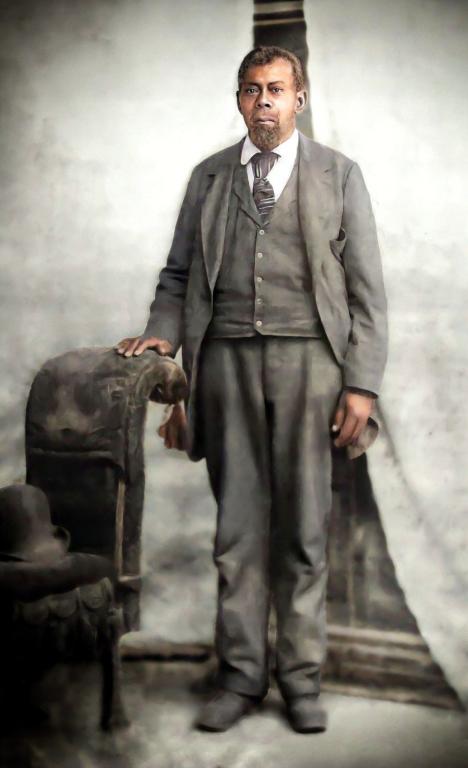
Finally, I share a passage from the interview about the status of slavery in antebellum California. A commenter called “Patrice” raised a question on the matter when I told a story of Brigham Young refusing, somewhere in 1850-1854, to send Green Flake to California so that he could be sold by his enslaver. “Patrice” doubted that such a thing could have happened, since California had ostensibly outlawed slavery:
And then, with the California Gold Rush, a lot of Southerners went to California, bringing enslaved people with them. So, I’ve seen different estimates, some as low as low as 400, but I’ve seen up to 1,500 enslaved people laboring in the gold mines. And there were a large number of Southerners, pro-slavery advocates, who were in the state legislature. So, despite the fact that it was a free state, the legislature came up with ways to allow enslavers to maintain the labor of enslaved people. So they passed one statute, which functionally allowed slavery to exist into the mid-1850s or so.
There is apparently another part of this interview that remains for me to read. So far, though, I see no real daylight between what Reeve and Rich have to say about their book, on the one hand, and, on the other hand, my allegedly lying, self-interested, and sociopathic reports about their book.
Posted from Seaside, Oregon














 Ad-Free & Subscriber Log-In