

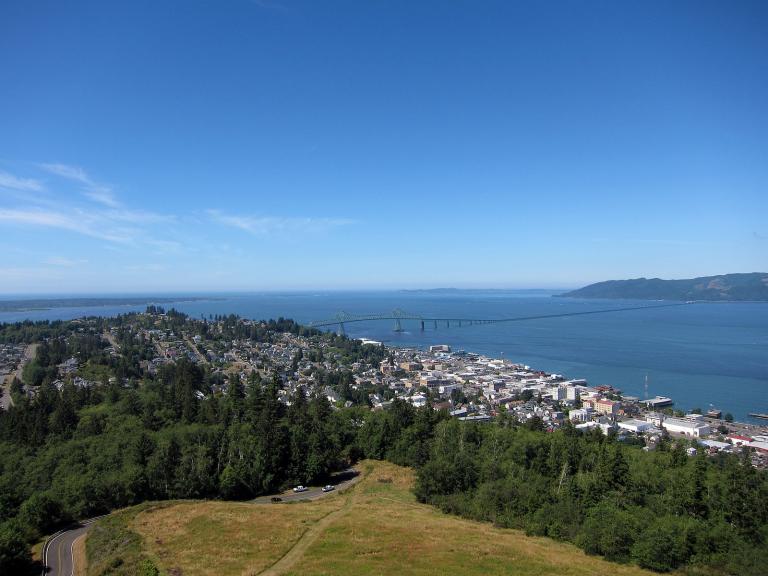
With our friends, we headed up to Astoria this morning. It’s the oldest city in the state of Oregon and, in fact, having been founded in 1811, was the first permanent American settlement west of the Rocky Mountains. Astoria is located on the south shore of the mighty Columbia River, near where the Columbia confronts the Pacific Ocean — creating the most continually turbulent estuary in the United States (and, possibly, in the world). Astoria was named after John Jacob Astor, whose American Fur Company founded Fort Astoria at the site in the early nineteenth century, establishing a monopoly in the fur trade that made him enormously wealthy. (His great grandson, John Jacob Astor IV, was — famously, tragically, and perhaps heroically — a passenger aboard RMS Titanic during its maiden and final voyage. John Jacob IV died at the age of forty-seven, on 15 April 1912.)
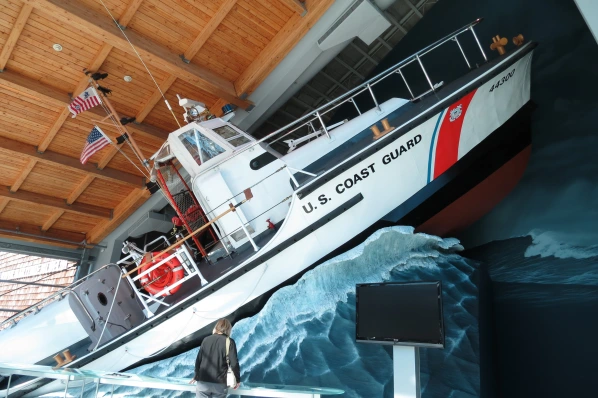
We started off by spending a couple of hours in the very good Columbia River Maritime Museum (CRMM), which does an excellent job of, among other things, telling about the two thousand (or perhaps three thousand) shipwrecks that have occurred along the Oregon coast (and especially near the mouth of the Columbia River) over the past two hundred and fifty years or so and illustrating and celebrating the impressive skill and heroism of members of the United States Coast Guard. Today, we watched a 3D film about a nuclear aircraft carrier and its battle group during international maneuvers. I found it quite interesting. This is perhaps the fourth or fifth time that my wife and I have visited the CRMM, and we recommend it.
We also recommend Bowpicker Fish and Chips, which is where we headed immediately after we were done at the Museum. In fact, Bowpicker is located almost directly across from the Museum in a converted gillnet boat. Bowpicker does Albacore tuna fish and chips. Or, if you would prefer, it also offers Albacore tuna chips and fish. The fish is caught locally, usually about thirty-five miles off shore, and it’s very, very good, which explains why there’s always a queue (which moves fairly rapidly). There are also no tables or seats, except for one park table with benches that’s situated across the street.
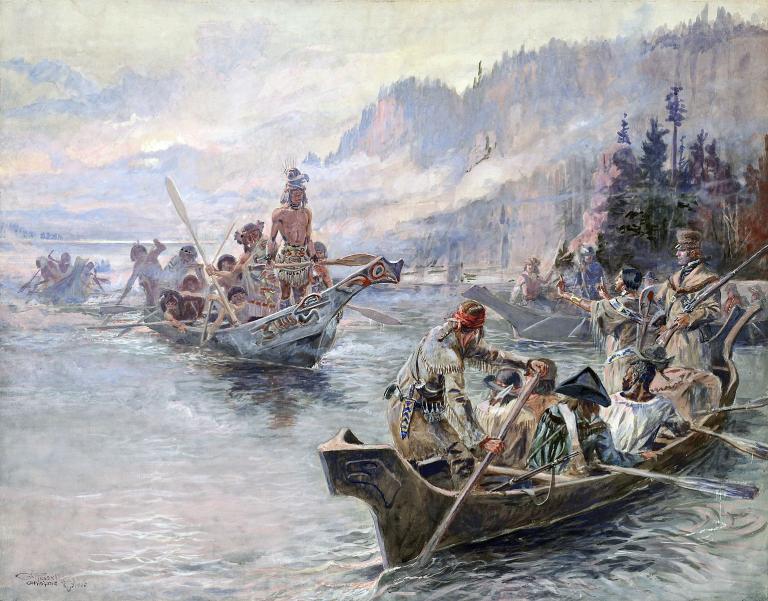
(Wikimedia Commons public domain image)
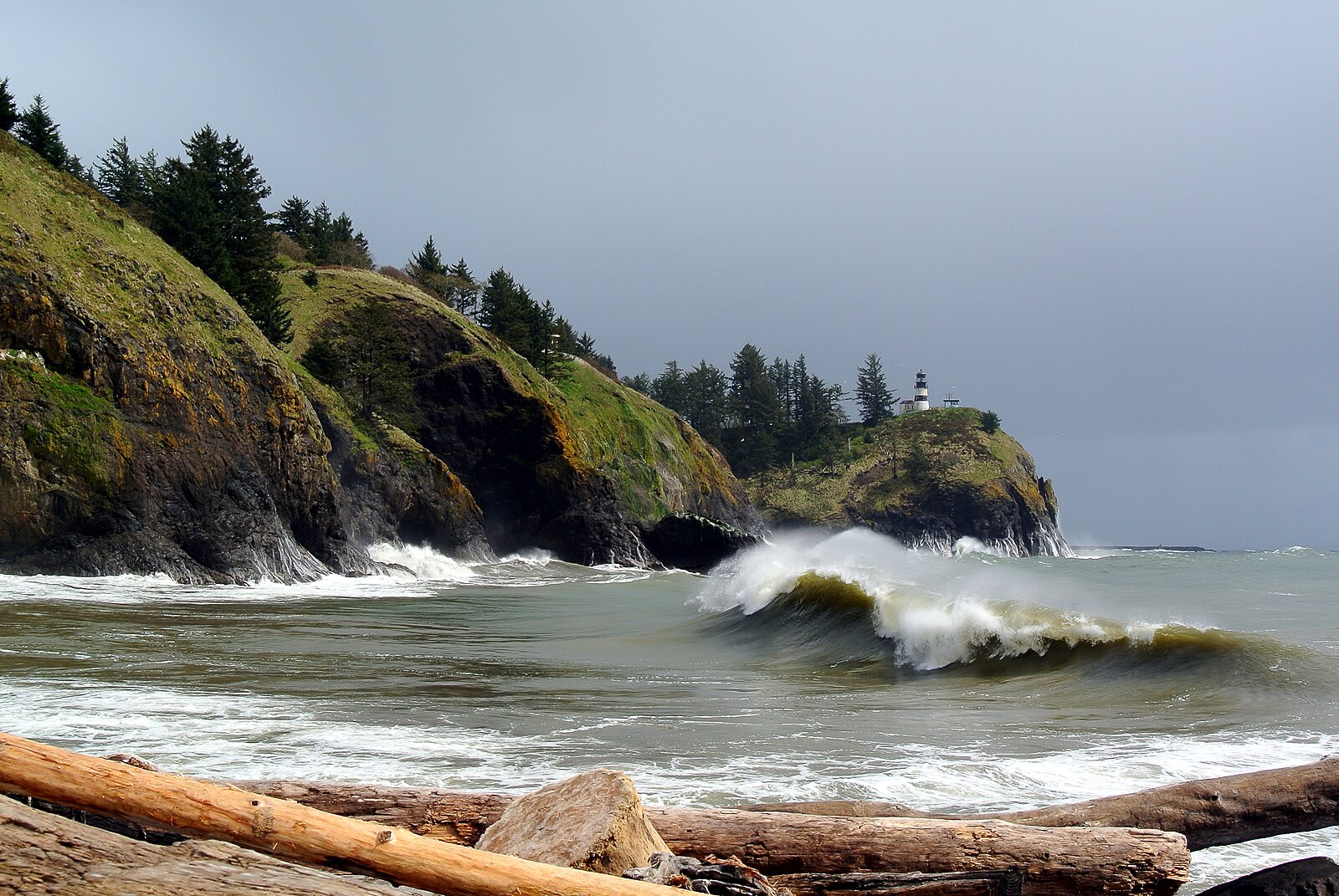
From Bowpicker, we drove up the hill to the Astoria Column, with its panoramic view of the surrounding area. Then we crossed over the Lower Columbia River via the Astoria-Megler Bridge to the state of Washington, where we spent a fair amount of time at the Lewis and Clark Interpretive Center, high up on the cliffs at Cape Disappointment.
In the gift shop at the Columbia River Maritime Museum, I browed through a book entitled
On a March evening in 1964, ten-year-old Tom Horning awoke near midnight to find his yard transformed. A tsunami triggered by Alaska’s momentous Good Friday earthquake had wreaked havoc in his Seaside, Oregon, neighborhood. It was, as far as anyone knew, the Pacific Northwest coast’s first-ever tsunami. More than twenty years passed before geologists discovered that it was neither Seaside’s first nor worst tsunami. In fact, massive tsunamis strike the Pacific coast every few hundred years, triggered not by distant temblors but by huge quakes less than one hundred miles off the Northwest coast. Not until the late 1990s would scientists use evidence like tree rings and centuries-old warehouse records from Japan to fix the date, hour, and magnitude of the Pacific Northwest coast’s last megathrust earthquake: 9 p.m., January 26, 1700, magnitude 9.0—one of the largest quakes the world has known. When the next one strikes—this year or hundreds of years from now—the tsunami it generates is likely to be the most devastating natural disaster in the history of the United States. In The Next Tsunami, Bonnie Henderson shares the stories of scientists like meteorologist Alfred Wegener, who formulated his theory of continental drift while gazing at ice floes calving from Greenland glaciers, and geologist Brian Atwater, who paddled his dented aluminum canoe up coastal streams looking for layers of peat sandwiched among sand and silt. The story begins and ends with Tom Horning, who grew up to become a geologist and return to his family home at the mouth of the river in Seaside—arguably the Northwest community with the most to lose from what scientist Atwater predicts will be an “apocalyptic” disaster. No one in Seaside understands earthquake science—and the politics and complicated psychology of living in a tsunami zone—better than Horning. Henderson’s compelling story of how scientists came to understand the Cascadia Subduction Zone—a fault line capable of producing earthquakes even larger than the 2011 Tohoku quake in Japan—and how ordinary people cope with that knowledge is essential reading for anyone interested in the charged intersection of science, human nature, and public policy.
I dunno. Maybe we should check out of our place here in Seaside and move a bit further inland and higher? My quick skim through The Next Tsunami probably won’t be any particular help with a good night’s sleep tonight.
By the way, I remember that 1964 earthquake in Alaska. My parents and I were camping on the beach near Ventura, California, when we were awakened by park rangers in (what seemed to me) the middle of the night and told to evacuate the beach for fear of a coming tsunami. They told us that it might conceivably be as high as a hundred feet. When it actually arrived, though, it was (fortunately) only a foot or two above normal. However, my older brother, ten years my senior, wasn’t with us. He was at home in San Gabriel. When he and his cronies heard about a coming tsunami, though, they immediately headed for Santa Monica, where they spent all night floating on their surfboards waiting for The Wave to come. They were deeply disappointed. But what if it had really come in at a hundred feet high? They would have ended up crashing through the glass on the fifth floor of the Pacific Telephone building, high up on the cliff above the Pacific Coast Highway.
Posted from Seaside, Oregon






 Ad-Free & Subscriber Log-In