


We headed to Fort Stevens State Park this morning, where we were able to look at what remains of the Peter Iredale, a four-masted steel ship that ran ashore in 1906 and is now (when the tide is low) one of the most accessible shipwrecks on the West Coast. It has been slowly decaying on the beach for more than a century. Then we clambered around some of the former gun emplacements there that were designed to defend the mouth of the Columbia River, and we paid a visit to the site’s military museum.
For reasons that I, at least, do not know, the Japanese devoted more attention to the Oregon coast during the Second World War than they did to the coasts of California and Washington. Perhaps — I’m speculating here — they were unaware of the treacherous water conditions at the confluence of the Columbia River and the Pacific Ocean and imagined that they might be able to use the river to penetrate far inland during some hoped-for future invasion?
I was previously unaware of this interesting story: On the night of 21-22 June 1942 — so, roughly half a year after the attack on Pearl Harbor and the declaration of war by the United States on Japan — the Japanese submarine I-25 surfaced off of Fort Stevens and fired seventeen shells from its 14 cm-caliber deck gun at the fort, making it the first military installation within the contiguous United States to come under enemy fire during World War II. For reasons that remain both somewhat mysterious and a bit controversial, the commander of the fort ordered his men not to return fire. (Twenty-six of them went temporarily AWOL thereafter in disgusted protest, for which they do not, so far as I know, appear to have been punished.) The Japanese attack did no damage to the fort itself, but the submarine did manage to destroy the backstop of the post’s baseball field.
The commander of Fort Stevens was evidently concerned that, if his artillery were to open fire, the flames from the gun barrels would be visible in the dark and would signal their precise position to the gunners of the I-25. (He was reportedly concerned about the safety of two thousand troops in the fort’s wooden barracks.) But fire (or smoke) from cannon barrels would always be a factor in any combat use of the weapons — and one wonders exactly what he thought their purpose was if, in fact, they were never to be used. Was the presence of a surfaced Japanese submarine — well within the territorial waters of the United States, at the entrance to one of the nation’s principal rivers and firing at an American military camp — not sufficient reason to return fire? If not, what would have constituted sufficient reason?
After lunch — yes, I admit it: I ate yet again today! — we spent two or three hours at Fort Clatsop in the Lewis and Clark National Historical Park. An interesting visitor center stands there, accompanied by a replica of the fort where the Lewis and Clark Expedition made its encampment near the mouth of the Columbia River during the winter of 1805-1806. The ranger guide there gave us a marvelously information-rich lecture alongside the reconstructed fort, and he stood around thereafter to answer questions that some of us had about such subjects as the later life of York, the enslaved man who was an important member of the “Corps of Discovery,” and the still-disputed 1809 shooting death of Captain Meriwether Lewis. (Was it murder or suicide?)
Here’s an interesting fact: We know reasonably well (though not quite precisely) where the Fort Clatsop of Lewis and Clark stood, and the area has been carefully examined, archaeologically speaking. Yet the ranger told us that no trace of the fort has ever been found, and were it not for the written accounts surviving from the expedition itself and for later recollections of Native Americans and perhaps others who claim to have seen it, there is no evidence that it was actually ever there. I couldn’t help but be reminded of something that I wrote several years ago for the Deseret News: “A Note on the Limits of Archaeology.”

While I was thinking about Lewis and Clark and the epic trail that they blazed from the Mississippi River to the Pacific Ocean, I came across this piece, from the Cowboy State Daily: “Bill Sniffin: Wyoming Could Use A Big New Monument – How About The Historic Oregon Trail? Columnist Bill Sniffin writes: “The Oregon Trail has significant sites and sights all across Wyoming that are still in place which deserve recognition. It is worthy of a more important national designation.”
I strongly agree with Mr. Sniffin. I believe that the Oregon Trail, which, as he points out, intersected with the Mormon Trail, the California Trail, and the Pony Express route, deserves more attention, more national notice, and more celebration than it seems to have received thus far. For what little it’s worth, I intend to drop him a note expressing my own support for his idea. I hope that something comes of it.
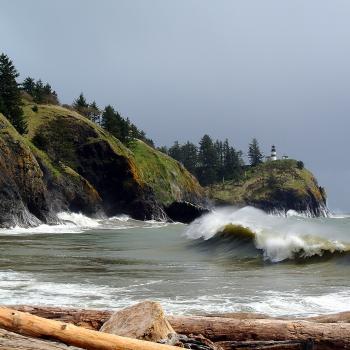
(Wikimedia Commons public domain image)
I want to call your attention again to the call for papers that has gone out for a conference that is planned to be held on the campus of Brigham Young University on 29-30 May 2026: ““For a Wise Purpose in Him”: Perspectives on the Small Plates of Nephi (1 Nephi – Words of Mormon).” The deadline for the submission of paper proposals is 1 October 2025. That’s somewhat less than a month away now.
I hope to submit a proposal myself. And, if that doesn’t completely kill your enthusiasm, I hope that you’ll consider proposing a paper. Details about the nature of the proposals that we are seeking can be found at the link that I’ve just provided.
Posted from Seaside, Oregon











 Ad-Free & Subscriber Log-In