

This particular item is probably also to be found — I haven’t looked for it there yet — in the legendary (but not merely mythical) Christopher Hitchens Memorial “How Religion Poisons Everything” File™: The Interpreter Foundation Podcast — August 21, 2025: Interpreter Articles and “Are Latter-day Saints Happier?”
For the second 21 August 2025 episode of the Interpreter Foundation Podcast, Terry Hutchinson, John Gee, and John Thompson discussed various recent articles in Interpreter: A Journal of Latter-day Saint Faith and Scholarship and recent posts on By Common Consent and Times and Seasons titled (in part) “Are Latter-day Saints Happier?”
While we’re talking about the Hitchens File, though, I did locate this item in it: “Which states have happiest people — and what creates happiness? WalletHub study finds emotional and physical well-being, work and community contribute happiness”
Of course, inquiring minds want to know the reason behind Utah’s dismal showing in this study. And it’s not hard to understand the background: Plainly, involvement with the Church of Jesus Christ of Latter-day Saints leaches happiness right out of the souls of those who are so unfortunate as to be involved with it. If the Church weren’t so dominant in the state, there can be no real question that Utah would have ranked first. Consider the state’s restrictive liquor laws alone: Can there be any actual happiness in a place that so severely limits chemical assistance?
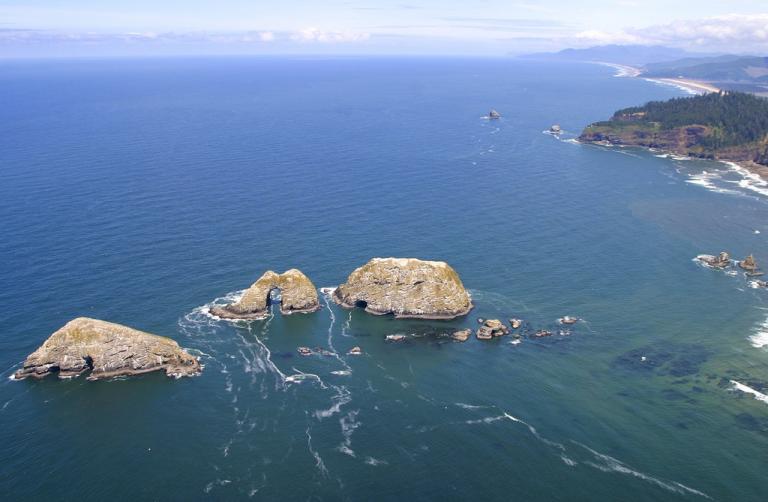
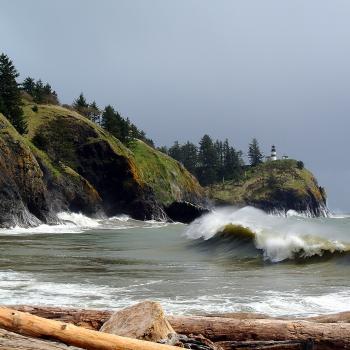
with Cape Meares National Wildlife Refuge (http://www.fws.gov/oregoncoast/capemeares/index.htm) and Oregon Islands National Wildlife Refuge (http://www.fws.gov/oregoncoast/oregonislands/index.htm) in the background. (Roy W. Lowe/USFWS)
We drove down the Oregon coast today. Obviously, we made our pilgrimage to the Tillamook Creamery. We also drove over to Cape Meares, where we walked about to the various sights and spectacular scenic overlooks. In fact, we stopped at quite a number of overlooks. (The Oregon coast can be rather grand.) The metereological forecasts had suggested that today would be quite rainy, but it wasn’t. Instead, the weather was surprisingly sunny and pleasant.
Yes. Yes. Yes. I’ve eaten — eaten food — several times during this trip. I won’t even attempt to deny it. And, sometimes, I’ve enjoyed the food. Shameful, I know, but there you have it.
Leaving the Seaside/Astoria area was a bit sad, and particularly so, in a sense, because we had just discovered Broder Strand in Astoria and because I had just discovered that the Pig’N Pancake restaurant near where we were staying in Seaside makes not only really good sourdough pancakes (which I already knew, though I had forgotten how good they are with a triple berry syrup) but also — my new discovery — extremely good thin and crispy Swedish pancakes that are topped with imported lingonberries and whipped butter.
There is a significant Scandinavian heritage in and around Astoria. There is, for example, a Finn Ware shop there, and Suomi Hall, where Lodge #2 of the Finnish Brotherhood meets, and, as I saw only yesterday, an Astoria Nordic Heritage Park. What really delighted me several years back, though, on our first visit to the area, was to see a lodge building for the Sons of Norway (Sons of Norway Land – Nidaros Lodge No. 18). Honestly, I’d never really thought of the Sons of Norway before, except in connection with jokes that my father told me while I was growing up. Here’s one of them:
The local Sons of Norway are holding a meeting to discuss the problem of their lodge’s declining membership. The discussion goes back and forth, and none of the suggestions has really captured the enthusiasm of the assembled lodge members.
In the back of the room, though, Ole has been raising his hand, hoping to get the attention of the others. (In such stories, it’s always Ole.) Finally, the lodge’s leader calls on him. So Ole stands up and addresses his fellow Sons of Norway.
“Vell,” he says, “diss iss a difficult problem. But,” he continues, “I tink I haff de solution. I say ve change de name uff de lodge from de ‘Sonss uff Norvay” to de “Sonss uff B@#$%es,” ant denn ve can include de Svedes, too!”
At Broder Strand in Astoria, my wife and I shared æbleskiver (a kind of Danish pancake), served with lingonberry jam; kotbullar (Swedish meatballs) in an absolutely delicious mushroom sauce or soup; and Norwegian potato lefse of the kind that my grandmother used to make — the love of which, after she died when I was just five years old, my father passed on to me. Alas, though, my kitchen skills don’t extend much beyond boiling water, and my wife isn’t especially fond of potato lefse. Moreover, like my mother before her, she’s very reluctant to make it because it’s both labor-intensive and exceptionally messy. And, to make the situation even more deeply tragic, on the rare occasions that I’ve seen lefse for sale (e.g., in Norway and at the Norwegian pavilion at EPCOT in Orlando, Florida), it’s almost always been flour lefse, which just isn’t my family tradition and which I don’t like nearly as much. Several years ago, we found a place in rural Minnesota that made wonderful potato lefse, exactly like the lefse with which I grew up (which even Broder Strand’s wasn’t, not quite), so I bought a fair amount of it and we (or, anyway, I) ate it for several days thereafter. I was delighted to learn that they would also ship it — but less so when I discovered that the price was roughly comparable to that for shipping gold bullion.
For a day or two, though, up by Seaside and Astoria, I was reveling in Scandinavian food — or, to use a phrase from C. S. Lewis in a sense very unlike his own, in “pure northernness.”
Posted from Gleneden Beach, Oregon









 Ad-Free & Subscriber Log-In