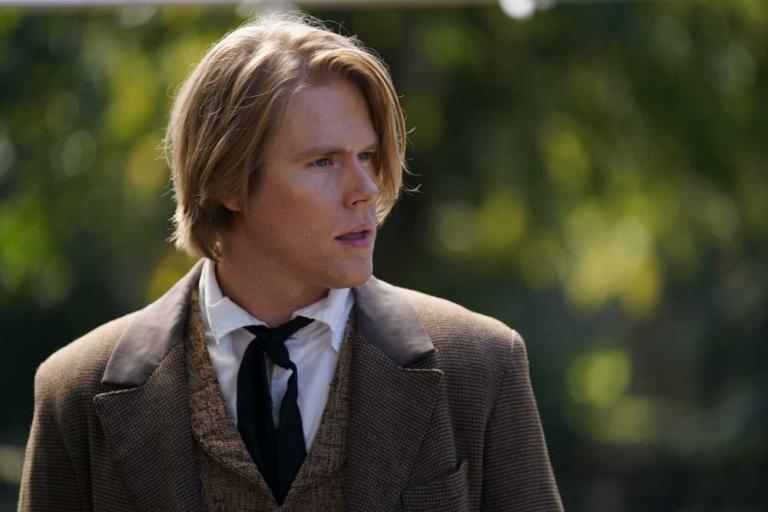
We tend to think of Brigham Young as the stern-faced old man from the few existing photos. But what was he like during his formative years? Our hosts explore this question, and Camrey interviews Susan Easton Black to get the historian’s perspective on the young Brigham.
And, of course, Episode 6 and all of the five preceding installments of the series are available at becomingbrigham.com. Please watch, enjoy, subscribe, and share.
At the Universiteit Utrecht, where Pim van Lommel received his medical degree. (Wikimedia Commons public domain image)
I was busily occupied this morning (see below for part of the reason) and I’ll be out and away from my computer for several hours this evening, so I think that, today, I’ll content myself to some extent with sharing some notes from my reading of Consciousness Beyond Life: The Science of the Near-Death Experience (New York: HarperCollins, 2010), by the Dutch cardiologist and researcher Dr. Pim van Lommel:
When heart patients without an NDE were asked to describe their resuscitation, they always made one or more essential errors, unlike patients who had an NDE during their resuscitation and who were able to recall surprising details of this procedure. (128)
And it is even harder to find a materialist explanation for perceptions at a considerable distance from the hospital or for verified perceptions by visually handicapped or blind people. (128)
There’s a reference in this next passage to an article published in The Lancet, which is a weekly peer-reviewed general medical journal. Founded in London in 1823, it now has additional offices in New York and Beijing and is generally ranked among the world’s oldest, most prestigious, and best known general medical journals. The article to which reference is made (and which I recommend) is Pim van Lommel, Ruud van Wees, Vincent Meyers, and Ingrid Elfferich, “Near-Death Experience in Survivors of Cardiac Arrest: A Prospective Study in the Netherlands,” The Lancet 358, no. 9298 (December 15, 2001): 2039–2045.
Reports of out-of-body episodes can include verifiable facts that people could not have seen or heard with their normal senses and that doctors and nurses never mentioned afterward. These reported perceptions usually take place from a position outside and above the body and sometimes even from outside the room where the body lies. As mentioned, medical and nursing personnel were usually stunned by the level of detail patients knew about their resuscitation and almost always responded with surprise or disbelief. The story of the dentures that were removed and stored during a resuscitation, which was published in The Lancet and told earlier, is inexplicable to most scientists because the patient knew details about his resuscitation and the appearance and actions of the doctors and nurses in attendance despite entering the hospital in a coma and being transferred to the intensive care unit for respiration while still comatose.
Out-of-body experiences are often difficult to corroborate if the NDEs took place many years ago. Additional prospective research is needed to verify out-of-body experiences shortly after resuscitation. But there are so many well-documented cases of people leaving their body, with a great many verifiable details, that it is virtually impossible to cast doubt upon them or to ascribe them to fantasy or imagination. (128-129)
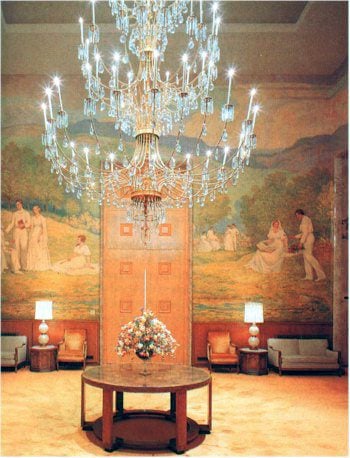
The Celestial Room of the Idaho Falls Temple. Please note the heavenly reunions depicted in the mural on the wall.
And here are three passages that I marked while reading Brent L. Top, What’s On the Other Side? What the Gospel Teaches Us about the Spirit World (Salt Lake City: Deseret Book, 2012):
“I have a father, brothers, children, and friends who have gone to the world of spirits. They are only absent for a moment. They are in the spirit, and we shall soon meet again. . . . When we depart [from this life], we shall hail our mothers, fathers, friends, and all whom we love, who have fallen asleep in Jesus. . . . It will be an eternity of felicity.” (Joseph Smith, cited on pages 42-43)
We have more friends behind the vail than on this side, and they will hail us more joyfully than you were ever welcomed by your parents and friends in this world; and you will rejoice more when you meet them than you ever rejoiced to see a friend in this life. (Brigham Young, cited on page 43)
What is more desirable than that we should meet with our fathers and our mothers, with our brethren and our sisters, with our wives and our children, with our beloved associates and kindred in the spirit world, knowing each other, identifying each other . . . by the associations that familiarize each to the other in mortal life? What do you want better than that? What is there for any religion superior to that? I know of nothing. (Joseph F. Smith, cited on page 43)
Whenever you’re feeling down, think about such things.
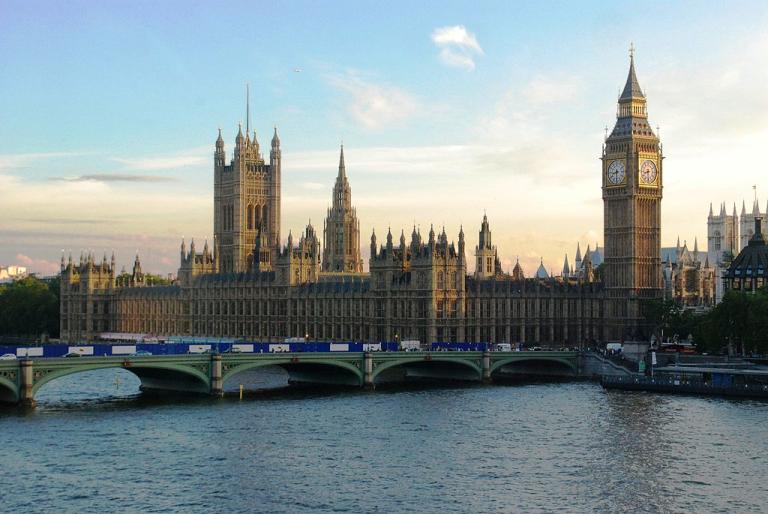
The Palace of Westminster (Wikimedia Commons public domain photograph)
As is my (perhaps unfortunate) habit, I spent a few minutes today reading at an online site where the dominating spirit seems to be one of anti-religious mockery, contempt, and derision, where a perpetually-cultivated sneer appears to have taken on the character of a permanent rictus. And I couldn’t help but think of a passage from the Anglo-French writer, historian, and parliamentarian Hilaire Belloc (1870-1953):
The Barbarian hopes — and that is the mark of him — that he can have his cake and eat it too. He will consume what civilization has slowly produced after generations of selection and effort, but he will not be at pains to replace such goods, nor indeed has he a comprehension of the virtue that has brought them into being. Discipline seems to him irrational, on which account he is ever marvelling that civilization should have offended him with priests and soldiers. . . . In a word, the Barbarian is discoverable everywhere in this, that he cannot make: that he can befog and destroy but that he cannot sustain; and of every Barbarian in the decline or peril of every civilization exactly that has been true.
We sit by and watch the barbarian. We tolerate him in the long stretches of peace, we are not afraid. We are tickled by his irreverence; his comic inversion of our old certitudes and our fixed creed refreshes us; we laugh. But as we laugh we are watched by large and awful faces from beyond, and on these faces there are no smiles.
One of the goals of this most recent blood test is to determine whether I have any actual human DNA or whether, instead, my genome is entirely reptilian. (Wikimedia Commons public domain image)
I want to get out in front of a potential conspiracy theory: In preparation for a routine physical examination that’s scheduled for the next few days, I gave a blood sample this morning at a nearby medical laboratory. All of the blood that I gave was my own. I generated it; it came from my arm. I offer this clarification in order to forestall any claim over at the Peterson Obsession Board that I used somebody else’s blood for the test, that it came from a naïve and duped donor to the Interpreter Foundation.














 Ad-Free & Subscriber Log-In