

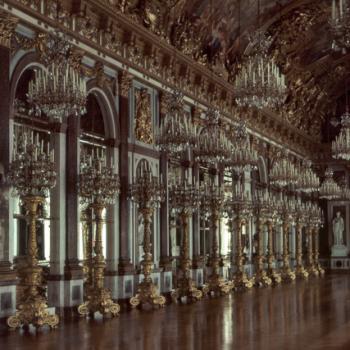
(Wikimedia Commons public domain image)
Episode 6 of our new Becoming Brigham series will go public tomorrow (Monday). In the meantime, a thirty-second-long teaser for the new episode is already available for viewing online, and the previous five episodes — including the most recent — are readily accessible at becomingbrigham.com.
And, in other film-related news, the Church of Jesus Christ of Latter-day Saints has just released a new video for the approaching Easter holiday: “Easter Video Invites All to Find ‘Greater Love’ Through Jesus Christ.” I encourage everyone to give it a look. It’s quite short, only a little bit more than four minutes in length.
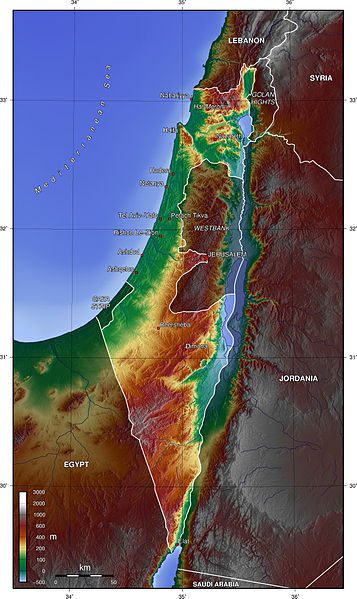
Israel/Palestine is essentially a mountain ridge, flanked on the West by a coastal plain going down to the Mediterranean Sea and, on the East, by a steep decline into the Jordan Rift Valley (a northern continuation of Africa’s Great Rift Valley) on the East, which is the deepest gash into Earth’s crust anywhere on the planet. (The Dead Sea lies 1407 feet below the surface of the Mediterranean.) Jerusalem sits high on the mountain ridge; the altitude of the Old City is roughly 2500 feet, with Mount Scopus and the Mount of Olives looming above it even higher.
From the Daily Mail, in the United Kingdom, comes an intriguing report — but one that should be received with some degree of caution or tentativeness. Surely the headline itself goes just a tad too far: “Scientists confirm biblical earthquake that shook the earth at the moment of Jesus’ crucifixion”
I was saddened, by the way, to learn of the lethal Iranian missile strike on the Israeli city of Beit Shemesh (בית שמש, lit. ”House of the Sun”). We’ve driven by the city more times than I can count; it’s along one of the main roads between Jerusalem and Ben Gurion International Airport, and I always try to point it out (as a biblical/historical site) to the passengers on our bus.
Staying for a moment more on Middle Eastern issues, I enjoyed this opinion piece by Shima Baradaran Baughman, the Iranian-born Woodruff J. Deem Professor of Law at Brigham Young University, whom I met last year at a conference in Samarkand, Uzbekistan, in which both of us participated: “Opinion: A turning point for the Middle East: Resist the temptation to oppose anything associated with Trump. Iranians around the world rejoice to not be standing alone anymore” By the way, traveling from Dubai to Samarkand and then, after the conference, from Tashkent back to Dubai, I flew across the entirety of Iran — airspace that is now closed to civilian traffic and replete with missiles and drones — before a turn eastward, avoiding Afghan airspace, toward Uzbekistan. And, beyond the American participants, I interacted there mostly with Iranian academics from Tehran, Qom, and Isfahan, whom I quite liked. (I was even invited to participate in a forthcoming conference in Qom.) This does tend to bring things home a little bit.

(Wikimedia Commons public domain photograph)
I really like this piece by Danny Frost, which was originally written for Public Square Magazine and has now appeared in the Deseret News: “Bowling for a Strike at BYU and Beyond.” In large part, it’s a defense of Elder Clark G. Gilbert against recent attacks against him.
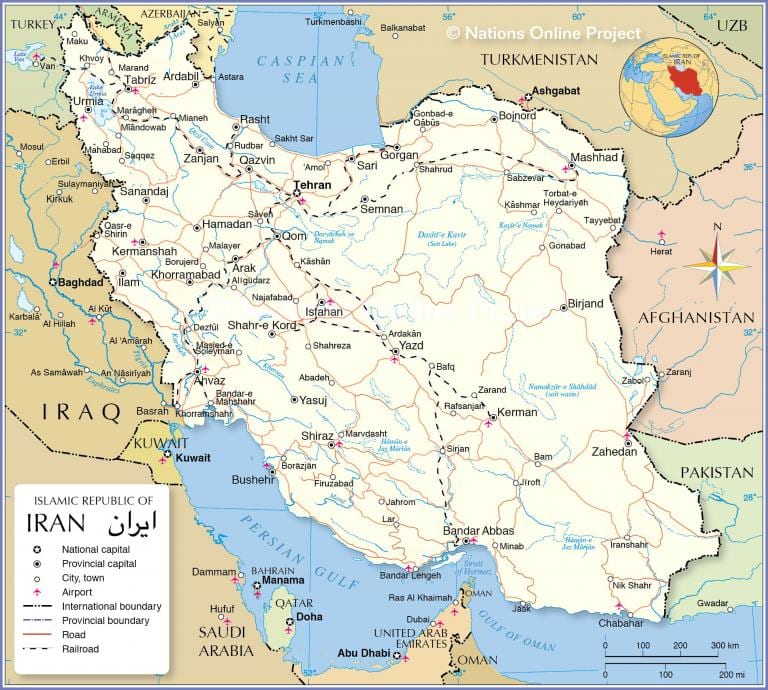
I try not to do politics of any kind on the Sabbath, but some of you may have noticed that there have been some political developments recently in Iran and the surrounding region. So I’m back, briefly, to the Middle East:
President Trump and others have been encouraging the Iranian people to take matters into their own hands, to overthrow the autocratic Islamic Republican regime and take this opportunity as a step toward freedom. In fact, his goals for the current military campaign against Iran seem to rely upon the idea of popular uprising. And it would indeed be wonderful if that could happen. The Iranian people deserve much better than they’ve had for the past half-century or so, and I know that many of them have desperately yearned for change.
However, dissent in Iran was recently set back in a major way by the government’s brutal repression: I’ve seen several estimates that, since the very end of last year, the regime has killed something on the order of 30,000 pro-democracy demonstrators. Which means that the opposition has been significantly wounded, weakened, and reduced, and perhaps even that many of its most committed and courageous leaders have been killed or, at the least, imprisoned (where they’re likely been tortured). And there is no clear opposition leader — with the possible exception of Reza Pahlevi, the former Iranian crown prince (on whom, maybe a bit more tomorrow or the next day) — because any even remotely plausible in-country person around whom dissent might have coalesced has long since been eliminated.
Moreover, with Ali Khamenei and many other leaders of the regime dead, and with Mr. Trump and others calling for the government’s overthrow, the Islamist regime is fighting for its life. Perhaps literally. And that makes it quite likely that the opposition will be repressed with even greater ferocity than heretofore. Further, whereas Iraq, for example, was a dictatorship completely focused on the egomaniacal Saddam Hussein, such that his toppling ended his regime, the Islamic Republic is far more bureaucratized and institutionalized. The mere elimination of Ali Khamenei, though a serious blow, doesn’t end the regime. Anyway, he was 86 and ailing, and probably not much involved in the day-to-day decisions and operations of the state. His departure was biologically imminent in any case. More serious, probably, is the apparent elimination of many of the leaders of Iranian intelligence and the military, the heads of the Islamic Revolutionary Guard Corps and the Basij militia, etc. In fact, the loss of central control may explain some of the weirder aspects of the Iranian response (e.g., the missile and drone attacks on civilian targets in the United Arab Emirates, Saudi Arabia, and so forth): The Iranians should have been trying to drive a wedge between the United States and the Gulf Arabs but, instead, these attacks have galvanized Arab hostility against an aspiring Shi‘ite Persian regional hegemon.










 Ad-Free & Subscriber Log-In