

My attention was caught by this article in the Deseret News: “Perspective: Iraq’s future is visible every day in the faces of its young people: We take the war seriously. But I mostly see ordinary people continuing to do their best to build stable lives, educate their children and contribute to their communities”
Why? Because its author, Brad Cook, contributed a volume to Brigham Young University’s onetime Middle Eastern Texts Initiative (METI), which, umm, well, I conceived and founded and led for many years. METI produced bilingual editions of books (mostly Islamic, but also sometimes Eastern Christian and Jewish) from the classical Islamic world. The books were printed at Brigham Young University Press and distributed by the University of Chicago Press.
The volume in question in this particular case is Bradley J. Cook and Fathi H. Malawi, eds.,
Unfortunately, a few years after my enforced departure from the Neal A. Maxwell Institute for Religious Scholarship, where I had chosen to house the otherwise rather free floating METI project, it was transferred by the Maxwell Institute to the massively expensive E. J. Brill Publishing in the Netherlands.
The volume compiled by Cook and Malawi features what I still consider the best single line that we ever published in the METI project. But, first, just a tiny bit of prefatory material:
Al-Ghazālī (d. AD 1111), who was one of the most significant figures in the history of Islamic thought, a legendarily brilliant philosophical theologian and legal thinker who spent most of his life in Iran and Iraq but who also sojourned for a significant period in Jerusalem, is talking about extremely poor students, and, in that context, attributes the following remark to Jesus:
“Even though I managed to raise the dead, I have never been able to cure an idiot!”
(See al-Ghazālī, “O Son!,” trans. David C. Reisman, in Classical Foundations of Islamic Educational Thought, ed. Bradley J. Cook and Fathi H. Malkawi [Provo, UT: Brigham Young University Press, 2010], 103.)
Now, I’ll admit that my first inclination when I came across the passage was to say that this alleged statement can’t possibly be authentic. And that’s still probably correct. But al-Ghazālī is entirely serious, and he plainly regards the statement as genuine. Furthermore, his citation of it takes us back fully a thousand years or more, halfway to the time of Jesus. So . . .
I have to confess that I rather like the idea that the Savior might have said such a thing. It humanizes him a bit. Surely, with all those long walks from Nazareth to Capernaum, and from Capernaum to Jericho, and from Jericho to Jerusalem, and from Jerusalem back up to Capernaum or Nazareth, it can’t all have been immortal sermons and solemn earnestness. (Can it? Maybe I’m just not fit for heaven.) There must have been some small talk. And the image of Jesus trudging along with the disciples down those dusty paths and confiding, at the end of a tough day, “You know, Peter? I can raise the dead, but I just can’t cure idiots” is oddly appealing to me.
Still, alas, it’s probably bogus.
Wikimedia Commons public domain image
We had lunch this afternoon with a kinsman who shall remain nameless here because his only criminal offense, so far as I’m aware, is being related to me by marriage. Otherwise, he is innocent, and he doesn’t merit an assault from my Malevolent Stalker, my Mini-Stalker, or any other member of that curious menagerie.
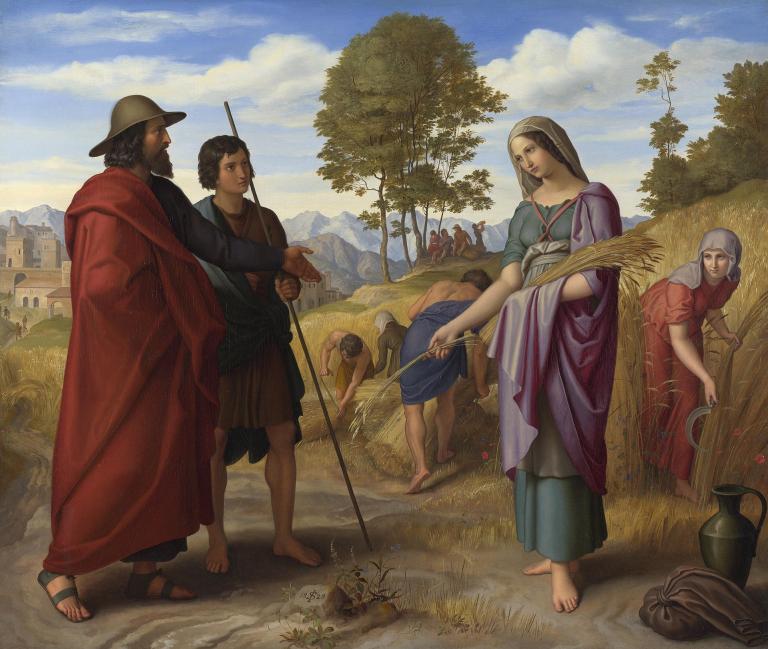
In the morning, we attended a stake institute class in Mesa that is taught by a friend (who shall be unnamed for different but analogous reasons). It’s spring break here, and so she indicated that her numbers were down a bit. (They’re normally up around seventy, she says.) Understandably, most (but not quite all) of those in attendance were women, and the focus of the course that they’re attending this year — it’s our friend’s seventh year of teaching stake institute, and the subjects have varied fairly widely in previous years — is on women in the Old Testament. Today’s lesson, very substantial, very well prepared, and very well taught, focused on the pleasant and rather pastoral story of Naomi and Ruth. Class members seem to have come prepared, having read the biblical text for the week. There was good discussion, and I’m delighted that such a class is offered during a weekday here, in at least this stake: I don’t know how widespread such stake classes are in the Phoenix area or beyond; I wish that all stakes in the Church offered such an opportunity. It would greatly enrich the intellectual and spiritual life of Latter-day Saint women.

Eight episodes of Becoming Brigham are now up for your viewing pleasure. The eighth one went up yesterday. New installments, with one planned exception or perhaps two, will continue to be posted every Monday into the middle of 2027.
Posted from Scottsdale, Arizona















 Ad-Free & Subscriber Log-In