

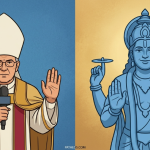
Imagine attending an interfaith panel discussion where all the major religions are represented. If you were asked to guess the ethnicity of the speakers, you might find yourself a bit flummoxed. The Christian representative could be from anywhere—of any color, nationality, or cultural background. The Muslim? If you haven’t been around the block too many times, you might guess that he or she would be Arab. And yes, you might be right—but it’s far from guaranteed. Anyone familiar with the global breadth of Islam knows the speaker could come from virtually any part of the world outside of Antarctica.
The Jewish representative, statistically speaking, is most likely to be Ashkenazi, with ancestral roots usually tracing back to Eastern Europe. But would you expect someone from Israel? Perhaps not. And yet Jews also come from Africa, Asia, and many places beyond.
Hindu Pluralism
Now we come to the Hindu. What DNA is swimming in that pool? Here, I can say with great confidence that there is over a 95% chance you will see someone of Indian origin on that dais. They might not have been born in India, but you can safely assume that an ancestor was. When people think of Hinduism, their minds almost always go straight to India. Yes, Nepal is a Hindu-majority nation as well—but unless you are Nepali, that is probably not where your mind goes first.
So why is this? Why does the third-largest religion in the world—with over a 1,000,000,000 adherents spread around the globe—retain such an overwhelmingly exclusive bond with just one country? I’ll offer two major reasons.

. India has long been home to extraordinary religious diversity. Several communities—Jews, Bahá’í, Zoroastrians, Buddhists, and minority Muslim groups—arrived as spiritual refugees fleeing persecution elsewhere. The sense of pluralism that permeates Indian culture fostered levels of acceptance that were historically rare. It is true that over a millennium ago, when Buddhism seemed poised to overtake Hinduism as the dominant religion of India, Śri Adi Shankaracharya responded vigorously through philosophical debate. But even then, there was never a sense that those who remained Buddhist were somehow “lost” or “damned.”
The Exception to the Rule
Some point to the International Society for Krishna Consciousness (ISKCON) as an example of Hindu proselytism. In its early days in the West, the movement was, to some observers, somewhat heavy-handed in its attempts to gain devotees. But even if this was an exception to the general rule, it is important to note that ISKCON has since reformed its outreach to mirror more traditional methods of sharing Dharma—namely through publishing, academics, and public lectures. These approaches allow interested people to explore the tradition without feeling pressured.
Conquest or the Lack Thereof
The other reason for Hinduism’s close association with India is that, for the most part, Hindu rulers did not value imperial expansion. India’s neighbors did not have to fear Hindu armies invading their homelands and replacing their culture or religion. Of course, wars between Indian kingdoms certainly occurred. While ahimsa is an honored virtue, plenty of rulers engaged in military conflicts. But the imperial paradigm that the West perfected—spreading one’s faith through territorial conquest—was never an organizing principle for Hindu polities. In much of the world, religions spread when conquering armies settled in new lands. This does not imply that the conquered were always “converted by the sword,” but there is ample evidence that adopting the religion of the new regime often made life easier.
So there you have it. The next time you visit a Hindu temple and wonder why nearly every face you see carries the smile of Bharat Mata—Mother India—you’ll know the reasons. And those reasons, I believe, are noble.








 Ad-Free & Subscriber Log-In