

Explore the perfectly imperfect series finale of Good Omens 3: a deep dive into Aziraphale and Crowley’s “final 15” with a surprising theological twist.
SPOILER ALERT: HIGH
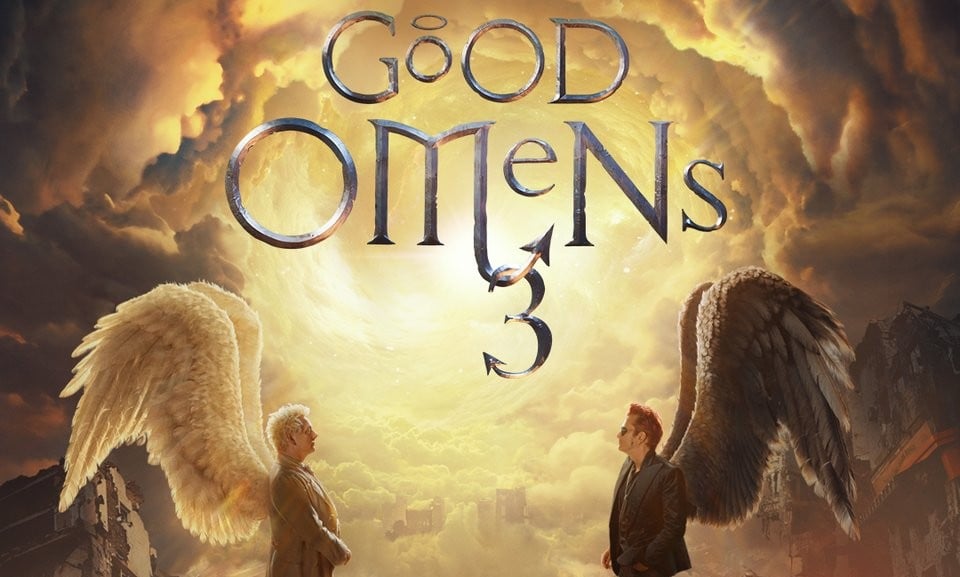
Starring Michael Sheen as the angel Aziraphale and David Tennant as the demon Crowley, Good Omens 3 is a perfectly imperfect ending to the series.
After an excruciating three-year wait, Amazon Prime/BBC released Good Omens 3 on May 13, 2026, as a 90-minute series finale. The series is based on the book Good Omens: The Nice and Accurate Prophecies of Agnes Nutter, Witch by the late Terry Pratchett and Neil Gaiman, with Season 2 adding all new material to the story line. The Season 3 finale faced enormous hurdles that precluded the previously planned six-part series. Yet, as director Rachel Talalay notes, the movie-length format allowed for a tighter storyline focusing on the essentials of the series.
Fans may debate what those essentials are, but a resolution to the emotional cliffhanger between Aziraphale and Crowley in the “final 15” of season two was a must.
From a theological perspective, the last episode of season two also begged for a resolution to the recurring themes of eschatology (the end times), theodicy (God’s relationship to evil), and anthropology (the human condition). In my humble yet theologically-educated opinion, the “final 15” of Good Omens 3 resolves these theological issues imperfectly.
But that’s the point.
And the outcome for Aziraphale and Crowley shows us why this imperfect ending is perfect for them, and maybe for us as well.
Let’s examine the Final 15 of Seasons 1 and 2 to set the stage.
Season 1’s Final 15: Thwarted Apocalypse
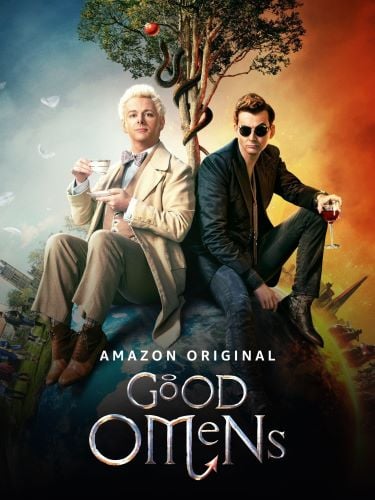
The first season’s final 15, “The Very Last Day of the Rest of Their Lives,” sets the stage by showing what happens when a 6,000-year plan for Armageddon meets human (and angelic-demonic) interference.
- The pre-teen Antichrist, Adam, rejects his hellish heritage and restores the world to its pre-apocalypse state, choosing an ordinary life in Tadfield over his destiny.
- After a yearning-filled moment at a bus stop, Aziraphale and Crowley are hauled to their respective realms to face execution for treason.
- Crowley is sentenced to a bathtub of holy water, and Aziraphale to a column of hellfire. To the shock of their superiors, both survive completely unscathed.
- Following Agnes Nutter’s prophecy to “choose your faces wisely,” it is revealed the two swapped bodies to survive their executions.
The season closes with the pair at the Ritz toasting “to the world.” As a nightingale sings in Berkeley Square, we see our heroes as they are meant to be: the world intact, Crowley “a little bit good,” and Aziraphale “just enough of a bastard to be worth knowing.”
Theological Stakes: Why Season 1 Matters
The finale of Season 1 introduces the core tensions that haunt the rest of the series:
- Eschatology: We are left in a “not yet” end times where human and celestial will have delayed the pre-ordained 6,000-year conclusion.
- Theodicy: Angels are heaven-bent and demons are hell-bent on destruction. They are equally reckless and feckless. God remains a silent observer, offering only silence and distance, with the trace of benevolent amusement.
- Anthropology: Humanity comes out on top. Adam chooses love over evil, while Aziraphale and Crowley’s appreciation for food, wine, and art affirms that human culture and relationships are worth saving, even on the world’s worst day.
Good Omens Season 2 Final 15: Heartbreaking Divergence
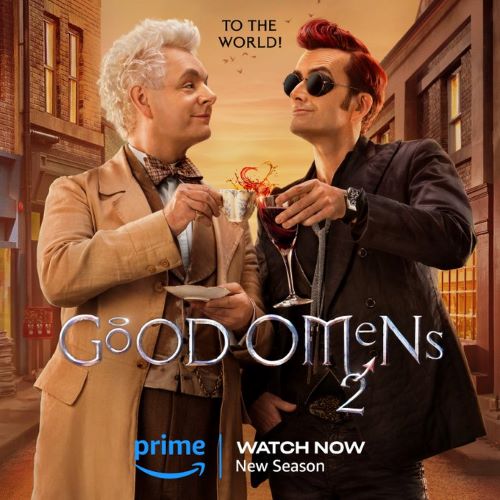
The final fifteen minutes of Season 2 reveal that even the most rigid celestial hierarchies can be subverted by love. But not always with a happy ending.
- We learn Archangel Gabriel and the demon Beelzebub have abandoned their posts for each other. Rejecting “Armageddon 2,” they choose to leave the conflict behind for a life together in Alpha Centauri.
- Inspired by this departure, Crowley prepares to confess his feelings to Aziraphale. However, the Metatron (the Voice of God) intervenes with a Machiavellian offer. Aziraphale can become Supreme Archangel and, crucially, restore Crowley to full angelic status.
- Aziraphale is bursting with the news, convinced they can “make a difference” together from the inside. Crowley, horrified, sees only a “toxic” system and begs Aziraphale to leave both sides behind and just “be an us.”
- In a final “Hail Mary” attempt to reach him, Crowley kisses Aziraphale. The response is a devastating “I forgive you,” followed by Crowley’s bitter “Don’t bother.”
As the nightingale falls silent, the two go their separate ways: Aziraphale ascends to Heaven to manage the Second Coming, while Crowley drives off in the Bentley alone.
Theological Stakes for Season 2
The Season 2 finale shifts the series’ focus from preventing an end-times war to surviving an institutional machine. The final fifteen minutes leave several profound theological tensions unresolved:
- Eschatology: The reveal of the Second Coming proves that despite thwarting one Armageddon, Heaven’s hierarchy remains committed to a destructive end-times plan. The core tension lies between the “Ineffable Plan” and the rigid, corporate “Great Plan.” Aziraphale’s belief that he can “make a difference” from within a system designed for destruction is an unresolved tension.
- Theodicy: Season 2 upends traditional morality by portraying Heaven as a sterile, manipulative bureaucracy. Through gnostic dualism, Heaven views physical matter as “gross,” allowing them to end the world without remorse. The Metatron’s “Coffee or Death” ultimatum proves the “good guys” can be just as devious as the “bad,” obsessed with winning rather than the flourishing of Creation.
- Anthropology: Having been in the human world over 6,000 years, Aziraphale and Crowley are defined by their connection to Earth rather than their celestial origins. The dagger-through-the-heart tragedy is that even a six-millennia bond can break under competing visions of “good.” Ultimately, Aziraphale is unable to pivot from his mission and cannot embrace the vulnerability and physical desire Crowley offers.
Good Omens Season 3 Final 15: Perfectly Imperfect Ending
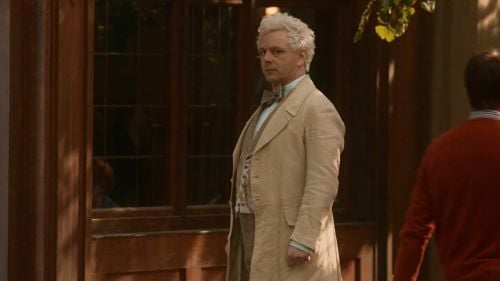
The final 15 minutes of Good Omens 3 find Aziraphale and Crowley back in the bookshop. It is the only place left after the angel Michael dementedly destroyed the universe by tossing the Book of Life into the Eternal Flame. Following years of painful separation, the pair had finally reunited when the Metatron, Jesus, and the Book of Life go missing and Aziraphale seeks Crowley’s help. Over a delectable meal of dim sum, Aziraphale had explained that his choice to go to Heaven was because the demon had showed him repeatedly that he could “stand up for what I believe in.”
Now, after “rescuing” both Crowley and their beloved Bentley and solving the mystery of the Heavenly murders, Aziraphale asks for Crowley’s forgiveness. He knows his intentions to “do the right thing” and turn Jesus’s Second Coming into a chance for “universal happiness” brought unmitigated misery to the one he loves. Crowley grants this forgiveness and their relationship is finally healed.
Yet they are not alone. Satan, in the form of a balding middle-aged white man, enters the shop and reveals his motives for being the “Adversary” in the losing battle that dragged Crowley and the rest of the fallen angels down with him. “It is about pride and honor. It’s about refusing to acknowledge humans as superior. It’s about challenging God,” he says.
And it is this very God who Aziraphale and Crowley summon to the bookshop by writing divine omnipresence into a makeshift Book of Life. God, in the form of a regal Black woman, finally allows each of them to ask their ultimate question.
The Anthropological Questions of Good Omens 3
Crowley’s is an anthropological question. “Why make people and then punish them for behaving like people?” he asks. “Humans are going to human. They are born into a world that is against them in a thousand different ways. And they devote most of their energy to making things worse,” he continues. “Where you’ll find the real grace and the real heart-stopping evil is right inside the human mind.”
He wisely notes that a person cannot be judged by the worst or the best thing they’ve ever done. So why make them that way?
When Aziraphale suggests the human condition is the result of free will, Crowley points out that the deck is stacked against them by God herself.
Then God invites Aziraphale’s question. He begins by asserting that he wanted to do the right thing – even though he was “lazy, gluttonous, and prideful,” in God’s words. The angel concedes the point, noting that he was still the second-best angel. Who was the best?
“This one,” Aziraphale says, moving toward Crowley. “You were the best of us. You cared so much about everything. . . the only one of us who genuinely believed there had to be a sensible purpose to it all.”
Then he turns to God with his heartrending question. “Why did you give me Crowley? Why make me complete and then take it away?”
It is the question that pools in the tears of anyone who has ever lost their true love. The anthropological implications are that human love is finite, messy, and bittersweet.
The Final Answer to the Problem of Evil
God’s answer? “Because you were able to value what most people never even know they have. Your love for him was the messiest, silliest, most predictable thing in the universe. And it always made me smile.”
Ah, there it is – the divine amusement, even while remaining aloof and ineffable. Yet, this is troubling. God takes delight in love but takes no responsibility for its pain. To sharpen the point, with a wave of her hand, God is ready to end the universe. No regrets. No second chances. And no second thoughts. God was just playing a game after all. And the game is over.
Until Crowley speaks up. “I don’t accept that. And I don’t accept that you’re the one that gets to make all the decisions.” This demonstrates a strong anthropological assertion: that created beings are moral agents who can say no even to God. It’s not prideful, like Satan’s refusal. Rather, it’s rooted in love and solidarity.
Surprisingly, God gives them the opportunity to choose what they want and gives them a moment of privacy. In this eschatological time-out, the angel and demon find themselves in an Eden-infused bookshop. The Tree of Knowledge is the library, and the library is a Tree of Knowledge! And together, they are a Tree of Life!
Aziraphale implies that the only thing he wants is to be with Crowley. But he asks what Crowley wants.
Eschatology in Good Omens 3: Ending the world by handing it back
Eventually they return to God and make their request. They want God to create another universe without angels or demons, God or Satan, Heaven or Hell. No great plan. No ineffable plan. Just start it with the Big Bang and let it play out without interference.
Shocked, God reminds them of the implications of this request. “You’re asking God to create a Godless universe. Neither of you could exist in such a universe.”
There are both eschatological and theodicy implications here. God chooses a kenotic self-emptying of Godself. And the metaphysical beings choose true free will for humans at the cost of their own existence. This is not a God who will set things right, as many religions assert. Rather, God sets the universe free. But is this an act of benevolence or another divine game?
Regardless, Aziraphale and Crowley fully comprehend the cost of their decision as they join hands. Aziraphale places his fingertips on his mouth, just as he did after Crowley kissed him, and touches them to Crowley’s lips. This is a full-circle moment that transforms a gesture of wounding forgiveness into one of true love.
With a final adoring gaze into each other’s eyes, their forms disintegrate into the void.
The “real” God of this universe
True to God’s promise, there is another Big Bang and another Earth comes into view, with a sign reading 13.8 billion years later. Not 6,000 years (as “Young Creationists” believe).
And there stands a bookshop. Just a plain, ordinary bookshop with piles of books and an angelic-faced shopkeeper who looks up to see a red-haired, sun-glassed man come in the door. Asa Fell meets Professor Anthony Crowley, author of a book on astrophysics. A Metatron-looking fellow named Derrick urges his friend to go after the professor. “You liked him. He obviously liked you.”
Later they have dinner at a local bar while Cyndi Lauper’s “Time After Time” plays in the background. The bartender resembles the former angel Michael. Angel Uriel is a waitress. Angel Muriel and Demon Eric are a couple at a table. Adam and Jesus are young men sharing a beer.
Are these characters reincarnated or just echoes from another universe? Did God quietly smuggle in the essence of these former beings to allow them an existence truly free from divine interference?
It is an imperfect ending – emotionally satisfying yet theologically unsettling. It raises the question: Is a world without God better if it means a world with true free will?
Then the camera pans to the face of a man smiling over them all. Here is the real God of this universe: Terry Pratchett. From a painting on the wall, he toasts them all, his glass holding a snow globe of the universe he created. It is a fitting tribute to his ongoing legacy.
In a Garden
As we were promised at the beginning of the first episode of Good Omens season one, “It starts, as it will end, in a garden.” Now with grey hair, Asa and Anthony are finally in their South Downs cottage. They are neither angel nor demon. No special powers, no miracles, no devious tricks. Just a bookshop owner and a professor. Yet they have found each other after 13.8 billion years.
However, Aziraphale’s question remains in our memories: “Why did you give me Crowley? Why make me complete and then take it away?”
We know in this universe their lives will not extend for thousands of years as it had in the previous universe. One of them will die, and then the other, as it will be for us all.
Yet they have each other for perhaps a few decades. And they have their cottage in the South Downs beneath a starry sky with a shooting star (debris of Halley’s Comet, Professor Crowley specifies). They hold their scrumptious cocoa as they grasp each other’s hands, complete with wedding rings.
The anthropology here is finite and sacramental. The shared cup, the rings, the cottage, the night sky are all outward signs of inward grace. It’s comfortable, it’s comforting, and it’s complete, if only for this brief moment.
And with that, Good Omens 3 concludes with its perfectly imperfect ending.
Read also:
Good Omens: An Antidote to Toxic Christian Apocalyptic Fiction
Falling In Love with Aziraphale and Crowley: Love Leaves Its Clues
Aziraphale’s Choice: The Tragic Theology & Ecclesiology of Good Omens

The Rev. Dr. Leah D. Schade is a seminary professor and ordained minister. Her opinions are her own.
She is the author of Preaching and Social Issues: Tools and Tactics for Empowering Your Prophetic Voice (Rowman & Littlefield, 2024), Preaching in the Purple Zone: Ministry in the Red-Blue Divide (Rowman & Littlefield, 2019) and Creation-Crisis Preaching: Ecology, Theology, and the Pulpit (Chalice Press, 2015). She is the co-editor of Rooted and Rising: Voices of Courage in a Time of Climate Crisis (Rowman & Littlefield, 2019). Her book, Introduction to Preaching: Scripture, Theology, and Sermon Preparation, was co-authored with Jerry L. Sumney and Emily Askew (Rowman & Littlefield, 2023).












 Ad-Free & Subscriber Log-In