


Yesterday we posted about tech magnate Peter Thiel’s view of the Antichrist and his fear that trying to regulate AI, among other technologies, would bring about the totalitarian one-world government that dispensationalists associate with the Antichrist.
Well, novelist Paul Kingsnorth, the former radical environmentalist turned Eastern Orthodox Christian, has been saying that AI is the Antichrist.
Now in my opinion, both are missing the point about the Antichrist, for the reasons I wrote about yesterday, but Kingsnorth has some interesting things to say about AI.
In an interview with Unherd, he made this observation (my emphases):
You have seen lots of warnings from people about how AI could become superintelligent and destroy us. Many of those warnings are coming from the people creating it. It’s not just weirdos like me. The journalist Ezra Klein went to a bunch of these people and asked why, given that they’re warning us it could destroy the world, are they creating it? And he said they couldn’t answer the question. They ended up more or less feeling that they had a responsibility to usher this new being into the world.
Pause to let that sink in.
Kingsnorth goes on:
We’ve got superintelligent AIs being created. Nobody really knows how they work. They’re already talking to each other in ways people can’t understand. They’re already persuading teenagers to kill themselves. Something very sinister is going on. Pre-modern societies wouldn’t have had much trouble understanding it. It’s like the Book of Genesis. Why don’t you just take the fruit of knowledge of good and evil and become as the gods? If you rebel against God, you can be God. That’s what we’re doing. We’re trying to create God.
The interviewer asks Kingsnorth, “do you actually think there’s an external force of some kind that is being made manifest?” Answer:
I’m a Christian, so I do believe in external forces of evil. I don’t want to get too carried away with that because it’s very easy to predict the rise of the Antichrist every five minutes.
Then the interviewer brings up the A-word:
FS: In the book [Against the Machine] you do name it the Antichrist. You say these machines are not just machines. They are something else. A body whose mind is in the process of developing; a body beginning to come to life.
PK: I think that’s true. I’ll stand by that.
I don’t know what the mind is. I don’t know whether the mind is the Antichrist or whether it is a man, or whether it’s something demonic, or whether it’s something that humans can create. I’m not sure we’re actually capable of creating a mind, even though we think we are, but I have the strong sense that something quite dark is happening.
The reference is to Kingsnorth’s new book Against the Machine: On the Unmaking of Humanity. It gets into other interesting subjects. The Free Press has published an excerpt, which it entitles How the West Lost Its Soul.
It begins with an affecting account of the Garden, our Fall, and the coming of Christ. “God himself walks on Earth and what does humanity do? We torture and kill him.”
“But the joke is on us,” Kingsnorth continues, “because it turns out that this was the point all along. The way of this creator is not the way of power but of humility, not of conquest but of sacrifice. . . .Through his death he conquers death itself, releasing us from our bondage. He gives us a way out, a way back home.”
Now imagine that a whole culture is built around this story. Imagine that this culture survives for over a thousand years, building layer upon layer of meaning, tradition, innovation, and creation, however imperfectly, on these foundations. . . .
No aspect of daily life was unaffected by this story: the organization of the working week; the cycle of annual feast days and rest days; the payment of taxes; the moral duties of individuals; the very notion of individuals, with “God-given” rights and duties; the attitude to neighbors and strangers; the obligations of charity; the structure of families; and most of all, the wide picture of the universe—its structure and meaning, and our human place within it.
“Then imagine that this culture dies, leaving only ruins.”
The point to focus on is this: that when a culture built around such a sacred order dies then there will be upheaval at every level of society, from the level of politics right down to the level of the soul. The very notion of an individual life will shift dramatically. The family structure, the meaning of work, moral attitudes, the very existence of morals at all, notions of good and evil, sexual mores, perspectives on everything from money to rest to work to nature to kin to responsibility to duty: Everything will be up for grabs.
Kingsnorth argues that every culture, every civilization, is built on some kind of sacred order.
If you knock out the pillars of a sacred order, the universe itself will change shape. At the primal level, such a change is experienced by people as a deep and lasting trauma, whether they know it or not. No culture can just shrug off, or rationalize away, the metaphysics which underpin it and expect to remain a culture in anything but name—if that.
When such an order is broken, what replaces it? The end of the taboos doesn’t bring about some abstract “freedom”; it strips a culture of its heart. That heart had, in reality, stopped beating some time before, but once the formal architecture is gone too, there is an empty space waiting to be filled—and nature abhors a vacuum.
Rushing into that vacuum, Kingsnorth argues in his book, is consumer capitalism, self-worship, blind faith in technology, and slavery to the Machine.
To his credit, Kingsnorth’s pessimism is countered by his Christian convictions. “This is all very doomy,” he admits to the Unherd interviewer. “We’re talking about the Antichrist and things. But for a Christian, the coming of the Antichrist is all good, because it’s all fine after that. Everything gets sorted. So we’re waiting for that day.”
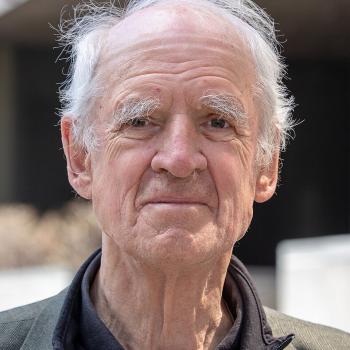
Photo: Paul Kingsnorth by Navjoat Kingsnorth, CC BY-SA 3.0 <https://creativecommons.org/licenses/by-sa/3.0>, via Wikimedia Commons










 Ad-Free & Subscriber Log-In