


In the service of the imposition of ashes, as the pastor marks my forehead, he says something that always cuts through whatever else is in my mind and gets my attention: “Remember that you are dust, and to dust you shall return.”
Now that I have passed my allotted three score years and ten (Psalm 90:10), those words have become very real to me. I am going to die.
This is a memento mori, a reminder of death. The Latin phrase means “remember that you have to die.” That’s a healthy topic to contemplate, according to the ancients, and it has long been a theme for devotions.
This remembrance gives perspective. All of the trivial things we get so worked up about, all of the little worries and petty antagonisms, become much less important when facing up to death. Reflection on the impending fact of our death also turns our attention to eternity and to eternal truths.
In the Roman triumphs, the massive parade and celebration that honored a conquering hero, in the chariot along with the person receiving all this adulation would be a slave constantly whispering in his ear: “Memento mori!”
It was important for the hero, at this moment of glory, to keep in mind that he is a mortal. To forget that is to commit superbia, or, in the Greek, hubris. That is, an overweening pride, which sets a mortal in conflict with the immortal gods. As the heroes in classical tragedy learned, hubris brings on Nemesis, the goddess of retribution, who harshly punishes human beings who think too much of themselves.
The Bible too urges us to remember the fact of our death.
Psalm 90, the prayer of Moses, is a reflection on the transience of human life, and it asks God to “teach us to number our days that we may get a heart of wisdom” (Psalm 90:12).
Isaiah 40 is a memento mori, but it goes on to show what that remembrance properly teaches:
All flesh is grass,
and all its beauty is like the flower of the field.
The grass withers, the flower fades
when the breath of the Lord blows on it;
surely the people are grass.
The grass withers, the flower fades,
but the word of our God will stand forever. (Isaiah 40:6-8)
Reflecting on our transience turns into reflecting on what is not transient–namely, the Word of God, with its message of salvation. That chapter in Isaiah is also full of gospel:
Comfort, comfort my people, says your God.
Speak tenderly to Jerusalem,
and cry to her
that her warfare is ended,
that her iniquity is pardoned. (Isaiah 40:1-2)
Christians took all of this to heart. Seventeenth century portraits often included a skull as a reminder of death. As in this portrait by the Dutch artist Frans Hals:

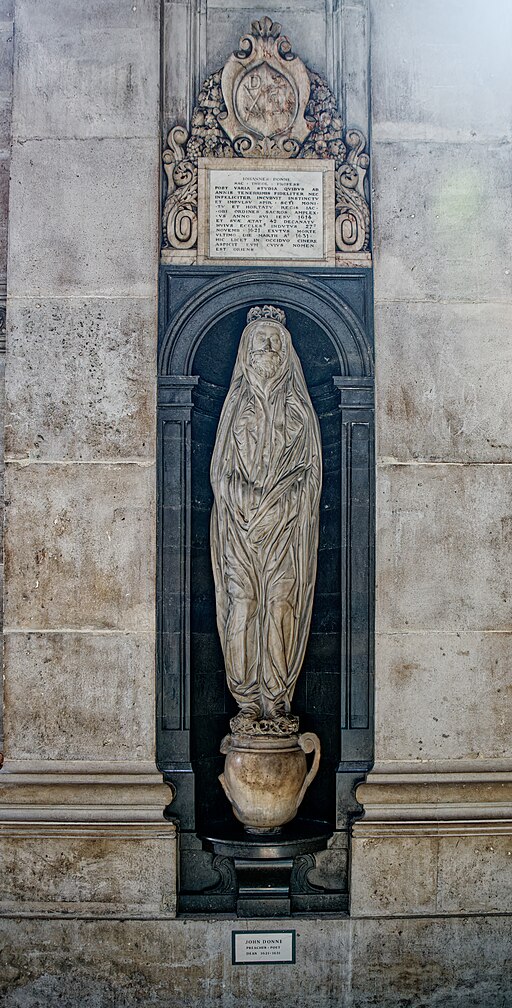
The great Christian poet John Donne took this sort of thing to an extreme when shortly before his death he posed for a sculpture of himself by putting on the shroud he would be buried in. Though some have called this macabre, it was anything but that. The statue was to be the monument on his grave. Today at St. Paul’s cathedral where he was buried you can see this memorial. Instead of showing him lying down in death, Donne’s shrouded image is standing up, wearing a half smile. What Donne, the author of the poem Death Be Not Proud, wanted portrayed was the moment of his resurrection.
The Ash Wednesday exhortation also points to our resurrection.
It quotes the curse of Adam: “By the sweat of your face you shall eat bread, till you return to the ground, for out of it you were taken; for you are dust, and to dust you shall return” (Genesis 3:19). On this beginning of the penitential season of Lent, we should remember that death is the consequence of sin. The reason we will die is that we are sinners. So in facing up to our death, we are confronted by God’s law, leading to repentance.
But St. Paul picks up that verse and transposes it into gospel:
The first man was from the earth, a man of dust; the second man is from heaven. As was the man of dust, so also are those who are of the dust, and as is the man of heaven, so also are those who are of heaven. Just as we have borne the image of the man of dust, we shall also bear the image of the man of heaven. (1 Corinthians 15:47-49)
Christ’s death leads to His resurrection, so when we are in Christ, our death leads to our resurrection! When the pastor makes the sign of the cross in ashes on our foreheads, it recalls the sign of the cross that was made on our foreheads at baptism. (At least for those baptized according to the traditional baptismal liturgy, as I was not. Still, the symbolism holds.) Baptism is about death and resurrection. Christ’s and ours:
Do you not know that all of us who have been baptized into Christ Jesus were baptized into his death? We were buried therefore with him by baptism into death, in order that, just as Christ was raised from the dead by the glory of the Father, we too might walk in newness of life. For if we have been united with him in a death like his, we shall certainly be united with him in a resurrection like his. (Romans 6:3-5)
Ash Wednesday begins Lent, a season of repentance for sin leading up to the commemoration of Christ’s death for that sin, but culminating in the celebration of Christ’s resurrection from the dead. According to St. Paul, we have been with Him all the way. In our baptism, we died with Him; we were buried with Him; and we were resurrected with Him.
And on the last day, after we have returned to dust, He will remake us from dust, breathing into us the breath of life as He did with Adam (Genesis 2:7), and making us part of His New Creation that will last forever (Revelation 21:1-5).
Art credits:
Performing the Ash Wednesday Ceremony via PickPic, Public Domain
Portrait of a Man Holding a Skull by Frans Hals (1615) – Unknown source, Public Domain, https://commons.wikimedia.org/w/index.php?curid=1170209
John Donne Monument, St. Paul’s Cathedral in London, by Nicholas Stone (1631), photo by Tilman2007, CC BY-SA 4.0 <https://creativecommons.org/licenses/by-sa/4.0>, via Wikimedia Commons









 Ad-Free & Subscriber Log-In