Here is something that I think both President Trump’s critics and his fans can agree on: He has a big ego.
He will be putting his signature on our currency. He is putting his portrait on U.S. passports and National Park passes. He has put his name on the Kennedy Center, a new line of battleships, the U.S. Institute of Peace, and children’s savings and investment accounts. (See this for more.)
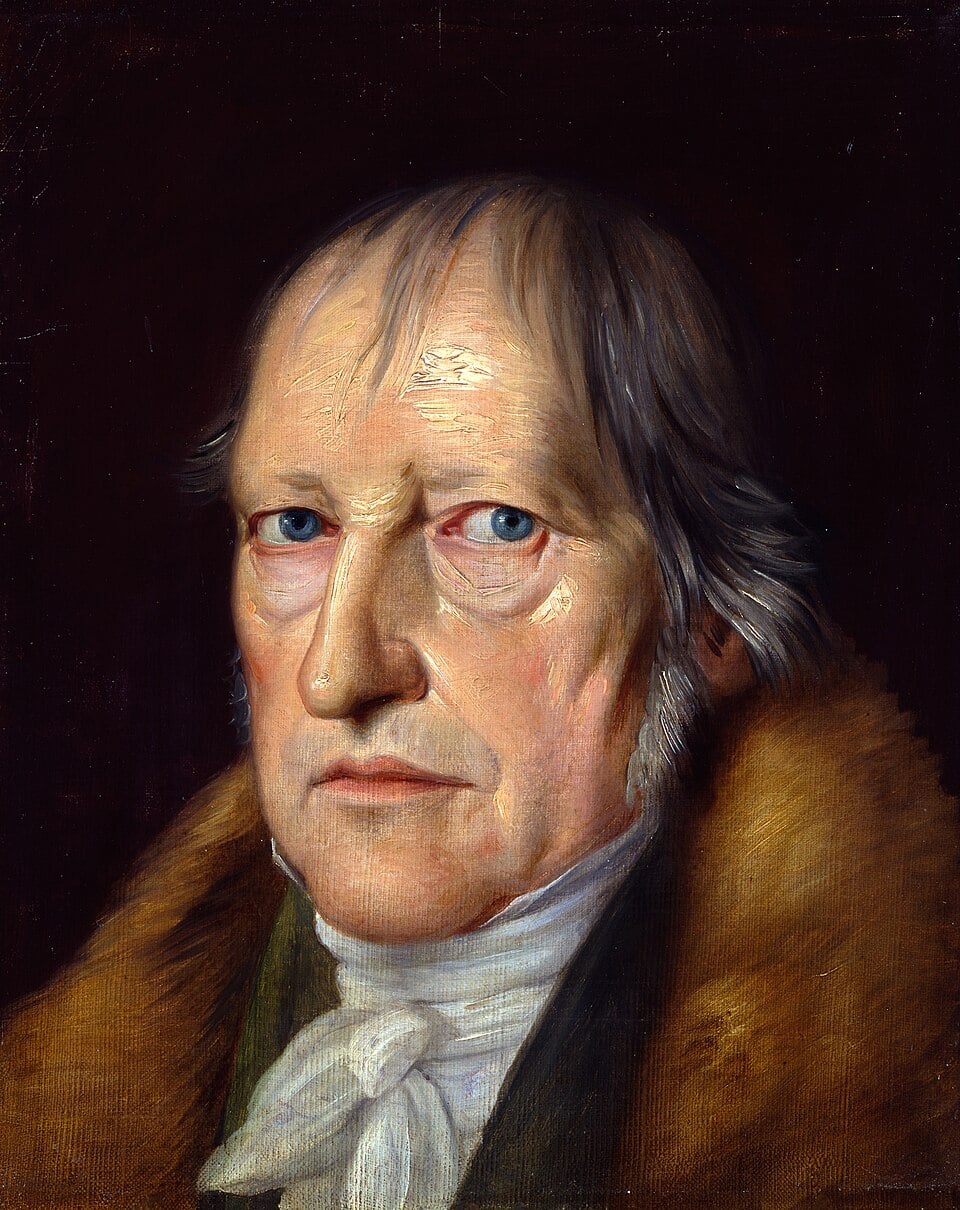
Why is he doing this? The White House has related the plans for our money, the passports, and National Park passes to the nation’s 250th birthday, but the connection isn’t clear. Is this egomania? Megalomania? Or a defense mechanism to compensate for an inferiority complex? Or is he one of Hegel’s “world-historical figures”?
Hegel’s theory of “world-historical individuals,” men who redirected the course of humanity, focused on three figures: Alexander the Great, Julius Caesar, and Napoleon Bonaparte. Hegel described them as unlikely “heroes of an Epoch” for upending established orders that had previously seemed fixed. They were “practical, political men” who were each condemned in their age for smashing norms and for other conduct “obnoxious to moral reprehension”—as Trump has been accused of, centuries later.
And though Trump has long compared himself to America’s two greatest presidents, we were recently told by two people who are in a position to know such things—a senior administration official and a longtime Trump confidant—that the president had, in private conversations, begun thinking about himself less as a peer of George Washington and Abraham Lincoln, and more as an addition to Hegel’s immortal trifecta.
“He’s been talking recently about how he is the most powerful person to ever live,” the confidant told us. “He wants to be remembered as the one who did things that other people couldn’t do, because of his sheer power and force of will.”
“Upending established orders”? Check.
“Smashing norms?” Check.
Condemned for conduct “obnoxious to moral reprehension”? Check.
Remaking the world through “sheer power and force of will”? That puts us beyond Hegel into the territory of Nietzsche and his Superman.
The Atlantic story focuses not so much on whether Trump is one of these “world-historical” figures as the fact that he believes that he is;
He did recently learn about the powerful triumvirate in a brief passage that someone handed him, the senior official told us, although that person couldn’t recall if it was a poem or an essay or something else. The second senior official suggested that Trump might be recalling a speech he heard at a golf-club event last year, where a speaker placed Trump in the frame of historical figures such as Alexander the Great and Genghis Khan.
The article quotes Trump calling his Middle East intervention as “one of the most important moments in the long and complex history of the World.” It cites his planned triumphal arch, reminiscent of Caesar; his golden over-the-top decor, as in the Imperial style of Napoleon’s France; all the portraits, statues, and banners; naming buildings and monuments after himself. (The story might have mentioned Alexander the Great, who, according to Plutarch,
named 70 cities after himself, of which only half a dozen
survive.)
Now I don’t put much store by Hegel, that Lutheran heretic whose philosophy would bear bitter fruit in Marxism and progressivism. Nor do I put much store in those approaches that reduce history to movements of vast, impersonal forces. The “
Great Man” approach to history is not completely wrong. (Hegel, in accord with his dialectical method, resolves the thesis of the Great Man with the antithesis of the vast impersonal forces, in this synthesis, as described in Wikipedia:
Hegel wrote: “Such are great historical men—whose own particular aims involve those large issues which are the will of the World-Spirit.” Thus, according to Hegel, a great man does not create historical reality himself but only uncovers the inevitable future.
Put another way, the world-historical Great Men embody the already-existing spirit of the times.
So what if Trump is one of these pivotal history-changing, world-shaping heroes? Maybe he is.
But that is not necessarily a good thing. What did these Great Men accomplish? What, exactly, did they change in the world?
Alexander spread Hellenistic civilization across the known world, but he also effectively destroyed Greek democracy.
Julius Caesar laid the foundations for the Roman Empire, but to do that he destroyed the Roman Republic, a constitutional system of representative elections, checks and balances, and citizens’ rights that had lasted nearly 500 years.
Napoleon laid the foundations for modern Europe, but to do that he finished off medieval civilization, abolishing feudalism, the Holy Roman Empire, and Christendom, replacing them with a new law grounded in the Enlightenment and despite being a dictator initiated a “liberal” approach to government grounded in the French Revolution.
I suppose that liberal political order is what the next world-historical figure will overthrow. The “world spirit” may be trending that way, with both the left and the right criticizing “liberal democracy.”
Trump certainly has had a major impact. He has changed American political conservatism beyond recognition. He has radicalized progressives by making them want to emulate him. He has blown up NATO and other institutions of the post-war world order. With his whim-driven tariff regimen, he has taken control of the world’s economy. He has made America militarily aggressive, threatening to seize Greenland, arresting a head of state with an incursion into Venezuela, starting a war with Iran.
But let’s hope he is not a world-historic individual. The acknowledged three came to bad ends. After conquering much of the known world, Alexander died at age 32. Caesar was assassinated. Napoleon was overthrown and died in exile.
We’ll see what Trump’s lasting legacy turns out to be. History will be the judge.
Illustration: G. F. W. Hegel by Jakob Schlesinger (1831) https://recherche.smb.museum/detail/963803 (Alte Nationalgalerie), Public Domain, https://commons.wikimedia.org/w/index.php?curid=126943438








 Ad-Free & Subscriber Log-In