

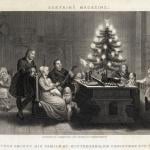
In 1851 when Rev. Heinrich Schwan, who would become the third president of the Lutheran Church Missouri Synod, put up a Christmas tree in his church in Cleveland, Ohio, it caused a scandal:
A prominent local newspaper called it “a nonsensical, asinine, moronic absurdity, besides being silly.” It editorialized against “these Lutherans . . . worshipping a tree . . . groveling before a shrub.” Worse, it recommended that the good Christian citizens of Cleveland ostracize, shun and refuse to do business with anyone “who tolerates such heathenish, idolatrous practices in his church.”
Michael Lockwood, a confessional Lutheran pastor from Australia, addresses this in his book from CPH entitled The Unholy Trinity: Martin Luther Against the Idol of Me, Myself, and I. This is one of those paradigm-shifting books that addresses quite brilliantly how to reach today’s secularists and the “spiritual but not religious.” (I blogged about this book here. Be sure to read the comments for Lockwood’s response.)
In this course of his discussion, Lockwood explains how Luther understood idolatry, in contrast to how the Reformed understand it.
For Luther, idolatry means worshiping a false god. In his explanation of the First Commandment in the Large Catechism, Luther says that whatever we put our faith in is our god. If we put our trust in the God revealed in Scripture and look to Him in our distress,
A god means that from which we are to expect all good and to which we are to take refuge in all distress, so that to have a God is nothing else than to trust and believe Him from the [whole] heart; as I have often said that the confidence and faith of the heart alone make both God and an idol. If your faith and trust be right, then is your god also true; and, on the other hand, if your trust be false and wrong, then you have not the true God; for these two belong together, faith and God. That now, I say, upon which you set your heart and put your trust is properly your god.
If you put your faith, trust, and confidence in anything else–a different deity, or your wealth, or your possessions, or your power, or whatever–you are committing idolatry. Indeed, such idolatry, Luther believed, is the root of all sin. Lockwood goes on to observe that the most common idolatry today, in all of its different manifestations, is faith in one’s self. Much of the book tells how to apply the Law and the Gospel to someone with this mindset.
Lockwood, though, contrasts Luther’s understanding of idolatry as putting one’s faith in a false god with the Reformed view of idolatry, which focuses on the alleged idol’s materiality. Thus, for the Reformed, using any material object in worship as a focus of devotion constitutes idolatry.
Luther’s guiding concern was that our faith and worship life be grounded in the promises of God and the means of salvation he has instituted for us in the Bible. This includes such physical things as the sacraments and the death and resurrection of Christ. The Reformed on the other hand were convinced that God’s transcendence over all created things must be preserved at all costs lest we fall into idolatry. . . .Thus they concluded that our worship must be centered on things that are “spiritual” in the sense of non-visible and non-material. This led them to ban religious images. It also led them–at least from Luther’s perspective–to fight against the created means of salvation that God has instituted. (Unholy Trinity, p. 149)
Luther only opposed religious images if people put their faith in them, which they often did in medieval Catholicism. The Reformed, though, “treated sacred images as inherently idolatrous regardless of whether people worship them or not.”
These same guiding principles led to different views of the Sacrament. If it demeans God’s majesty to be associated with any physical thing, then what about the Sacraments? The basic Reformed opinion was that the rejection of idolatry also entails a rejection of the church’s sacramental system. Although they retained Baptism and the Lord’s Supper, they spiritualized them. They interpreted them symbolically, and denied that God or his power can be present within the elements. . . .
In complete contrast, Luther regarded a high view of the Sacraments as essential if we are to avoid idolatry. That is, he regarded the rejection of Christ’s sacramental presence with us as a rejection of the incarnate Christ that must inevitably lead to idolatry. . . .For Luther, the Sacraments are Gospel, and the Gospel is sacramental. If we say that the means of the Gospel do not actually deliver Christ and his grace to us, then they are not Gospel. Instead, they are laws that teach us how to express our piety or vainly direct us to climb up to God. And if the means of the Gospel are not Gospel, then we have no Gospel. Nor do we have Christ, since we can only grasp hold of Christ sacramentally through the Gospel and not with some self-invented law. (Unholy Trinity, pp. 152-153)
This Reformed mindset that the spiritual must always be separated from the material leads them also, at various points in their theology, to split off Christ’s human nature from His divine nature, rather than admit their coming together in the Incarnation.
Luther certainly believed in God’s transcendence and His glory. “It was Luther’s belief in God’s almighty power that led him to assert that if the Creator chooses to join himself to part of his creation, and to unite the infinite with the finite by becoming incarnate, he is able to do so.” And, to a Reformed critic who argued that the notion that God comes to us through the material realm reduces His glory, Luther “argues instead that God’s glory is revealed most in his willingness to enter into our world and the lowest depths for us.” (Unholy Trinity, pp. 155-156)
So no, “these Lutherans” were not “worshipping a tree.” And to discern Christ’s body in Holy Communion is not idolatry, since Christ is true God. And celebrating Christmas, far from being pagan, is a recognition “that God’s glory is revealed most in his willingness to enter into our world and the lowest depths for us.”
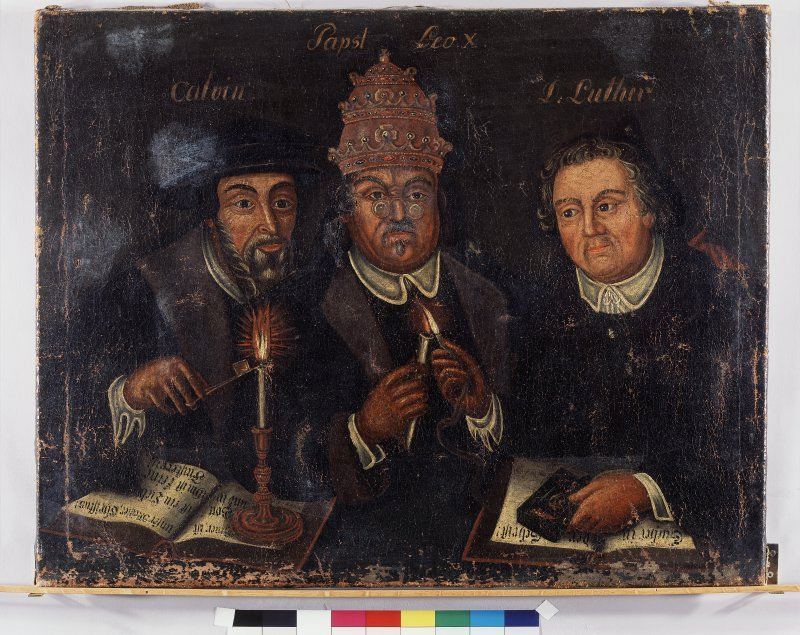
Allegory of the True Faith [Calvin, Pope Leo, Luther] by Anonymous – https://www.nationalmuseum.ch/sammlung_online/?lauftext=LM-76931&sID=&numOf=30, Public Domain, https://commons.wikimedia.org/w/index.php?curid=64303095
[I think this Swiss allegory shows Calvin lighting his candle by himself, while Luther is lighting his candle from that of the pope. Calvin thus has the “true faith,” while Luther is “too Catholic.”]









 Ad-Free & Subscriber Log-In