

Some Lutherans deny that they should be classified as Protestants. And some Protestants are seemingly unaware that Lutherans exist.
In a post for Mere Orthodoxy entitled The Plight of the Protestant Scholar, Princeton graduate student John Ahern laments the way scholarship by orthodox Protestants is overshadowed by scholarship by orthodox Catholics. He is involved with a new study center called Coverdale House that hopes to further distinctly Protestant scholarship.
The first activity of the Coverdale House will be for participants to read and discuss Luther’s Large Catechism. I think that is a brilliant choice. But I was amused by Ahern’s explanation:
We’re choosing Luther to start off for a number of reasons. For one thing, it is a beautiful summation of the gospel, written in simple and immediate language. It will be familiar and affirmative and accessible. But, for another thing, it will also likely shock us. Many of us Protestants in the room will be surprised to find Luther urging us to cross ourselves, Luther telling us to look to our baptisms for assurance of salvation, Luther, like a Desert Father, denouncing one of the “mortal” sins, acedia. We are, as it turns out, reading a historical document. It’s not modern, decidedly not modern evangelical. It will force everyone to engage with the text historically and carefully, and not merely as a mirror held up to one’s nodding self.
The Protestant evangelicals in the room will appreciate Luther’s “beautiful summation of the gospel,” as well they should. But they will be “shocked” that Luther teaches that we should make the sign of the cross? That he believes in baptismal regeneration? Wait until they get to The Sacrament of the Altar!
As Ahern says, Luther’s Large Catechism is “not modern” and is “decidedly not modern evangelical.” It is, however, a “historical document.”
But there are quite a few of us in this modern world who still believe all that stuff in Luther’s catechism–who make the sign of the cross, who hold to baptismal regeneration, who believe the Sacrament of the Altar is “the true body and blood of our Lord Jesus Christ, in and under the bread and wine,” given to us for the forgiveness of our sins–and, indeed, we are obliged to believe it. The Large Catechism is one of the definitive confessions of faith collected in the Book of Concord that all Lutherans must affirm in order to be Lutheran and that contains quite a few other “shocking” teachings.
Many, maybe most, Protestants disapprove of, if they are even aware of, what Lutheranism entails. This has led some Lutherans to refuse to call themselves “Protestants.” This seems odd, since Lutherans pretty much started that whole movement.
The word originally referred specifically to the Lutheran princes who defied the Emperor at the Diet of Speyer in 1526 who planned to enforce the Edict of Worms against them. In response, these Lutheran laymen issued a statement called the “Protestation.” In time, the Zwinglians and others who took their stand on the Word of God and protested the Emperor’s plan to confiscate their property also signed on to the “Protestation,” giving them too a claim to the name.
All of the Protestants–Lutherans, Zwinglians, Calvinists, Anabaptists–differed with each other, but they agreed on insisting that the Bible, not the Pope, is the church’s authority. They also agreed that salvation comes not through acquiring merit by our works but by the grace of God through faith in the atoning work of Christ. This is the “good news,” rendered in Greek as “evangel,” with the adjective form “evangelical.”
Lutherans are sacramental, like Catholics and the Orthodox. They are also evangelical and Biblical, beliefs shared by others who call themselves Protestants.
So we can think of Lutherans as Protestants: sacramental Protestants.
One term proposed for Lutherans is “evangelical Catholics.” But Catholicism has the connotation of papal authority and salvation by good works, which wouldn’t work in this context. But technically, “catholic” means something like “universal.” I think that Lutherans are “catholic” in that sense.
Catholics reject Protestantism, a major stream of Christianity. Catholics are therefore not nearly catholic enough. Regular Protestants reject Catholicism, a major stream of Christianity. Lutherans can draw on both of the great strains of Christianity, upholding what they get right, while avoiding what they get wrong. The result, in my experience of coming to Lutheranism after experimenting with the different strains, is a holistic Christianity.
You could even describe it as “ecumenical”–not in the sense of the modern “ecumenical movement,” which sought church unity by toning down everybody’s doctrine, but by heightening doctrine.
Maybe Lutherans should describe themselves as Catholic Protestants. Or Protestant Catholics.
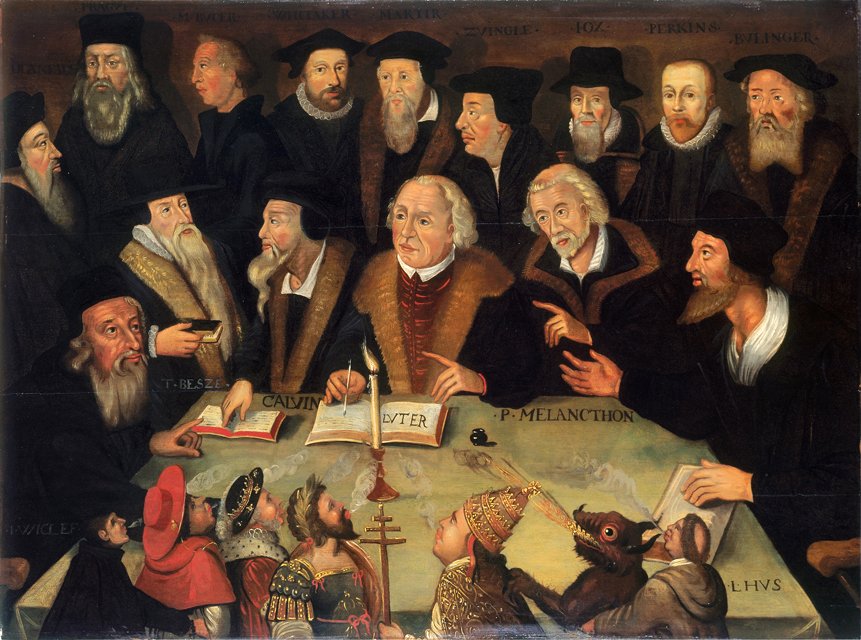
Illustration: Martin Luther in the Circle of Reformers (1650), by anonymous – Deutsches Historisches Museum, Public Domain, https://commons.wikimedia.org/w/index.php?curid=58978204.
[Pictured are Luther at the center, which is fitting, with Calvin on his right and Melanchthon on his left. Also pictured are John Wycliffe, Jerome of Prague, Huldrych Zwingli, Johannes Oecolampadius, Martin Bucer, Peter Martyr Vermigli, John Knox, Matthias Flacius, Heinrich Bullinger, Girolamo Zanchi, Theodore Beza, and William Perkins. Across the table and arrayed against this company are smaller figures representing the Church of Rome and the Holy Roman Emperor.]






 Ad-Free & Subscriber Log-In