

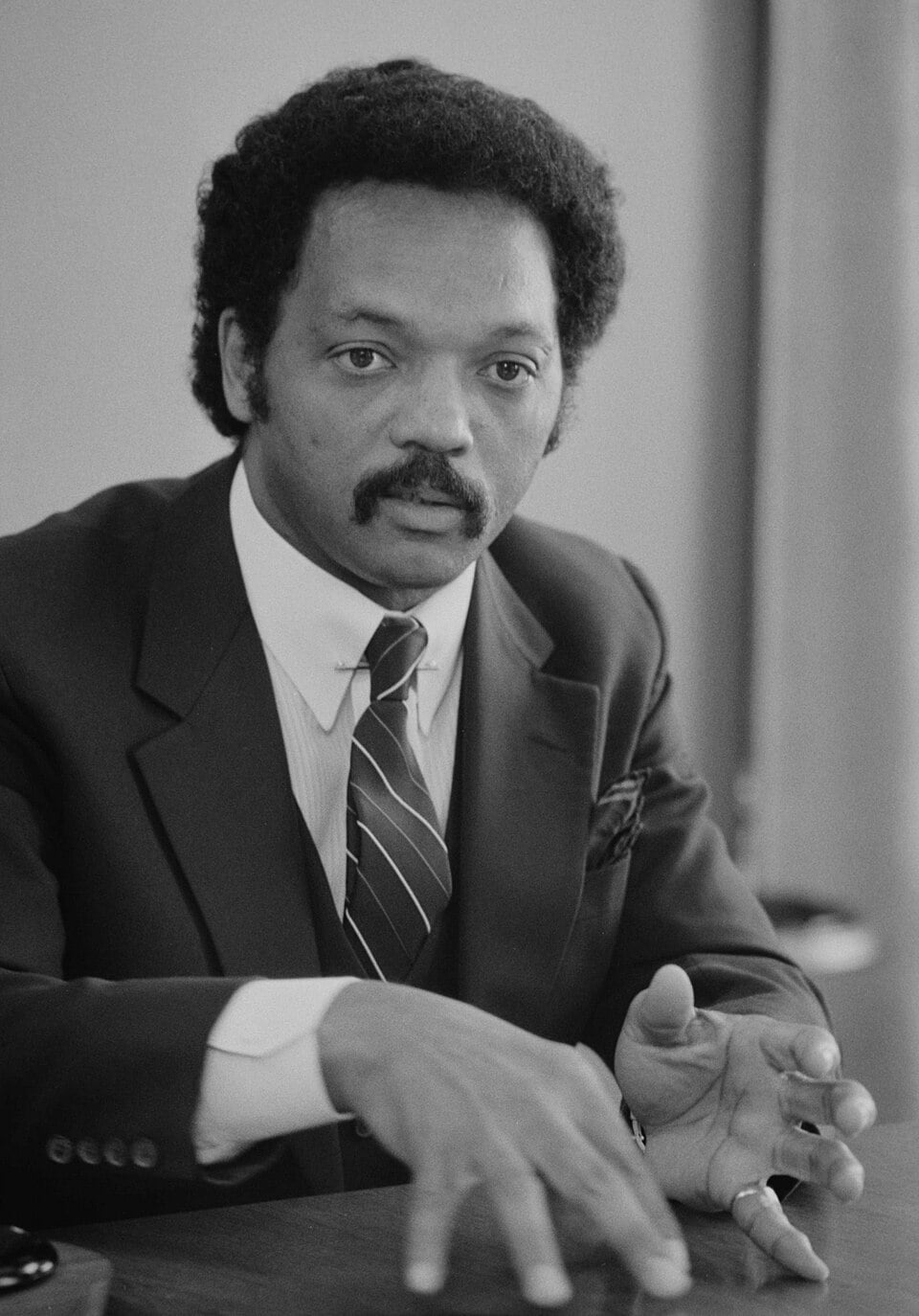
Rev. Jesse Jackson died on February 17 at the age of 84. He was a Civil Rights activist who ran for president twice in Democratic primaries, coming in third in 1984, after Walter Mondale and Gary Hart, and second in 1988, after Michael Dukakis.
He was also a Baptist minister who had been very pro-life. He protested the Roe v. Wade ruling, pushed for a Constitutional amendment against abortion, and was one of the few public figures who stood up for Terry Schiavo, who became a victim of euthanasia.
And yet, tragically, when he ran for president, he changed his tune, accepting abortion so as to be in line with the Democratic establishment.
Lots of Democrats used to be pro-life, but became pro-abortion when they ran for higher office. Those include Joe Biden, Al Gore, Bill Clinton, Dick Gephardt, Ted Kennedy, Dennis Kucinich, Tulsi Gabbard, and Tim Ryan. There are still some pro-life Democrats, though only one in a national office, Texas representative Henry Cuellar.
Changing one’s positions for political expedience–especially ones that are connected to the person’s religious faith, as is the case with Catholic and Evangelical politicians–is shameful, a kind of apostasy in the face of worldly pressure.
Still, you have to read what Jackson said about abortion in 1977. Dan MacLaughlin discusses this issue, quotes from part of the article he wrote, and quotes the conservative satirist P. J. O’Rourke on Jackson’s speech at the 1988 Democratic convention:
“I did, however, want to hear Jesse Jackson speak. He is the only living American politician with a mastery of classical rhetoric. Assonance, alliteration, litotes, pleonasm, parallelism, exclamation, climax and epigram — to listen to Jesse Jackson is to hear everything mankind has learned about public speaking since Demosthenes. Thus Jackson, the advocate for people who believe themselves to be excluded from Western culture, was the only 1988 presidential candidate to exhibit any of it.”
Here is a sampling of an article by Jackson published in Right to Life News:
How we respect life is the over-riding moral issue
By JESSE JACKSON; Right to Life News, January 1977.
The question of “life” is The Question of the 20th century. Race and poverty are dimensions of the life question, but discussions about abortion have brought the issue into focus in a much sharper way. How we will respect and understand the nature of life itself is the over-riding moral issue, not of the Black race, but of the human race.
The question of abortion confronts me in several different ways. First, although I do not profess to be a biologist, I have studied biology and know something about life from the point of view of the natural sciences. Second, I am a minister of the Gospel and therefore, feel that abortion has a religious and moral dimension that I must consider.
Third, I was born out of wedlock (and against the advice that my mother received from her doctor) and therefore abortion is a personal issue for me. From my perspective, human life is the highest good, the summum bonum . Human life itself is the highest human good and God is the supreme good because He is the giver of life. That is my philosophy. Everything I do proceeds from that religious and philosophical premise.
Life is the highest good and therefore you fight for life, using means consistent with that end. Life is the highest human good not on its own naturalistic merits, but because life is supernatural, a gift from God. Therefore, life is the highest human good because life is sacred. . . .
In the abortion debate one of the crucial questions is when does life begin. Anything growing is living. Therefore human life begins when the sperm and egg join and drop into the fallopian tube and the pulsation of life take place. From that point, life may be described differently (as an egg, embryo, fetus, baby, child, teenager, adult), but the essence is the same. The name has changed but the game remains the same.
Human beings cannot give or create life by themselves, it is really a gift from God. Therefore, one does not have the right to take away (through abortion) that which he does not have the ability to give.
Some argue, suppose the woman does not. want to have the baby. They say the very fact that she does not want the baby means that the psychological damage to the child is reason enough to abort the baby. I disagree. The solution to that problem is not to kill the innocent baby, but to deal with her values and her attitude toward life–that which has allowed her not to want the baby. Deal with the attitude that would allow her to take away that which she cannot give.
Some women argue that the man does not have the baby and will not be responsible for the baby after it is born, therefore it is all right to kill the baby. Again the logic is off. The premise is that the man is irresponsible.
If that is the problem, then deal with making him responsible. Deal with what you are dealing with, not with the weak, innocent and unprotected baby. The essence of Jesus’ message dealt with this very problem — the problem of the inner attitude and motivation of a person. “If in your heart . . .” was his central message. The actual abortion (effect) is merely the logical conclusion of a prior attitude (cause) that one has toward life itself. Deal with the cause not merely the effect when abortion is the issue.
Pleasure, pain and suffering
Some of the most dangerous arguments for abortion stem from popular judgments about life’s ultimate meaning, but the logical conclusion of their position is never pursued. Some people may, unconsciously, operate their lives as if pleasure is life’s highest good, and pain and suffering man’s greatest enemy. That position, if followed to its logical conclusion, means that that which prohibits pleasure should be done away with by whatever means are necessary. By the same rationale, whatever means are necessary should be used to prevent suffering and pain. My position is not to negate pleasure nor elevate suffering, but merely to argue against their being elevated to an ultimate end of life. Because if they are so elevated, anything, including murder and genocide, can be carried out in their name. . . .
Another area that concerns me greatly, namely because I know how it has been used with regard to race, is the psycholinguistics involved in this whole issue of abortion. If something can be dehumanized through the rhetoric used to describe it, then the major battle has been won. So when American soldiers can drop bombs on Vietnam and melt the faces and hands of children into a hunk of rolling protoplasm and in their minds say they have not maimed or killed a fellow human being something terribly wrong and sick has gone on in that mind. That is why the Constitution called us three-fifths human and then whites further dehumanized us by calling us “n*****s.” It was part of the dehumanizing process. The first step was to distort the image of us as human beings in. order to justify that which they wanted to do and not even feel like they had done anything wrong. Those advocates of taking. life prior to birth do not call it killing or murder; they call it abortion. They further never talk about aborting a baby because that would imply something human. Rather they talk about aborting the fetus. Fetus sounds less than human and therefore can be justified. . . .
What happens to the mind of a person, and the moral fabric of a nation, that accepts the aborting of the life of a baby without a pang of conscience? What kind of a person, and what kind of a society will we have 20 years hence if life can be taken so casually?
It is that question, the question of our attitude, our value system, and our mind-set with regard to the nature and worth of life itself that is the central question confronting mankind. Failure to answer that question affirmatively may leave us with a hell right here on earth.
This was not an inconsistency on Jackson’s part, to be a political “liberal” while wanting to protect life. Liberals used to be all about caring for the weak, the vulnerable, and the marginalized. No one is more weak, vulnerable, and marginalized than a baby in the womb.
For Jackson, as he says in this article, the value of life underlies Civil Rights and all of his other causes.
There is nothing “liberal” about abortion. Most pro-abortion arguments are libertarian or utilitarian, rather than truly “progressive.” It’s a tragedy that America’s “liberal” establishment shifted away from Rev. Jackson’s insights–and that Rev. Jackson shifted along with them.
Photo: (1983) Library of Congress, Public Domain, https://commons.wikimedia.org/w/index.php?curid=10467598












 Ad-Free & Subscriber Log-In