

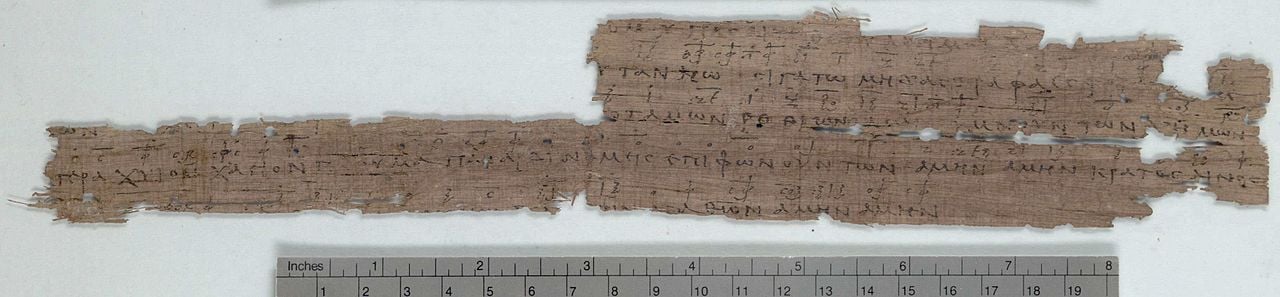
I randomly came across an article about Contemporary Christian Music artist Chris Tomlin’s interest in an 1,800 year old hymn, the subject of a documentary entitled The First Hymn.
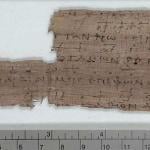
Back in 1918, archaeologists discovered a fragment of papyrus in Oxyrhynchus, Egypt, dated sometime in the late 200’s A.D. It turned out to be, in the words of its Wikipedia entry, “the earliest known manuscript of a Christian Greek hymn to contain both lyrics and musical notation.”
I didn’t even know that the ancient Greeks had a written system of musical notation! Here is the Wikipedia entry on that. (I can’t make heads or tails of it. If you can, please explain in the comments.)
This means that we can not only read the lyrics of this ancient Christian text, we can hear the music! We can sing it!
The Wikipedia entry also says this:
The Phos Hilaron and the Oxyrhynchus hymn constitute the earliest extant Christian Greek hymn texts reasonably certain to have been used in Christian worship that are neither drawn from the Bible nor modeled on Biblical passages.
To this day, liturgical churches sing the Phos Hilaron (“Joyous Light”). We Lutherans chant it as part of the service of Evening Prayer (Lutheran Service Book, p. 244). It dates from around the same time, though we don’t seem to have the original music, as we do with the Oxyrhynchus Hymn.
Here are the words. As you can see from the photo of the manuscript, above, what we have is not complete and various words are missing. The words in brackets below are reconstructions based on extant letters from the original. Wikipedia also gives the original Greek, which makes the basis of the reconstructions clearer. Again, from Wikipedia:
- . . . together all the eminent ones of God. . .
- . . . night] nor day (?) Let it/them be silent. Let the luminous stars not [. . .],
- . . . [Let the rushings of winds, the sources] of all surging rivers [cease]. While we hymn
- Father and Son and Holy Spirit, let all the powers answer, “Amen, amen, Strength, praise,
- [and glory forever to God], the sole giver of all good things. Amen, amen.”
Notice that the hymn praises “Father and Son and Holy Spirit.” The Council of Nicaea would take place in 325 A.D. So no, that council did not invent the doctrine of the Trinity. As this hymn proves, in the previous century, in the very first hymn that we have, Christians were already worshiping the Holy Trinity.
Now here are the words sung to the music. (Look carefully at the manuscript, above, and you can see what the Greek musical notation, written above the lines of text, looked like.) From John Hilton III, at YouTube:
Notice the continuity of this ancient music with that of the liturgy we use today! I’ve heard our liturgical music dismissed as “German,” as “European,” or “Catholic,” but here it is in ancient Egypt, from the Early Church, as far back as we can go.
And here it is in modern-day musical transcription:
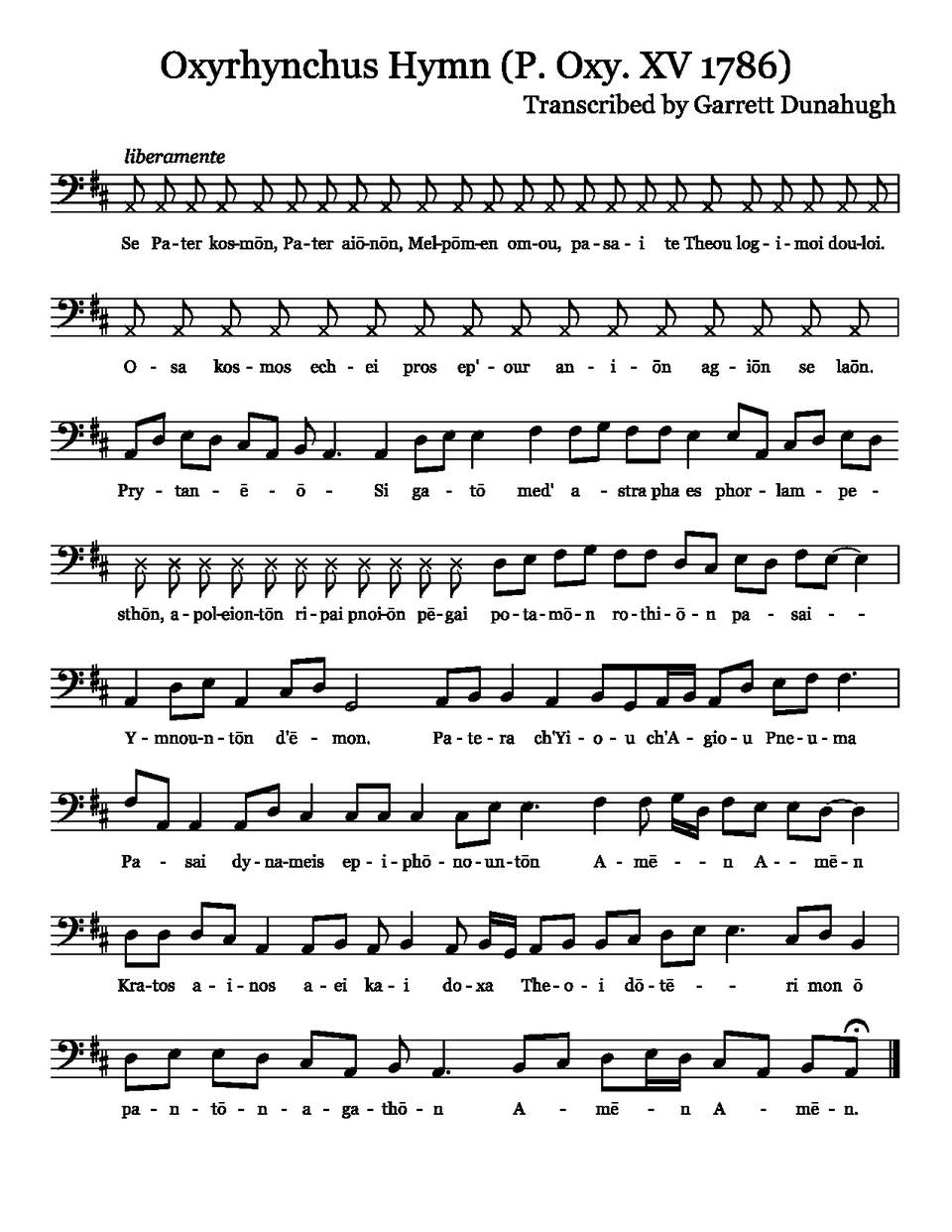
Transcription Credit: Oxyrhynchus Hymn via Alphonsothe28th, CC BY-SA 3.0 <https://creativecommons.org/licenses/by-sa/3.0>, via Wikimedia Commons
Manuscript photo: Fragment of Oxyrhynchus hymn, 29.6 x 4.8–5.0 cm. By Unknown author – http://163.1.169.40/cgi-bin/library?e=q-000-00—0POxy–00-0-0–0prompt-10—4—-ded–0-1l–1-ru-50—20-help-1786–00031-001-1-0utfZz-8-00&a=d&c=POxy&cl=search&d=HASH011f50b846c78b83819959d1, Public Domain, https://commons.wikimedia.org/w/index.php?curid=19524795









 Ad-Free & Subscriber Log-In