

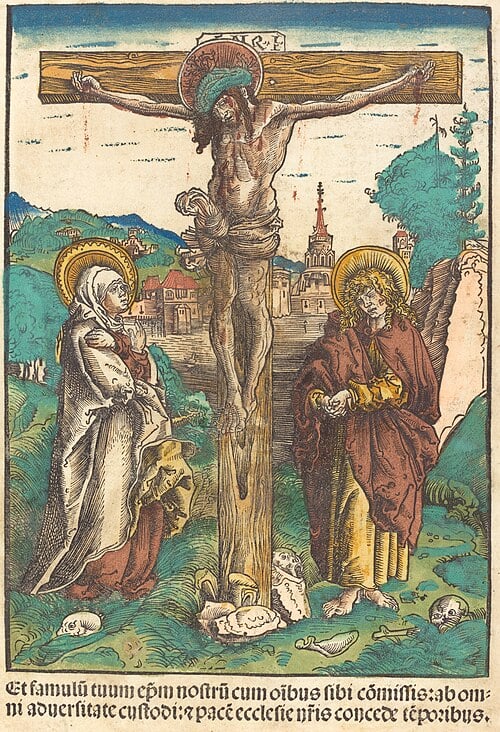
A notable Lenten hymn is “Not All the Blood of Beasts” by Isaac Watts, a meditation on the crucifixion of Jesus and His atoning blood.
I wrote about this hymn in an entry to Lutheran Service Book: Companion to the Hymns, 2 vols., which gives the background, tells about the writers, and discusses the meaning of every hymn in the LSB. This work is a real treasure for hymn lovers, and I was asked to research and write about ten of them.
Last year during Lent, I wrote about my commentary in the LSB Companion for “My Song Is Love Unknown.” This year I thought I would share my article on this other Good Friday classic.
Especially interesting is the way the hymn has been adapted for different theologies. Calvinists believe in a limited atonement, the notion that Christ did not die for everyone, but only for the predestined elect. So Watts, being of that persuasion, originally wrote that the soul looking to the cross “hopes” that its sins are there. The Wesleyan version changes the line so that the soul “knows” its sins are there. And yet Wesleyanism is more subjective, so that version has the soul “feel” the curse removed. Lutherans believe that Christ died for the sins of the entire world, so that none is excluded from His atonement (1 John 2:2), so they use the Wesleyan “knows.” But Lutherans believe that atonement is objective, so they change the subjective “feel” back to Watt’s original “see the curse removed.”
First, the hymn, from Lutheran TV – Hymns from the LSB, which usefully shows the words as the congregation sings:
LSB 431 Not All the Blood of Beasts
Text Background
Before Isaac Watts, English Protestants at worship tended to sing rhymed, metrical paraphrases of the Psalms rather than hymns. Watts took the structures and tunes of the metrical Psalms and gave them fresh, expressive lyrics that were not limited to the Old Testament texts. In doing so with such poetic power, Watts became “the father of English hymnody.”
His first book in this attempt was Hymns and Spiritual Songs, published in 1707. Two years later, he added more songs in a second edition. He would publish another large collection entitled Psalms of David in 1719. In the preface to the second edition of Hymns and Spiritual Songs, Watts summarized his argument that simply singing metrical Psalms confines Christian worshippers to Old Testament expressions rather than their New Testament fulfillment. He also set forth principles for his hymn writing. Though Watts was a non-conformist pastor of strong, mostly Reformed, theological convictions, he said that he tried to compose his hymns so as to avoid sectarian controversies so that Christians of all persuasions could sing them. He also said that he worked hard to restrain his literary impulses so that all Christians, including the less-educated, could understand what they were singing.
“Not All the Blood of Beasts” was published in 1709 in the second, expanded edition of Hymns and Spiritual Songs. It appears in Book II of that collection as one of the hymns “Compos’d on Divine Subjects,” as opposed to the metrical paraphrases of Scripture in Book I and the songs “Prepar’d for the Lord’s Supper” in Book III. The hymn is printed with the headnote “Faith in Christ our Sacrifice.”
This hymn, as it was adopted by many different traditions, appears in a number of variations. For example, in stanza 4, Watts originally says that the soul looking on the burdens that Christ bore on the cross “hopes her guilt was there.” The Wesleyan version gave a stronger assurance: the soul “knows her guilt was there.” The LSB version takes the Wesleyan reading but makes the point even stronger by clearing up the syntax: “I know my guilt is here.” In stanza 5, Watts wrote that “we rejoice/To see the curse removed.” The Wesleyans sought a more subjective response: “we rejoice/To feel the curse removed.” In this case, the LSB goes back to Watts’s original.
Text Discussion
The first line is not meant to cast aspersions on the Jewish religion, as might be assumed today; rather, it is a reference to Hebrews 10, which speaks of how the Old Testament sacrifices (which are not practiced in contemporary Judaism) never took away sin, as such, but instead pointed to the sacrifice of Christ. The first stanza speaks both of “the guilty conscience” and “the stain” of sin, the uncleanness of our fallen nature. The blood of animals cannot give peace and cannot “wash away the stain,” but, as the second stanza says, the “richer blood” of Christ, the Sacrificial Lamb of God, can.
Before killing the animal, the person who brought the sacrifice would first lay his hand on the offering, signifying the transfer of his sin onto the sacrificial victim (Leviticus 3-4). In stanza 3 of the hymn, the sinner is laying his hand on the head of Christ. He does this by confessing his sin and reaching out to Christ in faith.
Watts makes skillful use of spatial imagery to express Christ literally removing sin from the sinner and taking it upon Himself. The Lamb “takes all our sins away.” The speaker looks back to see the burden that Christ is bearing on the cross: “I know my guilt is there.” Because of “the cursed tree,” “we rejoice to see the curse remove.”
The most striking poetic effect is in the last words of the hymn: “His bleeding love.” Christ’s love is not an abstraction, a general quality or disembodied feeling. Christ’s love bleeds. His love is such that He pours out His blood for us. The hymn that begins with the blood of beasts and a still-guilty conscience ends with rejoicing and “a cheerful voice” singing “the bleeding love.”
Illustration: Lucas Cranach, Christ on the Cross between the Virgin and St. John. This file was donated to Wikimedia Commons as part of a project by the National Gallery of Art. Please see the Gallery’s Open Access Policy., CC0, https://commons.wikimedia.org/w/index.php?curid=81680754. [Hand-colored woodcut print.]










 Ad-Free & Subscriber Log-In