

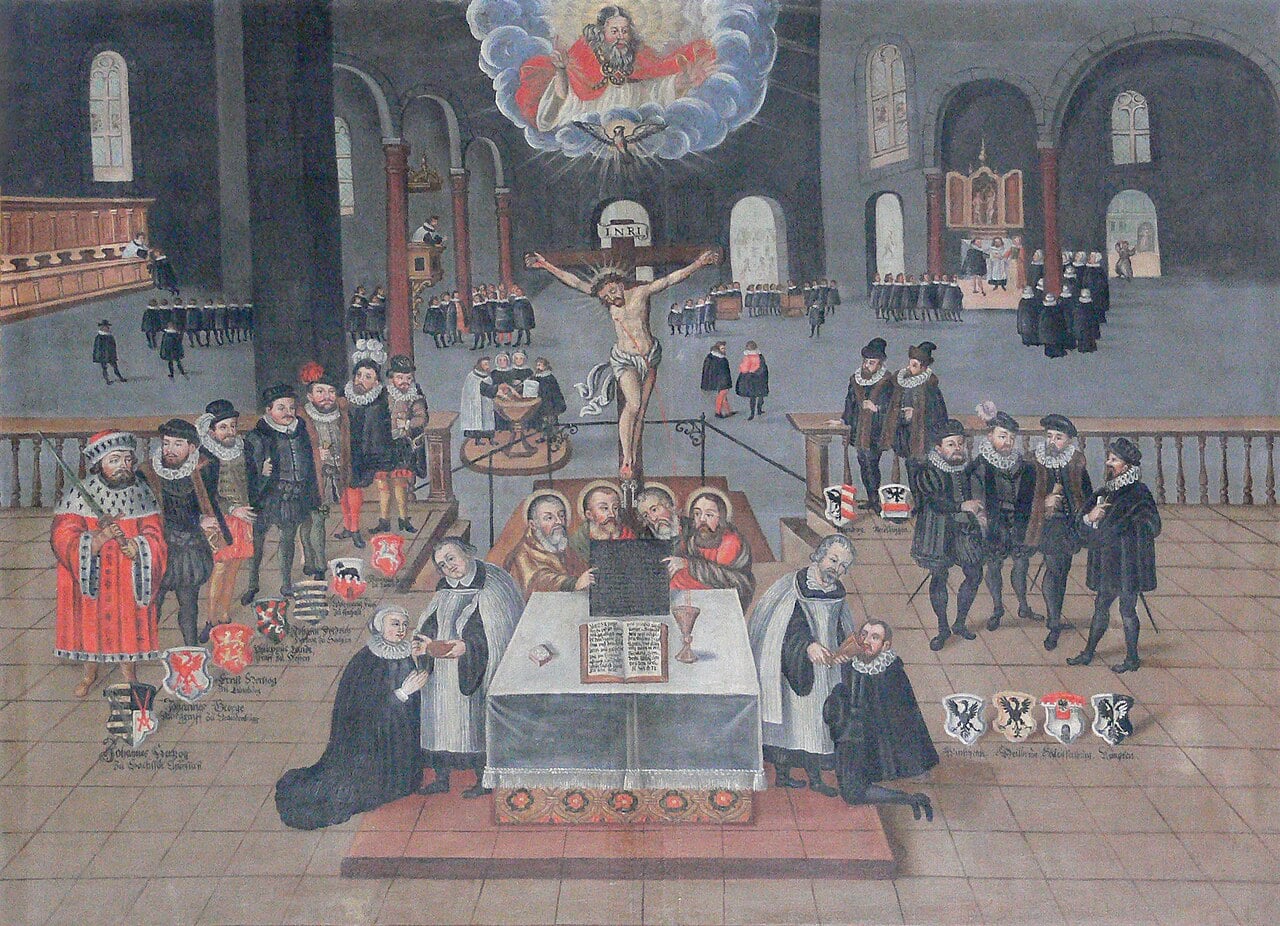
On Maundy Thursday, commemorating Christ’s institution of the sacrament of His body and blood, it’s good to contemplate what’s at stake.
This is evident in a controversy at the Vatican. In 2016, the late Pope Francis issued a “papal exhortation” on the family entitled Amoris laetitia (The Joy of Love). In its 256 pages are wide-ranging discussions of marriage and family life. But one footnote stirred a major outcry in Catholic circles.
In what a reporter described as “vague terms,” Pope Francis seemed to open the door to allowing divorced and remarried Catholics to receive Holy Communion. Not in so many words, but he indicated that bishops, under certain circumstances, on a case-by-case basis, after a “journey of discernment,” especially if the person in question was not at fault for the divorce, might possibly allow that person to take the sacrament.
Saying that the church should help those in a state of sin by giving them pastoral care, he added a footnote that ignited the fury. As reported by Nicole Winfield:
In the related footnote No. 351, Francis elaborated that “in certain cases, this can include the help of the sacraments.” He told priests that “the confessional must not be a torture chamber, but rather an encounter with the Lord’s mercy” and that the Eucharist “is not a prize for the perfect, but a powerful medicine and nourishment for the weak.
Pope Francis was definitely on the progressive spectrum of Catholicism when it comes to homosexuals, social justice, environmentalism, anti-capitalism, restricting the Latin mass, and the like. But this one issue, based on this one footnote, according to Winfield, proved to be his most controversial position. Conservative cardinals even accused him of heresy:
Within the first year of publication, four conservative cardinals formally asked Francis to clarify certain questions, or “dubia,” raised by the text. They argued church doctrine held that Catholics who remarried without a church annulment were living in sin and couldn’t receive the sacraments. . . .The following year, a petition of conservative Catholic theologians accused Francis of heresy.
In that accusation, 62 theologians sent him a “A Filial Correction Concerning the Propagation of Heresies,” the first time such a document was sent to a pope since the Middle Ages. The theologians accused Pope Francis of succumbing not only to modernism but to Martin Luther! As reported in the National Catholic Register,
Regarding Martin Luther, they show how some of the Pope’s ideas on marriage, divorce, forgiveness, and divine law correspond to those of the German Reformation monk, and draw attention to the “explicit and unprecedented praise” the Pope has given the 16th century heresiarch.
No wonder this mild openness of Pope Francis to the possibility of a sinner receiving the sacrament would lead to charges of heresy, even the “heresy” of Lutheranism! Permitting a divorced and remarried Catholic to take Communion strikes not only at Rome’s position on marriage, but at its sacramental theology and its understanding of salvation.
According to the Catholic Catechism,
Anyone who desires to receive Christ in Eucharistic communion must be in the state of grace. Anyone aware of having sinned mortally must not receive communion without having received absolution in the sacrament of penance. (paragraph 1415)
A “State of Grace,” according to the Catholic Dictionary, means the “Condition of a person who is free from mortal sin and pleasing to God. It is the state of being in God’s friendship and the necessary condition of the soul at death in order to attain heaven.”
Not only must you be “free from mortal sin” in order to receive the Eucharist, you must be “free from mortal sin” in order to attain heaven.
For Luther, the “heresiarch” (that is, an “arch-heretic,” the originator of heresies), grace is God’s unmerited favor, His gift of forgiveness through Jesus Christ. For Catholics, grace is a gift of God that enables us not to sin. Grace gives us merit. As explained in the Catholic Catechism,
The merit of man before God in the Christian life arises from the fact that God has freely chosen to associate man with the work of his grace. the fatherly action of God is first on his own initiative, and then follows man’s free acting through his collaboration, so that the merit of good works is to be attributed in the first place to the grace of God, then to the faithful. Man’s merit, moreover, itself is due to God, for his good actions proceed in Christ, from the predispositions and assistance given by the Holy Spirit. (2008)
In contrast, Luther’s Small Catechism teaches that
These words, “Given and shed for you for the forgiveness of sins,” show us that in the Sacrament forgiveness of sins, life, and salvation are given us through these words. For where there is forgiveness of sins, there is also life and salvation.
Those words of God, plus the gift of Christ’s broken body, plus the gift of Christ’s blood poured out for the remission of sins, are nothing less than the gospel. The answer to the question, “How can bodily eating and drinking do such great things?” is faith in that gospel:
Certainly not just eating and drinking do these things, but the words written here: “Given and shed for you for the forgiveness of sins.” These words, along with the bodily eating and drinking, are the main thing in the Sacrament. Whoever believes these words has exactly what they say: “forgiveness of sins.”
To the question, “Who receives this sacrament worthily?,” the answer is not to be without sin, but to have faith in the gospel that the sacrament communicates:
Fasting and bodily preparation are certainly fine outward training. But that person is truly worthy and well prepared who has faith in these words: “Given and shed for you for the forgiveness of sins.”
But anyone who does not believe these words or doubts them is unworthy and unprepared, for the words “for you” require all hearts to believe.
To be sure, we should examine ourselves, confess our sins, and discern Christ’s body, but these all grow out of faith.
The main issue in contention with the sacrament is not the mode of Christ’s presence. Lutherans believe in the doctrine of the Real Presence of Christ’s body and blood, indeed, not in the Reformed sense of a “spiritual” presence, but that the bread is the body of Christ and that the wine is the blood of Christ. According to Hermann Sasse’s magisterial treatment of the topic, This Is My Body, Luther would accept communicants who believed in transubstantiation, even though that was not his own belief, as long as they believed in Christ’s bodily presence.
Though there are many other differences–particularly, the Catholic view that the sacrament is a re-sacrifice of Christ–the major difference is that Lutherans believe that Holy Communion is for sinners who come to Christ in faith. That is to say, to sinners who are also saints, not by their merits but by their faith in Christ.
I think Luther would agree with Pope Francis on very little, him being an Antichrist, but he probably would on this one point, that the Lord’s Supper is not “a prize for the perfect” but “a powerful medicine and nourishment for the weak.”
This has come up again in Catholic circles once again because Pope Leo XIV has been praising Amoris laetitia (The Joy of Love) on its tenth anniversary. Traditional Catholics once again are worrying whether or not the Pope is Lutheran.
Illustration: Luckau, Landkreis Dahme-Spreewald, Brandenburg St.-Nikolai-Kirche, Gemälde. Public Domain via Wikipedia Commons











 Ad-Free & Subscriber Log-In