

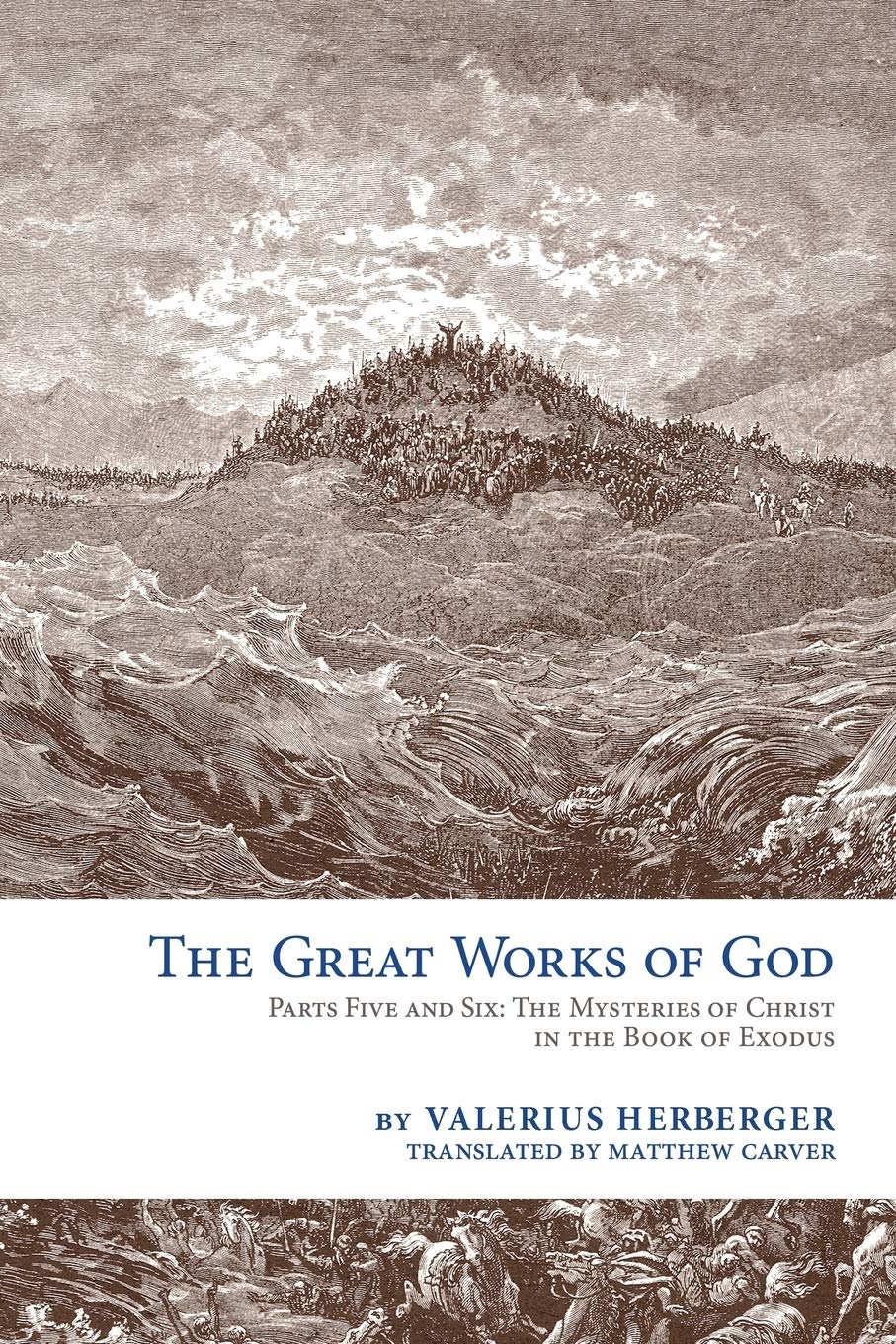
Yesterday I posted about my discovery of Valerius Herberger, the 17th century German-Polish pastor who has written some of the best devotions I have come across, in quite a few years of reading devotions.
For Lent, I have been reading his book entitled The Great Works of God: The Mysteries of Christ in the Book of Exodus. This has been one of the most personally rewarding Lenten projects I’ve undertaken. Today I want to tell you some of the things I’ve gotten from these meditations.
Valerius takes a verse from Exodus and treats it usually in just three or four pages, so the meditations are quite short, making for easy reading. The only exception is the meditation on the Passover, which has so much built-in typology that Valerius really goes to town, taking 18 pages to unpack it. His writing is lively and stimulating (perhaps translator Matthew Carver deserves credit for at least some of that), and he is both learned and down-to-earth. He brings in church fathers, medieval writers, classical parallels, Latin proverbs, homely German-Polish sayings, classical history, even local history (for example, relating the Egyptian plagues to the plague of 1568 “right here in Fraustadt” [p. 155]).
Throughout, Valerius comes up with profound insights that I had never thought of before. For example, he says of the repetitions in Exodus, that it is part of human nature to forget:
Moses forgot the comfort which the Lord had given him from the burning bush, so the Lord had to comfort him anew. . . .But lest he should likewise forget the instructions which he received, God recounted them a second time. . . .Forgetfulness is the greatest malady of man. Therefore, one of the words which Hebrew uses for men is enosh, from “forgetting.” Hence the beautiful verse, “What is man, that you are mindful of him?”–that you are mindful of him who is unmindful of You? Thus it is that God’s ministers, following His example, are required to repeat the same teaching many times, as St. Paul also writes in Philippians 3:1. Good things cannot be spoken of too much, and a good song may be sung thrice.
Notice how he goes from an observation about the Bible, to a discussion of a Hebrew word, to connections to other Biblical texts, to a practical application about the work of pastors, to a homely saying about how we like to repeat good music.
I wondered about enosh. I looked it up and Hebrew dictionaries define the word as man with an emphasis on his frailties, often rendered as “mortal.” But I dug deeper and, sure enough, the rabbinic tradition sees in the word the same root as “to forget.”
Valerius later draws another kind of attention to this human trait of forgetfulness. Speaking about how the Israelites refused to be comforted, he makes this observation:
When news is too good, it is scarcely believed. . . .When things go well, [the heart] quickly thinks that it will stay that way forever, and acts with presumption. When trouble strikes, it thinks that things will never improve and that it would be impossible for God to keep His word.
We forget our own experience of the ups and downs of life, expecting things to go on as they are, for better or for worse. We forget how God has taken care of us in the past. Instead of remembering His constant provision, we worry all over again.
Valerius’s typological-historical-grammatical approach can illuminate puzzling passages from Scripture. For example, he takes up the exceedingly odd text about what happens when Moses with his wife Zipporah and their son is on his way back to Egypt to fulfill his commission from God:
At a lodging place on the way the Lord met him and sought to put him to death. Then Zipporah took a flint and cut off her son’s foreskin and touched Moses’ feet with it and said, “Surely you are a bridegroom of blood to me!” So he let him alone. It was then that she said, “A bridegroom of blood,” because of the circumcision. (Exodus 4:24-26)
Huh? Why would God, after everything that has happened, want to kill Moses? And if He wanted to do that, why didn’t he? And what’s going on with Zipporah, the foreskin, touching Moses’ feet, and saying he is “a bridegroom of blood”? It isn’t just that the account is gross and grisly–it doesn’t seem to make sense! What does it all mean? Even some of the most learned commentators just don’t know what to do with this passage. The Lutheran Study Bible takes a stab at some of the possibilities but admits, in an understatement, “This episode is difficult to understand.”
Here is what Valerius does with this episode (my emphasis): The Lord struck Moses with what seemed like a fatal illness. “The reason that the Lord looked so angrily at Moses is that he had not had his son circumcised, for Moses had discarded the sacrament of circumcision to please his wife. . . .Moses was also unwilling to embarrass his father-in-law Jethro in the sight of the heathens, who viewed circumcision as a great shame.”
“When God struck her husband down, and she was told that he and his whole family would die unless he had his child circumcised,” Zipporah herself did the deed. “Zipporah, seeing her son bleeding and in pain, was angered, and cast the foreskin at Moses’ feet, saying, ‘You are a bloody husband to me.’ Zipporah was only interested in her husband’s religion insofar as it involved things good and pleasant.”
And, yes, this seemingly harsh and angry God is Jesus:
Neither did Jesus do anything new here, but acted as He did before when He met Jacob on his journey from Mesopotamia and wrestled with him (Gen. 32:24). So here too, He met Moses as he journeyed, wrestled with him, and so overpowered him that Moses hardly hoped to recover from the contest.
Oh, Lord Jesus, this is your way from of old. He to whom You wish to show great grace must first wrestle with You and face great tribulation.
Job, His Mother Mary at the wedding at Cana, the Syro-Phoenician woman–all were seemingly repudiated by Jesus at first. Thinking about this leads Valerius to prayer:
Dear Lord Jesus, strengthen me in such struggles so that, like Jacob, I do not let You go until You bless me (Gen.32:26). Comfort me so that, like the Canaanite woman, I do not cease praying until You help me.”
Wrestling with Jesus is an exercise of faith. The episode also contains a warning: “O Lord Jesus, as You were angry with Moses and his children for neglecting circumcision, the Sacrament of the Old Testament, You are also genuinely angry with all who despise Holy Baptism and neglect the most worthy Supper.”
But then comes the Christological epiphany:
Zipporah said to Moses, “you are a bloody husband to me,” for it took blood to keep him. Oh, Lord Jesus, you are my spiritual Bridegroom; that is my certain comfort. You are my bloody Bridegroom, for it took Your blood to keep and redeem me.
On the Passover Feast, he says this about the instruction to roast and eat the Passover lamb whole, making this rather humorous shot at Catholicism:
Human additions, monkish soups, and cloister dressings are of no use with the Passover lamb. Monks might well talk of the Lamb of God and Christ crucified, but they make such a polifke* or soup out of it, you could sail half a mile on it: Mary, dead saints, cloister life, masses, vigils, fast are all supposed to be added. This is nothing but idolatry and abomination, which You, O Lord Jesus, the true Passover Lamb, cannot tolerate in Your presence. (p. 200)
*a Polish soup
We just need the Lamb, not lamb soup! We could also extend that to the watered-down weak broth of liberal Christianity. His treatment of the Passover and the consequent exodus from Egypt includes the well-known Christian typology (the blood of the lamb causing God’s judgment to pass over us; deliverance from the slavery of sin to the freedom of the Gospel, etc.), and then he takes it in a direction I hadn’t thought of: the Exodus that is our death, when Christ delivers us from our bondage in this life to the liberty of everlasting life. He then brings the meditation back to the Passover meal, saying with many historical examples how blessed it is to receive the Lord’s Supper before dying.
In his discussion of how Jesus was present in the Pillar of Cloud by day and the Pillar of Fire by night (Exodus 13:22), he says,
The Israelites had no advantage over us. They themselves did not see the Lord with the eyes of their body, but discerned and believed in the Lord’s true presence in the pillars of cloud and fire which hovered before their eyes. O Lord Jesus, we do not see You with the eyes of our body either, but in the Word and Holy Sacraments our heart affirms Your true presence. Through Your Word and Holy Sacraments You bring us also to the promised land. (p. 221)
Noting that the Israelites moved out in battle formation (Exodus 13:14) led by the pillars of cloud and fire, Valerius vividly recounts what it means to “follow Jesus”–not so much that we do what He does, but that He “goes before us”:
O Lord Jesus, as You were the point of the Israelite’s battle formation, be the point of my prayers. Go up ahead of me and speak a good word for me to the heart of Your heavenly Father that I may be heard. When Your heavenly Father offers me the point of His wrath, oh, then by the power of Your bloody death, run to the front line and catch the point of His burning wrath lest I perish! When the evil foe pros me with the spearpoint of tribulations, block his attack and deflect all evil from me. . . .
O Lord Jesus, go before me in my life at all times. . . .As the Israelites followed You, so will I follow You also, for as long as I live. (p. 222)
There is much, much more. In my Lenten reading, I have arrived at the place where the Israelites have finally been released. That’s appropriate for Maundy Thursday, Good Friday, and Easter. But I’m going to keep reading to get Valerius’s insights into the Word of God as the Israelites–and I–trudge through the wilderness.
Illustration: Cover of Valerius Herberger, The Mysteries of Christ in the Book of Exodus via Amazon.com. [Based on Gustave Doré, The Egyptians Drown in the Sea]









 Ad-Free & Subscriber Log-In