

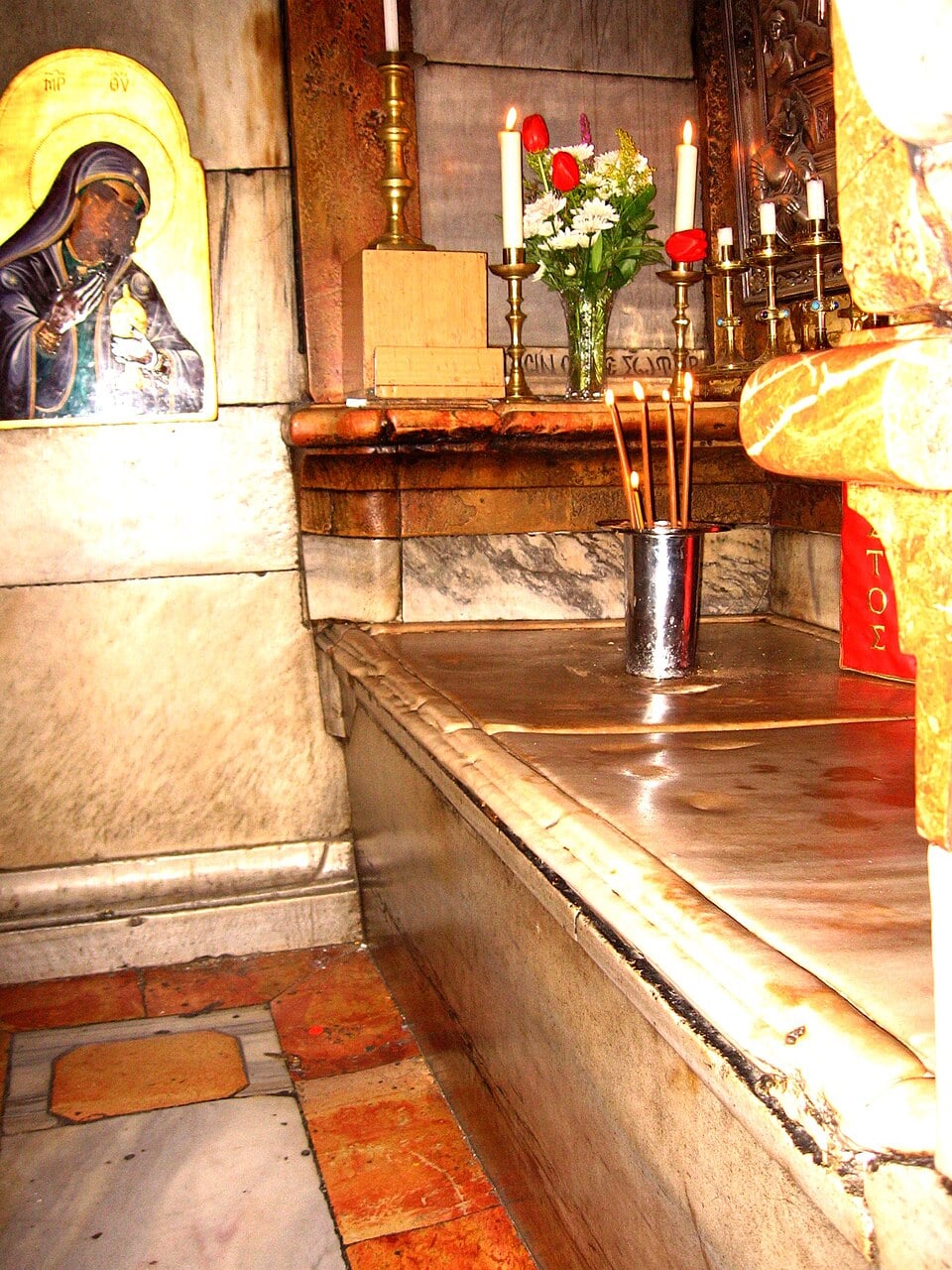
This photo is reportedly from inside Christ’s tomb, showing the actual place where Jesus’ body was laid.
Yes, the Church of the Holy Sepulchre covers everything up with medieval marble and pious decorations. But the site is actually well-attested, having been built over an ancient quarry outside the city walls that also contained a garden with other rock-carved tombs.
The church is said to cover both Golgotha and Jesus’ tomb, which the Bible says were near each other: “Now in the place where he was crucified there was a garden, and in the garden a new tomb in which no one had yet been laid” (John 19:41).
The site has been venerated as the place of Jesus’ crucifixion and resurrection as far back as we can go. After the Romans all but destroyed Jerusalem, they built a temple to Jupiter over the site, but Constantine, the first Christian emperor, tore that down and built the church, which has been expanded, added to, remodeled, and excavated throughout the centuries.
So, although we can not be certain, this photograph very likely shows the very “the place where he lay” (Matthew 28:6). But, as the angel says in that same verse, “He is not here, for he has risen, as he said.”
The point here is that this really happened! Jesus actually rose from the dead. The resurrection was not a symbolic myth, a vision, a sense in the disciple’s hearts that Jesus will always be with them, or any other kind of subjective explanation of the sort that liberal theologians are fond. Rather, Jesus rose from the dead physically as an objective, historical fact.
The various accounts of Jesus after His resurrection recorded in the gospels seem rather disjointed and confusingly organized to many readers. But this is because these are eyewitness reports that the gospel writers have assembled. I can tell you as a literary scholar that the post-Resurrection narratives are coming from particular points of view–Mary Magdalene’s, other women’s, Peter’s, the men’s who were walking the road to Emmaus, the disciples’ in the Upper Room, in small groups and in large groups. St. Paul lists some more:
He appeared to Cephas, then to the twelve. Then he appeared to more than five hundred brothers at one time, most of whom are still alive, though some have fallen asleep. Then he appeared to James, then to all the apostles. Last of all, as to one untimely born, he appeared also to me. (1 Corinthians 15:5-8)
St. John too speaks of the utter tangibility of Jesus and His saving work:
That which was from the beginning, which we have heard, which we have seen with our eyes, which we looked upon and have touched with our hands, concerning the word of life— the life was made manifest, and we have seen it, and testify to it and proclaim to you the eternal life, which was with the Father and was made manifest to us— that which we have seen and heard we proclaim also to you, so that you too may have fellowship with us; and indeed our fellowship is with the Father and with his Son Jesus Christ. 1 John 1-3)
We have heard Him. We have seen Him. We have touched Him. If we had been there, we could have heard, seen, and touched Him too.
Going back to the angel’s words to the women at the tomb: “He is not here, for he has risen, as he said. Come, see the place where he lay” (Matthew 28:6). A key part of this proclamation is “as he said.” Just as He rose from the dead “as he said,” we can trust the other things that “he said,” including His promises of everlasting life.
On Easter, we celebrate not only Christ’s resurrection but our resurrection. This has already happened in our baptism and in our Christian life, and it will happen to us tangibly, physically, when He comes again:
Do you not know that all of us who have been baptized into Christ Jesus were baptized into his death? We were buried therefore with him by baptism into death, in order that, just as Christ was raised from the dead by the glory of the Father, we too might walk in newness of life. For if we have been united with him in a death like his, we shall certainly be united with him in a resurrection like his. (Romans 6:3-5)
So what a day to celebrate!
Photo: Tomb of Jesus, inside the Edicule. Church of the Holy Sepulchre, Jerusalem by adriatikus en:commons:talk – self-made using a Canon PowerShot A530 camera, CC BY-SA 3.0, https://commons.wikimedia.org/w/index.php?curid=3482274










 Ad-Free & Subscriber Log-In