

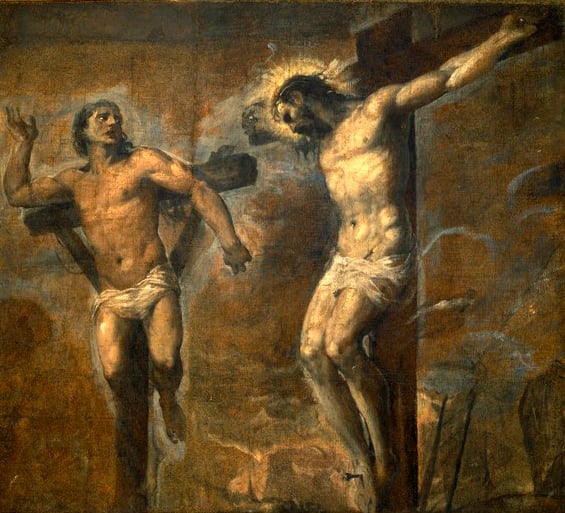
Over Holy Week, I came across two reflections on the thieves who were crucified with Jesus. One on the repentant thief and the other on the nonrepentant thief. This still being the Easter season, they are both worth contemplating.
Hans Fiene of Lutheran Satire fame, speaks as the pastor that he is in an X post.
He begins by saying that evangelicals often bring up the repentant thief in arguments against the Lutheran doctrine of baptismal regeneration. The thief on the cross wasn’t baptized, they say, but he was saved by Jesus. Therefore, baptism doesn’t save us.
Rev. Fiene answers that by saying (1) that we don’t know whether or not he was baptized, since all kinds of people were going out to John the Baptist; (2) this was before Christ’s resurrection and thus before the Holy Spirit started working through the sacraments, so to say the thief wasn’t baptized would be like saying Abraham wasn’t baptized; (3) Lutherans believe that while baptism saves, that doesn’t mean that “only baptism saves,” since God’s Word–from the Bible, a sermon, or in this case from the crucified Word Himself–is also a means of grace.
But then Rev. Fiene make his most salient point by turning the whole issue around. He brings up what Romans 6 teaches about baptism. I’ll quote it in full (my emphases):
Do you not know that all of us who have been baptized into Christ Jesus were baptized into his death? We were buried therefore with him by baptism into death, in order that, just as Christ was raised from the dead by the glory of the Father, we too might walk in newness of life.
For if we have been united with him in a death like his, we shall certainly be united with him in a resurrection like his. We know that our old self was crucified with him in order that the body of sin might be brought to nothing, so that we would no longer be enslaved to sin. For one who has died has been set free from sin. Now if we have died with Christ, we believe that we will also live with him. (Romans 6:3-8)
Then he says (my emphasis):
And what do we see at Calvary? Here is a man united in a death like Christ’s, literally crucified with Christ who, through His own cross, sets the man free from his sins. Here the man dies as a thief, while he is given the promise that he will be a thief no more in paradise with our Lord, paradise that will reach its completion through the resurrection of our Lord, which this man will share. . . .
And so, with the thief on the cross, we don’t see evidence against a simple and literal reading of the words “baptism now saves you.” Rather, we see a beautiful image of how God has saved us through baptism. In that blessed sacrament, God gave us the death and resurrection of our Lord. And in this man, the thief-become-our-brother, we see ourselves, how we were crucified alongside Christ, how He put to death our sinful nature through the blood placed into our baptismal waters. And through the words “I baptize you in the name of the Father and of the Son and of the Holy Spirit,” we hear the resurrection promise in those same baptismal waters. We hear Jesus grant us new life, promising that, on the last day, we too will be with Him in paradise.
In our baptism, we become the thief on the cross!
As for the other thief, the reflection is not nearly so sublime, but it’s worth mentioning. The recently retired Archbishop of New York, Cardinal Timothy Dolan wrote a piece for National Review entitled The Meaning of St. Dismas, referring to the name that tradition has given the repentant thief. (I briefly met Cardinal Dolan when he was the Archbishop of Milwaukee when we lived in Wisconsin.)
He offers a meditation on this sinner-turned-saint. He notes that when the thief says, “Jesus, remember me when you come into your kingdom!” (Luke 23:42), this is the only time in the Gospels when someone is recorded addressing Jesus by His personal name. “Lecturing his ‘thick as thieves’ buddy, Dismas admits his own crime, repents, and acknowledges his own guilt,” Dolan writes. “Contrition! Conversion of heart! Only at that point does he speak this to Jesus.”
To address Jesus is to pray, and “Jesus, remember me” is a good prayer. The other thief, though, is also addressing Jesus (my emphasis):
He, too, pleads with Jesus — that’s prayer — even before Dismas does, and his prayer goes something like this: “Hey, you! I hear you claim to be divine. Well, start acting like it. Get down off that lumber. And, while you’re at it, get me off mine.”
We can agree that’s a rather selfish oration. It’s a plea for a miraculous rescue right here and now, a demand to escape the cross, probably then to go back to his life as a criminal. It’s a prayer, I admit, very often like my own: I want a miracle, on my terms, right away, usually to get out of some difficulty.
How different the words of Saint Dismas!
Illustration: Christ and the Good Thief (ca. 1566) by Titian – Pinacoteca Bologna, Public Domain, https://commons.wikimedia.org/w/index.php?curid=15465522














 Ad-Free & Subscriber Log-In