

Much of our civilization has been built on that of the ancient Greeks. We have drawn on them we for our ways of thinking (rationalism, idealism), our mathematics (geometry, arithmetic), our literature (narrative, poetry, drama), our art (formalism, aesthetics), our politics (democracy, representative republics, law).
And yet a tremendous amount of that so-called classical heritage has been lost. So says Philip Jenkins in his post All the Epics We Have Lost. We have Homer’s Iliad and Odyssey. These have exerted a huge influence on western literature and on western readers, from ancient times to this very day. (A reportedly faithful movie version of the Odyssey will be released on July 17.)
But we have records and in some cases fragments of many other ancient Greek epics. For a list, go here. It includes six more epics on different aspects of the Trojan War, four having to do with the city of Thebes, and eight on other subjects.
Some of these were ascribed to Homer himself. In fact, Aristotle refers to a comedy by Homer entitled Margites, an exceedingly stupid man, snatches of which survive in ancient Greek insults. Think of what that would be to read a Homeric comedy! Speaking of which, there is reportedly a lost work of Aristotle, whose Poetics remains the definitive treatment of tragedy, that is a similar treatment of comedy!
Greek drama influenced ours, not only in their performance, but in our playwrights’ imitations of them, their influence, and even in our playwrights’ reactions against them. (Such as Shakespeare’s defying the unities of time, place, action, and the classical rules about character and decorum.)
But we have only a fraction of Greek drama. We have 7 plays by Sophocles, including Oedipus Rex and Antigone, but he wrote over 120! We have 7 plays by Aeschylus, including the Orestea cycle, but he wrote around 80! We have 19 plays from Euripedes, including Medea and Electra, but he wrote as many as 95!
“Taken together,” says Jenkins, “that means we possess only some ten percent of the writings of those three superstar playwrights, and that takes no account of other contemporary authors whose oeuvre is entirely lost. See this list of lost works, including not only literary texts but what we have lost from the great philosophers.
So why was so much lost? We don’t know for sure, of course, but allow me to speculate.
It may be that some of these works were never written down. Poetry was originally meant not to be read but to be sung. The genres of epic and drama were written in verse. Epic began as an oral form, sung by bards, memorized and handed down for generations.
Recording spoken or sung words by writing was a fairly recent technology. In Plato’s dialogue Phaedrus, Socrates–like one of us modern-day media and technology critics–says that writing will ruin our memories, since instead of using our minds to learn and retain knowledge, we will just write it down in a book to refer to when we need it. Philosophy too, he argues, is better when actual human beings discuss issues among themselves, rather than reading written trains of thought. If we read and have a question, we cannot ask the author, which we can do when we interact with the philosopher in person. Far better than writing, Socrates concludes, is “the living word of knowledge which has a soul.”
He was not wrong. But if we didn’t have writing, those stimulating dialogues Plato recorded would be lost forever. Because of reading, we can tap into the minds and imaginations of human beings who have died centuries ago. And with the help of a teacher to answer questions and lead discussions, we can recover that “living word of knowledge.”
But we can imagine the wisdom and beauty that was never written down! Homer’s epics were written down, so we still have them. Why were his lines put down in writing while others were not? Perhaps because his were the best. That lets us hope that the greatest works of the ancient Greeks survived, so that we can draw on them.
We do know, though, that many, perhaps most, of the works listed were written down because we have fragments of them. But before the printing press, works had to be copied out by hand. This meant that few were made. Paper and papyrus are fragile. Unless continually recopied generation by generation, they will crumble. And they burn.
What of our civilization today will be lost and what might survive? Electronic bits and bytes may be even more transient than paper.
I would add that there are some “literary” epics–that is, epics that were composed in writing as opposed to be being part of an oral tradition–that have survived or have continued to be written. Virgil’s Aeneid is the great epic of Rome and well worth reading today. But other Latin epics have also survived.
Lucan’s Pharsalia, for example, about the civil war between Julius Caesar and Pompey, offers a good antidote to Shakespeare’s making Caesar a hero. Lucan’s Caesarian hero became a model for Milton’s portrayal of Satan in Paradise Lost. That is a “modern” epic you should read, along with his brief epic Paradise Regained, about Satan’s temptation of Jesus. These are Christian, Biblical epics that in many ways transcend Homer’s achievement. Dante has written a Christian epic that is also a comedy, since it has a happy ending, moving from Hell to Heaven.
More to the point, if a generation stops reading what has been preserved, that is as good as destroying it. That has largely happened. Thus the importance of classical Christian education in reconstructing our civilization and bringing it back to life.
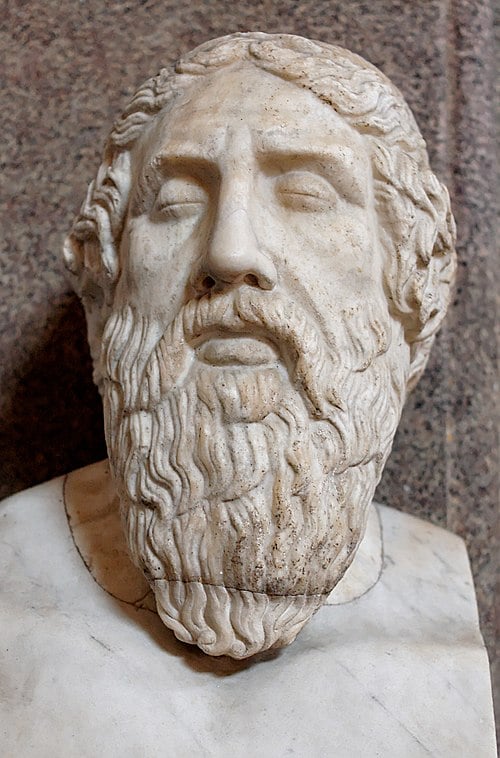
Illustration: Bust of [the Blind] Homer: A Roman copy after a Greek original from the 5th century. By Unknown artist – Jastrow (2006), Public Domain, https://commons.wikimedia.org/w/index.php?curid=1307127











 Ad-Free & Subscriber Log-In