


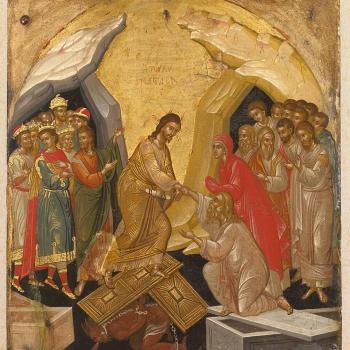
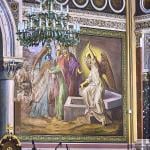
When talking about Christ’s resurrection, we must acknowledge the faith of the women who followed Christ, and how many of them had a faith that was stronger than that of many of the men who followed him. It was women showed more courage, more fidelity to Christ, even in his death, than those men who were chosen to lead the faithful and fled from the scene. During the darkest period of the Christian faith, during the spiritual night on which Christ was dead and descended to the realm of the dead (Hades), that is, during the time when it appeared that all was lost, it was women who continued to show their devotion and fidelity to him. They brought myrrh and other oils and spices with the hope of anointing his body, and in return, thanks to the wisdom which had them prepared for what God was about to do, they were the first, not only to witness Christ’s resurrection from the dead, but to preach it to others:
And when the sabbath was past, Mary Magdalene, and Mary the mother of James, and Salome, bought spices, so that they might go and anoint him. And very early on the first day of the week they went to the tomb when the sun had risen. And they were saying to one another, “Who will roll away the stone for us from the door of the tomb?” And looking up, they saw that the stone was rolled back; — it was very large. And entering the tomb, they saw a young man sitting on the right side, dressed in a white robe; and they were amazed. And he said to them, “Do not be amazed; you seek Jesus of Nazareth, who was crucified. He has risen, he is not here; see the place where they laid him. But go, tell his disciples and Peter that he is going before you to Galilee; there you will see him, as he told you” (Mk. 16:1-7 RSV).
Many men like to talk about their courage and fortitude; even Peter bragged about it when he said that he would stay with Christ to the very end. Like with Peter, more often than not, we find in times of difficulty, it was only talk. Such men might believe what they say, but when they are tested, the truth will come out. Thus, we see, when Christ was arrested, his disciples not only fled the scene, Peter denied his association with Christ. Those who boast of their courage, therefore, are often the most cowardly; those with real courage will act on it instead of announce it with words; indeed, those who boast are afraid that people will see them for who they are, for the fears which they have, the fears which they cannot control. There is nothing wrong to be afraid. There are even times when it is right to flee from danger; even Jesus, when the time was not right for his passion, fled from those who were looking to do him harm. What is not fine is to be a hypocrite, to promote false bravado, trying to make people think you are something which you are not. Thus, we see the wisdom of the women who followed Christ; they were more courageous than the men, but they didn’t need to say anything to promote themselves. They just acted when it was time to act. They showed courage while most of Christ’s apostles fled the scene. Only a few men, like Joseph of Arimathea and John, the apostle, were like the women who remained with Christ when it appeared all had been lost. Thus, it was Joseph of Arimathea who went to Pilate and asked him for Jesus’ body: “Joseph of Arimathea, a respected member of the council, who was also himself looking for the kingdom of God, took courage and went to Pilate, and asked for the body of Jesus” (Mk. 15:43 RSV). After he secured a place for Christ’s body, it was women who wanted to keep Christ company, even in his death. And those who went to anoint him can be seen to be like the five wise maidens who prepared themselves for their bridegroom in a parable which Jesus had given:
Then the kingdom of heaven shall be compared to ten maidens who took their lamps and went to meet the bridegroom. Five of them were foolish, and five were wise. For when the foolish took their lamps, they took no oil with them; but the wise took flasks of oil with their lamps. As the bridegroom was delayed, they all slumbered and slept. But at midnight there was a cry, `Behold, the bridegroom! Come out to meet him.’ Then all those maidens rose and trimmed their lamps. And the foolish said to the wise, `Give us some of your oil, for our lamps are going out.’ But the wise replied, `Perhaps there will not be enough for us and for you; go rather to the dealers and buy for yourselves.’ And while they went to buy, the bridegroom came, and those who were ready went in with him to the marriage feast; and the door was shut. Afterward the other maidens came also, saying, `Lord, lord, open to us.’ But he replied, `Truly, I say to you, I do not know you.’ Watch therefore, for you know neither the day nor the hour (Matt. 25:1-13 RSV).
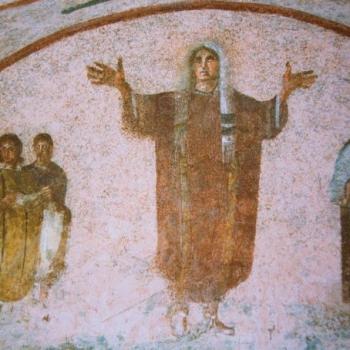
The myrrh-bearing women got up in the middle of the dark spiritual night, when Christ was among the dead, and collected what they needed to honor Christ’s body. It was because of their wisdom, the wisdom which told them not to abandon Christ and what he had taught, that had them become the first (outside of Mary, his mother), to meet their spiritual bridegroom, Christ, after he rose from the dead. The eschatological parable of the ten virgins (or maidens) applies here because Christ is the immanent eschaton, and in his resurrection from the dead, he brings the glory of the kingdom of God to all who meet him in his glorious, transformed body. Just as the wise women received the bridegroom, he received them, giving them a share of the glory which is to come in eternity. Their wise actions should encourage us to follow their example, to keep our faith, even when the darkness around us makes it seem all is lost; we must light up the oil of faith by engaging what Christ told us, doing the good which we would have us do, while we await the time when he comes again. We are to be like them, even as they were like the wise maidens of Christ’s parable, by keeping vigilant, making sure we are ready for the eschaton, when our bridegroom, Christ, comes again. We can even imitate the myrrh-bearing women by showing Christ honor and respect even in the midst of our own trials and tribulations. And how are we to do that? By believing him when he said the good we do to others, especially those in need, we do to him; and, like the myrrh-bearing women, this often means we will have to have courage, because we will be confronted by the powers that be, the systemic structures of sin, when we help those who are in need or oppressed.
Will we show the courage of Joseph of Arimathea, John, and the myrrh-bearing women, and become like the wise maidens by taking care of Christ as he is found in others? Or will we be like the foolish virgins who found all kinds of excuses to ignore what was expected of them? Will we let our faith light up the way for us, and follow it as it illuminates the path of love which requires us to perform acts of love and charity, or will we be like the unwise virgins, who try to find excuses for not doing so?
All the present age is named “night” according to the [symbolic] sense, as the parable of the ten virgins makes clear. And so, since the sun shines at day and not at night, there must be lamplight for those who live at night. And this is that which enlightens those who obey godly instruction. [1]
Mary Magdalene and the other myrrh-bearing women embraced the light; it allowed them to see what those who do not have it cannot see. Christ came to them and revealed to them the glory of his resurrection from the dead, and then they were sent out, first to the apostles, and to the rest of the world, not only to attest to the light but to share it with others. Will we be wise, or will we be foolish? Will we take care of Christ, or will we flee back into the dark??
[1] Anonymous, “Anonymous Greek Scholia on the Apocalypse ,” in Cassiodorus, St. Gregory the Great, and Anonymous Greek Scholia Writings On the Apocalypse. Trans. Francis X. Gumerlock, Mark DelCoglianto, and T.C. Schmidt (Washington, DC: CUA Press, 2022), 113 [9].
Stay in touch! Like A Little Bit of Nothing on Facebook.
If you liked what you read, please consider sharing it with your friends and family!
N.B.: While I read comments to moderate them, I rarely respond to them. If I don’t respond to your comment directly, don’t assume I am unthankful for it. I appreciate it. But I want readers to feel free to ask questions, and hopefully, dialogue with each other. I have shared what I wanted to say, though some responses will get a brief reply by me, or, if I find it interesting and something I can engage fully, as the foundation for another post. I have had many posts inspired or improved upon thanks to my readers.









 Ad-Free & Subscriber Log-In