


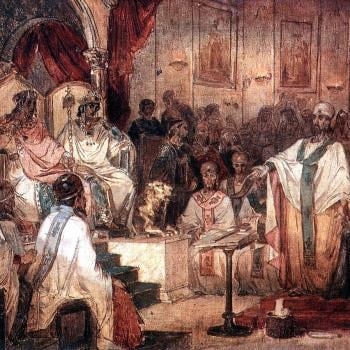
An issue I have with many so-called traditionalists, Catholic or Orthodox, is that they do not know history, and the development and changes which have happened in religious praxis throughout Christian history. They don’t know or appreciate tradition, that tradition is meant to be living and not a dead-end. They think various practices they like have always been and should always be what is practiced. Similarly, they think their interpretation of them has always been how they were always interpreted. In realty, much of what they think as being ancient is far more recent in origin and came from the cultural norms of the time when those developments happened. This is why, when they try to say their preference is more than a mere preference, but superior to all other possible ways of worship, if not actually necessary for all Christians to follow, they are wrong. They use their own cultural norms, or worse, the cultural norms of the recent past which are no longer applicable, to make say this. I often see this coming from Western (Latin) traditionalists; many of suggest that the “most reverent” way of receiving communion is by kneeling (and on the tongue, not in the hand). Some go so far as saying it is the only way to do so. Those who have studied history know that this was not how the faithful received communion in the earliest eras of Christian history; they either received at a table or, after various liturgical developments took place, standing up. Indeed, the Council of Nicea decreed that the faithful should not kneel, but stand, during the liturgy (as a sign of the joy Christians possess in light of the resurrection).
It would be absurd to say that Jesus, his apostles, their immediate successors, or the Council of Nicea, promoted inferior forms of piety, but that would have to be the conclusion one has if they believe the most reverent form of receiving communion is done while kneeling. So-called traditionalists thinking this, not only act, often out of show, to make sure people see they do what they tell others to do, they like to do so as a way to suggest this makes them better Christians than anyone else. In the end, the fall for the sin of pride, and in that pride, they end up thinking their way is superior to the way of Christ himself!
Liturgical developments can, and do happen, and we can see in the West, especially during the medieval era, changes in the way communion was received. This is because liturgy is meant to work with the culture at large. The cultural norms of the medieval era, ones which promoted kneeling, not just with communion, but in society at large, often for political reasons, are no longer the norms for us today. Liturgical changes were necessary to reflect current cultural norms. In the modern age, we like to emphasize the equal dignity of every human person, a principle which follows Catholic teaching, and so is justified to represent it by having the faithful stand when receiving communion (which is why the reason might be different from ancient times, but yet, the ancient representation demonstrates it is a perfectly acceptable praxis).
The debates surrounding communion and its reception serve as examples of a greater issue, and that is, the way traditionalists confuse culture, and the liturgical rites established in certain times, as norms which must never be changed. No culture is perfect. When Christians find a problem with a particular culture, they must work to fix those problems. If and when it is discovered that those problems made their way into the church and its liturgical practices, liturgical reform becomes necessary. This is especially the case with misogyny. Traditionalists embrace cultural norms from patriarchal societies which undermined the potential women had, and, whenever reforms promote fixing that problem, they resist it with every fiber of their being. Of course, those problems, if properly examined, go against the way of Christ, and with it, Christian doctrine. Sadly, they tend not to examine the implications of the doctrines and dogmas they otherwise affirm, for if they did, they would see they go against the cultural norms they have accepted. We can see this in the way traditionalists like to point to Mary, and Marian doctrines, while not understanding many of those doctrines were established as a way to confront misogyny, and not just any kind, but the kind traditionalists want to embrace. For example, I see often see so-called traditionalists declare that women should not be allowed in the sanctuary or near the altar; there is a history, which can be examined, that tells us how this practice developed, a history which includes the way liturgical theologians began to accept and use an over-literal reading of Levitical laws and applied them to the Christian context (which was never the intention of Scripture). They promoted the idea that men, not women, were welcome in certain spaces (even though tradition said Mary went to the holiest of spaces in the Temple!). This makes it seem that Scripture justifies their cultural beliefs and practices concerning genders (and with it, the inferior nature of women). In this way, cultural norms were followed instead of the teaching of Scripture, for Scripture tells us that the differences between the genders are relative and overcome in Christ (as Paul said, in Christ Jesus, there is neither male nor female). When we understand this and take it into consideration in our liturgical celebration, our liturgical practices, knowing how liturgy should embrace modern cultural advances, using symbols and practices which promote the best of those advance, we should work to promote the equality of the sexes in the liturgical setting, in the church, in the sanctuary itself. And, when we do so, we would be taking on and promoting elements found in the pre-Nicene era which were slowly eradicated from Christian praxis.
For, when we look to the the earliest eras of Christian history, we see women were elevated by the faithful. From the first century, we hear of a remarkable missionary St. Thekla, whose authority and responsibility seem to have challenged men and led to some of the push back against women. We also find women deacons, whose place in the church lasted for centuries. We also discern many women taking autonomy over their own lives by rejecting marriage (which led some of them being killed for denying men when men thought they had a right to control women). Slowly, we see the culture at large influencing the Christian community; as more converts came into it, bringing with them an anthropology that suggested women were inferior to men, we see the role of women in the church becoming less and less. Eventually, they were told there were places they did not belong (like in the sanctuary). We see this front at center at the Nestorian controversy and the debate concerning the title Theotokos for Mary. It was St. Pulcheria who emphasized the title, Theotokos, and she did so as a response to misogyny. She was, at the time, the sister of the emperor, one who dedicated herself to virginity, giving her a special place in the church community, as Sozomen indicated:
This princess was not yet fifteen years of age, but had received a mind most wise and divine above her years. She first devoted her virginity to God, and instructed her sisters in the same course of life. To avoid all cause of jealousy and intrigue, she permitted no man to enter her palace. In confirmation of her resolution, she took God, the priests, and all the subjects of the Roman empire as witnesses to her self-dedication. In token of her virginity and the headship of her brother, she consecrated in the church of Constantinople, a holy table, a remarkable fabric and very beautiful to see; it was made of gold and precious stones; and she inscribed these things on the front of the table, so that it might be patent to all.[1]
It was at this holy table, this altar, Pulcheria would receive communion. When Nestorius learned of this, he would not allow that practice continued. He took away her altar cloth and forbade her to receive communion at the altar. He closed the royal doors at Easter, saying no women should be allowed into the sanctuary. Many see this as the beginning of the Nestorian conflict. Pulcheria resisted Nestorius and his changes. She said she had a theological reason why he was wrong, and that was the status of Mary. She is the Mother of God, the Theotokos. She had been allowed into the Holy of Holies. She was closer to Christ, to God, than any man because God had dwelt in her during his pregnancy. Nestorius, in response, denied that she is the Theotokos, the mother of God, and said she was just the mother of the man, Jesus. God had not been in her like that. Pulcheria worked to have Nestorius’ heresy refuted. She was actively involved in having the Council of Ephesus (and later, Chalcedon), called. She stood up for the truth of Christ, but in and with it, the truth of the place of women in the church.
Nestorius’s actions show us that he took his cultural background and used it to deny the place of women had in the church, while Pulcheria showed that an authentic Christology must lead to promoting women and allowing them access to all places in the church. Sadly, that lesson had been forgotten over time, as women found themselves cut off from the altar and turned away from the sanctuary. For far too long, misogynous cultural practices held sway in the church. Things have changed recently, and that is why we see St, Pulcheria’s revolution once again bearing its fruit: women are once again found in the sanctuary. Sadly, in response to this, many are acting like Nestorius, trying to deny them what the church allows, doing so without understanding that traditional theology affirms the praxis they want to deny. This is why, whenever I see someone demand women to be kept away from the altar, I cannot help but think of the Nestorian element which lay behind their praxis, and point, like St. Pulcheria, to Mary, and say women most certainly have a right to the altar, for who can deny women their closeness to God when God has affirmed it?
There are many other cultural changes and revolutions seen throughout Christian history, each having its impact on Christian theology and praxix. It is important to look back to tradition, not just to some of it, but all of it. We should see how cultures have influenced Christian praxis, for good, but also for ill. When we see the bad, we should do what we can to purify our praxis, either going back to a tradition, a purer form, which existed before cultural corruption affected it, or engage modern doctrinal development and establish a praxis which reflects that development. We must not get so caught up in one form, in one stage, of praxis, and make it the end all and be all of praxis, which is exactly what I find so-called traditionalists tend to do. We should know that praxis, discipline, changes over time, and what is best for one age might not be best for all.
* This Is Another Post From My Personal (Informal) Reflections And Speculations Series
Stay in touch! Like A Little Bit of Nothing on Facebook.
If you liked what you read, please consider sharing it with your friends and family!
N.B.: While I read comments to moderate them, I rarely respond to them. If I don’t respond to your comment directly, don’t assume I am unthankful for it. I appreciate it. But I want readers to feel free to ask questions, and hopefully, dialogue with each other. I have shared what I wanted to say, though some responses will get a brief reply by me, or, if I find it interesting and something I can engage fully, as the foundation for another post. I have had many posts inspired or improved upon thanks to my readers.
[1] Sozomen, Ecclesiastical History. Book IX. In NPNF2(2): 419.











 Ad-Free & Subscriber Log-In