

Interfaith marriage remains a complex and sensitive topic in contemporary and postmodern societies. In the modern globalised world, Interfaith marriages are not just a symbol for liberalism but also inevitable. While ideals of equality and mutual respect in such unions are often promoted, achieving true harmony is still a challenge. The author is using a Dharmic lens to analyse interfaith marriages, which offers unique insights into their dynamics, where tradition and spirituality play a pivotal role in societal structures.
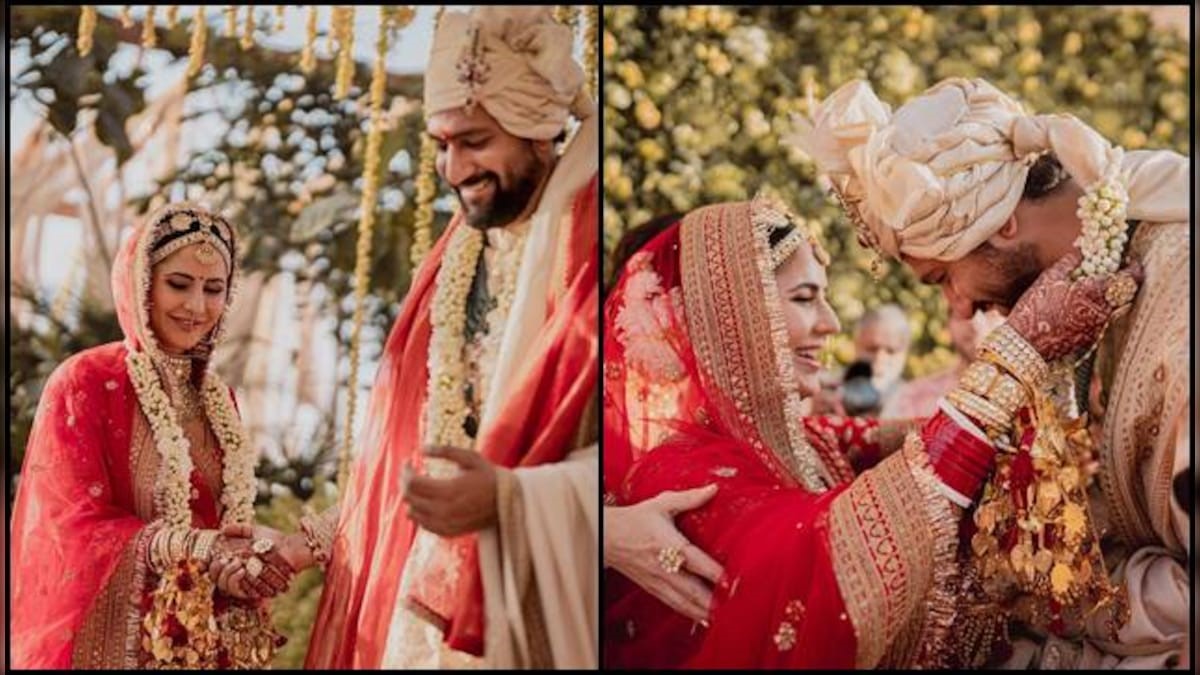
In this write-up, the author explores the interfaith marriage of Bollywood power couple Katrina Kaif and Vicky Kaushal. Their union serves as an intriguing example of how Dharmic traditions foster inclusivity and harmony in interfaith marriages.
The Wedding of Katrina Kaif and Vicky Kaushal
Katrina Kaif and Vicky Kaushal tied the knot in 2021 in a grand ceremony that captivated fans and media alike. Their wedding reportedly included both Hindu and Christian rituals, yet public imagery and reports predominantly highlight their Hindu wedding. (Note: The Author couldn’t verify the details of the Church wedding, if any.)
Vicky Kaushal, a Punjabi Hindu, rose to prominence in Bollywood from humble beginnings. Katrina Kaif, on the other hand, comes from a multicultural, multifaith, and multinational background. While netizens speculate about her religious identity—some believing she is Christian, others assuming she is Muslim—Katrina has consistently maintained that she is spiritual rather than adhering to any particular faith. She has stated that she had the liberty to choose and practice any belief system.
Katrina Kaif’s Background and Bollywood Journey
Born in Hong Kong as Katrina Turquotte, she is the daughter of Kashmiri Muslim father Mohammed Kaif and British Christian mother Suzanne Turquotte. Having been raised in the UK and travelling worldwide, she holds British citizenship.
When she entered Bollywood in the early 2000s, she changed her surname from Turquotte to Kaif. Some speculate that this was a strategic move to enhance her acceptability in the Indian film industry, given that Islamic surnames were often romanticised in Bollywood during that period. The 1990s and early 2000s also saw concerns over ‘Love Jihad,’ a term used to describe the alleged conversion of Hindu women to Islam through romantic relationships. However, Katrina adopted her father’s Islamic surname rather than embracing a wholly new identity. Today, she is among the most successful actresses in the Hindi film industry.
The Role of Dharmic Traditions in Their Marriage
Despite their interfaith backgrounds, Katrina and Vicky’s marriage exemplifies the inclusive nature of Dharmic traditions. Unlike Abrahamic religious structures that emphasise conversion, Hinduism and other Indic traditions allow individuals to engage in practices without the necessity of formal adoption or conversion.
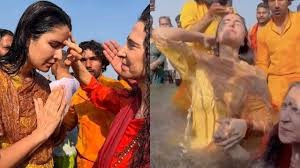
Since her marriage, Katrina has increasingly participated in Dharmic rituals and traditions, often displaying deep devotion. Media coverage has highlighted several instances of her embracing Hindu customs, such as:
- Taking a holy dip at the Mahakumbh festival in Prayagraj, India (March 2025), a ritual symbolising spiritual purification.
- Participating in Satsangs and spiritual sadhanas at an ashram under the guidance of a Guru.
- Visiting Siddhivinayak Temple in Mumbai, a revered site for Hindu devotees.
- Performing serpentine rituals at the Subramanya Temple in Karnataka, an important practice for seeking relief from ‘Sarpa Dosha’ (snake afflictions).
Hinduism: A Set of Multiple Traditions, Not Just a Religion
Hinduism is widely regarded as one of the world’s great religions, yet historically, it was more of an umbrella of traditions rather than a single faith system. European colonisers categorised Hindu traditions under the singular label of ‘Hinduism’ only a few centuries ago. Before this, these traditions coexisted with mutual respect, recognising Jainism, Buddhism, Sikhism, materialism, and atheism as part of the broader Indic spiritual landscape. Prof. Balagangadhara of Ghent University, a renowned Indic scholar, commented that Hinduism in the Indian lens is always comprised of multiple traditions that are indifferent to their differences. ( in his book: The Heathen in his Blindness)
Unlike Abrahamic religions, which often emphasise conversion, Hinduism allows individuals to self-identify and practice its traditions without formally renouncing their existing beliefs. This unique characteristic enables interfaith marriages, like that of Katrina and Vicky, to flourish without coercion.
Future Considerations: Children and Identity
As of now, the couple does not have children. It will be interesting to observe how they navigate the religious and cultural identity of their future offspring. Will their children take Hindu names? Will they follow Hindu traditions or maintain a more secular, global identity? Only time will tell.
Conclusion: The Dharmic Approach to Interfaith Harmony
Katrina Kaif and Vicky Kaushal’s interfaith marriage is a testament to the accommodating nature of Dharmic traditions. While Katrina has not officially converted to Hinduism, her voluntary embrace of Hindu rituals underscores the non-coercive nature of Hindu traditions. This aligns with the broader Dharmic ethos of accepting multiple pathways to spiritual fulfilment.
However, it is crucial to recognise that while Hinduism may see all traditions as part of its vast umbrella, Abrahamic religions may not always reciprocate this inclusivity. Therefore, individuals in interfaith marriages must navigate these complexities with sensitivity and mutual respect. The author also observes that all the Indigenous Traditions and Religions are more pluralistic than Semitic Religions.
This case study offers valuable insights into how tradition, culture, and personal choice intersect in interfaith marriages. It demonstrates that when religious harmony is rooted in voluntary participation rather than imposition, interfaith unions can thrive in a spirit of mutual respect and understanding.
(Note: This article has been written following my participation in the course “Interfaith Marriages” by Dr Dilip Amin.)
Author: Shashi Holla
Western Australia
Source:
Everything we know about Katrina Kaif and Vicky Kaushal’s wedding | Vogue India
Katrina Kaif And Vicky Kaushal’s Royal Wedding in Six Senses Fort Barwara, Sawai Madhopur Rajasthan








 Ad-Free & Subscriber Log-In