


The hoisting of the Dhwaja atop the newly reconstructed Ram Mandir on 25 November 2025 is far more than a religious ritual or an architectural milestone. It marks a civilisational crescendo — a luminous watershed moment in the long and unbroken arc of Hindu tradition. In an age where Indigenous cultures across the world have been erased or museumised, this event announces the renewed cadence of the world’s oldest living civilisation.
Plural Truths vs. Singular Claims
Monotheistic Religions often assert their truths as exclusive, singular, and historically final. Hindu thought, by contrast, frames truth as plural, contextual, and expansive—a mosaic rather than a monolith.
For centuries, doctrinal exclusivism and political monotheism categorised Indigenous cultures as pagan, idolatrous, or inferior polytheistic traditions. Driven by expansionist zeal, these monotheistic zealots launched waves of conquest that obliterated civilisations and extinguished countless Indigenous epistemologies.
Hindu Survival: Resistance, Not Accident
Hindu civilisation endured not by accident but through resistance and remarkable cultural resilience. Over the last millennium, it survived repeated invasions, ideological assaults, and systematic attempts at erasure. Yet it lives today not as an anthropological artefact but as a vibrant, continuous civilisation carrying forward its ritual systems, philosophies, languages, and metaphysics.
In contrast, many other Indigenous civilisations—the Inca, Maya, Aztec, Mesopotamian, and numerous tribal cultures—were reduced to archaeological memory. Their living traditions were replaced by exclusive monotheistic theologies, leaving behind only museum relics and cinematic caricatures.
The Resurrection of Ram Mandir: Five Centuries of Struggle and Faith
The original temple was demolished in 1528 by the Central Asian ruler Babur, a foreign king from present-day Uzbekistan. Scholars estimate that several thousand Hindu temples were destroyed by expansionist monotheistic invaders who viewed these sacred spaces as “idolatrous” and therefore illegitimate.
For centuries, Hindus attempted to rebuild the shrine at Ayodhya, but their efforts were blocked—first by Mughal rulers, later by colonial administrators. Even after independence in 1947, grievances over the site received little attention from successive secular governments.
It was only in 2019 that the Supreme Court of India, after examining extensive evidence, finally granted permission for reconstruction. The Court’s decision rested on textual, legal, archaeological, and historical travelogue sources, all converging to affirm the longstanding Hindu claim.
What Ayodhya Temple’s ‘Dharma Dhwaj’ Signifies
The triangular flag, measuring 10 feet by 20 feet, features:
-
A radiant Sun
-
The sacred Om
-
The Kovidara tree
Together, these symbols express three foundational pillars of Sanatana Dharma.
Om represents the eternal spiritual vibration.
The Sun marks Lord Rama’s Suryavanshi lineage and invokes divine energy.
The Kovidara tree, believed to be created by Rishi Kashyap from Mandar and Parijat, symbolises sacred knowledge and continuity.
Ram: A Meta-Civilisational Hero
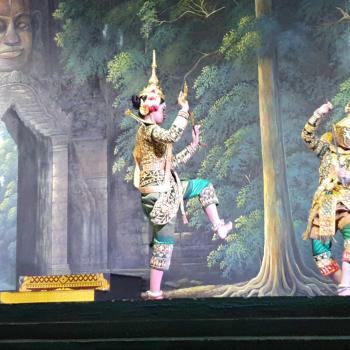
Ram is not just an Indian deity; he is a meta-civilisational figure whose story transformed cultures across Southeast Asia.
Forms of the Ramayana include:
-
Cambodia’s Reamker
-
Thailand’s Ramakien
-
Java’s Kakawin Ramayana
-
Ritual traditions in Laos and Vietnam
-
Architectural inspiration at Angkor Wat
These transmissions were carried by maritime trade, cultural exchange, and diplomacy across the Indian Ocean world, as documented by R. C. Majumdar and O. W. Wolters.
The Dhwaja rising in Ayodhya resonates across this entire civilisational sphere.
They Destroyed Temples, Not the Civilisation
Hindu civilisation has long faced:
-
Monotheistic supremacists seeking conversion (by violence and deceit)
-
Marxist ideologues seeking erasure (obsessed with caste and Hindutva)
-
Liberal universalists seeking dilution and appropriation (Yoga, meditation, Ayurveda)
Despite these pressures, Hindu civilisation remains unbroken.
The Dhwaja atop the Ram Mandir symbolises continuity after rupture, presence after absence, and a future rooted in cultural self-confidence.
As Amish Tripathi notes, reconstruction reflects Hindu civilisation’s ability to modernise while remaining rooted—building from within rather than imitating external models.
If the current Hindu intellectual and cultural resurgence continues, the 21st century may witness alliances among surviving Indigenous traditions worldwide, promoting plurality, coexistence, and civilisational dignity.
Shashi Holla, WA
Notes / References
-
How India Is Reclaiming Temples While Egypt and Rome Fell — Swarajya
-
Sun, Om & Tree: The Symbols on Ayodhya Ram Temple’s Dharma Dhwaj — Times of India
-
In Ayodhya, the Soul of a Civilisation Finds Utterance — Vikram Sampath
-
Interviews of Amish Tripathi in multiple media outlets







 Ad-Free & Subscriber Log-In