

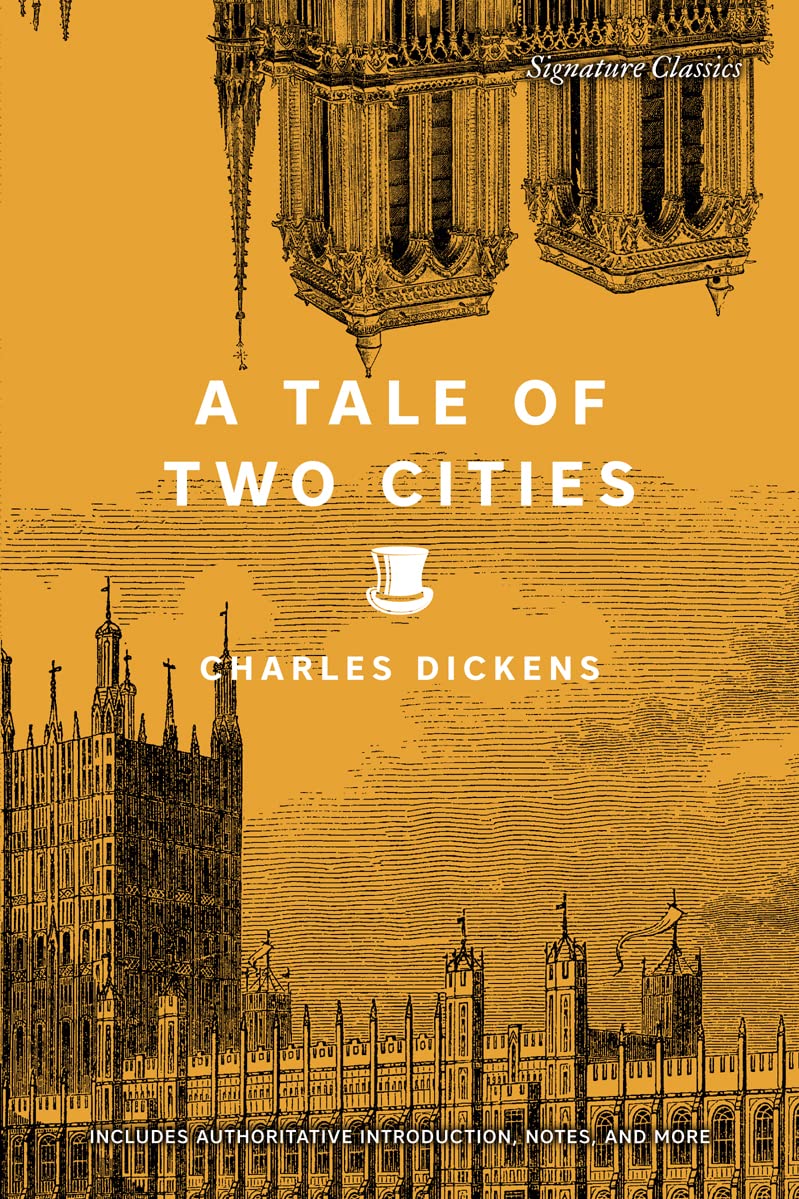
 “Why do you wear a guillotine around you neck?,” someone asked me. Just recently, a student gave me a guillotine pendant after we finished reading A Tale of Two Cities. I now wear it, openly, around my neck, certainly not as an endorsement of revolutionary violence, but as a reminder and a provocation to genuine reflection.
In A Tale of Two Cities, the guillotine is never just a machine. It is an idea. A promise. A hope. And Dickens insists that we take seriously the kind of salvation a society seeks when it places its faith in an instrument of death.
Warning: This post will have spoiler for anyone who has not read the book.
A Tale of Two Instrument Of Death
Few novels are as preoccupied with killing as Dickens’. But he is not merely cataloging executions or dramatizing revolutionary excess. He asks a deeper question, “what kind of meaning does a society attach to death?” Two images dominate that question: the guillotine and the cross. One belongs to revolutionary modernity; the other to ancient empire and Christian memory. Dickens places them in deliberate tension because both are claimed as instruments of salvation. Both promise a redeemed world. Both demand blood. That similarity is unsettling, just as Dickens intends it to be.
At first glance, the comparison feels strained. The guillotine is mechanical, efficient, and cold; the cross is religious, ancient, and often sentimentalized. Yet Dickens presses the comparison anyway. He wants readers to feel uncomfortable about how easily violence cloaks itself in moral language. The question is not whether death will be used (history suggests it always is) but how it will be justified, and to what end.
The Guillotine as National Faith
From the moment it enters the novel, the guillotine functions as more than a tool. It operates as a kind of public faith. Dickens repeatedly frames it in religious terms: it is exalted, trusted, and revered as the means by which France will be purified. The Revolutionaries do not merely use the guillotine; they believe in it. Blood becomes therapeutic. Death becomes restorative. Its blade promises to cleanse the nation of corruption and usher in a morally renewed future.
 What makes the guillotine especially chilling is not its brutality but its impersonal nature. Unlike older forms of execution, it is quick, efficient, and egalitarian. Aristocrat and peasant die the same way. In theory, this makes it just. In practice, it makes death scalable. Judgment becomes a process. Vengeance becomes routine. The crowd gathers, the blade rises, the sacrifice is made, and the people disperse, only to return the next day for the same ritual.
Dickens is careful in his depiction of the people’s zeal. This is not madness. It is fervor. The people are not irrational; they are religious. This guillotine faith requires no priest, no confession, no forgiveness. One simply lines up, and the blade does the believing for you. That is precisely why it can be trusted so completely, and why it becomes so dangerous. Once violence is framed as morally cleansing, mercy begins to look like betrayal.
The Cross Before It Was Holy
Against this stands the cross, though Dickens never treats it as a harmless or purely redemptive emblem. He understands its scandal. The cross, too, began as an instrument of terror. Rome used it to warn rebels what happens when power is defied. Like the guillotine, it was meant to inspire fearful compliance. Dickens does not oppose revolutionary violence with a sanitized Christianity; he opposes it with the original meaning of the cross: state violence masquerading as justice.
However, the cross did not remain what Rome intended. Christianity did something subversive with it. It reinterpreted the cross not as proof of imperial righteousness but as proof of the victim’s innocence. It transformed an instrument of domination into a symbol of self-giving love. The power of the cross lies not in killing but in who chooses to die and why. Dickens draws deeply from this moral imagination, even if he never turns the novel into explicit theology.
When the Guillotine Imitates the Cross
Here Dickens makes his most dangerous move: he allows the guillotine to resemble the cross. He describes the Revolution lifting the blade with reverence, almost devotion. This is not endorsement. It is exposure. Revolutionary justice imitates religious sacrifice. It promises redemption through death. Dickens wants us to feel how close these logics can come to one another as well as how catastrophic that resemblance can be.
The decisive difference, however, is agency. The guillotine demands victims. The cross receives one who chooses.
Sydney Carton and the Subversion of Death
Sydney Carton’s final act is where this distinction becomes unavoidable. He does not overthrow the guillotine. He does not denounce the Revolution. He submits to the blade. In so doing, he empties it of its claimed meaning. His death is not revolutionary. It does not purify France or advance a cause. It saves a family.
The Revolution kills for abstractions: the people, the future, the nation. Carton dies for particular people with names and faces. Carton subverts the guillotine in much the same way that Christ subverted the cross as it was used by the Romans. Through his sacrifice, the guillotine bring salvation to Darney (and ultimately his family)
In that moment, the guillotine becomes what the cross once was: a place where the innocent die at the hands of the righteous. Unlike the Revolution’s victims, Carton’s death is voluntary. He redeems the meaning of the instrument by refusing its logic.
This is where Dickens quietly, but unmistakably, aligns Carton with the moral shape of the cross. Carton bears the weight of others’ guilt. He gives life through loss. He transforms death from punishment into gift. Dickens does not suggest that sacrifice magically fixes political systems. The Revolution continues, and the blade keeps falling. Still, something else has happened that the Revolution cannot undo.
Why One Instrument Fails and the Other Endures
The guillotine ultimately fails because it cannot absorb sacrifice; it can only multiply it. Each execution requires another. Each act of purification produces more impurity. There is no final victim, no completion, no peace. The cross, by contrast, ends something. Its power lies not in repetition but in sufficiency. Dickens gestures toward this logic without preaching it. Carton’s final vision is not of France redeemed by blood, but of lives quietly flourishing because one man chose to die.
When students read these chapters for the first time, they often assume Dickens is simply condemning the Revolution. But that is too easy. Dickens is far more interested in how easily moral language attaches itself to killing, and how quickly instruments of terror are baptized as instruments of hope.
Two Gospels of Death
In A Tale of Two Cities, Dickens sets before us two gospels. The gospel of the guillotine says the world will be saved when the guilty are removed. The gospel of the cross says the world is saved when the innocent offer themselves. Both take death seriously. Both speak the language of sacrifice. But only one can sustain hope without becoming cruel.
Dickens does not let us escape with a clean symbol. The guillotine remains standing. The Revolution grinds on. What he leaves us with is not a simple contrast between good and evil, but a harder question: which kind of death is a society willing to call holy—and what does that choice do to those who must live with it?
That is why the guillotine pendant does not unsettle me. It reminds me how easily we sanctify death— and how desperately we need the courage to ask what kind of salvation we are really seeking.












 Ad-Free & Subscriber Log-In