

Some books wear their theology on the surface. Others do not say much about God directly, yet they force us to ask theological questions because they strip life down to the bone. One Day in the Life of Ivan Denisovich is that kind of book.
Aleksandr Solzhenitsyn’s short novel is set in a Soviet labor camp under Stalin. It follows one ordinary prisoner, Ivan Denisovich Shukhov, through one ordinary day. There is no dramatic escape. No heroic revolt. No stirring speech about the indomitable human spirit. There is only cold, hunger, labor, surveillance, exhaustion, and the daily grind of humiliation.
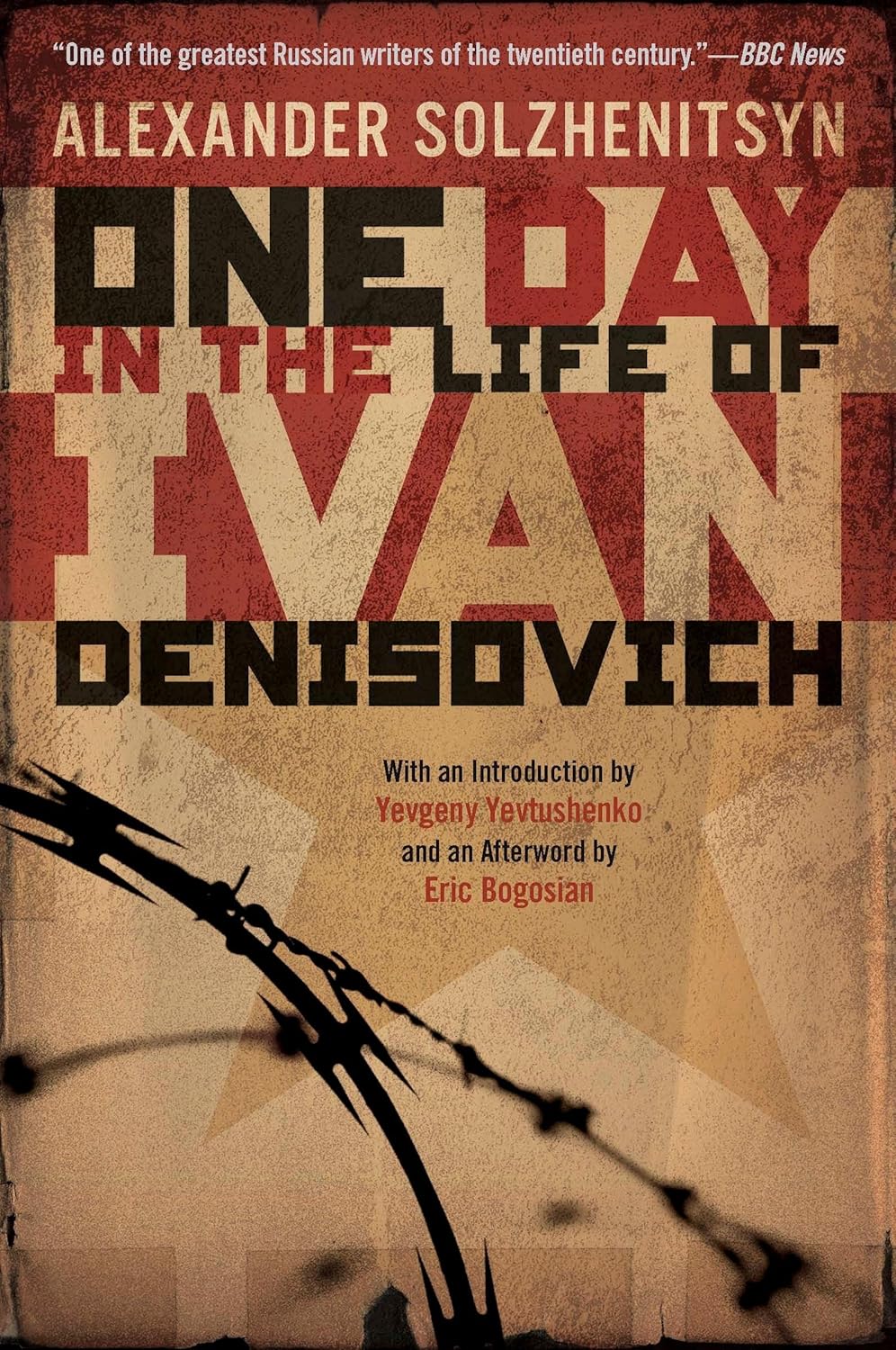
That is precisely what makes the novel so theologically rich. Solzhenitsyn does not hand us doctrine in tidy form. He does something harder. He shows us what becomes visible when almost everything else is taken away. What is a human being when comfort, privacy, status, and freedom are stripped away? What does evil actually do to the soul? Can dignity survive degradation? Can grace still appear in a world organized by lies?
Those are theological questions, whether the novel announces them as such or not.
Built on a False Anthropology
At the center of the novel is a conflict over what a human being is. The camp is not simply a harsh environment. It is a machine built on a lie about the human person. Men are counted, sorted, rationed, assigned, and punished. They are treated as labor power, bodies to be managed, mouths to be fed only enough to keep them useful. The state does not merely govern the prisoners. It effectively redefines them.
From a Christian standpoint, that is not merely political evil. It is theological evil. Scripture teaches that human beings are made in the image of God. Their dignity is not granted by the state, nor earned by productivity, nor dependent on recognition. Human worth is rooted in creation. A person matters because he is made by God. The camp denies this in practice. It treats persons as things.
Yet Solzhenitsyn quietly resists that lie throughout the novel. Shukhov is hungry, cold, and tired, but he is never merely an animal trying to survive. He notices. He judges. He chooses. He remembers. He cares how work is done. He wants to preserve self-respect. He remains a moral subject.
In theological terms, the image of God is battered and beaten, not erased.
That is why the camp is not merely painful. Pain alone is too small a category. The camp is evil not only because it inflicts suffering, but because it trains people to see human beings as manageable material rather than neighbors, bearers of God’s image, or creatures with irreducible dignity. It does not merely punish bodies. It catechizes souls.
Sin Becomes a World
The novel also gives us a distinctly biblical picture of evil. Evil here is not limited to a few cruel men making bad choices. It has become organized. It has become routine. It has become a world.
That is very close to Scripture’s own moral vision. The Bible certainly speaks of personal sin. But it also speaks of Pharaoh, Babylon, corrupt judges, false witnesses, and principalities and powers. Sin does not remain private. Human pride hardens into institutions.
So too in Solzhenitsyn. The camp is a social order built on domination. But domination is not sustained by force alone. It is sustained by falsehood. The camp is not merely cruel; it is a world of official unreality. It renames injustice as order. It disguises degradation as necessity. It throws language and truth into a funhouse of mirrors, then demands that people live inside the distortion.
This is precisely how evil works. The serpent deceives before he destroys. Sin falsifies reality. It misnames good and evil, then compels submission to the lie.
That is why the novel is not only about physical suffering. It is also about moral and spiritual pressure. The danger is not only that a man will be starved or punished. It is that he will begin to see the world through the categories of the camp. The deepest battle is never merely over the body. It is over whether lies will become your world.
Suffering Is Not Good, But It Does Reveal
Christians should be careful when speaking about suffering, and Solzhenitsyn helps us be careful. The novel does not romanticize pain. Hunger is evil. Cold is evil. Humiliation is evil. The camp is evil. There is no theological wisdom in pretending otherwise.
Oppression is not somehow transformed into beauty simply because someone may grow through it. That sort of pious talk usually comes from people standing at a safe distance from real suffering.
Yet, the novel clearly shows that suffering reveals. It strips away illusion. In ordinary life, people can imagine themselves virtuous without ever being seriously tested. The camp removes that luxury. Under pressure, people reveal what they love, what they fear, and what they are becoming. Some become petty, grasping, and numb. Others retain patience, gratitude, discipline, and quiet decency.
This fits a biblical pattern. Suffering does not automatically sanctify, but it does expose. It reveals idols and uncovers loyalties. It shows whether a person has inward substance or merely outward polish. So the novel avoids two equal and opposite errors. It neither sentimentalizes suffering nor treats it as spiritually meaningless. Evil wounds the soul, but it does not automatically own it. A man may be humiliated without becoming base. He may be oppressed without inwardly surrendering.
Christianity does not teach that evil is good. It teaches that evil may become the setting in which faithfulness is either abandoned or displayed. That is a very different claim.
Daily Bread Becomes Visible Again
One intriguing feature of the novel is its attention to ordinary material life. Bread matters. Soup matters. Warmth and sleep matter. Tools matter. Work matters. Every small mercy matters. This is not because Solzhenitsyn reduces all of life to bodily needs. It’s because he restores our sense of creatureliness. Human beings are embodied and dependent. We do not live above food, labor, shelter, and rest. We live through them.
Comfortable modern people often lose contact with this reality. “Give us this day our daily bread” becomes a line we recite rather than a need we feel. In the camp, daily bread becomes visible again for what it is: not a metaphor but a true gift.
This is also why gratitude matters so much in the novel. Shukhov is not grateful for the evil around him. He is grateful within it. That distinction matters. He notices small goods without denying the larger injustice. This is not sentimentality. It is truthful gratitude.
Christian thanksgiving does not require pretending the world is fine. It requires recognizing that God’s gifts remain gifts even in a fallen world. Grace does not wait for ideal conditions before it appears. In fact, suffering often has a strange way of making ordinary mercies visible again.
Work as a Refusal of Inner Collapse
Shukhov’s care for his work is one of the most revealing details in the book. He wants to lay bricks well. He takes satisfaction in doing a task properly. That may seem like a small point. It is not.
In the camp, labor is no longer a free vocation; it’s forced toil. Yet Shukhov’s workmanship becomes a form of resistance. He refuses to become inwardly sloppy in a world built on degradation.
This makes deep Christian sense. Biblically, work belongs first to creation, not to the curse. Human beings are made to cultivate, build, shape, and steward. Sin distorts labor into frustration and domination, but it does not erase the goodness of work itself. Even in a cursed world, work can still carry traces of vocation.
So when Shukhov works well, he does more than pass the time or fulfill a quota. He’s preserving humanity. He is refusing inner disintegration. He is saying, however quietly, that the camp may command his body, but it will not fully colonize his soul.
That point matters because faithfulness is often ordinary. It does not always arrive with drama. Sometimes it looks like care, precision, patience, and integrity in small things. In that sense, workmanship itself becomes a refusal of the camp’s lie.
Alyoshka and Ultimate Reality
Alyoshka the Baptist matters because he opens the spiritual horizon of the novel. He represents a way of suffering that is shaped by faith rather than mere calculation.
He does not deny pain. He does not pretend the camp is pleasant. But he refuses to let the camp define ultimate reality. He interprets life in relation to God.
That is decisive. The camp claims practical ultimacy. It controls bodies, schedules, food, labor, and punishment. It acts as though it is the highest power. Alyoshka quietly denies that claim. He reminds the reader that the state is not ultimate, visible power is not ultimate, and suffering is not ultimate. In other words, Alyoshka’s posture only makes sense if the camp is not ultimate. There is, in fact, another kingdom, another authority, and another horizon of meaning beyond the state.
This is one of the novel’s most Christian dimensions. The kingdom of God does not appear here through spectacle or triumph. It appears through prayer, inward freedom, and hidden fidelity. It’s not flashy, nor is it impressive by worldly standards. It’s real.
That is often how grace works too. It does not always come in the form we would choose. Sometimes it appears simply as the refusal to let visible power define the whole of reality.
Hope in a Minor Key
The novel offers no cheap hope. It does not flatter modern faith in progress. It does not suggest that history naturally bends toward justice if only the right system is installed. Solzhenitsyn is far too honest for that fairy tale.
But neither is the novel hopeless.
Its hope comes in a minor key. Evil has not fully succeeded. A man may still remain human. He may still pray, share, work well, resist lies, and preserve some integrity. That is not yet the fullness of Christian hope, but it’s not nothing. It is hope under pressure. It is hope in reduced form.
That sort of hope may seem small, but it certainly matters.
From a Christian standpoint, it matters because evil is real but not ultimate. The camp behaves as though it has final authority over meaning. The book quietly denies that claim. The image of God persists. Truth persists. Grace has not been extinguished.
While not Easter morning in full light, it’s enough to remind us that Good Friday is not the final word.
Remaining Human Before God
One Day in the Life of Ivan Denisovich presents a world in which an idolatrous political order tries to reduce human beings to useful matter through lies, hunger, domination, and shame. Yet the novel also shows that a person’s God-given dignity cannot be wholly erased. Evil dehumanizes, but grace appears in fragments: in gratitude, workmanship, prayer, truthfulness, fellowship, and the refusal to surrender the soul.
That is why the novel deserves theological reflection. We’re reminded that the deepest human battle is not only for bodily survival, or even outward freedom, important as those are. It is for the soul. It reminds us that the image of God may be battered without being destroyed. It reminds us that grace often appears not in triumph, but in stubborn faithfulness.
And perhaps that is the book’s deepest theological insight: the most human thing in the camp is also the most Christian thing. Not optimism or self-expression. It’s not even heroic grandstanding. But the stubborn refusal to let evil have the final word over what a person is.
In a world of lies, to remain human before God is already a form of witness.














 Ad-Free & Subscriber Log-In