

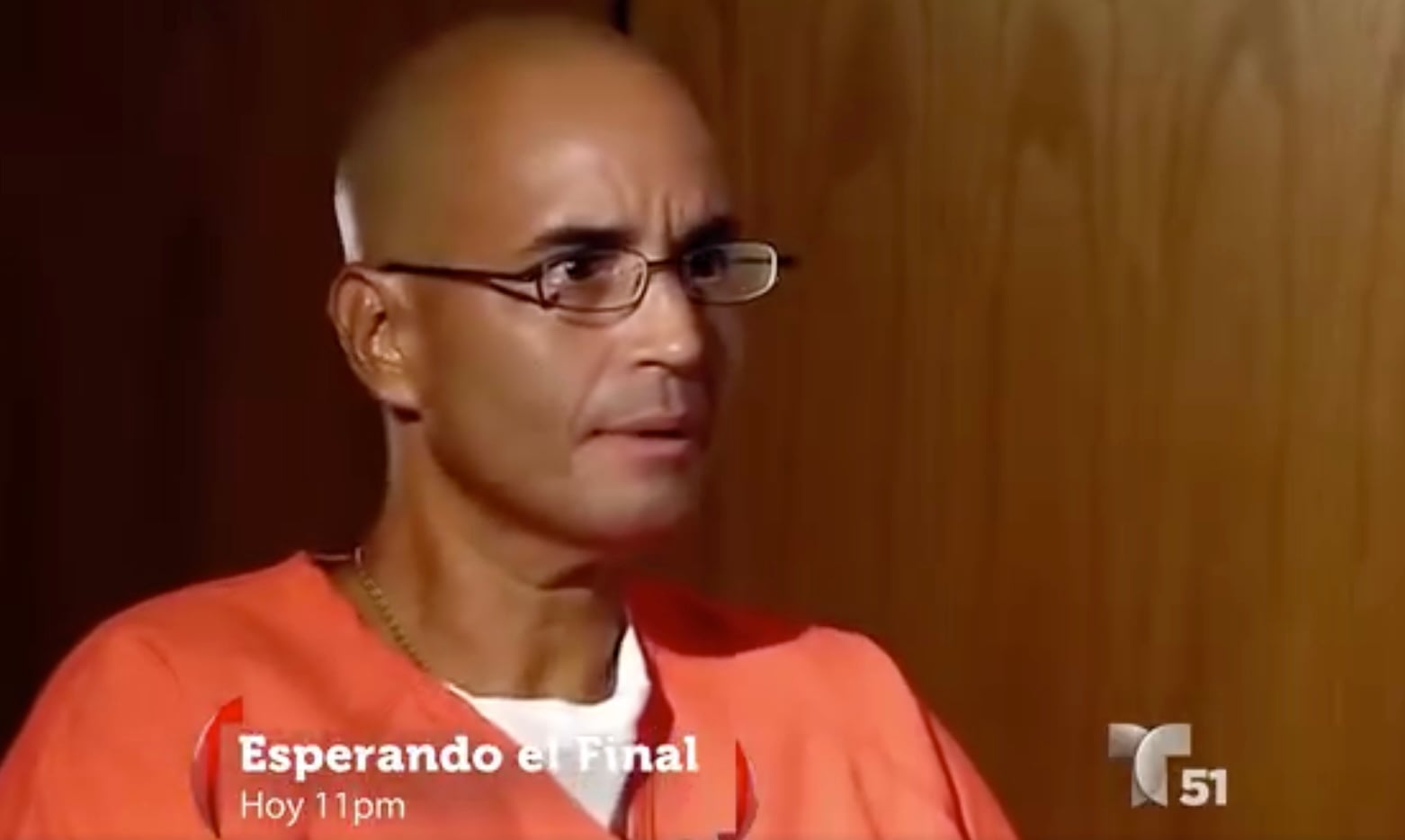
This is the manuscript of a new book from Complicit Press entitled:
NOT COMMENSURATE: The Case for Mercy for Marbel Mendoza
Jeff Hood
In support of legal relief for Marbel Mendoza
Florida Department of Corrections | DC# 450307
Dade County Case No. 92-9940C
Primary Sources: Florida Supreme Court Opinion No. 84,370 (1997); Florida Supreme Court Corrected Opinion No. SC04-1881 (2007); Marbel Mendoza, Petition for Executive Clemency; personal correspondence with the author.
CONTENTS
Preface: A Question of Proportion
Chapter One: The Man Before the Morning
– Who Marbel Mendoza Was
– The Architecture of Addiction
– A Family, a Faith, a Future Forfeited
Chapter Two: What Actually Happened
– Two Accounts of One Morning
– The Debt, the Bookie and the Suppressed Defense
– The Physical Evidence and What It Does Not Show
– The Only Eyewitness
Chapter Three: When Death Is Warranted and When It Is Not
– The Constitutional Framework
– The Worst of the Worst
– The Felony Murder Doctrine
– Florida’s Proportionality Review
Chapter Four: The Broken Trial
– Two Attorneys, No Investigator
– The Gunshot Residue Failure
– Lazaro Cuellar: The Witness Never Called
– The Penalty Phase: Opening a Forbidden Door
Chapter Five: Lost in the Language of Death
– What It Means to Face a Capital Trial in a Language Not Your Own
– The Gap Between Interpretation and Understanding
– Counsel, Communication and the Broken Attorney-Client Relationship
– The Research on Language and Capital Justice
– What Was Lost in Translation
– The Silence That Followed
– What a Fair Process Would Have Required
Chapter Six: The Mitigation That Was Never Heard
– What Competent Counsel Would Have Found
– Chronic Depression and Untreated Mental Illness
– Substance Dependency as Statutory Mitigation
– The Asylum Application
– What the Jury Was Not Told
Chapter Seven: The Process That Failed Him
– Thirty Years of Inadequate Review
– Direct Appeal: Error Found, Error Excused
– Six Days of Hearings, Two Pages of Analysis
– The Judge Who Died
– The Voice That Has Never Spoken
Chapter Eight: The Aggravators, the Mitigators and the Math
– What the Sentencing Order Shows
– The Aggravating Factors
– The Mitigation That Was Found
– The Seven-to-Five Vote as Constitutional Data
– A Standard the State No Longer Stands Behind
Chapter Nine: The Comparative Lens
– How Mendoza’s Case Measures
– Where Florida Has Vacated Death
– The Co-Defendant Disparity
– Race, Poverty and the Death Penalty’s Arithmetic
– The International Standard
Chapter Ten: The Weight of Remorse
– What Thirty Years Has Produced
– The Four Purposes of Punishment
– The Victim and the Truth
Chapter Eleven: What Justice Requires
– Three Paths Forward
– Path One: Executive Clemency
– Path Two: Resentencing Before a New Jury
– Path Three: An Evidentiary Hearing With His Testimony
– The Proportionality Conclusion
Conclusion: Let Him Speak
Sources and Record
About the Author
For Conrado Calderon, whose death demands the full truth.
For Marbel Mendoza, whose voice has never been heard.
For every juror who voted for life.
PREFACE
A Question of Proportion
Seven voted yes. Five voted no.
Five people looked at this man and said: not death.
This book is for those five.
This book is not a defense of everything Marbel Mendoza has done. He is not asking for that and neither is this argument. What follows is a narrower and more urgent proposition: that whatever Mendoza’s culpability for the death of Conrado Calderon on March 17, 1992, that culpability does not meet the threshold required to take his life. The punishment Florida seeks to impose is disproportionate to the crime as the evidence actually establishes it. The evidence is far thinner and more contested than any death sentence can bear.
The word commensurate means proportional. It means fitting. It means the punishment corresponds, in weight and in kind, to the offense. The question this book asks and answers is whether the death penalty is commensurate with what Marbel Mendoza actually did, as opposed to what the State’s theory of the case, built almost entirely on the testimony of a cooperating co-defendant, says he did.
Mendoza has been on death row for more than thirty years. He was twenty-five years old when Conrado Calderon died. He is fifty-nine now. He has watched the legal system process his case through two rounds of Florida Supreme Court review, a failed postconviction proceeding, a deceased judge, a reset and an ongoing silence on the most basic question of all: whether the man condemned to die ever had a fair chance to tell his story.
He did not. That is what this book documents. But beyond the procedural failures, serious as they are, this book makes the substantive argument: that the crime for which Mendoza was sentenced to death, examined honestly against the legal and moral standards for when death is warranted, does not belong in the category of cases where the state kills a citizen. The aggravating factors were minimal. The mitigating circumstances were substantial and largely ignored. The planning and premeditation that distinguish first-degree murder from lesser homicide were, at minimum, genuinely contested. Five of twelve jurors agreed that death was not the answer.
What follows is the full argument. It draws from the Florida Supreme Court’s own opinions, from the record of what happened at trial and in postconviction proceedings and from Mendoza’s own words. Words that have never been weighed by any court but that deserve to be weighed before the State acts with finality.
The death penalty is not reserved for all killings. It is reserved, by law and by constitutional mandate, for the worst of the worst. Marbel Mendoza’s case, honestly examined, is not that.
CHAPTER ONE
The Man Before the Morning
WHO MARBEL MENDOZA WAS
The law measures what a man did.
Mercy asks who he has become.
Marbel Mendoza was born on September 23, 1966, into a Roman Catholic family in Miami. By his own account, his upbringing was defined by reverence, warmth and discipline. His parents raised their children with what he describes as unyielding kindness. He went to school. He received his high school diploma at eighteen. He moved out at twenty-one, got engaged, married and became a father. He worked in food service and she waited tables to build a life together.
None of that background excuses what followed. But it is necessary context for understanding who Marbel Mendoza was before the machinery of addiction took over his life. And who he has become, after more than three decades of incarceration, reflection and what he describes as genuine transformation.
From adolescence, Mendoza struggled silently with chronic depression. He kept it to himself, as young men of his generation and community were expected to do, because of the stigma attached to mental illness. Self-medication followed: alcohol first, then marijuana, then cocaine, then crack cocaine and heroin. The escalation was not unusual. It is a clinical pattern well documented in the literature on untreated depression and substance use disorders: the brain seeks relief through whatever chemistry is available and the relief becomes the trap.
I silently battled and struggled with chronic bouts of depression from early in my adolescence but kept it to myself due to the stigma that my peers and most of society tend to attach onto mental health issues. So I did what most teens and young adults who suffered from mental health issues do… self-medicate at first with alcohol and soft narcotics, then as my body developed a tolerance I gradually advanced to hard drugs.
The Mendoza who stood in Conrado Calderon’s driveway in the early morning darkness of March 17, 1992 was not the young man his parents had raised. He was twenty-five, unemployed for nearly a year, addicted to hard narcotics and had descended into a world of street crime not as a career criminal but as an addict in freefall. His prior crimes… robberies and burglaries committed in the months before Calderon’s death… were the acts of a man consuming himself in the pursuit of his next high, not the calculated conduct of a seasoned predator.
* * *
THE ARCHITECTURE OF ADDICTION
It is worth pausing here to be precise about what addiction does to moral agency. Not to exonerate but to calibrate. The question of culpability in law and in ethics is not binary. It is not a switch between full responsibility and none. It is a spectrum and where someone falls on that spectrum affects the proportionality of punishment.
When Mendoza was evaluated by Dr. Jethro Toomer, the defense psychologist at the penalty phase of his trial, Toomer found no evidence of antisocial personality disorder, the clinical marker most associated with calculating, predatory criminal behavior. What Toomer found instead was consistent with a man driven by the compulsive demands of substance dependency. The drug history, the depression and the impulsive criminal conduct all pointed toward a person in the grip of addiction, not a person with a stable and dangerous character.
The jury never heard that full picture. The one witness who might have conveyed it was gutted by evidence the court later found should never have been admitted. The clinical reality remains and it bears on the proportionality question directly: death is not the appropriate response to crimes rooted in addiction and untreated mental illness.
* * *
A FAMILY, A FAITH, A FUTURE FORFEITED
Mendoza is now fifty-nine years old. He has been in custody since 1992. More than thirty years. He has not held his child. He buried both parents from behind bars. The man who asks for clemency today is not the twenty-five-year-old addict who lost his way on a dark morning in Hialeah. He is a man who has lived inside the consequences of that morning for three decades, who has turned to faith, who describes himself as God-fearing not as a performance for a clemency board but as a description of who he has actually become.
I am no longer the immature, impulsive, impaired-minded drug addict 25-year-old young man who was under the consuming dominion of hard narcotics. The person who now seeks your compassion and intervention is a 59-year-old matured God-fearing man whose only prayer is to have the blessing of paying it forward in a productive manner that will impact and deter others from a similar path.
Whether or not one accepts that transformation as genuine. The record of three decades of incarceration without institutional violence is relevant evidence that it is. It remains true that executing a fifty-nine-year-old man for what a twenty-five-year-old addict did accomplishes nothing that a life sentence does not also accomplish. The deterrence argument does not apply to a man who has been imprisoned for thirty years. The incapacitation argument does not require death when the alternative is continued confinement. The retribution argument, if it is to have any moral purchase, must measure the offense against the punishment. On that measurement this case fails.
CHAPTER TWO
What Actually Happened
TWO ACCOUNTS OF ONE MORNING
One man told the story. One man went free. One man waits to die.
There are two accounts of what happened in Conrado Calderon’s driveway before dawn on March 17, 1992. The State’s account, built entirely on Humberto Cuellar’s testimony, says three men went to Calderon’s home to rob him, that they had surveilled his routine, lay in wait and confronted him with deadly weapons. The State’s account produced a first-degree felony murder conviction and a death sentence.
Mendoza’s account says something different. He says Humberto Cuellar recruited him to help collect an unpaid debt from Calderon, a bookie, an operator of an illegal numbers lottery, a bolitero who owed money and had ignored other attempts to collect it. Mendoza says the plan was to confront Calderon, pressure him and if he refused, to rough him up. He says there was no plan to rob Calderon. He says that when Humberto unexpectedly struck Calderon with his pistol, Calderon drew his own weapon and fired. Everything that followed was chaos, not a plan.
These two accounts lead to radically different legal conclusions. If the State’s account is correct, Mendoza participated in a planned armed robbery during which the victim was killed. That is classic felony murder, sufficient for a death sentence under Florida law. If Mendoza’s account is correct, the encounter was a violent and ultimately fatal debt confrontation. Serious, criminal and resulting in death but not a planned robbery and therefore not the specific crime for which Mendoza was sentenced to die.
* * *
THE DEBT, THE BOOKIE AND THE SUPPRESSED DEFENSE
The defense at trial attempted to introduce evidence that Calderon was a bolitero, that he ran an illegal numbers lottery, handled significant cash and was involved in a world where debt enforcement by intimidation was routine. The trial court restricted this evidence severely.
The Florida Supreme Court addressed this on habeas review and declined to find the restriction prejudicial. But the court’s reasoning deserves examination. The court held that even if Calderon was a bolitero, that fact alone could not establish that Mendoza and the Cuellars were collecting a debt rather than attempting a robbery. That inference would require stacking one inference upon another.
This reasoning misunderstands how context works in a criminal defense. The question was not whether Calderon being a bolitero logically proved the debt-collection theory. The question was whether the jury, hearing that Calderon ran an illegal numbers operation, handled large amounts of cash and was involved in a world where debt enforcement sometimes looked exactly like what happened in that driveway, would have evaluated the competing narratives differently. The answer is almost certainly yes. Humberto Cuellar’s robbery narrative depends on the jury having no alternative frame. Give the jury a frame and the narrative becomes genuinely contested. The defense was not asking for an acquittal. It was asking for the opportunity to be heard.
* * *
THE PHYSICAL EVIDENCE AND WHAT IT DOES NOT SHOW
The physical evidence at the scene is consistent with Mendoza’s account and, in one critical respect, inconsistent with a robbery gone wrong.
No money was taken. Conrado Calderon was found with cash in his pockets, cash in his wallet and a bank bag containing $2,089 under his body. In the State’s theory, three armed men lay in wait, confronted a lone victim and engaged in a violent struggle and then left every dollar behind. The prosecution’s explanation is that the robbery was interrupted by Calderon’s resistance. But Calderon was shot four times, three at point-blank range and the last from less than six inches away. He was on the ground. The men had a moment. They left with nothing.
A man collecting a debt who encounters more violence than he planned and flees in panic leaves money behind. A man executing a robbery who leaves with nothing has failed at the one thing robberies are designed to do. Mendoza’s theory requires accepting that a debt confrontation turned deadly and the participants fled a scene they had not intended to create. That is, at minimum, plausible enough to have been heard.
* * *
THE ONLY EYEWITNESS
The entire factual structure of the State’s case rested on Humberto Cuellar. He was the only person who testified to the planning of the robbery, to the intent to rob rather than collect, to the decision to go to Calderon’s house that morning for the purpose of taking his money. Without Humberto’s testimony, the State had fingerprints on a car, a gun consistent with the caliber used and a suspect who fled and shaved his head. None of that proves planned robbery.
Humberto Cuellar received twenty years, covering second-degree murder, conspiracy, attempted armed robbery, burglary and use of a firearm, in exchange for his testimony against Mendoza. His brother Lazaro received ten years for manslaughter. Humberto has since completed his sentence. Lazaro has since completed his. The man who held the gun, struck the victim and brought Mendoza into the situation is free. The man who may or may not have fired the fatal shots is on death row.
Lazaro Cuellar, the getaway driver and the only person with an unimpeded view of the full sequence of events, was never called to testify at trial. He is also the man whom Mendoza’s account identifies as the shooter: the person who, in a panic as his brother lay shot, returned fire and killed Calderon. That account, if believed, would not exonerate Mendoza of all criminal liability. But it would fundamentally change the nature of that liability. From principal in a planned robbery-murder to participant in a violent confrontation who did not fire the fatal shots.
Humberto Cuellar asked if I was interested in assisting him in collecting a substantial unpaid bookie’s debt for a percentage of the debt recovered… Humberto would do the talking. Humberto explained that Mr. Calderon was an older man and would get the message… everything unfolded in seconds.
This is the account that has never been heard. The man who could have contradicted or corroborated it was never called. The man who gave it was advised not to testify. The jury that decided whether Marbel Mendoza should live or die heard one side of the story. The other side has been waiting thirty years.
CHAPTER THREE
When Death Is Warranted and When It Is Not
THE CONSTITUTIONAL FRAMEWORK
Death cannot be undone. That is not a legal argument. It is the only argument that matters.
The Eighth Amendment to the United States Constitution prohibits cruel and unusual punishment. Since the Supreme Court’s 1972 decision in Furman v. Georgia, which temporarily halted all executions in the United States, the constitutional law of capital punishment has been organized around one central principle: death is different. It is qualitatively, not merely quantitatively, different from every other punishment the state imposes. Because it is final, irreversible and total, it requires a level of certainty and proportionality that no other punishment demands.
In Gregg v. Georgia (1976), the Court upheld the constitutionality of capital punishment but established a framework: guided discretion, individualized sentencing, meaningful consideration of both aggravating and mitigating circumstances and proportionality review. In Coker v. Georgia (1977), the Court held death disproportionate for rape. In Atkins v. Virginia (2002), disproportionate for intellectually disabled defendants. In Roper v. Simmons (2005), disproportionate for juvenile offenders. The arc of constitutional doctrine bends consistently toward fewer and fewer cases where death is permissible.
The Florida Supreme Court has recognized this in its proportionality review jurisprudence. Before affirming a death sentence, the court compares the case to others and asks whether death is warranted given the specific facts, the specific aggravators, the specific mitigators. It is not enough that the crime was violent. It is not enough that a person died. The question is whether this case belongs in the category where the ultimate punishment applies.
* * *
THE WORST OF THE WORST
American death penalty jurisprudence has arrived at a working standard for when execution is appropriate: the worst of the worst. This formulation captures the constitutional requirement that death be reserved for the most aggravated, the most deliberately cruel, the most morally depraved cases within the universe of first-degree murders.
What does the worst of the worst look like? It looks like serial killing. It looks like torture-murder. It looks like the killing of children. It looks like contract killing. It looks like murder committed after meticulous planning for the pure satisfaction of causing death. It looks like cases where the defendant demonstrates a complete and stable absence of anything recognizable as human conscience.
Marbel Mendoza’s case does not look like that. It looks like a chaotic, violent confrontation in a driveway that lasted less than a minute, involving three men whose stated purpose, whatever one believes, was not to kill anyone, in which the victim himself was armed and fired his weapon, in which the co-defendant who struck the first blow received twenty years and is now free, in which the getaway driver received ten years and is now free and in which the man on death row received his sentence on a seven-to-five jury vote.
* * *
THE FELONY MURDER DOCTRINE
Mendoza was convicted of first-degree felony murder. That doctrine holds that any killing committed during the course of certain enumerated felonies, including robbery, constitutes first-degree murder regardless of intent to kill. Felony murder is among the most expansive and, critics argue, most morally problematic doctrines in American criminal law.
Multiple states have reformed or abolished felony murder in recent decades. California substantially reformed the doctrine in 2018 through Senate Bill 1437, limiting liability to those who actually killed, intended to kill or were major participants acting with reckless indifference to human life. The national trend reflects a growing recognition that felony murder, applied at its broadest, can produce sentences grossly disproportionate to actual culpability.
In Mendoza’s case, the jury was not required to find that he pulled the trigger. It was not required to find that he intended Calderon to die. It was required only to find that a death occurred during the commission of the felony of robbery, a felony whose existence Mendoza disputes. The jury that sentenced him to death may have done so without believing he killed anyone. That is the architecture of felony murder. And it is precisely why a death sentence built on felony murder requires the most rigorous proportionality scrutiny.
* * *
FLORIDA’S PROPORTIONALITY REVIEW
On direct appeal, the Florida Supreme Court conducted proportionality review and concluded that death was not disproportionate. It distinguished two cases, Terry v. State and Jackson v. State, where it had vacated death sentences, noting that in those cases the prior violent felony aggravator was based on crimes contemporaneous with the murder while in Mendoza’s case it was based on a separate prior robbery conviction.
This distinction is technically correct but substantively thin. The proportionality analysis was conducted against a mitigation record artificially stripped of content by deficient counsel. As Chapter Five documents, the defense presented virtually no penalty-phase mitigation, not because none existed but because trial counsel conducted an inadequate investigation. The Florida Supreme Court compared Mendoza’s sentence against a record that was incomplete. It is not a fair comparison.
CHAPTER FOUR
The Broken Trial
TWO ATTORNEYS, NO INVESTIGATOR
No investigator. One witness. A strategy no one could name.
This is what it cost him.
Barry Wax and Arnaldo Suri represented Marbel Mendoza at trial. Both were public defenders. Neither hired an investigator. In a capital case where a man’s life is at the end of every decision, that is not a strategic choice that merits deference. It is a structural failure that compromised the entire defense from the beginning.
An investigator in a capital case interviews family members, traces the defendant’s history, documents the mitigating circumstances that a penalty phase requires, locates witnesses who can speak to character and background and provides counsel with the raw material for a defense a jury can evaluate as complete. Without an investigator, counsel is working blind, conducting a defense based only on what the defendant says and what the prosecution’s file contains.
What did Wax and Suri miss by not hiring an investigator? We cannot know with certainty, because the investigation was never done. But we can observe what was not presented: a full account of Mendoza’s childhood and family history, a complete picture of his substance dependency and its relationship to his criminal conduct, witnesses who might have spoken to his character, documentation of the untreated depression that drove his self-medication. These are the materials of a mitigation case. None of them were adequately developed.
* * *
THE GUNSHOT RESIDUE FAILURE
Among the specific claims raised in postconviction proceedings was the allegation that trial counsel was ineffective in preparing and presenting gunshot residue evidence, the defense’s only forensic support for its theory that someone other than Mendoza fired the fatal shots.
The defense called Gopinath Rao, a criminalist for the Miami-Dade County Police Department, as its sole guilt-phase witness. Rao testified as an expert in particle analysis and presented findings about gunshot residue swabs taken from Lazaro and Humberto Cuellar. The theory was that the residue evidence could establish who had fired a weapon, corroborating Mendoza’s account that Lazaro fired the shots that killed Calderon.
The problem: Rao’s testimony contained a critical error. He reported the wrong time that the gunshot residue swabs were taken. This inaccuracy was discovered by the State and hammered in closing argument as evidence that the defense’s expert was incompetent or had been given false information. The Florida Supreme Court noted this in its 2007 postconviction opinion, observing that without a proper circuit court order evaluating the evidence and witness credibility, it could not determine whether counsel’s preparation of Rao had been constitutionally adequate.
The significance of this failure is hard to overstate. The gunshot residue evidence was the only physical, scientific basis for the defense’s alternative theory of the shooting. If properly prepared and presented, it could have given the jury tangible forensic support for the argument that Lazaro, not Mendoza, fired the shots that killed Calderon. Instead, it became a liability. The sole defense witness at the guilt phase made the defense weaker. That is the measure of the representation Mendoza received.
* * *
LAZARO CUELLAR: THE WITNESS NEVER CALLED
The most significant failure of trial counsel was the decision not to call Lazaro Cuellar as a witness. Lazaro was the getaway driver. He was present in the car. He drove to the scene. He was, by Mendoza’s account, the person who fired the fatal shots.
Lazaro had already pled guilty. His plea covered his conduct. He could have been called to testify. At the evidentiary hearing years later, neither Wax nor Suri could explain why they had not called him. They said it was a strategic decision. They could not articulate what the strategy was.
A strategy that cannot be explained is not a strategy. It is a gap. In a capital case, a gap of this magnitude. Failing to call the one living witness whose testimony could have corroborated the defendant’s account and potentially shifted the narrative of who fired the shots that killed Conrado Calderon, is not a harmless oversight. It is the kind of failure that hollows out a defense from the inside.
Still to this day, I have not had an evidentiary hearing where my witness testimony is part of the trial record on appeal.
Mendoza’s testimony. Lazaro’s testimony. The two accounts that could have competed directly with Humberto’s narrative. Neither was ever heard. The jury that sentenced Marbel Mendoza to death heard one man’s story. The rest was silence.
* * *
THE PENALTY PHASE: OPENING A FORBIDDEN DOOR
The penalty phase is where the jury decides whether a convicted defendant should live or die. Its purpose is individualized sentencing: the jury is supposed to hear the full human picture of the person before it, weigh the aggravating and mitigating circumstances and make a moral judgment. That process depends entirely on defense counsel presenting mitigation with competence and care.
At Mendoza’s penalty phase, defense counsel called one witness: Dr. Jethro Toomer, a psychologist who testified that Mendoza could be rehabilitated and that his history of substance dependency and mental health issues warranted a life sentence. On direct examination, counsel asked Toomer directly: Can Marbel Mendoza be rehabilitated?
That question opened a door. On cross-examination, the State walked through it. The prosecutor asked Toomer whether, in forming his rehabilitation opinion, he had considered the defendant’s pending criminal charges. Toomer admitted he had not been fully informed. The State then used this in closing to portray the entire mitigation case as a fabrication, the expert as a hired gun who knew nothing about anything bad Mendoza had done.
The Florida Supreme Court found this was error. The court’s own precedent in Hildwin v. State clearly prohibited telling the jury about arrests and pending charges that had not resulted in convictions. The court called it harmless error, noting that the jury had also heard from Robert Street, a prior robbery victim and that Mendoza was subsequently convicted on those charges. But this reasoning is circular: it uses the existence of other properly admitted evidence to excuse the improperly admitted evidence, without grappling with what the erroneous evidence did to the only mitigation witness.
Dr. Toomer was not just a witness. He was the entire mitigation case. When he was made to appear ignorant of the defendant’s own history, reduced to a hired expert who had not done his homework, the mitigation case collapsed. And the jury voted seven to five for death.
CHAPTER FIVE
Lost in the Language of Death
WHAT IT MEANS TO FACE A CAPITAL TRIAL IN A LANGUAGE NOT YOUR OWN
The court spoke. He heard sounds.
Between those two things, a man’s life was decided.
Marbel Mendoza is a Spanish-speaking man. The trial that sentenced him to death was conducted in English. The witnesses who testified against him spoke English. The judge who sentenced him spoke English. The attorneys who represented him communicated with him across the barrier of language, through interpretation that was never examined for adequacy and never made part of the appellate record as a concern. This chapter argues that the language barrier in Mendoza’s case was not a minor inconvenience. It was a structural deprivation that touched every stage of the proceeding and that has never been fully reckoned with.
Capital trials are the most consequential legal proceedings a human being can face. They demand not just the presence of the defendant but his active participation: the ability to communicate with counsel, to understand the testimony being offered against him, to evaluate whether witnesses are saying what he believes they are saying, to instruct his attorneys on the details of his own account, and to make informed decisions at every turn. A defendant who cannot fully access the language of his own trial is not fully present at it. He is a spectator at the proceeding that will determine whether he lives or dies.
For a Spanish-speaking defendant in a Miami courtroom in 1994, the guarantee of an interpreter did not solve this problem. It translated the formal record. It did not translate the texture of the proceeding, the asides, the tone of witness testimony, the sidebar conversations, the unrecorded moments when attorneys and judges communicated in ways that shaped the direction of the case. It did not give Mendoza the ability to tell his lawyers, in the moment, that something a witness said was wrong, or that a line of questioning was missing the point, or that a piece of evidence was being characterized in a way that did not match his experience. The interpreter translated words. The experience of being tried remained foreign.
* * *
THE GAP BETWEEN INTERPRETATION AND UNDERSTANDING
There is a difference between interpretation and comprehension. Interpretation converts words from one language to another. Comprehension requires that the converted words carry their full weight: the legal significance of terms of art, the implications of procedural rulings, the meaning of an objection sustained or overruled, the difference between what a witness said and what the same words mean in a different cultural register.
Legal English is not ordinary English. Capital trial proceedings involve terms and concepts that are opaque even to educated native speakers: felony murder, aggravating circumstances, mitigating factors, harmless error, proportionality review. When these terms are interpreted into Spanish for a defendant hearing them for the first time, in a courtroom, under the pressure of a proceeding that is moving faster than his comprehension can follow, the interpretation may be technically accurate and still functionally useless. The words arrive. The meaning does not.
Mendoza has stated that he was incapable of adequately assisting his lawyers, citing his substance dependency and impaired judgment as the primary reasons. But the language barrier compounded this incapacity in ways that were never examined. A defendant who cannot follow his own trial in real time cannot catch his attorney’s errors. He cannot flag the moment when the defense theory begins to drift from his account of events. He cannot signal that the witness on the stand is saying something inconsistent with what he told his lawyers in consultation. He is dependent entirely on those lawyers to get it right. And as Chapter Four documents, they did not get it right.
* * *
COUNSEL, COMMUNICATION AND THE BROKEN ATTORNEY-CLIENT RELATIONSHIP
Effective assistance of counsel requires effective communication between attorney and client. In a capital case, that communication must be deep enough to support a complete investigation of the defendant’s life history, a thorough development of the facts from the defendant’s perspective and an informed joint decision about strategy at every critical juncture, including the decision about whether to testify.
When the attorney and client do not share a language, the communication that effective assistance requires does not happen automatically. It requires deliberate effort: extended consultation through qualified interpreters, time spent ensuring the defendant genuinely understands not just the translation of words but the legal significance of choices, and a conscious attention to the ways that linguistic distance can create misunderstanding about what the defendant wants and what the defense strategy actually is.
The record of Mendoza’s case contains no evidence that this kind of deliberate effort was made. The postconviction proceedings, which examined at length whether counsel was deficient in preparing witnesses and developing mitigation, do not appear to have examined in detail whether counsel’s communication with Mendoza across the language barrier was adequate to support genuinely informed decisions. The question of whether Mendoza fully understood his right to testify, and whether his decision not to testify was genuinely informed in his own language, has never been resolved.
This matters because Mendoza maintains he wanted to testify. He maintains he was told not to by counsel. Whether that advice was communicated to him in terms he fully understood, whether the consequences of not testifying were explained to him with the clarity that a decision of that magnitude requires and whether he had the opportunity to raise in his own language the objections he now articulates in his clemency petition are questions the record does not answer. They are questions that should have been answered before a death sentence was affirmed.
* * *
THE RESEARCH ON LANGUAGE AND CAPITAL JUSTICE
The intersection of language access and capital punishment has received increasing attention from legal scholars, capital defense organizations and human rights advocates. The data is not encouraging.
Studies of capital cases involving non-English-speaking defendants have found persistent patterns: inadequate interpreter qualifications, inconsistent interpretation protocols, failure to provide defendants with translated copies of key documents, and attorney-client relationships structured around the interpreter rather than around genuine mutual understanding. In many jurisdictions, the standard for interpreter adequacy in capital cases was not meaningfully different from the standard in minor traffic proceedings. The gravity of the proceeding was not reflected in the rigor of the language access provided.
The Due Process Clause of the Fourteenth Amendment has been construed to require that non-English-speaking defendants have access to interpretation sufficient to allow them to understand the proceedings against them and to communicate effectively with their attorneys. But the standard for what suffices is low and the enforcement mechanism is weak. An appeal based on inadequate interpretation requires showing not just that interpretation was deficient but that the deficiency resulted in prejudice to the defense. This is a standard that is nearly impossible to meet after the fact, because the failures of real-time comprehension leave no record. The defendant who did not understand what a witness said cannot prove, years later, what he would have said to his attorney if he had understood it.
Marbel Mendoza’s case was tried in Miami-Dade County, which has a large Spanish-speaking population and a court system with more experience in bilingual proceedings than most American jurisdictions. But experience does not guarantee adequacy, and adequacy was never the subject of focused inquiry in this case. The language barrier was present. It was managed by the provision of an interpreter. Whether that management was constitutionally sufficient to give Mendoza a trial he could genuinely participate in was never asked.
* * *
WHAT WAS LOST IN TRANSLATION
Consider what Mendoza’s language access required him to miss or miscommunicate. His account of the events of March 17, 1992 is detailed, internally consistent and fundamentally different from Humberto Cuellar’s account in ways that are legally significant. The debt versus robbery distinction, the sequence of events in the driveway, the identification of Lazaro as the shooter, the absence of any plan to take Calderon’s money: these are the elements of a defense that, fully articulated and competently presented, might have produced a different verdict or at least a different sentencing recommendation.
For that defense to be built, Mendoza needed to be able to communicate it. He needed to sit with his attorneys and convey not just the bare facts but the texture and sequence and significance of what he witnessed. He needed to be able to correct misunderstandings as they arose. He needed to be able to read the draft of a defense theory and say: that is not quite what happened, here is the difference that matters.
None of that is possible when communication is mediated by interpretation under the pressures of an active case, when the client is also struggling with acute substance dependency and untreated depression, and when counsel has not hired an investigator who could have spent the time with Mendoza, in Spanish, working through his account with the patience that building a defense requires. The language barrier did not operate in isolation. It operated in combination with every other failure documented in this book, multiplying the effect of each one.
A defendant who cannot communicate fully with his attorneys cannot correct their errors. He cannot tell them that the gunshot residue witness has the timing wrong. He cannot tell them that Lazaro’s account would contradict Humberto’s. He cannot tell them that the bolitero evidence matters and explain why in terms they will act on. He is trapped inside a proceeding being conducted on his behalf by people who do not fully know what he knows because he cannot fully tell them.
* * *
THE SILENCE THAT FOLLOWED
In the years since his conviction, Marbel Mendoza has written in Spanish and communicated through others about what happened. His clemency petition, written in English, carries the marks of a man working carefully to be understood across a linguistic barrier that has defined his relationship with the legal system for his entire adult life. The precision of his account, the specificity of his corrections to Humberto’s narrative, the clarity with which he identifies the errors in his trial: these are not the words of a man who had a fair chance to speak at trial. They are the words of a man who has spent thirty years finding the language to say what he could not say when it mattered.
He has never testified. That silence is partly the product of counsel’s advice. It is also the product of a system that never gave him the tools to participate in his own defense in a language he fully commanded. The decision not to testify was made under conditions of linguistic and cognitive impairment that were never examined. The man who sits on death row today, writing in careful English about what happened in that driveway, is a man who was never given the chance to say it in his own language, in his own words, to a jury that could evaluate whether he was telling the truth.
I due to my strong substance dependency and impaired judgments before and after my arrest was incapable of assisting my lawyers. As well as standing firm in my willingness to testify during both phases of the trial which my then trial counsel adamantly told me not to do so because of pending felony charges in separate non-capital cases.
The substance dependency and the language barrier and the absence of a competent defense all operated on the same man at the same time. Any one of them, standing alone, would be a serious problem in a capital proceeding. Together, they describe a defendant who was present in the courtroom and absent from his own trial. The constitution requires more than physical presence. It requires the ability to participate. On that standard, Marbel Mendoza never had his day in court.
* * *
WHAT A FAIR PROCESS WOULD HAVE REQUIRED
A constitutionally adequate capital trial for a Spanish-speaking defendant requires more than a warm body at the interpretation table. It requires qualified legal interpreters specifically trained in capital proceedings, not general court interpreters pressed into service for a complex multi-week trial. It requires translated copies of key pleadings and evidence provided to the defendant in advance, so he can review them in his own language and raise concerns with counsel. It requires extended attorney-client consultation conducted through interpreters, with sufficient time for the defendant to genuinely understand the strategy being proposed and to contribute his own account in sufficient depth to support the investigation. And it requires a mitigation investigation conducted in the defendant’s language, by an investigator or social worker who can access the full texture of his history in the register in which he actually lived it.
None of these requirements were demonstrably met in Mendoza’s case. The trial record does not reflect extended bilingual consultation. The mitigation investigation, as Chapter Six documents, was effectively not conducted at all. The one mental health expert who testified did so based on a psychosocial history gathered from Mendoza himself, in a single evaluation, without the documentary support and family testimony that a thorough investigation would have produced. The evaluation was almost certainly conducted through interpretation. Whether the interpretation was adequate to capture the clinical nuances on which a penalty-phase determination depends has never been examined.
There is a reason that capital defense organizations have developed specialized protocols for representing non-English-speaking defendants. The reason is that ordinary procedures are not adequate. The stakes are too high and the opportunities for failure are too many. Marbel Mendoza did not have the benefit of those specialized protocols. He had two public defenders, no investigator and a language barrier that was never treated as the significant structural problem it was.
CHAPTER SIX
The Mitigation That Was Never Heard
WHAT COMPETENT COUNSEL WOULD HAVE FOUND
The jury was never shown the man. They were shown the crime.
The crime was enough to kill him.
In capital cases, mitigation is everything. It is the constitutional guarantee that the jury will not decide life or death based on the crime alone. It will be compelled to confront the full human being it is being asked to execute. The Supreme Court’s decisions in Wiggins v. Smith (2003), Rompilla v. Beard (2005) and Williams v. Taylor (2000) establish that trial counsel’s failure to investigate and present available mitigating evidence constitutes ineffective assistance of counsel and that such failures can undermine confidence in a death sentence even when the guilt-phase verdict is sound.
What was available to be presented in Marbel Mendoza’s case, had counsel conducted an adequate investigation? The record is incomplete but it suggests quite a lot.
Chronic Depression and Untreated Mental Illness
Mendoza has described, in his clemency petition, a history of chronic depression beginning in adolescence. He kept it secret… as men of his generation and community were expected to… because of the stigma attached to mental illness. He self-medicated. The trajectory from untreated depression to substance abuse to impulsive criminal conduct is so well-documented in the clinical literature that it is nearly a template.
Dr. Toomer testified that he found no evidence of antisocial personality disorder in Mendoza… a significant finding, because antisocial personality disorder is the clinical profile most associated with dangerous, predatory criminal behavior. What Toomer found instead was consistent with a man driven by addiction and untreated mental illness. But his testimony was based on a psychosocial history provided largely by Mendoza himself, without the documentary support and corroborating family testimony that a thorough mitigation investigation would have produced.
Competent penalty-phase preparation includes mental health evaluations using multiple instruments, review of school records and medical history, interviews with family members, childhood teachers and neighbors, and, where available, documentation of the experiences that shaped the defendant’s development. None of this was done here.
Substance Dependency as Statutory Mitigation
Florida’s capital sentencing statute, section 921.141, explicitly lists impairment of capacity to appreciate the criminality of conduct as a statutory mitigating circumstance. The law recognizes that addiction, real and consuming, diminishes the kind of rational deliberation that distinguishes the worst offenders from those whose conduct is driven by dependency.
Mendoza’s addiction was severe. He describes it as total: a complete redirection of his will and judgment toward the pursuit of drugs.
I literally became someone else, someone I never imagined I could be capable of becoming… a person without scruples whose only purpose was to find the means to get high, to live in that alter reality moment by moment whatever the cost.
This is not minimization. It is an accurate description of how severe addiction functions and it is the kind of description that, supported by clinical evidence and family testimony, can move a jury toward a life recommendation. The jury that sentenced Mendoza to death heard almost none of it.
The Asylum Application
Among the mitigation evidence excluded at trial was a political asylum application submitted by Mendoza’s mother to the United States Immigration and Naturalization Service, documenting aspects of the family’s history. The trial court excluded it because the preparer was never identified and no official action had been taken on it.
This exclusion could have been avoided with competent preparation. A capital mitigation investigator would have located the preparer, documented the family’s history independently and presented childhood context through live witness testimony rather than through an unauthenticated document. The Florida Supreme Court called the exclusion harmless, noting that Mendoza’s mother had testified and the application would have been cumulative. But cumulative is precisely the point: a mitigation case is built from accumulation. When the pile is thin, as Mendoza’s was, nothing is truly cumulative.
* * *
WHAT THE JURY WAS NOT TOLD
What did the jury that sentenced Marbel Mendoza to death know about him as a human being? It knew he had committed other robberies. It knew he had pending charges. It heard an expert who admitted he hadn’t examined the full record. It heard no family members speak to his childhood with depth. It heard no documented history of the depression that drove his addiction. It heard no clinical assessment grounded in records rather than self-report.
What the jury did not know: the childhood of a Roman Catholic family, parents who raised him with love and discipline and are now both dead; the untreated depression he carried alone for years; the wife and child he left behind when addiction unmade him; the man he has become in thirty years of prison; the faith that has rebuilt him; the genuine remorse that runs through every word he has written about what happened in that driveway.
A death sentence issued by a jury that knew the first list but not the second is not a proportionate sentence. It is a sentence issued in partial darkness. And partial darkness is not the standard for the most irrevocable punishment the state possesses.
CHAPTER SEVEN
The Process That Failed Him
THIRTY YEARS OF INADEQUATE REVIEW
The legal history of Marbel Mendoza’s case is not, as the State might prefer to characterize it, a story of thorough review reaching a settled conclusion. It is a story of failures at every level, across trial, direct appeal and postconviction, and of a man bearing the weight of those failures without any of them being corrected on the merits.
Direct Appeal: Error Found, Error Excused
On direct appeal, the Florida Supreme Court found error: the improper elicitation of pending criminal charges against Mendoza’s mental health expert, in violation of the court’s own ruling in Hildwin v. State. The court called it harmless. The analysis is in Chapter Four. The short version: a seven-to-five death recommendation, based in part on the destruction of the only mitigation witness, is not a verdict that should be described as harmless-error-proof.
Six Days of Hearings, Two Pages of Analysis
After the direct appeal concluded and the United States Supreme Court denied certiorari, Mendoza filed an amended motion for postconviction relief in 2000, raising twenty-seven claims, including ineffective assistance of counsel at both the guilt and penalty phases.
The circuit court summarily denied the motion without a hearing. Mendoza appealed. The Florida Supreme Court vacated the denial and ordered an evidentiary hearing on the ineffective assistance claims. New counsel was appointed. Hearings were scheduled.
Six evidentiary hearings were held between April 2003 and March 2004. The defense called multiple witnesses: trial counsel themselves, expert witnesses on mitigation investigation and capital defense standards and witnesses bearing on the specific claims. Six full days of testimony on the question of whether Marbel Mendoza had received constitutionally adequate representation at the trial that sentenced him to die.
The circuit court’s response was a two-page order. It stated the standard for ineffective assistance of counsel claims under Strickland v. Washington. It declared that Mendoza’s petition had not met or overcome those requirements. It provided no factual findings. It evaluated no witness testimony. It addressed no specific claim. The Florida Supreme Court described this as having effectively summarily denied postconviction relief, using the same language it had used when it reversed the first summary denial years earlier.
Despite the six days of evidentiary hearings and extensive presentation of testimony, the circuit court’s order essentially summarily denied Mendoza’s postconviction claims… the circuit court neither stated on the record nor rendered an order detailing its factual findings and the reasons for its decision.
That is the Florida Supreme Court speaking. Not Mendoza’s advocates. The court itself characterized what happened as a failure of process that left it unable to conduct meaningful and appropriate appellate review.
The Judge Who Died
The 2007 Florida Supreme Court opinion ordered a new evidentiary hearing. The basis for this order was not that Mendoza’s claims were meritless. It was that the postconviction judge who had heard six days of witnesses, evaluated their credibility and then issued two pages of boilerplate was dead. The court could not remand to him for explanation. A new judge was appointed. A new evidentiary hearing was ordered under the clean slate rule, meaning Mendoza would have to re-present every claim, every witness and every argument from the beginning.
Thirty years of accumulating error and the system’s answer was: start over.
The Voice That Has Never Spoken
Through the trial, the appeals, the postconviction proceedings and the remands, one thing has remained constant: Marbel Mendoza has never testified. He was told not to testify at trial. Mendoza maintains it was counsel’s concern about his pending charges in separate cases, the same charges that were improperly introduced into evidence at the penalty phase anyway. He wanted to testify. He had an account to give. He was silenced and then watched the charges he was silenced to protect against be used to destroy his mitigation case.
The jury nor the court has never been presented with the actual terms of events and facts… my witness testimony… of the tragic events that took place on that regrettable day. Still to this day, I have not had an evidentiary hearing where my witness testimony is part of the trial record on appeal.
A man has been on death row for thirty years and no court has ever asked him, under oath, what happened. That is not justice. That is a system that has substituted procedure for truth.
CHAPTER EIGHT
The Aggravators, the Mitigators and the Math
WHAT THE SENTENCING ORDER SHOWS
Florida’s capital sentencing scheme requires the trial court to find statutory aggravating and mitigating circumstances, weigh them and determine whether the aggravators outweigh the mitigators sufficiently to warrant death. In Mendoza’s case, the sentencing order’s analysis reveals both the thinness of the aggravation and the inadequacy of the mitigation presentation.
The Aggravating Factors
The trial court found two aggravating circumstances. First: Mendoza had previously been convicted of a violent felony, namely the robbery of Robert Street, committed in 1991 and tried separately. Second: the murder was committed while Mendoza was engaged in an attempted robbery for pecuniary gain. The court merged the second factor with the commission-during-a-robbery aggravator, treating them as effectively one.
The result is, at its fullest, one-and-a-fraction aggravating circumstances. The prior violent felony was a separate crime. The robbery aggravator is the heart of the felony murder theory, a theory contested by the defendant and supported only by the testimony of a cooperating co-defendant who received twenty years for his own role in the same events. Florida courts have vacated death sentences with comparable or greater aggravation when accompanied by meaningful mitigation.
The Mitigation That Was Found
The trial court found no statutory mitigating circumstances. It acknowledged evidence of drug use and mental health issues but gave them little weight and minimal weight, respectively, as nonstatutory mitigation. The sentencing order concluded that the aggravating circumstances outweighed the mitigating circumstances.
But you cannot outweigh what you have not placed on the scale. The mitigation presented at Mendoza’s penalty phase was not a mitigation case. It was a sketch of one: a single expert witness, quickly undermined, with no supporting documentation, no family witnesses speaking to childhood in any depth and no clinical records. When the court gave it little weight, it was accurately assessing what had been put before it. The failure is not the court’s weighting. The failure is what counsel gave the court to weigh.
* * *
THE SEVEN-TO-FIVE VOTE AS CONSTITUTIONAL DATA
Five jurors voted against the death penalty for Marbel Mendoza. In the calculus of capital punishment, this number is not merely a procedural artifact. It is substantive information about how twelve ordinary people, having heard the evidence, evaluated whether death was the appropriate response.
Five people heard the same aggravating evidence. Five people looked at the same defendant. Five people said: not this man. Not for this. That judgment deserves recognition. Not as a procedural artifact of Florida’s old majority-recommendation system but as a moral assessment by five human beings who were asked the hardest question the law can ask and answered it: not death.
The significance of the seven-to-five vote is amplified by what the jury did not know. It did not know the full mitigation picture that competent counsel would have developed. It did not know the full account that Mendoza himself would have given had he testified. It did not have the benefit of Lazaro Cuellar’s account. Five jurors voted for life based on an incomplete record. With a complete record, that number might well have been six, seven or more.
* * *
A STANDARD THE STATE NO LONGER STANDS BEHIND
The seven-to-five vote that condemned Marbel Mendoza to death would not have been sufficient to recommend death under any version of Florida’s capital sentencing law in force since the United States Supreme Court’s 2016 decision in Hurst v. Florida, which held that Florida’s capital sentencing scheme, in allowing judges rather than juries to find the facts necessary to impose death, violated the Sixth Amendment.
Florida’s legislative response evolved rapidly. In March 2016, the legislature first amended the statute to require at least ten jurors to recommend death. Then, in October 2016, the Florida Supreme Court on remand in Hurst v. State held that the state constitution required a unanimous jury recommendation before death could be imposed. The legislature codified unanimity in 2017. In January 2020, the Florida Supreme Court reversed course, overruling its Hurst precedent and no longer requiring unanimity as a matter of state constitutional law. Then in April 2023, following the Parkland school shooter’s life sentence on a nine-to-three jury vote, the legislature passed and Governor DeSantis signed Senate Bill 450, reducing the threshold to eight of twelve jurors, making Florida, in the words of a dissenting justice, the absolute outlier among death penalty states, with the lowest standard in the nation.
Under every version of Florida law in force from 2016 through today, a seven-to-five jury recommendation would not have supported a death sentence. The State of Florida has revised its own standard for when death may be imposed no fewer than three times since Mendoza was sentenced. Each revision reflects a legislative or judicial judgment that the prior standard was insufficient, that it did not provide adequate assurance that a death sentence reflected genuine community consensus. Notably, Florida has documented thirty death row exonerations since 1973, the highest number in the nation and nearly all of those exonerations involved non-unanimous jury recommendations or cases where a judge overrode the jury’s life recommendation. A sentence imposed under the oldest, most permissive version of that standard, a standard the State has twice legislatively revised and once abandoned entirely, is a sentence that the State’s own evolving judgment has rendered inadequate.
CHAPTER NINE
The Comparative Lens
HOW MENDOZA’S CASE MEASURES
Put this case beside the worst cases. Look at the distance.
That distance is the argument.
The constitutional requirement of proportionality in capital cases is not abstract. It requires placing a case in context, comparing it against the universe of cases in which death has been sought and imposed and asking honestly: does this case belong in that category?
Florida’s own death row contains cases that are the undeniable worst of the worst: serial killers, torture murderers, men who killed children with deliberation and pleasure, contract killers, defendants with twenty and thirty prior violent convictions. Measured against them, Marbel Mendoza’s case is not comparable.
* * *
WHERE FLORIDA HAS VACATED DEATH
A review of Florida Supreme Court decisions vacating death sentences on proportionality grounds reveals consistent patterns. Death is disproportionate when: the killing is unplanned and responsive to circumstances rather than premeditated; the defendant’s role in the death is secondary or ambiguous; the jury’s recommendation is divided; the mitigation evidence is substantial and was given insufficient weight; or the aggravating factors are few and of moderate weight.
Mendoza’s case presents multiple of these factors simultaneously. The killing, on any account, was unplanned in the sense that the participants did not go to Calderon’s home intending to shoot him. The role of the parties in the actual shooting is disputed, with Mendoza identifying Lazaro as the shooter. The jury’s recommendation was the closest possible divided vote. The mitigation evidence is substantial and was inadequately developed. The aggravating factors are two, merged into effectively one.
In Terry v. State and Jackson v. State, both robbery-murders with comparable aggravation profiles, the Florida Supreme Court vacated death sentences on proportionality grounds. The court distinguished Mendoza’s case on the basis of the nature of the prior violent felony aggravator. But that distinction does not account for the full picture: the disputed facts about intent and identity of the shooter, the seven-to-five jury vote, the inadequate mitigation presentation. Taken together, these factors present a proportionality argument that the direct appeal’s analysis did not fully address.
* * *
THE CO-DEFENDANT DISPARITY
Perhaps the most visceral proportionality argument in Mendoza’s case is the one provided by the sentences of his co-defendants. Humberto Cuellar struck Conrado Calderon with a pistol. He initiated the physical confrontation that led to the shooting. He drew his weapon first. He was shot in the return fire. He has served his sentence and is free. Lazaro Cuellar drove the car, was present at the scene and, on Mendoza’s account, fired the shots that killed Calderon. He served ten years and is free.
Marbel Mendoza has been on death row for more than thirty years and the State of Florida seeks to kill him.
The disparity between the sentences of the three men involved in the events of March 17, 1992 is not just striking. It is, in the context of proportionality review, a form of evidence. The State’s theory holds Mendoza most responsible because he fired the shots. But the State’s only evidence for this is Humberto’s testimony, the testimony of the man whose sentence was dramatically shorter than Mendoza’s and who had every reason to maximize Mendoza’s culpability to minimize his own. The disparity in their sentences reflects the mechanics of plea bargaining, not the proportionality of their culpability.
* * *
RACE, POVERTY AND THE DEATH PENALTY’S ARITHMETIC
No honest analysis of any American death penalty case can ignore the demographic context in which capital punishment is administered. The research literature on this point is unambiguous: in the United States, the death penalty is applied in ways that reflect racial and economic disparities that no fair system can justify.
The landmark study by David Baldus, Charles Pulaski and George Woodworth, conducted in Georgia and cited before the Supreme Court in McCleskey v. Kemp (1987), found that defendants charged with killing white victims were significantly more likely to receive the death penalty than defendants charged with killing Black victims, and that Black defendants charged with killing white victims faced the highest probability of a death sentence. The Supreme Court, in a five-to-four decision, declined to find that this statistical pattern constituted a constitutional violation in any individual case.
McCleskey v. Kemp is one of the most criticized decisions in the Court’s modern capital jurisprudence. Four justices dissented, arguing that the majority had failed to reckon with what it means to operate a system that produces racially disparate outcomes at the level of life and death. The majority’s answer, that statistical patterns cannot establish constitutional violations in individual cases, has never fully answered the moral charge.
Marbel Mendoza is a Latino man represented by public defenders who, by the record of postconviction proceedings, conducted no mitigation investigation and hired no investigator. The disparity in legal resources between a capital defendant represented by public defenders without investigative support and a capital defendant represented by well-funded retained counsel is not an accident. It is a structural feature of the American capital system that falls most heavily on defendants who are poor, who are minority and who lack the social capital to attract adequate legal resources. When those conditions produce a death sentence, proportionality review must account for the full context in which the sentence was produced.
* * *
THE INTERNATIONAL STANDARD
The United States is one of a small and dwindling number of nations that still practices capital punishment. Among Western democracies, the United States stands alone. The trend globally is toward abolition, driven by a consensus that the death penalty violates fundamental human dignity, that it is applied arbitrarily and disproportionately and that the risk of executing innocent people is too high a price for whatever deterrent effect it may provide.
The case of Marbel Mendoza would not be a death penalty case in any of the countries that have retained capital punishment as a narrow exception for the most extreme offenses. It would not come close.
CHAPTER TEN
The Weight of Remorse
WHAT THIRTY YEARS HAS PRODUCED
Thirty years is long enough to know who a man has become.
The question is whether anyone will look.
Florida’s clemency process is not a court proceeding. It is not constrained by the rules of evidence or the doctrine of procedural default. It is an act of mercy, or its withholding, by the executive branch of government. And it is authorized by the Florida Constitution precisely because there are things courts cannot do: they cannot consider the full arc of a human life, the reality of transformation, the question of whether the man who will be executed is the same person who committed the crime.
Marbel Mendoza committed serious crimes. Between 1991 and 1992, he committed multiple armed robberies. He accepted responsibility for those crimes, pled guilty and was sentenced to twenty-seven years. He did not accept responsibility for the specific charge of planning to rob Conrado Calderon, because, he maintains, it was not true. That refusal cost him. He was offered a plea of twenty-five years to life. He refused it. A man who pleads guilty to what he did and refuses to plead guilty to what he did not do, is not gaming the legal system. He is insisting, at enormous personal cost, on the truth.
What has thirty-plus years in prison produced? The record available includes a man who has not been cited for institutional violence, who has deepened his Catholic faith, who has educated himself, who has written with clarity and moral seriousness about what he did and what it cost and what he hopes to offer if given the chance.
I want my regrettable actions to contribute to the betterment of our society… I now seek your compassion and intervention as a 59-year-old matured God-fearing man whose only prayer is to have the blessing of paying it forward in a productive manner that will impact and deter others from a similar path.
This is not the language of a man who has learned to write what clemency boards want to read. This is the language of a man who has lived with what he did for thirty years and come out the other side with something other than bitterness or denial. He acknowledges his crimes. He acknowledges the loss of Conrado Calderon’s life. He carries it.
* * *
THE FOUR PURPOSES OF PUNISHMENT
Criminal punishment in American law serves four recognized purposes: deterrence, incapacitation, rehabilitation and retribution. Each bears on whether Marbel Mendoza should be executed.
Deterrence: The empirical evidence on whether the death penalty deters murder more effectively than life imprisonment is, at best, mixed and the scientific consensus among criminologists is that it does not. Even granting the deterrence argument in principle, it applies most powerfully at the point of sentencing, not after thirty years of incarceration. The man who might have been deterred is not the fifty-nine-year-old man who has lived with the consequences of his actions for three decades.
Incapacitation: Mendoza is incapacitated. He has been for more than thirty years. A life sentence without parole continues that incapacitation without ending his life. The incapacitation argument does not distinguish between death and life imprisonment. Only death prevents any possible future good.
Rehabilitation: The evidence of thirty years suggests rehabilitation has occurred, to whatever extent long incarceration makes it possible. The man who describes himself as God-fearing and who wants to pay it forward, who has written with moral seriousness and without self-pity about what he did, is not the twenty-five-year-old addict who made catastrophic decisions in the grip of dependency.
Retribution: This is the hardest argument. Conrado Calderon is dead. He died in his driveway before dawn. His family lost him. That loss is real and permanent and it demands a moral accounting. The question is not whether Mendoza should face consequences. He has. The question is whether the proportionate retributive response to his conduct, contested as to its most serious elements, rooted in addiction and untreated mental illness and committed by a twenty-five-year-old who is no longer the person he was, is death. The retribution argument loses force when the offense, honestly examined, falls into the contested middle ground where a five-person minority of a jury said: not death.
* * *
THE VICTIM AND THE TRUTH
Any honest argument for Marbel Mendoza’s life must include the name and reality of Conrado Calderon. He was a man. He had a family. He left his house at 5:40 in the morning, armed with his own weapon, going about his life and he died in his driveway before the sun rose. Nothing about this argument minimizes that loss.
What this argument does insist upon is that the full truth about what happened in that driveway has not been established to the standard that a death sentence requires. The truth was told to the jury by one man, a man with overwhelming incentive to construct a narrative that maximized someone else’s culpability. The truth as Mendoza tells it has never been heard by any fact-finder. The truth as Lazaro Cuellar might tell it has also never been heard.
Conrado Calderon’s family deserves the truth. They deserve to know what actually happened. If the debt-collection account is true, if their father was not simply a random robbery victim but a man involved in an illegal numbers operation who had made enemies, that does not make his death less tragic. But it changes the story. And the full story has never been told.
CHAPTER ELEVEN
What Justice Requires
THREE PATHS FORWARD
There are three doors out of this.
Any one of them leads somewhere better than where he is going.
The argument assembled in this book points toward three possible forms of relief for Marbel Mendoza, any one of which would be more consistent with justice than proceeding to execution.
Path One: Executive Clemency
The Governor of Florida and the Florida Board of Executive Clemency have the constitutional authority to commute Mendoza’s death sentence to life in prison or to grant any other form of clemency they deem appropriate. The clemency power exists for exactly this kind of case: where the legal system has processed a case through every available mechanism and arrived at a result that, viewed from a distance with the full record and the full passage of time, does not inspire confidence.
Mendoza has petitioned for clemency. His petition is not a denial of responsibility. It is a request to be seen as a full human being and judged as one. Executive clemency is not reserved for the innocent. It is reserved for cases where continued application of the original sentence does not serve justice. Marbel Mendoza’s case presents compelling grounds: contested guilt on the specific charge, inadequate representation, erroneous penalty-phase evidence, a seven-to-five jury vote, a sentence that would not be permissible under any version of Florida’s current law and thirty years of transformation.
Path Two: Resentencing Before a New Jury
If clemency is not granted, justice requires that Mendoza be resentenced before a new jury under current law. The seven-to-five vote that produced his death sentence would not meet even the reduced eight-to-four threshold that Florida law currently requires. A new sentencing proceeding would give a jury, for the first time, a complete mitigation presentation, prepared by competent capital counsel with the benefit of the full record and three decades of additional evidence about who Mendoza is and has become.
Mendoza himself has asked for this. It asks not for exoneration but for a fair process, the process he did not receive in 1994 when an under-prepared defense presented a single witness who was destroyed by improperly admitted evidence and a jury voted, narrowly, for death.
Path Three: An Evidentiary Hearing With His Testimony
At a minimum and as a prerequisite to any execution, Marbel Mendoza should have the opportunity to testify, to have his account of March 17, 1992 heard by a court, under oath, subject to cross-examination and weighed against Humberto Cuellar’s account in an adversarial proceeding with all of the evidence on the table.
This has never happened. In thirty years of litigation, no court has heard from the defendant himself about what he witnessed, what he intended and what he did. The Florida Supreme Court’s 2007 remand for a new evidentiary hearing contemplated exactly this kind of proceeding. What it produced, if anything, is not fully in the public record. What Mendoza’s words make clear is that he still waits.
I pray that this honorable and esteemed panel take a hard look at the true facts of this case omitted by Humberto’s fictional narrative of the events and consider my plea for mercy… whether by modifying my sentence, ordering a resentencing in front of a new jury or sending my case for an evidentiary hearing where the courts can evaluate the weight of my testimony and the cumulative errors in my case.
* * *
THE PROPORTIONALITY CONCLUSION
The death penalty is not commensurate with Marbel Mendoza’s offense as the record honestly establishes it. The case does not belong in the category of the worst of the worst. It belongs in the category of cases where a violent and tragic confrontation, involving multiple parties with contested roles and motives, produced a death, and where the legal system, under-resourced to defend, reached a conclusion that thirty years of reflection has not made more secure.
Five jurors knew this in 1994. They looked at Marbel Mendoza and voted for his life. They heard the same evidence, the same arguments and the same instructions. They concluded that whatever he had done, it did not warrant death. Their judgment deserves recognition. Not as a procedural artifact of Florida’s old majority-recommendation system but as a moral assessment by five human beings who were asked the hardest question the law can ask and answered it: not death.
Proportionality is not a feeling. It is a comparison. The comparison between the contested facts of this case, the thin aggravation, the suppressed mitigation, the broken process and the standard that American and Florida constitutional law have established for when the state may take a life does not support execution.
CONCLUSION
Let Him Speak
On March 17, 1992, Conrado Calderon died in his driveway. He was killed with a .38 caliber weapon. Three men were present: Humberto Cuellar, who struck the first blow; Lazaro Cuellar, who drove the car; and Marbel Mendoza, who was there at Humberto’s request, for reasons that, in his account, had nothing to do with robbery.
Humberto told the story. The State believed it, or decided to act on it. Mendoza was convicted of first-degree murder and sentenced to die. Humberto and Lazaro, both of whom have served their sentences, are free men.
For more than thirty years, Marbel Mendoza has been on death row in Florida. He was twenty-five when Calderon died. He is fifty-nine now. His parents are dead. His child has grown up without him. He has lived with what happened in that driveway every day for three decades and he carries it with a moral seriousness that the court record, read carefully, makes unmistakable.
He has never testified. His account of what happened has never been weighed by any court against Humberto’s. The process that was supposed to find the truth, that is supposed to find it before a life is taken, has produced two rounds of Florida Supreme Court review, a failed postconviction proceeding, a dead judge, a reset and an ongoing silence on the most basic question: what does the man who was there say happened?
This book has argued nine things. One: The crime for which Mendoza was sentenced to death, as the evidence actually establishes it and stripped of Humberto’s contested narrative, is not commensurate with the death penalty under any proportionality standard Florida or federal constitutional law recognizes. Two: The only eyewitness to the alleged planning of the robbery was a cooperating co-defendant who received a dramatically reduced sentence in exchange for testimony that suited the State’s theory. Three: The physical evidence, no money taken, cash left in Calderon’s pockets and a bank bag under his body, is more consistent with Mendoza’s debt-collection account than with the State’s planned-robbery narrative. Four: Defense counsel was deficient in ways the Florida Supreme Court itself acknowledged. No investigator, no coherent trial theory, the sole guilt-phase witness making the defense weaker, Lazaro never called and the penalty-phase expert destroyed by counsel’s own question. Five: Mendoza faced his capital trial as a Spanish-speaking defendant in an English-language proceeding, without the language access, the extended bilingual consultation or the culturally competent mitigation investigation that a fair capital proceeding requires. Six: The mitigation presented at the penalty phase was a fraction of what competent counsel would have developed and the sentencing court found no mitigation because almost none was put before it. Seven: The postconviction process failed entirely. Six days of hearings, two pages of analysis, a dead judge and a mandate to start over. Eight: Under every version of Florida’s death penalty statute since 2016, a seven-to-five jury vote would not support a death sentence; the State has revised its own standard multiple times and each revision would have spared this man. Nine: Marbel Mendoza has never testified. His account has never been heard. Executing him without ever having heard his own account of what happened is not justice. It is finality without truth.
The least the State of Florida can do, before it acts with the permanence and the weight of death, is let him speak.
* * *
SOURCES AND RECORD
Florida Supreme Court Opinion No. 84,370, Mendoza v. State, decided October 16, 1997. Direct appeal affirming conviction and death sentence. All case facts, procedural history, legal holdings, error findings and quotations from the court’s opinions in this book are drawn from this document and from SC04-1881 unless otherwise noted.
Florida Supreme Court Corrected Opinion No. SC04-1881, Mendoza v. State, decided May 24, 2007. Postconviction appeal reversing circuit court denial and remanding for new evidentiary hearing; habeas corpus petition denied.
Marbel Mendoza, Petition for Executive Clemency: Claim of Legal Innocence of First-Degree Felony Murder. Submitted to the Florida Clemency Board and the Governor of Florida. All quotations attributed directly to Mendoza are drawn from this petition or from personal correspondence with the author.
Strickland v. Washington, 466 U.S. 668 (1984). Standard for ineffective assistance of counsel claims.
Furman v. Georgia, 408 U.S. 238 (1972); Gregg v. Georgia, 428 U.S. 153 (1976). Constitutional framework for capital punishment.
Hurst v. Florida, 577 U.S. 92 (2016). Florida’s capital sentencing scheme held unconstitutional under the Sixth Amendment. Following the Supreme Court’s ruling, the Florida Supreme Court on remand in Hurst v. State (Fla. 2016) held that a unanimous jury recommendation was required under state law. The Legislature codified unanimity in 2017. In January 2020, the Florida Supreme Court in State v. Poole overruled its Hurst precedent, no longer requiring unanimity retroactively. In April 2023, Florida SB 450, signed by Governor DeSantis, reduced the threshold to eight of twelve jurors, the lowest in any death penalty state.
Wiggins v. Smith, 539 U.S. 510 (2003); Rompilla v. Beard, 545 U.S. 374 (2005); Williams v. Taylor, 529 U.S. 362 (2000). Standards for mitigation investigation in capital cases.
Hildwin v. State, 531 So. 2d 124 (Fla. 1988). Prohibition on jury notification of uncharged criminal conduct in penalty phase. Note: This is a Florida Supreme Court case distinct from Hildwin v. Florida, 490 U.S. 638 (1989), which addressed a related but different issue before the U.S. Supreme Court.
Terry v. State, 668 So. 2d 954 (Fla. 1996); Jackson v. State, 575 So. 2d 181 (Fla. 1991). Florida proportionality review; death sentences vacated.
McCleskey v. Kemp, 481 U.S. 279 (1987). Racial disparity evidence and the Eighth Amendment.
California Senate Bill 1437 (2018). Reform of felony murder doctrine.
Florida SB 450, Chapter 2023-23. Reduction of jury unanimity requirement for death recommendations to eight of twelve jurors, signed April 20, 2023.
Florida Department of Corrections inmate record, DC# 450307, Eleventh Judicial Circuit, Dade County, Case No. 92-9940C. Sentencing Judge: The Honorable Alan L. Postman. Trial attorneys: B. Wax and A. Suri, Assistant Public Defenders. Date of offense: March 17, 1992. Date of sentence: August 2, 1994.
* * *
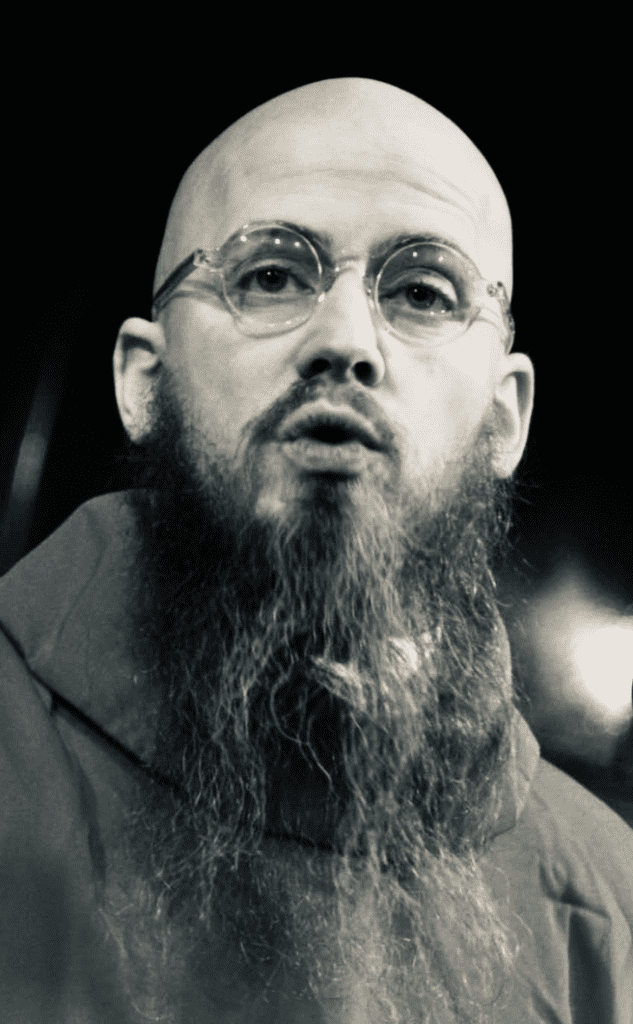














 Ad-Free & Subscriber Log-In