

Fire in the New South:
The Self-Immolation of Willie B Phillips in Atlanta, Georgia
October 7, 1972
On October 7, 1972, as a public parade (organized by Morris Brown College) moved through the streets of downtown Atlanta part of the city’s effort to present itself as a center of progress in the years following the major legislative victories of the Civil Rights era. Crowds gathered along the route watching as Atlanta projected an image of order growth and racial moderation. By the early 1970s, civic leaders were promoting the city as a model of the “New South” a place where the most visible structures of segregation had been dismantled and where the future appeared stable and manageable. It was within that setting…without warning or visible buildup…that 27-year-old organizer for the Southern Christian Leadership Conference Willie B Phillips stepped forward from the crowd and carried out an act that brought that narrative to a halt.
At approximately 11:25 that morning Phillips moved into an open space along the parade route carrying a container of flammable liquid. In full view of those around him, he poured the liquid over his body and ignited it. The act unfolded quickly and for a moment witnesses did not fully understand what they were seeing. That uncertainty gave way almost immediately to shock as the reality became clear. This was not an accident or a malfunction tied to the event. It was deliberate and it was public. As the flames spread Phillips spoke directing his words toward those present and by extension to a wider audience. According to accounts recorded afterward, he called on white Americans to stop mistreating Black people and urged unity within Black communities. Emergency response followed but the severity of his injuries made left no chance of survival. Phillips died as a result of the burning and the parade intended as a demonstration of civic progress came to an immediate stop.
Who Willie B Phillips Was
The historical record preserves only limited information about Willie B Phillips’ life prior to that morning and that absence is itself significant. He was not a nationally known figure nor widely recognized as a leader within established civil rights organizations. What is known is that he was a veteran of the Vietnam War placing him within a generation of Black men who served in a demanding and controversial war only to return to a United States that remained deeply unequal. Military service did not guarantee stability recognition or protection. For many Black veterans the transition back into civilian life meant confronting the same racial barriers they had left behind often without adequate support or opportunity.
Understanding Phillips in this context situates his final act within broader historical conditions rather than isolating it as purely individual. He was a person shaped by war, race and the uneven realities of post civil rights America. The limited documentation of his life means that much about his personal experiences motivations and circumstances remains unknown. This gap has contributed to the way he has been remembered or more precisely not remembered in the decades since his death. Unlike more prominent figures of the Civil Rights Movement…whose lives were extensively documented and interpreted…Phillips remains largely defined by a single moment with relatively little surviving context to deepen that picture.
Immediate Reactions to Willie B Phillips’ Self-Immolation
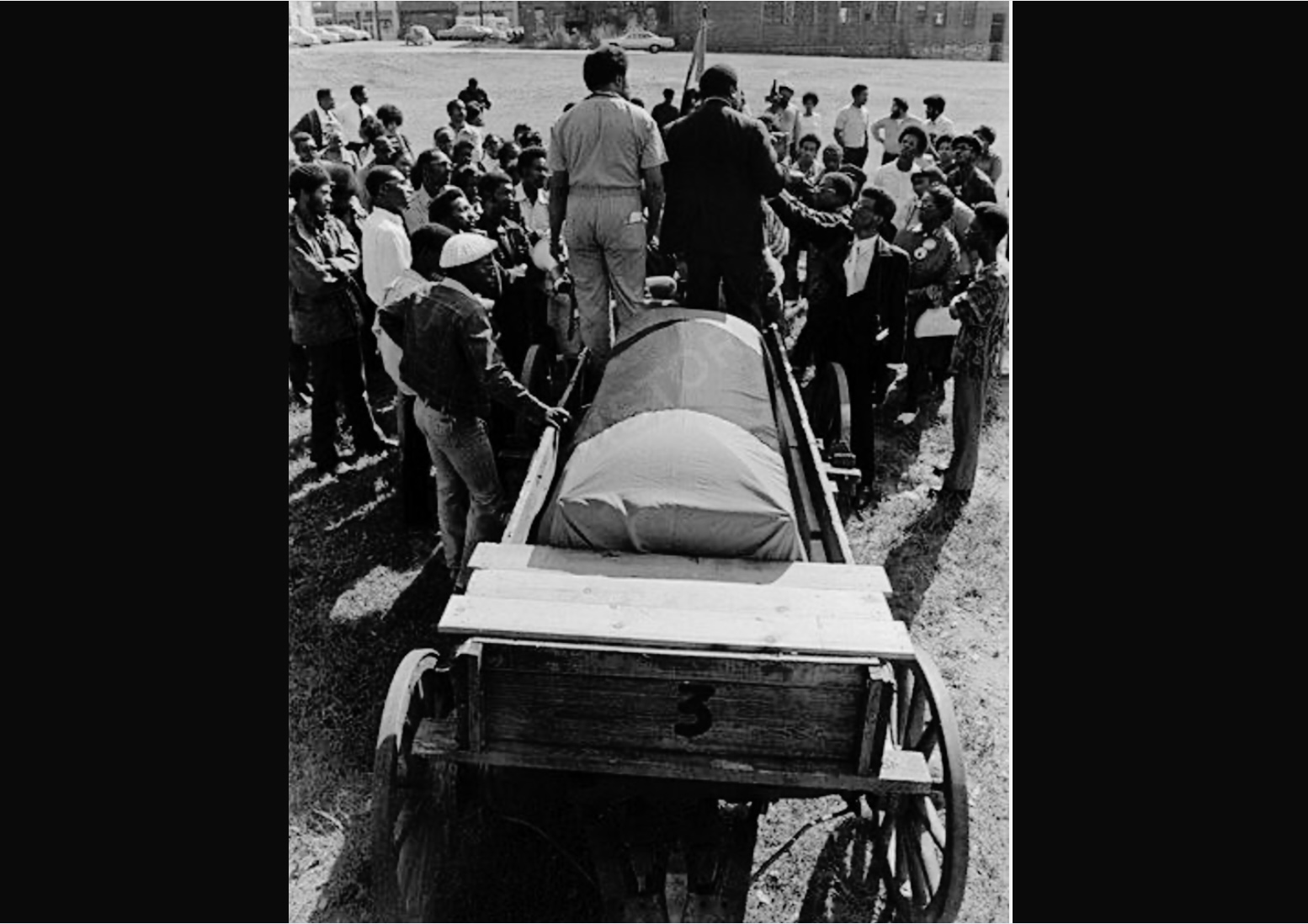
In the days following Phillips’ death, those who were aware of the event attempted to interpret what had taken place and their responses reflected broader divisions within Black political life at the time. Leaders associated with the Southern Christian Leadership Conference…including civil rights legend Rev. Hosea Williams…approached the event through a framework shaped by the movement’s Christian foundations. Williams publicly framed Phillips’ death as a form of sacrifice emphasizing the idea that his actions exposed the persistence of racial injustice at a moment when many Americans were inclined to believe that the central struggles of the previous decade had been resolved. The historic mule-drawn wagon funeral procession that followed reflected this interpretation presenting Phillips not only as a victim of circumstance but as someone whose death carried broader moral significance.
At the same time other voices within the Black freedom struggle were less inclined to adopt that interpretation. Activists associated with the Black Panther Party and similar currents of Black Power politics were more likely to view Phillips’ death in terms of its practical consequences rather than its symbolic meaning. From this perspective the central question was not whether the act revealed injustice but whether it contributed to the ongoing struggle in a material way. Self immolation in this view removed an individual from the community without strengthening its capacity to organize defend itself or pursue structural change. What some interpreted as sacrifice others understood as a tragic loss that did not produce tangible gains. These competing interpretations did not resolve into a single consensus leaving Phillips’ death difficult to categorize within existing frameworks of protest.
Context and Comparison of Willie B Phillips’ Act
Although Phillips’ act was shocking to those who witnessed it, it did not occur in a complete vacuum. By 1972, self immolation had become a recognizable if rare form of political protest in various parts of the world. Earlier that year, Romas Kalanta set himself on fire in Soviet controlled Lithuania contributing to the unrest known as the Kaunas self-immolation protest. In the years leading up to that event, similar acts had taken place in Southeast Asia particularly in connection with the Vietnam War where Buddhist monks used self immolation as a form of protest against political and religious repression. Images of these events circulated widely through international media making the act itself legible even as its meaning remained contested.
As a Vietnam veteran, Phillips lived in a cultural environment shaped by those images and the broader realities of the war. While it would be overly simplistic to draw a direct line of influence, it is historically reasonable to situate his actions within a period in which self immolation had entered a global repertoire of protest. By the early 1970s, it was understood at least in general terms as a way of expressing urgency and drawing attention to conditions perceived as intolerable. At the same time the act remained difficult to interpret within conventional political categories which contributed to the challenges of incorporating events like Phillips’ death into broader historical narratives.
Memory and Disappearance
Despite the visibility of the event at the time Willie B Phillips does not occupy a prominent place in the historical memory of the Civil Rights Movement. This absence reflects the ways in which historical narratives are constructed and maintained. Movements are often remembered through events and individuals that can be integrated into coherent and widely accepted storylines. In the case of the Civil Rights Movement, this has frequently meant emphasizing nonviolent protest legislative achievement and figures whose actions can be presented as both morally compelling and strategically effective.
Phillips’ death does not fit easily within that framework. It occurred after the passage of major civil rights legislation and does not align clearly with either nonviolent strategy or militant resistance. Its meaning remains ambiguous and that ambiguity makes it difficult to incorporate into narratives that depend on clarity and resolution. The physical site of Philips’ death did not become a widely recognized place of public memory. As the city continued to grow and develop, there was no sustained effort to preserve or mark the location in a way that would anchor the event in public consciousness.
The result is that Phillips persists primarily in archival records rather than in widely shared historical understanding. His story survives in fragments accessible to those who seek it out, but largely absent from the broader narrative of the Civil Rights era.
Conclusion
Yet, Willie B Phillips’ 1972 self-immolation was public, deliberate and clearly intended to communicate something about the conditions in which he was living. Recovering his story does not require resolving all of its ambiguities. It requires recognizing that the history of the movement…and our movements…must include moments that do not fit neatly within established categories. Phillips’ act stands as one of those moments and its relative absence from public memory highlights the selective nature of how modern history is too often told.
Those who do not fit our narratives are often the ones we forget the quickest, no matter what they gave.
Sources
The Atlanta Constitution. October 8–12, 1972
The Atlanta Daily World. October, 1972
Black Panther Party, The Black Panther. October 14, 1972
Southern Christian Leadership Conference, Records, 1972.
Jon Coburn. “Black Protest Suicide and the 1972 Self-Immolation of Willie B. Phillips.” HOTCUS (Historians of the Twentieth Century United States) Conference Paper, 2025












 Ad-Free & Subscriber Log-In