

What role does magic play in Paganism? It depends on who you ask.
A Naturalistic Pagan is likely to say that their practice is focused on reverence for Nature. If magic exists, it’s only change in consciousness easily explainable by mundane psychology.
Some polytheists – especially ethnic reconstructionists – say that magic is impious. It claims for ourselves what properly belongs to the Gods. And in any case, their practice is focused on honoring their Gods and their ancestors.
On the other hand, I’ve had witches tell me “keep your religion out of my witchcraft.” For them magic is strictly a secular thing, creating change in conformity with will (to borrow Aleister Crowley’s famous definition). They may acknowledge the reality of spirits and even of Gods – most do – but they want nothing to do with devotion.
Still, all three of these groups are likely to show up at Pagan gatherings, buy – and sometimes, write – Pagan books, participate in Pagan events, and generally hang out in the Big Tent of Paganism. They’re part of our movement.
And so are those of us who do all three – who blend magic, devotion, and reverence for Nature into a consolidated practice under the umbrella of Paganism.
As we continue our efforts to ensure that Paganism is defined by practicing Pagans and not by our enemies, I want to take a look at magic both as a tool and as an element of our religious practice.

Defining – and describing – magic
I’m not a Thelemite, but I’ve yet to find a better definition of magic than the one proposed by Aleister Crowley: “the science and art of creating change in conformity with will.”
Very early on my Pagan journey, it became obvious to me that magic works in three ways.
One way is through the intercession of Gods and other spirits. We pray, and if our Gods see fit, they use their divine power to create the changes we want. Or we make a deal with an other-than-divine spirit and they do work that we as spirits who are limited by bodies cannot do.
Another way is through the manipulation of energy and unseen forces. We raise energy, we direct it toward a target, and the energy impacts and influences our target.
A third way is through psychological programming. We use symbols and correspondences to communicate with our subconscious, which influences how we act, which brings about the changes we want.
Sometime our magic uses one of these methods, sometimes two, and sometimes (in my practice, most of the time) all three.
Magic is part of our heritage as humans
We can find evidence of magic as far back as we find evidence of humans, especially when we look at grave goods. Some of the earliest examples of writing concern magical workings. Late antiquity gave us the Greek Magical Papyri, the late medieval and early modern periods gave us the grimoires, and we’re currently living in a golden age of magical publishing.
Our mainstream society uses “magical thinking” as an insult for things unsupported by a materialist worldview, and at the same time actual belief in magic and spirits is as strong as it ever was.
They might as well try to stop us from telling stories, singing songs, and looking up at the moon in wonder and awe.
We’re humans – magic is what we do.
Magic as part of a Pagan worldview
Modern Western society likes to put religion in a box where it can be labeled and studied and easily understood. A simple look at religion as it’s actually practiced around the world – for good and for ill – shows that’s an impossible task. Religion is inseparably intertwined with metaphysics, philosophy, politics, and culture. Pagan religion is no exception.
Magic is a part of a Pagan worldview. That means that no matter how bad things get, no matter how powerless we may feel, we always have magic.
And because we always have magic, we always have agency. We can always do something to make things better. We can’t realign the world to match our expectations and desires, but we can influence our own situations, and we can improve our abilities to deal with the world as it is.
The reality of magic tells us to take care of ourselves first. The limits of magic tell us to work together to deal with those things that are beyond the capability of any single individual. We are magical creatures and we are social animals. Not one or the other, but both.
Magic or witchcraft?
Like many, I was attracted to Paganism because I wanted to be a witch. I knew I could never do the things fictional witches do, but I also knew there was a reality behind the fiction. It took me a long time to find it, but I did.
If you want to start a fight, try to tell people who is and isn’t a witch. Those fights aren’t helpful, but I do think it’s helpful to understand that witchcraft is a subset of magic.
Witchcraft is unauthorized magic – magic that established religion, politics, and society says is reserved for certain people. Witches reject those limitations. Witchcraft is magic worked by a witch for the witch’s own reasons regardless of what anyone else thinks.
While some Pagans aren’t witches and have no interest in being witches, in this current religious and political climate we need all the witches we can get.
Magic as devotion and service
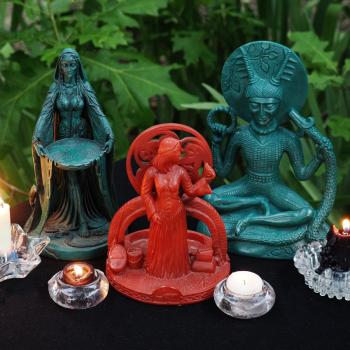
Egyptian lore credits Isis for teaching humans weaving and healing – and magic.
In Irish lore, the Morrigan is a Goddess of Battle, but she rarely fights with physical weapons. Instead, she fights with magic.
As Pagans, we honor our Gods with worship and sacrifice, but we also honor them by incorporating their virtues and values into our lives. We honor them by learning and practicing what they teach.
Including magic.
We also honor them when we use magic to promote their virtues and values, and to support those who are working toward those ends.
Yes, as I mentioned at the beginning, there are some polytheists who consider magic to be impious. I’m not one of them. None of the deities I worship, work for, and work with have discouraged me from working magic – much less forbidden me to work it. Instead, they’ve encouraged me to study, learn, and practice magic as skillfully as possible to protect myself and my community and to promote our shared values.
Honor the Gods by learning and practicing magic.
Practice magic because magic works
All this talk of magic leaves one big question: does it work? 30+ years of practicing magic have led me to three conclusions:
1) No, it doesn’t work the way we see it work in fiction.
2) Yes, it has demonstrable impacts. Those impacts are small but real.
3) Magic doesn’t make things happen. Magic improves the odds that things will happen. As Jason Miller advises, make a plan that doesn’t require magic to work and then use magic to increase the chances that it will work.
Learn to recognize your magical successes. One success may be a coincidence. Two successes might be confirmation bias. But by the time you get to eight or ten or fifty successes, it’s easier to just accept that magic works and spend your time trying to figure out how you’re going to use it next instead of rationalizing it away.
Truth to the public – truth to ourselves
When Paganism is attacked – whether by conservative monotheists or by aggressive atheists (and to be fair, the aggressive atheists aren’t nearly as aggressive as they were ten years ago) – those attacks almost always include an attack on magic that labels it naïve, evil, or both. We need not engage in bad-faith debates with people who have declared themselves our enemies.
At the same time, we need to make sure that the public has accurate information about who we are, what we believe, and what we do. Like it or not we live in a marketplace of religions, and while we are not interested in proselytizing we do want to make sure people who are called to our way of seeing the world and relating to the world can find us.
More importantly, we want to make sure our own people aren’t unduly influenced by our enemies just because they’re louder and more numerous.
Some Pagans don’t practice magic. Some only practice magic. But for most of us, magic and witchcraft are an essential part of our Pagan religion.








 Ad-Free & Subscriber Log-In