

 That depends on how the word “worship” is defined. Since Christians generally base their faith on the Bible, it depends especially on the meaning of the word proskuneo in the Greek New Testament.
Dr. Larry Hurtado is a New Testament scholar and a historian of Christian Origins. He also is the preeminent leader of a group of scholars who claim that the early Christians mentioned in the New Testament worshipped Jesus and that this indicates that they believed Jesus was God. Since these first Christians were Jews, and Jesus was a Jew, scholars debate about how these early Jewish Christians could have gone from adhering to the distinctive Jewish belief that God is numerically one to believing that God is more than one, that is, a multi-personality consisting of Father, Son (Jesus), and the Holy Spirit. In recent centuries, the Jewish belief that God is one has been called monotheism. Thus, to restate the question, how could strictly monotheistic Jews switch to believing that God was a multi-personal being? And how long would that take?
Larry Hurtado has written several books about this. One time I discussed it with him when he was the speaker at the Kermit Zarley Lectures at North Park University. Larry answers the above question by claiming that prior to Jesus, Jews also believed that angels and some men were divine conduits to God and that this paved the way for the early Christians to believe Jesus also was God. The wikipedia article on him puts it this way, “Hurtado has argued that this Jesus-devotion comprises a novel ‘mutation’ in ancient Jewish monotheistic practice.”
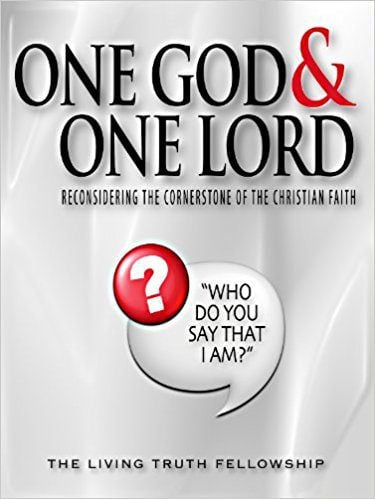
In Hurtado’s first book on this subject, One God, One Lord: Early Christian Devotion and Ancient Jewish Monotheism (1988), he states (p. 3), “I propose that early Christianity drew upon important resources in ancient Judaism and also developed a somewhat distinctive ‘mutation’ or innovation in this monotheistic tradition.” Then Larry says on p. 5, “the veneration of Jesus is not at all late but extremely early, easily within the first decade of the Christian movement.” For the next three decades, Larry did not depart from these assertions and wrote several books trying to prove them.
But in Larry Hurtado’s first book, he didn’t define “worship” or “monotheism” and was later criticized for this by other scholars.
Here is how these scholars, such as Larry Hurtado and Richard Bauckham reason:
- The first Christians believed that only God should be worshipped.
- The first Christians worshipped Jesus.
- Therefore, the first Christians believe Jesus was God.
I believe the fallacy in this reasoning is in its fundamental avoidance in defining the word “worship” and perhaps addressing sufficiently the two words that appear in the Greek New Testament that are sometimes translated “worship” in English Bibles. They are foremost proskuneo, which is sometimes is accompanied with pipto, meaning “to fall” or “fall down,” and secondarily latreuo.
Proskuneo means to honor or respect someone by an act of bowing down to the ground before that person. It could also indicate lying prostrate. The etymology of proskuneo is that pros means “toward” and kuneo means “to kiss.” Thus, ancients often bent the knee or laid prostrate before someone, such as a king, and kissed that person’s sandals.
Sometimes in the New Testament, people did proskuneo before Jesus, and they meant no more by it than that they were honoring and/or respecting Jesus. For instance, when Jesus walked on water, he got into the boat, and “those in the boat worshipped him, saying, ‘Truly you are the Son of God'” (Matthew 14.33). The word translated “worshipped” is prosekunesan. But surely they merely bowed before Jesus and didn’t think of him as God. This is further suggested from the other two synoptic accounts, in Mark 6.51 and Luke 6.21, since they don’t even mention the disciples’ bowing or identifying Jesus as “the Son of God.”
Other incidents occurred when people did proskuneo before Jesus, and English Bibles render it “bowed down,” “knelt,” or the like, such as Matthew 8.2, 9.18, and Mark 5.6. These Bibles translate it this way since it is obvious these people were not worshipping Jesus as God.
Since there are numerous episodes recorded in the New Testament when people performed proskuneo before Jesus and it did not indicate they believed he was God, it should be understood that in other cases when Jesus’ disciples performed proskuneo before him it did not necessarily indicate that they believed he was God, either.
James (Jimmy) D. G. Dunn wrote a book entitled Did the First Christians Worship Jesus? He mentions Hurtado and Bauckman in the Introduction and indicates that he seeks to make a correction about what they say about this subject. For, Dunn’s answer to his question-title of this book is pretty much “no.”
But Dunn is sometimes misunderstood by answering “no,” meaning the first Christians did not worship Jesus as God. Jimmy Dunn also believes in the developmental theory of Christology for which his binitarian PhD instructor Charley (C.F.D.) Moule was well known. It means that although the first Christians did not believe Jesus was God or that God was Trinity of persons, the church did right in later centuries by determining these identifications because they appear in embryonic form in the New Testament.
………………
To see a list of titles of 130+ posts (2-3 pages) that are about Jesus not being God in the Bible, with a few about God not being a Trinity, at Kermit Zarley Blog click “Chistology” in the header bar. Most are condensations of my book, The Restitution of Jesus Christ. See my website servetustheevangelical.com, which is all about this book, with reviews, etc. Learn about my books and purchase them at kermitzarley.com.









 Ad-Free & Subscriber Log-In