

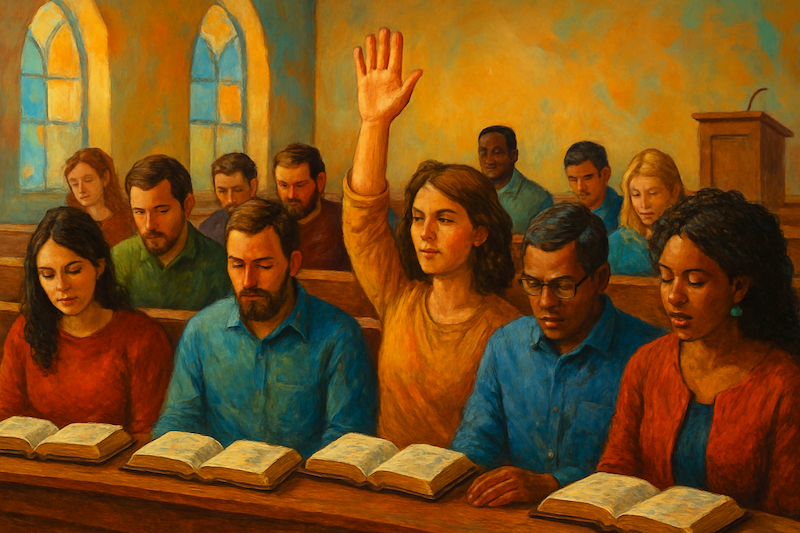
This Sunday at River Corner Church, we tried something a little different. We experimented with shared learning. On fifth Sundays, we’re beginning a new rhythm: worship shaped by conversation. Instead of listening to only one voice, we opened Scripture together in a Lectio Divina fashion, noticing what stood out, asking questions, and helping one another hear God’s voice.
When Paul urges the Thessalonians to “make it your ambition to lead a quiet life” (1 Thessalonians 4:11–12), he is speaking to a church, not just to individuals. Living quietly is more than a journey of personal exploration; it is, like Paul’s command, learning to embody this way together as a community. Learning to lead a quiet life together also pushes back against what others have told us life and church must look like, exchanging it for faithfulness to what we sense God calling us to be. Leading a Quiet Life as a community reminds us that faithfulness is found not in noise or spectacle, but in simple, steady obedience lived out side by side. That is a journey we take together.
Wrestling With the Road to Emmaus
At River Corner Church, this past Sunday, we turned to Luke 24:13–35, the story of the disciples on the road to Emmaus. Together we wrestled with questions like:
- What words, phrases, images, and ideas stood out to us?
- Why didn’t they recognize Jesus?
- Why were their eyes opened in the breaking of bread?
- What does their immediate return to Jerusalem show us about encountering the risen Christ?
- How does this story challenge the way we expect Jesus to show up in our lives?
The Emmaus story is pivotal to the apologetic of Jesus’ resurrection, but it is also a story that reflects our own journeys. It invites us to open our eyes to the presence of Jesus in our everyday lives, to recognize God in our midst even when we are weary or discouraged, and to let our hearts burn again as the scriptures are opened before us. It is a call to break bread together, and to believe that where two or three are gathered in Jesus’ name, he will be among them.
The Biblical Call to Shared Learning
Reading Scripture in community is nothing new—it’s part of the church’s DNA—and has been for a very long time. Though somewhere along the way, the consumption of information (part discipleship) has become the central aspect of the church community. Paul reminded the Corinthians that “everything must be done so that the church may be built up” (1 Corinthians 14:26). We are all invested in building each other up. Paul encouraged the Colossians to “let the message of Christ dwell among you richly as you teach and admonish one another” (Colossians 3:16). Paul uses the word ” dwell that speaks to letting an idea influence the room by inhabiting it. The writer of Hebrews adds that we are to keep meeting together to “spur one another on toward love and good deeds…encouraging one another” (Hebrews 10:24–25). All are encouraging each other. I want to live into this better, and so we are developing greater rhythms as a church community. On the first Sunday, we enjoy a potluck together. On the third Sunday, we engage at the Lord’s Table together. Now, on fifth Sundays, we focus on shared learning by engaging in a conversational discussion on a selected scripture.
Pushing Back on “Normal” Sundays
Too often, we settle for Sunday morning patterns that feel predictable—sing a few songs, listen to a sermon, shake some hands, and go home unchanged. But Scripture calls us to more. The New Testament church was a community of participation, where everyone brought something, and where encountering the risen Jesus disrupted what was “normal.” If we want to grow as a community of Jesus followers, we need to resist the temptation to do things simply for the sake of routine and instead lean into practices that shape us into the body of Christ. The Scriptures are full of valuable insights on how to do this effectively.
Shared Learning: Learning to Lean Into Our Size
I was impressed with how this went. However, I also realize that it may feel a little awkward at first, but I believe these conversations help us hear God’s scriptures more deeply, value one another’s voices, and live Scripture out together. What one person hears and sees from the Holy Spirit in a text might be different than another, and those insights are essential. For now, we’ll practice this on our fifth Sundays—but I hope it becomes a meaningful rhythm for our community that might even show up in other moments.
We are a small church community of faithful followers of Jesus, simply learning to lean into our size well.
- What might our gatherings look like if everyone’s voice and story shaped how we hear Scripture—pursuing shared learning?
- How would our community be different if we measured church by faithfulness and love rather than size or spectacle?
- In what ways can small churches leverage their strengths as smaller churches to embody the way of Jesus more fully?














 Ad-Free & Subscriber Log-In