


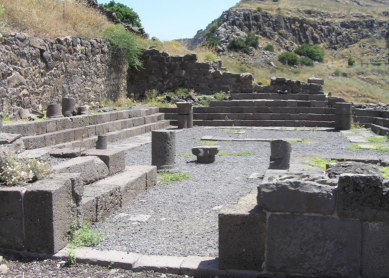
Not long ago, I stood inside a re-created first-century synagogue at the Museum of the Bible. The room was simple, featuring stone benches along the walls, columns that framed an open space, and a table in the center. But as I stood there, it struck me: this wasn’t just an architectural design. It was an ethos.
These synagogues, common in Jerusalem between the first and third centuries, were not primarily performance halls or places of worship through song. They were mainly places of teaching, but also of conversation, dialogue, and shared life. The seating itself preached a message: people faced one another, not merely a platform. The community wrestled with the scriptures together. Smiles, questions, prayers, and stories were exchanged across the room.
Recently, while visiting the Museum of the Bible, I attended a meeting of the Biblical Archaeological Society. One of the presenters noted how, just a few decades ago, we had very little archaeological insight into first-century synagogues. We had clear remains from the second and third centuries, but not complete examples from the first century. That changed in recent years with some newer discoveries, and they revealed something striking: the “stage” was even less prominent than what developed later. In the earliest synagogues, the focus was not on a platform but on one another. The elevated stages we associate with later synagogues, and eventually with church life, were built up over time. By the time church life was commercialized and professionalized, the stage had become central to the process. But its roots were not there in the beginning.
I often think of the Richard Halverson quote, the former chaplain of the United States Senate, that reads:
“In the beginning, the church was a fellowship of men and women centering on the living Christ. Then the church moved to Greece, where it became a philosophy. Then it moved to Rome, where it became an institution. Next, it moved to Europe, where it became a culture. And, finally, it moved to America, where it became an enterprise.”
This rhythm of the synagogue undoubtedly shaped the earliest followers of Jesus. Many of them still attended synagogue, while also meeting in homes for worship, prayer, and the breaking of bread. In Acts, we hear of disciples gathering daily in the temple courts and in homes (Acts 2:46). In Romans, Paul greets the church that meets in the house of Priscilla and Aquila (Romans 16:5). These house churches, like the synagogues they knew so well, carried forward an ethos of participation—everyone’s voice mattered. Practices, disciplines, teaching, food, and worship were shared.
Synagogues & The New Testament Ethos
When Paul instructed churches, he consistently called them to this shared practice. To the Colossians, he wrote:
“Let the message of Christ dwell among you richly as you teach and admonish one another with all wisdom through psalms, hymns, and songs from the Spirit, singing to God with gratitude in your hearts.” (Colossians 3:16)
And to the Corinthians, describing what their gatherings should look like:
“When you come together, each of you has a hymn, or a word of instruction, a revelation, a tongue or an interpretation. Everything must be done so that the church may be built up.” (1 Corinthians 14:26)
This wasn’t a suggestion for a few gifted leaders—it was the ethos of the whole body. Each member came bringing something. Each one contributed. Teaching was not the sole possession of the preacher, nor was it the music of the worship leader. The Spirit equipped the whole community, and the community was expected to share what God had given them.
It’s no accident that this mirrors synagogue life. The early believers, shaped by synagogue practice, brought that participatory expectation into their gatherings as they became the church.
From the Didache to Today
Even as the early church grew and its worship became more defined, this ethos didn’t vanish. The Didache—one of the earliest Christian writings outside the New Testament—offers glimpses of order and liturgy, including prayers, fasting, baptism, and the Eucharist. Yet woven throughout is a consistent expectation of community participation.
For example, the Didache instructs the whole church to examine traveling teachers, prophets, and evangelists—not just a single minister or overseer. It charges the church—not an outside authority—to discern whether someone’s life matches their words. Likewise, it is the community’s responsibility to appoint bishops and deacons. In other words, the conversational weight, the examination of leaders, and the forming of structure all rely on the community as a whole.
This shows us that even as Christian practice gained structure, the ethos of “all investing in” remained central. Leadership wasn’t about hierarchy or personality but about shared responsibility under Christ.
I want It, The Synagogue Way
I believe most of us still long for something like what this room represents: authentic conversation, engagement, scripture wrestling, and shared life centered on God. Sadly, I think we are too addicted to what we have now to ever really rediscover another way. We have been discipled by the ethos of our culture in a way that we can never truly shed bigger, better, theatrical performance.
The synagogue wasn’t perfect. It had its communal and cultural faults, just like the church today. The church community is God‘s idea; the synagogue is not. However, could it be that some of God‘s intent for the church is more embedded in a synagogue model, and it is in our church practices today? Although the synagogue provided Jesus with a platform to proclaim his ideas, he also did so in the streets. Our places of worship need to be a place that reminds us who we are worshiping, engages all of us, and propels us back into the streets.
The Biblical Archaeological Society has a great article on what first-century synagogues look like. I quote from an article from 2023:
Synagogues from this period share certain features, including a central hall supported by pillars and lined with benches. Ryan elaborates:
Synagogue buildings in the early Roman period featured a main assembly hall, which was quadrilateral in shape. Stepped benches typically lined the walls, meaning that the attendees sat facing the center of the room, and people seated along opposite walls would have faced one another. The seating arrangement was thus designed to facilitate discussion, particularly among people seated along different and especially opposite walls. … Synagogue assembly rooms also typically featured columns, usually in the central floor area, which supported a clerestory ceiling. The columns would have obscured the view of the central floor from the benches, which indicates that synagogues were likely designed with hearing rather than seeing in mind. In short, the architectural evidence reveals that synagogues of the early Roman period were places of community assembly, made for listening and discussing.
Synagogues served many purposes in ancient Galilee and Judea. Not only were they places of worship, but they also functioned as a town hall, court of law, community center, and even guesthouse.
A Dangerous Reminder
Standing in that reconstructed synagogue, I couldn’t help but grieve how much we’ve drifted. Many of our churches have become places of consumption rather than conversation, with stages replacing circles and programs replacing participation. Somewhere along the way, as Frank Viola and George Barna suggest, much of this shift occurred during the Constantinian era (see Pagan Christianity).
But Paul’s words still echo across the centuries: let the Word dwell richly among you. Each one brings something. Build up the body together.
This is more than history. It’s an ethos the New Testament consistently witnesses to—an ethos that should haunt us still. It needs to inform us today, as well.
In 2026, our church community of River Corner Church will be wrestling with a ‘key verse’ from Hebrews 10:24-25. This verse reads, “And let us consider how to spur one another on toward love and good deeds, not giving up meeting together, as some are in the habit of doing, but encouraging one another—and all the more as you see the Day approaching” (NIV).
That synagogue room has become for me a dangerous reminder. Once you see it, you can’t unsee it. Once you recognize that church was never meant to be a spectator event, you’ll never be satisfied with less.













 Ad-Free & Subscriber Log-In