

Vexilla Regis prodeunt;
fulget Crucis mysterium,
quo carne carnis Conditor
suspensus est patibulo.
Go forth the banners of the King;
the secret of the Cross doth shine:
the body’s Maker’s Body sing
which hung upon that beam divine.
Arbor decor’ et fulgida,
ornata Regis purpura,
electa digno stipite
tam sancta membra tangere.
O tree bedecked with holy glow,
dress’d in the King’s own crimson dye;1
O gallows unto this foreknown,
to bear those sacred limbs on high.
—Vexilla Regis Prodeunt, vv. 1, 4; composed by Venantius Fortunatus (6th cent.), trans. Gabriel Blanchard2
EDIT: When I first published this, I erroneously put “patibulum” instead of “patibulo” at the end of that first stanza—derp! Fixed now.
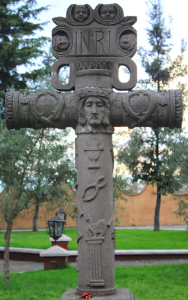
Cross outside the Church of St. John the
Baptist in Metepec, Mexico. Photo by
Arturo Galicia, used under a CC BY-SA
3.0 license (source).
“Even So Must the Son of Man Be Lifted Up”
This Sunday, our ordinary readings are displaced by those of a feast held in honor of the Cross.3, 4 Given that we’re now well clear of the Easter season, its timing may seem a bit arbitrary. Is there something about September that makes it any more cruciform than other months? Not really, no, but this date was chosen in memory of three historical events, dating to the fourth and seventh centuries. More on all that in a bit.
I have yet to mention this feast’s formal name, because it has two: the Exaltation of the Cross or the Triumph of the Cross. (Three, if you count the Invention of the Cross, but the word “invention” no longer retains the sense of “finding, discovery” that it once possessed.) I have no problem with the first title, but I think Triumph is a much better one; I again have two reasons for this. One is simply that triumph is a shorter word, ergo, points for concision. A lot of the best, punchiest words are good partly because they’re only a syllable or two long—words like death, hope, warlike, lonely, and spork.
The Triumphus
The other reason “Triumph of the Cross” is such a good name is that it relates this feast to the ancient Roman tradition of the triumphus, one of the highest civic honors a Roman citizen could enjoy, which was at the same time a religious rite (as many civic ceremonies in the ancient world were). In classical Rome, the ritual of the triumphus was thought to be older than Rome itself. Some writers traced it to a victory procession held by Bacchus,5 who rode in a chariot drawn by tigers and was surrounded by mænads and satyrs as he went; their cry of θρίαμβος [thriambos] (of unknown meaning, though coming to mean a hymn to the god of wine by association) was supposedly borrowed into Etruscan in the form <thriampe>, which became the root of the Latin term.
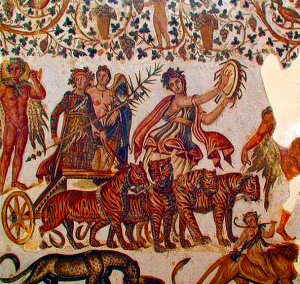
Selection from The Triumph of Bacchus,
a mosaic from Roman Africa.6
Be that as it may, the ceremonial of the triumphus was well-established by republican times, and the god it was most associated with was Jupiter rather than Bacchus. A triumph had to be granted by the Senate, at least while the Republic lasted. The vir triumphalis (i.e., the recipient of triumphal honors) has his face painted red, possibly in imitation of the terracotta cult statue of Jupiter Optimus Maximus (“Father Jove, Best and Greatest”), located in his temple on the Capitoline Hill. He also donned, like that statue, a toga picta or “painted robe”: most togas were were white, in varying degrees of brilliance that depended on the circumstances and the wearer’s wealth, but the toga picta was dyed Tyrian purple1 and intricately woven with patterns in thread-of-gold.
There were games and other entertainments for a triumphus, but the main event was the procession. His war-spoils, including prominent captives, were driven before him. The vir triumphalis followed, entering the city on a quadriga, or a chariot drawn by four horses, otherwise associated only with Jupiter and Apollo; his army followed him. (By some accounts, a slave was placed beside him in his chariot, whose sole job was to say periodically in his ear, “Remember, you are a mortal”; others relate that the soldiers marching behind were allowed and expected to indulge their crass sense of humor about him, relaxing the usual rules of public decorum, and he was not supposed to retaliate or avenge himself. These principles again aimed at avoiding hubris in the strict sense, i.e. a kind and degree of pride that would offend the gods.) The procession began from the Campus Martius, outside the city’s sacred pomerium—the boundary of the city, which generals were normally required by law to lay down their command before crossing. It entered the city through a triumphal gate or arch, and made its way to the Capitoline Hill, where the vir triumphalis would sacrifice a pair of oxen to Jupiter Optimus Maximus.
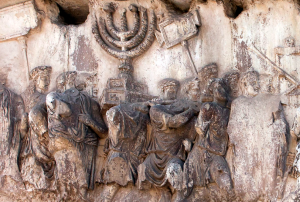
Detail from the Arch of Titus, depicting some
of the spoils exhibited during his triumph
in 71. Photo by David Castor.
The Divine Triumph
It’s not used as the epistle for this feast (which to my mind is a pity), but St. Paul actively associates the Passion with the triumphal ritual:
In him dwelleth all the fulness of the Godhead bodily. And ye are complete in him, which is the head of all principality and power: … you … hath he quickened together with him, having forgiven you all trespasses; blotting out the handwriting of ordinances that was against us, which was contrary to us, and took it out of the way, nailing it to his cross; and having spoiled principalities and powers, he made a shew of them openly, triumphing over them in it.7
—Colossians 2:9-10, 13-15
I don’t usually like the NIV all that much, but it has moments of brilliance, and its translation of v. 15 is excellent, stating that he “made a public spectacle of them, triumphing over them in the cross”: this evokes triumphal language, which at least draws the idea to mind. There’s a set of analogues between the procedure of the triumphus and the Via Dolorosa, the latter being the road taken by Christ bearing his cross; please consider the following:
- The triumphus began outside the city and proceeded into its heart; the Via began within Jerusalem and worked its way out to the fringe.
- The vir triumphus had his face painted to resemble a particular statue of Jupiter; Jesus “was made in the likeness of men” (Philippians 2:7), and “when they had mocked him, they … put his own clothes on him, and led him out to crucify him” (Mark 15:20).
- The triumphus allowed a certain rowdiness from the soldiers to help keep check their general’s ego while he wore the toga picta; the rowdiness of the soldiers toward Jesus resulted in his being briefly dressed in purple and mocked with royal homages.
- The triumphus concluded with a sacrifice to Jupiter Optimus Maximus; the Via Dolorosa was the next-to-last stage of the sacrifice that validated the New Covenant.
- Lastly, a vir triumphus drove his spoils and captives before him, and had his armies in his train; Jesus likely had to follow the Roman soldiers assigned to crucifixion detail, and we know that of his followers, at least some of the women came behind him (Luke 23:57).
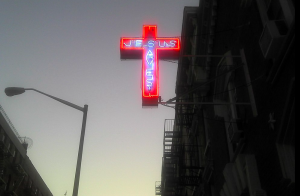
A cruciform neon sign reading “JESUS SAVES”
outside a Protestant church in New York City.
Photo by David Shankbone, used under
a CC BY 3.0 license (source).
I haven’t in fact seen any artists do this; but I’ve often thought it would be a splendid artistic decision, if one were depicting the Via Dolorosa, to give it in two versions: one showing only the artist’s version of what we’d have seen “in real life,” and one showing the angelic criers, attendants, regiments, and captives, that I for one think must have been there too.8
By night on my bed I sought him whom my soul loveth:
…I sought him, but I found him not. …
Who is this that cometh out of the wilderness
…like pillars of smoke,
perfumed with myrrh and frankincense,
…with all powders of the merchant?
Behold his bed, which is Solomon’s;
threescore valiant men are about it,
…of the valiant men of Israel.
They all hold swords,
…being expert in war:
every man hath his sword upon his thigh
…because of fear in the night. …
Go forth, O ye daughters of Zion,
…and behold King Solomon
with the crown wherewith his mother crowned him
…in the day of his espousals …
—Song of Solomon 3:1, 6-8, 11
So Why 14th September?
Three historical events reputedly set the date of this feast. (I don’t know that all three happened on the same date, but if the second and/or third were deliberately chosen to align with the anniversary of the first, that would be a typically Roman thing to do.)
- 326. The discovery of the True Cross by St. Helena, mother of Constantine the Great, during a pilgrimage to Jerusalem.
- 335. The consecration of the Church of the Holy Sepulchre in Jerusalem, built by St. Helena.
- 629. The entry of a piece of the True Cross to Constantinople with the Emperor Heraclius, after its recovery from the Persian Empire, which had seized the relic as pillage when it conquered Jerusalem in 614.
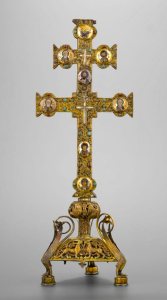
A reliquary for a fragment of the True Cross,
crafted by Hugo of Oignies, ca. 1200-1240.
Photo by Hughes Dubois, used under
a CC BY-SA 4.0 license (source).
The story of Heraclius is honestly a pretty good one, even before his rise to the throne. (He wasn’t part of this new generation of illiterate, entitled πορφυρογέννητοι [porfürogennētoi] that everybody had to be to be anybody nowadays; Heraclius became Cæsar the old-fashioned way—winning a civil war.9)
Philippians 2:5, 6-11, RSV-CE
Have this mind among yourselves, which was in Christ Jesus, who, though he was in the forma of God, did not count equality with God a thing to be grasped,b but emptied himself, taking the form of a servant, being born in the likeness of men. And being found in human formc he humbled himself and became obedientd unto death, even death on a cross. Therefore God has highly exalted him and bestowede on him the name which is above every name, that at the name of Jesus every knee should bow, in heaven and on earth and under the earth,f and every tongue confess that Jesus Christ is Lord, to the glory of God the Father.
Philippians 2:5, 6-11, my translation
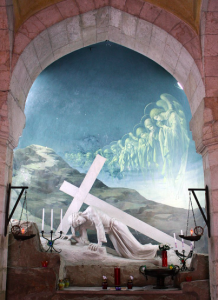
The chapel of the Third Station of the Cross
(Jesus falls the first time) on the Via Dolorosa
in Jerusalem. Photo by AntanO, used under
a CC BY-SA 3.0 license (source).
Bear this in mind among yourselves, which the Anointed Jesus also did, who, existing in God’s shape,a did not deem it plunder to be equal to God,b but emptied himself and took a slave’s shape, becoming [one] in the likeness of humans; and, found in fashionc as a human, he lowered himself and became obedientd to the point of death—death on a cross; because of which God has also lifted him up, and gracede him with the name over every name, in order that in the name of Jesus every knee shall bend, of the heavenly ones or earth-dwellers or those underground,f and every tongue acknowledge that Jesus the Anointed is Lord, to the glory of God the Father.
Textual Notes
a. form/shape | μορφῇ [morfē]: In Plato’s dialogues, μορφή is one of a collection of words (εἶδος [eidos] and ἰδέα [idea] are others) the philosopher uses in his famous doctrine of the Forms. It was akin in meaning to “essence” or “nature,” rather than carrying connotations of something merely external.
This is of particular importance in light of the development of the Gnostic heresies; early forms of Gnosticism were taking shape before the close of the first century, and they experienced their heyday between the early-to-mid second century and the early third. A key belief shared by virtually all Gnostic sects was docetism, the belief that Jesus’ humanity was an illusion, a “concession to our condition”—not a genuine, permanent embodiment. This often involved a belief that matter, subject as it is to decay, was evil; or it might view matter merely as ignoble and inferior, not worth the divinization of the Incarnation. I John 4:1-3 and II John 7 both allude to docetism, and these two are widely thought to be among the latest letters in the New Testament.
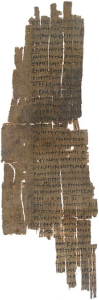
Oxyrhynchus Papyrus 654, containing a fragment
of the Gospel of Thomas (widely thought to be
of Gnostic authorship).
b. did not count equality with God a thing to be grasped/did not deem it plunder to be equal to God | οὐχ ἁρπαγμὸν ἡγήσατο τὸ εἶναι ἴσα θεῷ [ouch harpagmon hēgēsato to einai isa theō]: When I was younger, I found virtually every translation of this verse baffling, but especially the one that I feel like I heard most often: “thought it not robbery to be equal with God.” Like … what? How would it be robbery to be equal with God? Would that be good or bad?—a question made especially muddy, since this comes in the context of powers he “emptied himself of” to live a human life!
To be honest, I’m not positive I’m clear what St. Paul is on about even now. However, I think the gist may be something like this. If you possess some kind of privilege or benefit—as a gift from your royal father, let’s say—there are two ways you can perceive it, which I’m going to call the surprised lens and the secure lens. The secure lens treats the gift with confidence: it isn’t going anywhere; your royal father gave it to you, he’s not a chain-yanking sort of person. The surprised lens, on the other hand, reacts along the lines of the phrase “we’ve made out like bandits”: it treats the gift, not as a thoughtful act of generosity, but more as a sentimental lapse in judgment that’s given you an advantage, which you should now defend at all costs. On paper, neither lens needs to involve robbery as such, i.e. taking what does not belong to you; but the latter is akin to it in its sharpness, its cynicism, its Darwinian assumptions, its whole “look out for number one” ethos. If that mindset could be, rather elliptically, described as “deeming it plunder to be equal to God,” then perhaps it’s what Paul means in this passage.
c. form/fashion | σχήματι [schēmati]: I’m rather put out by the tendency of many translations (not just the RSV) to level synonyms into a single word. This term has more of a connotation of “outward form, semblance,” as contrasted with μορφή.
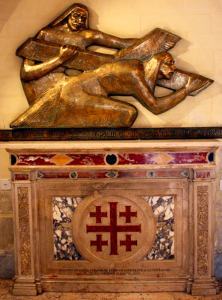
The chapel of the Fifth Station (Jesus aided
by Simon of Cyrene) on the Via Dolorosa.
Photo by AntanO, used under a CC BY-SA
3.0 license (source).
d. obedient | ὑπήκοος [hüpēkoos]: A more literal rendering of this word would be “listening (to), heeding”; it is a compound derived from the preposition ὑπό [hüpo], which typically means “under” or “sub-,” and the verb ακούω [akouō], “to hear.” Funnily enough, “obedient” itself comes from a Latin verb of quite similar meaning, obaudīre (ob “near” + audīre “to hear, listen”).
e. bestowed/graced | ἐχαρίσατο [echarisato]: This verb is directly derived from the noun χάρις [charis], “favor, grace.”
f. in heaven and on earth and under the earth/of the heavenly ones or earth-dwellers or those underground | ἐπουρανίων καὶ ἐπιγείων καὶ καταχθονίων [epouraniōn kai epigeiōn kai katachthoniōn]: This interested me. Having heard this passage many times since childhood, I had expected it to be a list of locations, but, in the original, it is actually a list of kinds: not “those in heaven” but “the heavenly ones” or “the celestials,” and so on. Admittedly, this is probably no different in meaning than it would be if it were a list of locations. Still, it puts me in mind of the Greek (and Roman) myths of chthonic spirits (καταχθονίος [katachthonios] is of course a related term, both from χθών [chthōn], “earth, soil, ground”)—dryads, satyrs, nereids, and the like, or their cousins from other mythologies, like the Norse dvergar and ljósalfar,10 or for that matter the 神 [kami] of Japan. I wonder whether there are, perhaps, angels whose function approximates what we would call that of nature spirits; it seems like it would explain a lot about human mythology.
John 3:13-17, RSV-CE
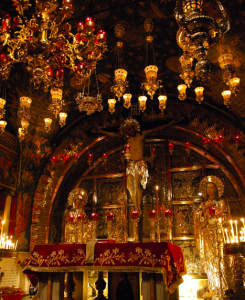
Altar of Golgotha in the Church of the Holy
Sepulcher, Jerusalem. Photo by Ierei
Maksim Massalitin, used under a CC BY-SA
2.0 license (source).
No one has ascended into heaven but he who descended from heaven, the Son of man. And as Moses lifted up the serpent in the wilderness, so must the Son of man be lifted up, that whoever believes ing him may have eternal life.h
For God so lovedi the worldj that he gave his onlyk Son, that whoever believes in him should not perish but have eternal life. For God sent the Son into the world, not to condemnL the world, but that the world might be saved through him.
John 3:13-17, my translation
And no one has gone up into heaven except he who came down from heaven, the Son of Man. And just as Moshe lifted up the snake in the desert, thus must the Son of Man be lifted up, in order that everyone who has faith ing him should have life forever. For thus God loved the worldh—such that he gave his only-borni Son, so that everyone who has faith in him should not be destroyed, but have life forever. For God did not send his Son out into the world in order that he might judgej the world, but in order that the world might be saved through him.
Textual Notes
g. believes in/has faith in | πιστεύων εἰς [pisteuōn eis]: The literal wording here is curious to our ears—the preposition εἰς does not quite mean “in,” but more exactly “into.” And this is not just a peculiarity of the verb; you can use this verb with other prepositions, or with none. This perhaps hints at one of the alternate translations of πιστεύω, besides “have faith” or “believe”: trust. (If you aren’t seeing the connection, think of terms like entrust or put trust in.)
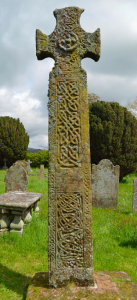
Irton Cross, an Anglo-Saxon cross in the
village of Irton-with-Santon in Cumbria in
northern England. Photo by Dougsim,
used under a CC BY-SA 3.0 license (source).
h. world | κόσμον [kosmon]: Κόσμος [kosmos] is related to the verb κοσμέω [kosmeō], meaning “arrange, put in order; beautify, adorn.” (Its range of meanings is therefore similar to those which belonged in Middle English to the word dress: before going out, one would “put oneself together,” or in shorter idiom get dressed; one might do so from a dresser, and, if one’s outfit were particularly smart or formal, it might consist in dressy clothes—e.g., a gown so splendid that it came to be called a dress.) This is one of four Greek words commonly translated “world” in English; the other three are γῆ [gē] “(planet) earth,” οἰκουμένη [oikoumenē] “inhabited world, known world,” and αἰών [aiōn] “age, period, generation, lifetime.” The accent on ordered beauty in κόσμος lacks an exact English equivalent, despite our borrowing of “cosmos”; “universe” is perhaps not too far, as the idea of unity-in-variety that it still retains has a suggestion of order to it.
i. only/only-born | μονογενῆ [monogenē]: The RSV’s choice here bugs me. I grant it’s difficult to find a translation of μονογενής [monogenēs] that makes natural-sounding English; but “only” is a bad option, because there’s a word that means “only,” and it’s not μονογενής—it’s μόνος [monos], no suffix. Μονογενής is a different word, one that means “only-born” or “only-begotten.”
j. condemn/judge | κρίνῃ [krinē]: This verb in Greek could bear the sense “condemn,” but only in the same way the English “judge” can bear the sense “condemn.”
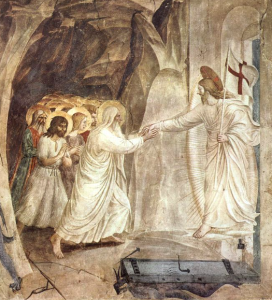
Christ in Limbo (ca. 1441), by Fra Angelico, a
depiction of the Harrowing of Hell. Note at
the bottom the devil that has been crushed
by the broken-off door, Wile E. Coyote style.
Footnotes
1In the ancient world, purpura (a loan from the Greek πορφύρα [porfüra], ancestor of English porphyry) is generally “purple” in translation, but normally indicated something more like a deep, rich shade of red, along the lines of a red wine.
2The Vexilla Regis is a traditional Christian hymn composed in honor of the Cross by Venantius Fortunatus, a cleric at the sixth-century Merovingian court. Unlike my renderings of the New Testament, when translating poetry (especially hymnodic poetry), I consider the use of meter—ideally the same meter as the original, though I’ll settle for a similar or analogous meter—as the overriding priority. My renderings of poems into English are therefore, on the whole, a good deal less precise. Here, “flesh” would be a more exact equivalent for carō (appearing in the forms carnis and carne) than “body” is; “sing” corresponds with nothing in the Latin, appearing chiefly for the sake of the rhyme, and I’ve juggled the direct object of the sentence accordingly; and patibulum simply means “(cross-)beam”—I’ve again added the adjective “divine” merely for the meter and rhyme. The fourth stanza, Arbor decor’et fulgida, is freer still: decora et fulgida means “honored and glittering,” which I have made a prepositional phrase; the second line is defensible, if archaic, English; but the last two are inexact to say the least! Ēlecta dignō stīpite / tam sancta membra tangere properly means “Chosen as a worthy trunk / such holy limbs to touch.” But Latin, particularly Medieval Latin, was not above selecting comparatively strange or contextually-strange words to suit poetic purposes, so I flatter myself my rendering counts as tolerably loyal.
3This would be true in any case at my parish: this is our feast of title (the saint or mystery we’re named after).so it generally gets moved from the 14th to the nearest convenient Sunday for us, though of course that isn’t necessary this year! In the ordinary form of the Roman rite, the Sundays during this time of year belong to a “weak” season, and the 14th is a feast, so it trumps the ordinal Sunday.
4Historically, this feast had two alternative English names. One name was Roodmas: rood was a Middle English term for the Cross, also found in the name of the Scottish royal chapel Holyroodhouse, and the ancestor of the Modern English “rod.” (The word “rood” is still, rarely, used, though only to describe crucifixes with the figures of St. John and the Mother of God at either side.) The other alternate name—and I won’t ask you not to laugh, because it is quite funny—was Crouchmas. “Crouch” is related to the word “crook,” as in “shepherd’s crook” or “crooked”; and you can perhaps see where this is going, establishing a link between “being crooked” and the shape of a cross—the German kreuz is again related, and indeed, the Latin crūx probably is too. (English has a number of words that form pairs where one has a hard k sound and the other has a softer ch sound, though both members of the pair descend from the same root; the divergence is probably because they come down to us through different dialects of Anglo-Saxon or of Middle English: “trickery” and “treachery” are an example, as are “break” and “breach,” “wake” and “watch,” and probably “sneak” and “snitch.”)
5Though sometimes described as “the Roman name for Dionysus,” Bacchus was not a solely Latin name for this god. It was a Greek name, Βάκχος [Bakchos], which the Romans and Greeks both used; its etymology and meaning are disputed. The god did have a Latin-only name, but that was Liber.
6The province of Āfrica, or Āfrica Prōcōnsulāris, centered on what is now Tunisia, but included adjacent parts of northern Algeria and most of the coast of Libya (except the eastern quarter, which belonged to the province of Crēta et Cyrenaïca). Perhaps surprisingly—at any rate this surprised me—Proconsular Africa was one of the wealthiest provinces in the Empire. What’s more, this was due its agricultural productivity; Africa reputedly fed the Empire at twice the rate Egypt did (and Egypt was basically the Iowa of Rome as far as grain was concerned). It was the loss of Africa that did the most to destabilize the East Roman Empire from the fifth century on, and the temporary reclamation of the province by Justinian was likely crucial to the Byzantines’ ability to survive the volcanic winter of 536, the repercussions of which (bizarre weather, famines, and plague outbreaks) lasted over a century.
7Lest there be any confusion, this is not merely a feature of the English; “triumphing” there is an exact translation of the Greek (θριαμβεύσας [thriambeusas] in this case).
8To avoid possible misunderstandings, I don’t mean that there were angelic beings with the stated ranks literally play-acting a triumphus in the invisible realm. Rather, I take the drift of St. Paul’s remarks to be that, for lack of a better way of describing it, a spiritual event that most nearly equates with a triumphus took place in the heavenly realms, because of, by means of, and indeed in, Jesus’ bearing of and crucifixion upon the Cross.
9Don’t worry, he didn’t overthrow anybody at all nice. Actually, his predecessor Phocas is one of the worse Roman emperors, just generally. He possessed nerves but not competence, and was a moral trash fire. Phocas usurped the throne from Emperor Maurice—and as fun as it would be to make a “crazy old Maurice” joke here, Maurice was actually a pretty decent emperor, and had moreover provided for the succession with a total of nine children. Phocas, in nearly a decade, couldn’t even be bothered to marry. What he could be bothered to do was not only execute Maurice and all his sons, but, after the empress and her daughters had retired into the religious life, go drag them out of the cloister and execute them too.
10Dvergar is the Norse cognate of English “dwarves,” and they seem to have been much the same sort of creature to the Norse tradition as they were to Britain’s. (The dictionary will tell you “dwarfs” is the proper plural of “dwarf,” unless you are, personally, J. R. R. Tolkien; I am bold to reply that, far from breaking a rule, “dwarves” is less unpredictable and irregular than “dwarfs.” Nobody says “I have a set of knifes” or “Put some cloths on” or “Throw him to the wolfs,” do they?) As for the ljósalfar, they were literally “light-elves,” ljós-alfar, alfr in the singular (whose Anglo-Saxon cognate, ᚫᛚᚠ [ælf], forms the first element of some famous names, like Alfred [⇐ ᚫᛚᚠ·ᚱᚫᛞ {ælf ræd}], “elvish [i.e., wise] counsel”).









 Ad-Free & Subscriber Log-In