

You can find my two-part introduction to the Gospel of John at these two links, and my index/outline for it here; for the previous installment on John 1:14-18, go here.
The Beginning of the New Cosmos, Part I (John 1:19-28)
We now enter on the main body of the Gospel, from 1:19 to 20:31 inclusive. The Logos has been declared to be God himself, though at the same time distinct from God the Father: the Logos is the Creator of mankind, our light, our life, and the one who makes the Father known to us. His entry into creation by incarnation, and his identity as Jesus, have both been announced as well.
Now, we “zoom in” to something concrete. The exact time (either in year or in season) is not specified, but apparently it is some time in the late 20s CE, as we are now to be given St. John the Baptist’s account of himself from the time when he was still freely preaching and baptizing. The Jerusalem templar officials themselves prompt this testimony, giving us our first in-narrative hint of the trial motif that will dominate John throughout.
To go on to the next section (vv. 29-42), go here.
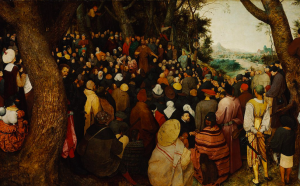
The Preaching of St. John the Baptist (1566)
by Pieter Bruegel the Elder.
Although (in a clever artistic twist) we do not yet receive the indication that will show this for what it is, this is the first day of a seven-day sequence spread across the first two chapters of John. In combination with the evocation of creation in the Prologue, this suggests that the incarnated Logos is the agent of a new creation (echoing other Apostles’ and other Gospels’ language of “the αἰών to come,” a phrase frequently found on Jesus’ lips). That makes this the new creation’s first day, corresponding to the day on which light was created, declared good, and divided from darkness.
John 1:19-28, RSV-CE
And this is the testimony of John,b when the Jews sent priests and Levitesb from Jerusalema, b to ask him, “Who are you?” He confessed, he did not deny, but confessed,c “I am not the Christ.” And they asked him, “What then? Are you Elijah?”b He said, “I am not.” “Are you the prophet?”d And he answered, “No.” They said to him then, “Who are you? Let us have an answer for those who sent us. What do you say about yourself?” He said, “I am the voice of one crying in the wilderness, ‘Make straight the way of the Lord,’ as the prophet Isaiahb said.”e
Now they had been sent from the Pharisees.b They asked him, “Then why are you baptizing,f if you are neither the Christ, nor Elijah, nor the prophet?” John answered them, “I baptize with water; but among you stands oneg whom you do not know, even he who comes after me, the thong of whose sandal I am not worthy to untie.” This took place in Bethanyb beyond the Jordan,b, h where John was baptizing.
John 1:19-28, my translation
And this is the witness of Yochanan,b when the Jews from Yrushalemb commissioned priests and Lewiyans,a, b that they might ask him: “Who are you?” And he affirmed and did not deny, and affirmedc that “I am not the Anointed.”
And they asked him, “Who, then? Are you Eliya?”b And he said, “I am not.”
“The prophet, are you he?”d And he answered, “No.”
So they said to him: “Who are you? In order that we may give an answer to those who sent us: what do you say about yourself?”
He said: “I am ‘a voice shouting in the desert, “Straighten out the Lord’s road”,’ just as Yshayahb the prophet said.”e
And those commissioned were from among the Pryshaya.b And they also asked him: “Then why do you immerse [people],f if you are neither the Anointed, nor Eliya, nor the prophet?” Yochanan, answering them, said, “I immerse in water; standing in the midst of you is oneg whom you do not know, who is coming behind me; as for him, I am not worthy to loosen the strap of his sandal.”
These things came about in Beyt ‘Anyab beyond the Yarden,b, h where Yochanan was immersing [people].
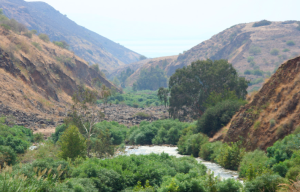
The Jordan River. Photo by Beivushtang, used
via a CC BY-SA 3.0 license (source).
Textual Notes
a. this is the testimony of John, when the Jews sent priests and Levites from Jerusalem/this is the witness of Yochanan, when the Jews from Yrushalem commissioned priests and Lewiyans | αὕτη ἐστὶν ἡ μαρτυρία τοῦ Ἰωάννου ὅτε ἀπέστειλαν οἱ Ἰουδαῖοι ἐξ Ἱεροσολύμων ἱερεῖς καὶ Λευίτας [hautē estin hē martüria tou Iōannou hote apesteilan hoi Ioudaioi ex Hierosolümōn hiereis kai Leuitas]: The witness of John the Baptist has been discussed in the abstract; he is one of only three human individuals (alongside Jesus and Moses) to be mentioned in the Prologue. The teaching of Moses is public knowledge—even those who aren’t familiar with it at least know where to look for it—so we zero in on the less-known figure of the Baptist, who (according to the Gospels) was, by both his own account and that of Jesus, the herald of Jesus and his ministry.
Although this Gospel does not name the Sanhedrin, they are plainly the body in view when it says that “the Jews from Yrushalem commissioned priests and Lewiyans” to interrogate him. (Only certain lineages of the tribe of Levi were priests, i.e. susceptible for assignment to offer sacrifices in the Temple, but all Levites were clergy; there was a great deal more to do in the Temple besides sacrificing animals.) Under Roman government, just as it had while the Kingdom of Yehud1, 2 remained independent, this seventy-one member religious council had ecclesiastical authority over the whole Judaic population. They’d naturally want to know what was going on with this newly-appeared apocalyptic preacher—nor were they ignorant that apocalyptic preachers tend to be either harmless lunatics or very dangerous lunatics. Their first step is to ask the Baptist what claims he makes for himself; accordingly, they select a regular delegation of qualified members and send them to cross-examine him. The number of the delegation is not stated, though presumably it would have been at least ten (enough to make up a minyan, a necessary quorum of adults for certain public religious purposes in Judaism).
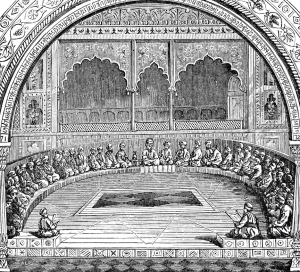
An artist’s rendition of the Sanhedrin from the
1883 People’s Cyclopedia of
Universal Knowledge.
b. John … Jerusalem … Levites … Elijah … Isaiah … Pharisees … Bethany … Jordan/Yochanan … Yrushalem … Lewiyans … Eliya … Yshaya … Pryshaya … Beyt ‘Anya … Yarden | Ἱεροσολύμων … Λευίτας … Ἠλίας … Ἠσαΐας … Φαρισαίων … Βηθανίᾳ … Ἰορδάνου [Hierosolümōn … Leuitas … Ēlias … Ēsaïas … Farisaiōn … Bēthania … Iordanou]: As best I’m able, I’ve tried to use names for places, groups, and people that approximate the first-century Aramaic in use at the time (under the constraints of what we Anglophones can pronounce!); after all, this is what the original authors of the New Testament were evidently doing, albeit for Greek rather than English. The conventional versions in most English New Testaments have been much mutated: first they got filtered through Greek, then Latin, finally entering late Middle or Early Modern English; they then went on to change as English has changed (especially in its vowel sounds) since the fifteenth and sixteenth centuries. The upshot of all this is names like Elijah, in which the only sound that the Anglicized form shares with the original name אֵלִיָּהוּ [‘Êliyyâhú] and that’s still in the same position is the l/ל!
In the list below, Ar. and Hb. indicate Aramaic (not Arabic) and Hebrew. In some cases, I haven’t been able to run an Aramaic name to ground in time, and have instead derived my version from Hebrew. I’ve contented myself with this on the grounds that: (1) Hebrew is also a “relevant” language, so to speak; (2) it’s closely related to Aramaic (albeit not identical); and (3) Hebrew terms were sometimes borrowed into Aramaic. As I habitually do, I have avoided writing out the Most Holy NAME, with or without vowel pointing.
- John: Yochanan, from Ar. ܝܘܿܚܲܢܵܢ [Yochannan],3 from Hb. יוֹחָנָן [Youchânân]—”God is merciful”
- Jerusalem: Yrushalem, from Ar. יְרוּשְׁלֶם [Y’rúsh’lem],4 ultimately from Hb. יְרוּשָׁלַיִם [Y’rúshâlayim]—meaning disputed, possibly “founded by Shalem [a Caananite god]”
- Levites: Lewiyans, ultimately from Hb. לֵוִי [Lêwy]—”Dedicated One”
- Elijah: Eliya, from Ar. ܐܠܝܐ [‘LY’],5 ultimately from Hb. אֵלִיָּהוּ [‘Êliyyâhú]—”My God is [TETRAGRAMMATON]“
- Isaiah: Yshaya, ultimately from Hb. יְשַׁעְיָהוּ [Y’sha3’yâhú]—”[TETRAGRAMMATON] saves”
- Pharisees: Pryshaya, from Ar. פְּרִישַׁיָּא [P’ryshayyâ’]—”the Separated” or “the Separatists”
- Bethany: Beyt ‘Anya, ultimately from Hb. בֵּית עַנְיָה [Bêyth 3an’yâh]—meaning disputed, possibly “House of the Wretched,” i.e. an almshouse
- Jordan: Yarden, ultimately from from Hb. יַרְדֵּן [Yar’dên]—meaning disputed, possibly “flowing downstream”
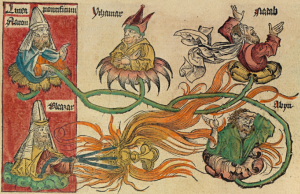
Illustration in the Nuremberg Chronicle (1493)
of the family of Aaron. L-R: Aaron, Ithamar,
Nadab; Eleazar, Abihu. Note how flames from the
censer held by Eleazar scorch Abihu and Nadab.6
c. He confessed, he did not deny, but confessed/he affirmed and did not deny, and affirmed | ὡμολόγησεν καὶ οὐκ ἠρνήσατο, καὶ ὡμολόγησεν [hōmologēsen kai ouk ērnēsato, kai hōmologēsen]: This curious bit of repetition has been suggested by some commentators to reflect the ancient Church’s concern with remaining steadfast under persecution (even though the Baptist really isn’t being persecuted here, in any sense). This may be. I find it interesting that the Baptist’s faithful confession that he is not the Christ is thus elaborately and artificially extended into a threefold act of testimony, while toward the other end of the book, Peter’s faithless denial of the Christ, during the latter’s examination by a delegation of the Sanhedrin, is also threefold—as is Christ’s restoration of Peter to office by the Sea of Galilee.
d. Are you the prophet?/The prophet, are you he? | Ὁ προφήτης εἶ σύ; [ho profētēs ei sü?]: Although messianism was a common element in Judaic theology at the time, it had not been altogether set in stone what the advent of the Messiah was supposed to look like, and there were competing theories. Today, a set of four messianic figures is considered orthodox, drawing e.g. on the vision of the Four Craftsmen from Zechariah 1:
- Elijah, who paves the way for the rest;
- the Messiah ben Joseph (or ben Ephraim), a hero who dies in battle with the foes of the Jewish people;7
- the Messiah ben David, the supremely messianic figure; and
- the Righteous Priest, who I assume has to do with the building and consecration of the Third Temple (I’ve consistently had trouble tracking down details about him).
This appears to have been one familiar messianic theory in late Second Temple Judaism, but we know from several sources, many of them preserved among the Dead Sea Scrolls, that neither these four nor the number four were universal at the time. One passage that was debated as having possible messianic significance was from Deuteronomy 18. In its original context, it professes to establish the distinction between the prophets proper to Judaism and the practices of a Canaanite pagan diviner—and then, among prophets, the distinction between the true and the false:
When thou art come into the land which the Lord thy God giveth thee, thou shalt not learn to do after the abominations of those nations. There shall not be found among you any one that maketh his son or his daughter to pass through the fire, or that useth divination, or an observer of times, or an enchanter, or a witch, or a charmer, or a consulter with familiar spirits, or a wizard, or a necromancer. For all that do these things are an abomination unto the Lord: … but as for thee, the Lord thy God hath not suffered thee so to do.
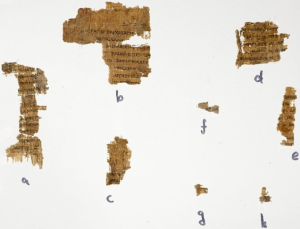
The eight surviving fragments of Papyrus
Rylands 458, the oldest known copy of
the Septuagint version of Deuteronomy.
The Lord thy God will raise up unto thee a Prophet from the midst of thee, of thy brethren, like unto me; unto him ye shall hearken … And the Lord said unto me, “… I will raise them up a Prophet … and will put my words in his mouth; and he shall speak unto them all that I shall command him. And it shall come to pass, that whosoever will not hearken unto my words which he shall speak in my name, I will require it of him. But the prophet, which shall presume to speak a word in my name, which I have not commanded him to speak, or that shall speak in the name of other gods, even that prophet shall die.” And if thou say in thine heart, “How shall we know the word which the Lord hath not spoken?” When a prophet speaketh in the name of the Lord, if the thing follow not, nor come to pass, that is the thing which the Lord hath not spoken, but the prophet hath spoken it presumptuously …
—Deuteronomy 18:9-22
There had, of course, been many prophets since that time. But had any of them been, strictly, “a prophet like Moses“? Certainly none of them had effected something as great as leading an entire nation out of enslavement to one of the most powerful empires the earth had yet seen. (Elijah, who had raised a boy from the dead, had arguably done something as great—though it’s kind of difficult to compare the two—but when Elijah came up in messianism, it was as the Messiah’s herald, not as the prophetic figure himself.) There had been prophets like Nathan, Elisha, Hosea, and Isaiah who summoned the Israelites and Judahites back to the covenant when they disobeyed; there had been those like Jeremiah, who foretold the punishment of Israel and Judah for breaking the covenant; there had been those like Baruch and Ezekiel, who sustained the exiled Judahites in Babylon; there had been those like like Ezra, Haggai, and Zephaniah, who rejoiced over the return of the exiles and encouraged the construction of the Second Temple. Yet even the prophets who accompanied the exiles back to the Holy Land did not effect their liberation; Cyrus did that (and, indeed, was hailed as the Lord’s anointed for it). So had the promise of Deuteronomy 18 actually been fulfilled, or not?
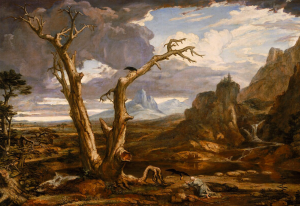
Elijah in the Wilderness (1818),
by Washington Allston.
e. “… the voice of one crying in the wilderness, ‘Make straight the way of the Lord,’ as the prophet Isaiah said”/”… ‘a voice shouting in the desert, “Straighten out the Lord’s road”,’ just as Yshayah the prophet said | φωνὴ βοῶντος ἐν τῇ ἐρήμῳ· Εὐθύνατε τὴν ὁδὸν κυρίου, καθὼς εἶπεν Ἠσαΐας ὁ προφήτης [fōnē boōntos en tē erēmō: Euthünate tēn hodon küriou, kathōs eipen Ēsaias ho profētēs]: For Christians, it is a little puzzling that St. John the Baptist said that he was not Elijah when asked, given that the Gospels elsewhere tell us in no uncertain terms that he was Elijah. The only explanation that comes to my mind is that this was to prevent the misunderstanding that he was Elijah reincarnate—reincarnation being an idea that does pop up from time to time in Judaic theology (e.g., the גִּלְגּוּל הַנְשָׁמוֹת [gil’gúl ha-n’shâmouth] or “wheel of souls” plays a standard role in Chasidism, a heavily mystical and charismatic branch of Orthodox Judaism). Supposing that the Baptist was primarily concerned here to deflect misunderstandings based on preconceived theories of his function, this would seem to tie in with his denial that he was “the prophet.”
f. Then why are you baptizing/Then why do you immerse [people] | Τί οὖν βαπτίζεις [ti oun baptizeis]: As his moniker suggests, the fact that this apocalyptic preacher was proclaiming a “baptism of repentance” is what was so eye-catching about him. (Well, the camel-skin and the unkempt hair were probably the eye-catching thing about him; the baptisms would have been more ear-catching.) This is because, in a sense, baptism already existed in Judaism; and still does.
What I’m talking about is ritual immersion in a mikveh (מִקְוֶה [miqhweh]). A mikveh can just be a natural body of water, but it is normally found in the form of a vat-like pool, built into the ground (generally as part of a synagogue), containing enough natural spring water, river water, or rainwater8 for an adult to be fully immersed in it. The Torah requires purification by washing with water, involving either partial or full immersion of both people and objects, for a variety of causes (new dishes and utensils are immersed in a mikveh before they begin to be used, for example). Priests who were assigned to offer sacrifices in the Temple would immerse themselves in a mikveh in the morning; Jewish women would normally immerse themselves every month, due to the impurity associated with menstruation. However, probably the most famous use of the mikveh was and is as part of the process of converting to Judaism. Besides circumcision—which of course only affects males—Gentile converts of both sexes must be immersed as part of their conversion, ritually washing away the impurities of the Gentile way of life.
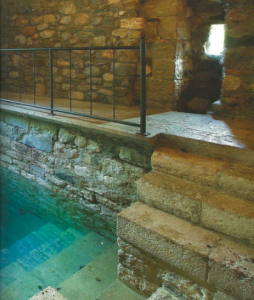
A Medieval mikveh from the city of Besalú in
northeastern Catalonia, Spain. Photo by Arie
Darzi, used via a CC BY-SA 3.0 license (source).
It seems to have been this, the proselytic use of the mikveh, that St. John the Baptist was alluding to in summoning people to be baptized. This might mean that he was, so to speak, calling the Jews of his day “no better than Gentiles,” in whatever sense and for whatever reason. On the other hand, the significance assigned to baptism by Christians had been more dramatic since decades before the Gospel of John was written: the Paulines repeatedly link baptism with death and rebirth, and St. Peter connects it to the Flood of Noah. (Moreover, though this is far from certain, it’s possible that Luke 3:14 indicates the Baptist admitted Gentiles as well as Jews to his baptism, which would make a message that implicitly insulted Gentiles as such rather unlikely.) I’m therefore inclined to think that the Baptist’s message was something more to the effect of: That is coming which none of you, Gentile or Jew, are ready for—the Holy One of God. Though no preparation can be enough, nevertheless, prepare to receive It; you must prepare to receive It.
g. among you stands one/standing in the midst of you is one | μέσος ὑμῶν ἕστηκεν ὃν [mesos hümōn hestēken hon]: This is a fascinatingly cryptic statement. On the face of it, it would appear to be asserting that Jesus was part of the Sanhedrin’s delegation!—but we have no other evidence of that. However, I do think this statement is in line with the view (which I believe all the Gospels and the rest of the New Testament agree with) that Jesus himself was a Pharisee, and could be a reference to it.
h. Bethany beyond the Jordan/Beyt ‘Anya beyond the Yarden | ἐν Βηθανίᾳ … πέραν τοῦ Ἰορδάνου [en Bēthania … peran tou Iordanou]: If Beyt ‘Anya did indeed basically mean “almshouse,” then it makes sense that more than one town would acquire such a name. (Neither this site nor the other Bethany are called by this name today: Bethany-beyond-Jordan is now known as المغطس [Al-Maghṭas], Arabic for “the [place of the] Immersion,” alluding to Jesus’ baptism in particular, while Judean Bethany is called العيزرية [Al-Eizariya], “the [place of] Lazarus.”)
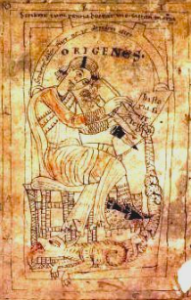
Depiction of Origen from ca. 1160.
In the third century, Origen, a prominent Biblical scholar living in Cæsarea-by-the-Sea—then the leading Christian see in the Holy Land9—noted that there was no place called Bethany on the east bank of the Jordan River in his time. He suggested that the place John meant might instead have been Bethabara (בֵּית עֲבָרָה [Bêyth 3àvârâh]), meaning “House of the Ferry,” a location which had the great advantage of existing. This Bethabara emendation, proposed by one of the foremost Biblical scholars of the time, was also endorsed in the following century by the great liturgist and Archbishop of New Rome, St. John Chrysostom; many Bibles to this day read Bethabara here, including the illustrious King James. Of course, two hundred years is plenty of time for a settlement to dwindle to nothing, even when you don’t have a couple of massive wars in the area during that time—which the Levant very much did: the First Jewish War of 66-73, and the Bar-Kochba Revolt of 132-136. Bethany-beyond-Jordan needn’t have been a large town when John knew it, after all—just one familiar enough to base directions on. On the other hand, Bethabara and Bethany-beyond-Jordan might have been names for the same place: an alternative etymology for Bethany would make it mean “House of the Ship,” which is hardly a leap from “House of the Ferry.” Moreover, if it were located relatively close to a different hamlet also named Bethany (based on the same etymology or not), there might have been more motive to look for a different moniker.
As my decision to go with Beyt ‘Anya suggests, I favor reading “Bethany” over “Bethabara.” (I do suspect there’s something in the “Bethany = Bethabara” idea—but the question of the right reading is What did the autograph10 say?, which is slightly different from What did the autograph mean?) Given the echo of the end of the book discussed in note c above, I’m intrigued as well that this witness to a Christ who is not present should occur in a place called Bethany, since the other Bethany is suggested at the end of Luke to have been the approximate location of the Ascension.
However, in the name of full disclosure, I must admit that I’m also inclined to take this view partly because, if correct, it would—nominally—net us a total of seven cities Jesus visits in this Gospel:
- Beyt ‘Anya (Bethany)
- Qanah (Cana)
- Yrushalem (Jerusalem)
- ‘Aynun (Ænon)
- Shekhem (Sychar)11
- K’far-Nachum (Capernaum)
- ‘Afrem (Ephraim)
This does seem very like John-the-book to me, and the Johannines in general. The “nominally” of a couple lines ago is load-bearing, since no matter how you slice it, this section’s Bethany is not the same one that Martha, Mary, and Lazarus are “of.” I do think that that kind of clever—even glib—wordplay is exactly the sort of thing the apostles would have been inclined to indulge in; but that’s a judgment call on my part. There are valid reasons to reply to that judgment with an Oh, come on.
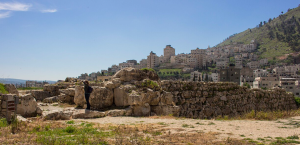
Ruins identified with ancient Shechem (the
modern buildings in the background are part
of the city of Nablus). Photo by TrickyH, used
via a CC BY-SA 4.0 license (source).
Footnotes
1Yehud (or earlier, under Persian sovereignty, Yehud Medinata or Yehud Medinta) was the Aramaic name for the Jewish state. Ἰουδαία [Ioudaia] was the Hellenistic name, transcribed into Latin as Iudaea, from which of course we get the English term Judæa. Curiously, where the Aramaic word for “Jew” means “person from Yehud,” deriving the name of the people from the land, Greek turns the derivation the other way, naming the land after the people; perhaps, due to the Jewish diaspora, Greek-speakers became familiar with Jews before there was any general knowledge of Judea, whereas the land was well-known to fellow Levantines long before the time of Alexander. (All of these terms, ethnic and geograpgical, are ultimately derived from the name of the Biblical patriarch Judah—in the original Hebrew, יְהוּדָה [Y’húdhâh], which comes in turn from יָדָה [yâdhâh], a verb meaning “to throw, cast” or “to praise, revere, worship.”)
2The Kingdom of Yehud had been a Roman ally since the time of the Maccabees, and was a client state of Rome’s from the accession of Herod the Great, in or around 37 BC. However, it did not become Roman territory per se until the year 6 CE. On Herod’s death, his will was disputed; Augustus was asked to mediate among: (1) Herod’s son, Herod Archelaus; (2) Herod’s sister, Salome I; and (3) a delegation of Jews asking Cæsar to assume direct rule rather than allow any member of the Herod family to retain power. The decision made was to divide Herod’s realm. Idumæa, Judæa, and Samaria (the bulk of the realm) were assigned to Archelaus; three cities (Azotus [the Old Testament’s Ashdod], Jamnia, and Phasaelis) and their environs were granted to Salome; and the remainder of Herod’s kingdom—Perea (we’d now call this “the East Bank”), the Galilee, and the regions northeast of the Sea of Galilee, wedged between the Decapolis and Roman Syria—were appropriated by Rome. But though Archelaus was named in Herod’s will as his heir, he proved to be not only as cruel as his father, but much stupider; he was deposed for tyranny and incompetence and exiled after a reign of less than ten years, and the Roman province of Iudaea as it would be known for most of a century was formed.
3In this entry and the one below for Eliya, the lettering that resembles Arabic is the Estrangela script; this was designed for Classical Syriac, a form of Aramaic spoken from around the middle of the first century to some time in the the thirteenth. As a linguistic term, “Aramaic” is a little more like “Romance” than, say, “Spanish”: it describes a related complex of languages—Achæmenid, Syriac, Turoyo, etc.—rather than a single tongue. (Classical Syriac survives as a liturgical language in Assyrian, Catholic, Miaphysite, and Orthodox Churches.) Ironically, the script we habitually call “the Hebrew alphabet” was also first designed to write an Aramaic language!—in this case Achæmenid, if memory serves. (This script is also sometimes known as כְּתָב אַשּׁוּרִי [k’thâv ‘asshúry], transcribed as Ktav Ashuri or Kethab Aschuriy or probably like six other things; the phrase means “Assyrian writing,” based on the place it originated.)
4In theory, given the actual spelling of the Aramaic, my version ought to be Yrushlem or something similar; however, at the risk of being quite ridiculous, my gut told me that people might put up with “Yrushalem” but wouldn’t stand for “Yrushlem,” so, here we are.
5I couldn’t find a version of the Estrangela with vowel pointing. Sorry.
6According to the Torah, Aaron had four sons: Nadab, Abihu, Eleazar, and Ithamar. However, before the Israelites had left the vicinity of Mount Sinai (where they remained for about two years—the arrival is recorded in Exodus 19, and their departure is not set down until Numbers 10), Nadab and Abihu were destroyed by God for offering “strange fire,” against the guidelines laid down for how the Tabernacle was to be served (Leviticus 10:1-7); there is a hint (vv. 8-11) that they were drunk at the time. Only Eleazar and Ithamar and their descendants went on to serve as Israelite/Judaic priests.
7There is—or so I understand—debate over whether the Messiah ben Joseph is guaranteed to come, or will come only if he is needed, according to the spiritual condition of the Jewish people.
8My information for this paragraph is derived largely from this article by Chabad, which specifically mentions rainwater; however, it also notes that natural bodies of water can be pronounced suitable for the same use (a rabbi must be consulted to establish whether the body of water in question meets the requirements).
9Its Latin name was Caesarea Maritima, hence my affected translation. This city, abandoned in the middle of the thirteenth century, stood about a mile to the south of the modern Israeli resort town which is its namesake, Qaysaria (a little over forty miles north of Tel Aviv, and a little over thirty south of Haifa). Cæsarea had been the foremost episcopal see in the Holy Land since shortly after the Church fled Jerusalem in the year 66; so it remained until Jerusalem was elevated as the fifth of the great ancient patriachates (after Rome, Alexandria, Antioch, and Constantinople) at the Council of Chalcedon in 451. Origen lived in Cæsarea-by-the-Sea from 231 or 232 until his death, which took place in or near the year 253.
10In manuscript criticism, an autograph is the original, first written version of a document (whether literally written by that document’s author or dictated by the author to an amanuensis). Establishing the text of the autograph is the ideal—usually an unattainable ideal, though not always—at which manuscript criticism aims.
11The identification of Sychar as Shechem (my “Shekhem”) is quite uncertain. Both appear to have been quite close to one another, but that they were the same place is only a guess.










 Ad-Free & Subscriber Log-In