

Here I continue my series, recently begun, of telling my memories and secrets of the American Evangelical Movement that began with the founding of the National Association of Evangelicals in the 1940s. These are my own memories and secrets I have kept.
When I was in seminary I encountered many what I would now call “progressive evangelical” thinkers, both in person and in their writings. They weren’t all considered “progressive” then, but later they would be so labeled by conservative/fundamentalist evangelicals.
One was New Testament scholar Robert (Bob) Stein who became my friend and colleague years after seminary. I eventually joined the faculty of Bethel College and Seminary (St. Paul, MN) where he taught. Although my office was on the “college side” and his was on the “seminary side” (a hill divided them) I got to know him over my fifteen years there.
Bob passed away a few months ago (January, 2026). He is already missed by many, including his former colleagues and students.
Before joining the Bethel faculty I already knew of Bob through reading some of his scholarly articles about redaction criticism of the gospels. I remember thinking that Bethel must be a very progressive place compared with my own evangelical background. Even in the evangelical Baptist seminary I attended not much attention was paid to higher criticism of the New Testament. (Although I did have an Old Testament professor who promoted belief in two, if not three, Isaiahs!)
Bob’s redaction criticism articles pointed up how using redaction criticism can help explain the gospels. Redaction criticism is the study of how authors’ and editors’ theological or other motives shape how they tell a story. Critics of redaction criticism claim that it undermines belief in biblical inerrancy. I found Bob’s articles refreshing and helpful.
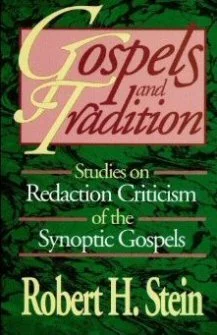
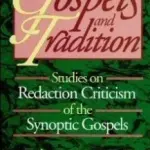
When I arrived at Bethel I discovered that Bethel has a statement of faith that includes inerrancy (of the original autographs). I wondered how Bob’s endorsements of redaction criticism fit with that. Then I read his 1991 book Gospels and Tradition: Studies on Redaction Criticism of the Synoptic Gospels (Baker). It seemed to me that there, written while on the Bethel Seminary faculty, his explanations of redaction criticism were not as “progressive” as in his scholarly articles (on which the book was based).
About the time I left Bethel (1999), perhaps somewhat earlier, Bob moved to Southern Baptist Theological Seminary, together with several other Bethel Seminary professors. Then I wondered how he could be there as I knew he was Arminian. He told me he was. At that time SBTS was enforcing belief in Calvinism. Bob also told me he had no problem with women in ministry, preaching and pastoring. SBTS was firmly opposed to that.
I still don’t know why SBTS recruited him or how he got along there. I asked him that after he went to SBTS and he said that neither of those beliefs mattered because he was a biblical scholar, not a theologian. Huh.
Bob was no fundamentalist, that I know. I also know that SBTS wanted him there. When he left Bethel it was turning in a new direction under the deanship of Millard Erickson. Millard attempted to recruit me to replace a retiring seminary theologian. During my conversations with Millard, who I knew well, he told me that if I joined the faculty I would have to use his three volume Christian Theology systematic as my primary textbook. I had used it when teaching at Oral Roberts University but was no longer enamored with it and did not want to be hedged in that way. I declined and withdrew my name from consideration. (For those of you interested, Robert Rakestraw stepped into that open faculty position. Robert had to keep quiet that he believed in annihilationism as the Bethel statement of faith affirmed the “eternal suffering of the wicked. I also got to know that Bob very well and we became good friends. He passed way a few years ago after a filed heart transplant. Bob was a fan and friend of Clark Pinnock.)
I enjoyed my time at Bethel (1984-1999) very much until John Piper and a group of pastors began to put pressure on the college to fire my friend and colleague Greg Boyd. For defending him I got caught up in that witch hunt and my own position was made tenuous. Because I said open theism is not heresy I was publicly called a “major promoter of open theism” by Don Carson. I challenged that in two letters to him. He responded to neither one. I discovered through numerous conversations that very few people even knew what open theism really is. Most had only secondary knowledge of it from critics who I knew were actually misrepresenting it as, for example, belief in an “ignorant God.” (Note to would-be commenters: Don’t argue that’s valid as I know it is not and am not open to your persuasion otherwise and I won’t allow my blog to be used to misrepresent open theism.)
*Note: If you choose to comment, make sure your comment is relatively brief (no more than 100 words), on topic, addressed out me, civil and respectful (not hostile or argumentative), and devoid of pictures or links.*



 Ad-Free & Subscriber Log-In