

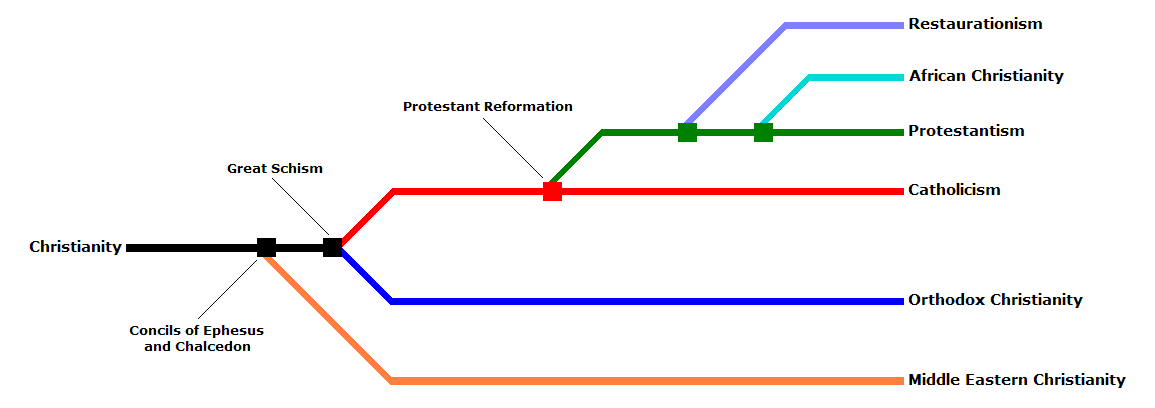
I recently here discussed a book by Gary Agee entitled That We May Be One: Practicing Unity in a Divided Church. I agree with Gary’s call for as much unity among Christians as possible. However, I also agree with Martin Luther who said “Peace if possible, but truth at any cost.” I will paraphrase that as “Unity if possible, but truth at any cost.”
Throughout my life I have been torn between unity and disunity among Christians. As a teenager I read The Handbook of Denominations in the United States, a reference work I found in my father’s pastoral library. I dreamed of writing such a book myself and ended up doing so. I wrote the 14th edition of that book.
As a young person I often wondered why our denomination existed. What justified its separate existence from other, similar, denominations? Eventually I doubt anything justified it except a false sense of importance. There were attempts to unify with other, nearly identical, denominations but nothing came of them. But the denomination itself was an “amalgamation” of two similar ones. So why couldn’t our leaders agree about another one?
Over the years of my profession as a theologian I studied denominations, their similarities and differences. And concluded that many of them should unite because their differences were petty. Others, however, I decided should not unify unless some important difference were resolved.
One such case, in my opinion, was the unification of the Evangelical United Brethren Church with the Methodist Church that formed the United Methodist Church. The EUBC was much more conservative theologically than the Methodist Church. It was simply swallowed up by the much larger Methodist Church so that its distinctive “voice” went silent.
I could name other such unfortunate ecumenical unions. There are have been some that I applauded such as the union of the major Free Will Baptist denomination in the US with the Northern Baptist Convention to form the American Baptist Convention (now the American Baptist Churches USA to which I belong).
Cutting to the chase…some divisions among Christians are valid and even fortunate. My Mennonite church (I am dually affiliated) left its denomination to join one that broke away from The Mennonite Church USA when the latter denomination decided that adherence by pastors to the Confession of Faith in a Mennonite Perspective was optional. And, according to critics, The Mennonite Church USA became rather rapidly just another mainline Protestant church infected by liberal theology.
When a denomination slips into liberal theology (see my book Against Liberal Theology) those with a more conservative, evangelical view are justified in leaving it. Currently, many people think and speak as if the churches leaving mainline Protestant ones are doing so only over LGBTQ inclusion issues. As a church historian and theologian I can tell you without doubt that the divisions run much deeper than that. They have to do with the dominance of liberal theology in the upper echelons of mainline Protestant denominations, especially in their institutions of higher education (colleges, universities, seminaries).
Division, separation is personal to me. I was raised in a very conservative Pentecostal denomination. My uncle was its president. Many of my family and friends were deeply embedded in it as pastors, missionaries, leaders. My parents were loyal to it to a fault. Then came the day that I could no longer live with its profound anti-intellectualism and its insistence (at that time) that nobody could be Spirit-filled who had not spoken in tongues (except Billy Graham so I was told). While I was studying for my PhD in Religious Studies I was told to leave my home denomination. I struggled to stay “one” with them, but I was excluded. Should I have been? Well, it turned out to be for my benefit.
Separation among Christians is sometimes necessary. But churches that hold to the essence of the gospel should strive to cooperate and have fellowship and especially to have open communion. Personally, I have no problem with denominations so long as they have open communion, are not riddled with liberal theology or heresy, and seek to engage in constructive cooperation with other churches that are biblically committed, basically orthodox, and Christ-centered.
*Note: If you choose to comment, make sure your comment is relatively brief (no more than 100 words), on topic, addressed to me, civil and respectful (not hostile or argumentative), and devoid of pictures or links.*










 Ad-Free & Subscriber Log-In