

I almost joined the Evangelical Theological Society (ETS) but I’m glad I didn’t.
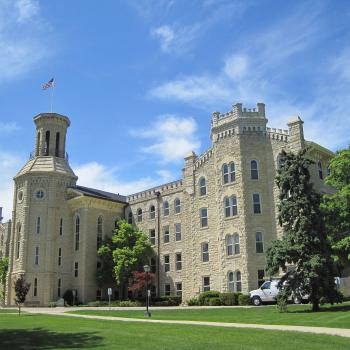
The year was 1985 and I was beginning my new teaching position in theology at Bethel College and Seminary in Arden Hills, Minnesota. It is now known as Bethel University. I remember that, when the administration was thinking of changing the name, a faculty member put a note on the bulletin board in the faculty lounge that said “When a college calls itself ‘university’ it loses its story.” Bethel had a strong sense of its own, distinct story, rooted in Swedish pietism and Baptist-ism.
I thought about joining the ETS but didn’t. And I stopped thinking about it when the ETS carried out an “investigation” into New Testament scholar, Westmont College Professor Robert Gundry. Some ETS leaders accused him of in effect denying inerrancy in his commentary on Matthew’s gospel. I followed the events in the pages of Christianity Today and decided not to be part of an organization that waned to expel Gundry. Gundry was a highly respected evangelical scholar. The whole thing “smelled” like a witch hunt to me.
My friend and co-author Stanley Grenz was a member of ETS but came under pressure and criticism for his positive approach to and use of some aspects of postmodernism. I did not think he really believed in inerrancy, and he did not really want to talk about it, but he remained in the ETS. I told him to “Come out from among them and be separate” when I detected what I considered some fundamentalist moves being made there.
The fundamentalist moves were about open theism. This began in the mid-1990s and went on for some time. It became clear that some ETS leaders were aiming to expel open theists and Clark Pinnock and John Sanders were in their sights.
I left Bethel under pressure from John Piper in 1999. He told me to my face “I will get you fired.” He had recently been instrumental in getting one of my Bethel colleagues fired. Bethel did not have real tenure, only five year contracts. I saw the handwriting on the wall and took one of two seminary positions offered me (on the same day!) elsewhere. Northern Seminary offered me a chair in theology, but I went to the new Truett Seminary at Baylor University. I’m so glad I did. During my interview process I discovered that NOT being a member of the ETS and having never been one was a virtue.
In 2006 I was contacted by phone by ETS president New Testament scholar Edwin Yamauchi. He invited me to deliver a plenary address at that year’s national meeting. I told him I did not believe in inerrancy and was not a member of the ETS. He said it didn’t matter. I agreed to speak and he agreed to have me speak and said the decision was his entirely.
The next day, I received an email from Yamauchi to the executive committee of the ETS informing them of the roster of speakers for the upcoming annual meeting in Pennsylvania. I was on the roster. Within hours I began to receiving emails from members of the executive committee demanding that Yamauchi withdraw his invitation to me. They did not notice that I was included in the group emails. I decided to respond to their false accusations about me. One, a Wheaton College theologian, called me “Barthian.” Others, including Millard Erickson, simply said I was not a theological fit. (Millard and I knew each other from Bethel where he was dean of the seminary while I was on the faculty of the college.)
Yamauchi bowed to their demands and withdrew the invitation. I ended up being invited to speak at that national annual meeting at three program unit meetings. I accepted two such invitations and flew to Pennsylvania for both the AAR/SBL and the ETS.
One member of the ETS executive committee invited me into a dialogue with him about inerrancy. He was the vice president of the ETS and incoming president. We exchanged numerous emails about the accuracy of the Bible and found that we mostly agreed. In fact, give all the qualifications he was willing to make, we agreed entirely. However, I told him I did not think the word “inerrancy” was intellectually honest—given all the qualifications he and others made. I asked him if I could join the ETS since he and I agreed on the actual nature of the Bible. He said no; I would have to affirm the WORD “inerrancy.” Then I knew it was a shibboleth. I prefer to call our shared view “infallibility” and I think the two words actually do point to different ideas. “Inerrancy” implies something foreign to the nature of scripture. “Infallibility” means “not capable of failing” and “perfect with respect to purpose.”
*Note: If you choose to comment, make sure your comment is relatively brief (no more than 100 words), on topic, addressed to me, civil and respectful (not hostile or argumentative), and devoid of pictures or links.*









 Ad-Free & Subscriber Log-In